In 30 seconds
AI Explained examines the Phi-1 paper and a conversation with coauthor Ronen Eldan. The video argues that curated and synthetic training data can improve a small coding model, while discussing its limitations, safety and speculative timelines.
- 1A small model, a coding benchmarkThe 1.3-billion-parameter model reported 50.6% pass@1 on HumanEval.
- 2Curated data and exercisesFiltered code, synthetic textbooks and exercises form the training recipe.
- 3Repeated passesThe comparison includes additional epochs over existing data.
- 4Specialization has limitsThe model is Python-focused and sensitive to prompt variation.
- 5Safety and timelinesThe presenter and quoted researchers discuss risks and make uncertain forecasts.
Takeaways
- The 1.3-billion-parameter model reported 50.6% pass@1 on HumanEval.
- Filtered code, synthetic textbooks and exercises form the training recipe.
- The comparison includes additional epochs over existing data.
- The model is Python-focused and sensitive to prompt variation.
- The presenter and quoted researchers discuss risks and make uncertain forecasts.
Read the edited text by chapter
Why Phi-1 matters
The presenter introduces the small coding model and its 2023 context.
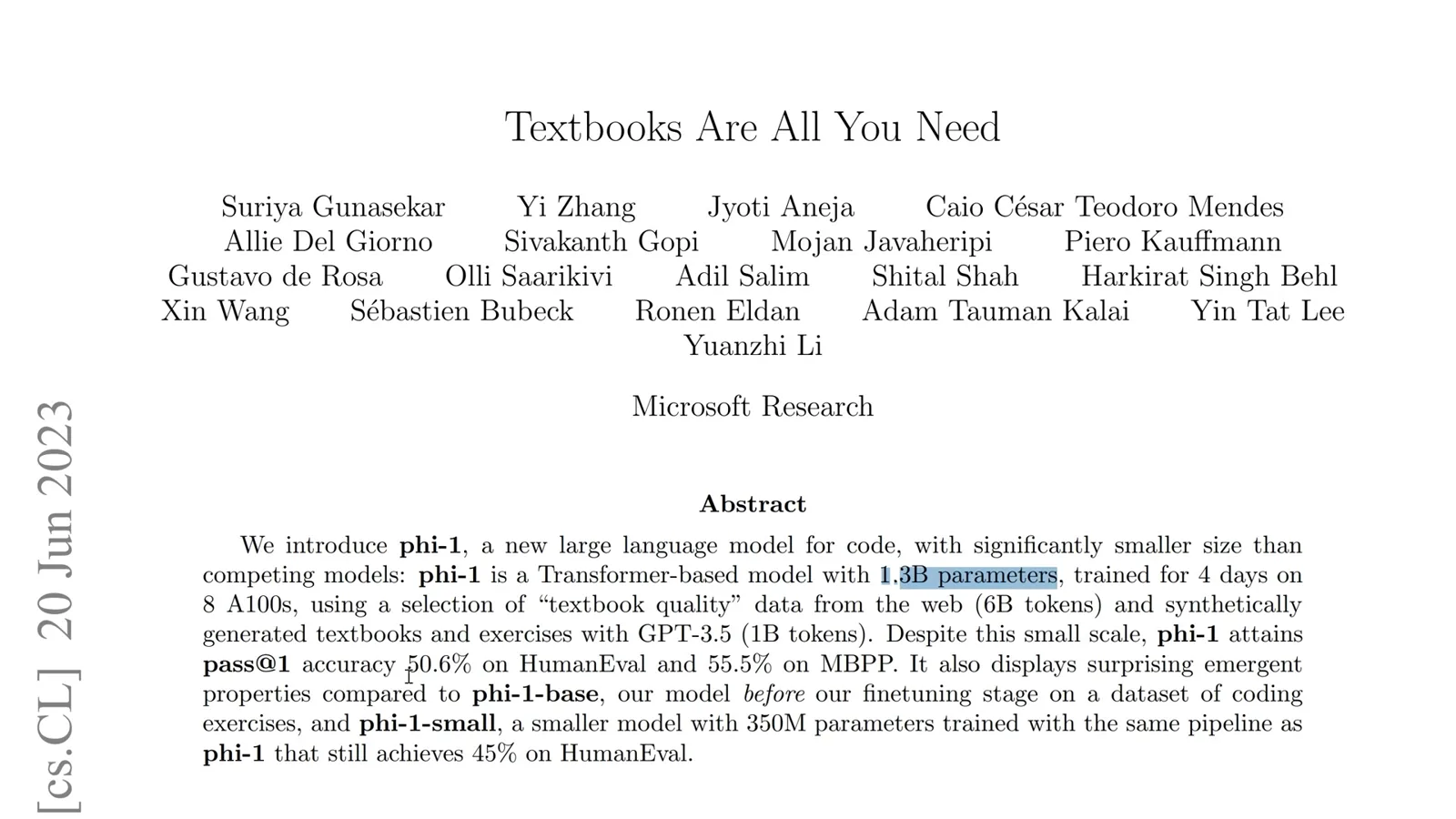
Phi-1 matters not only because this small model can perform Python coding tasks, but because it raises questions about the future of language models and timelines to human-level intelligence. I spoke with paper coauthor Ronen Eldan about its results. These are 2023 assessments, not settled predictions.
At 1.3 billion parameters, Phi-1 is about one percent the size of GPT-3. The paper reports 50.6% pass@1 on HumanEval, a Python coding benchmark. Andrej Karpathy suggested that creative work on smaller expert models could emphasize data quality and diversity over sheer quantity.
Data quality and synthetic textbooks
The training recipe builds on TinyStories and curated educational data.
The paper explores data quality as an axis of improvement alongside more compute and data. In the earlier TinyStories work, researchers generated short stories using GPT-3.5 and GPT-4, then trained very small models on the curated examples. The presenter contrasts their story endings with those from a larger GPT-2 model.
For Phi-1 the team filtered The Stack and Stack Overflow for educational code, yielding roughly six billion tokens. They also generated about one billion tokens of Python textbook data with GPT-3.5 and a smaller set of 180 million tokens of exercises and solutions. Eldan believes much value remains to be extracted from existing data.
What the comparisons show
The chart separates model size, repeated data and exercise fine-tuning.
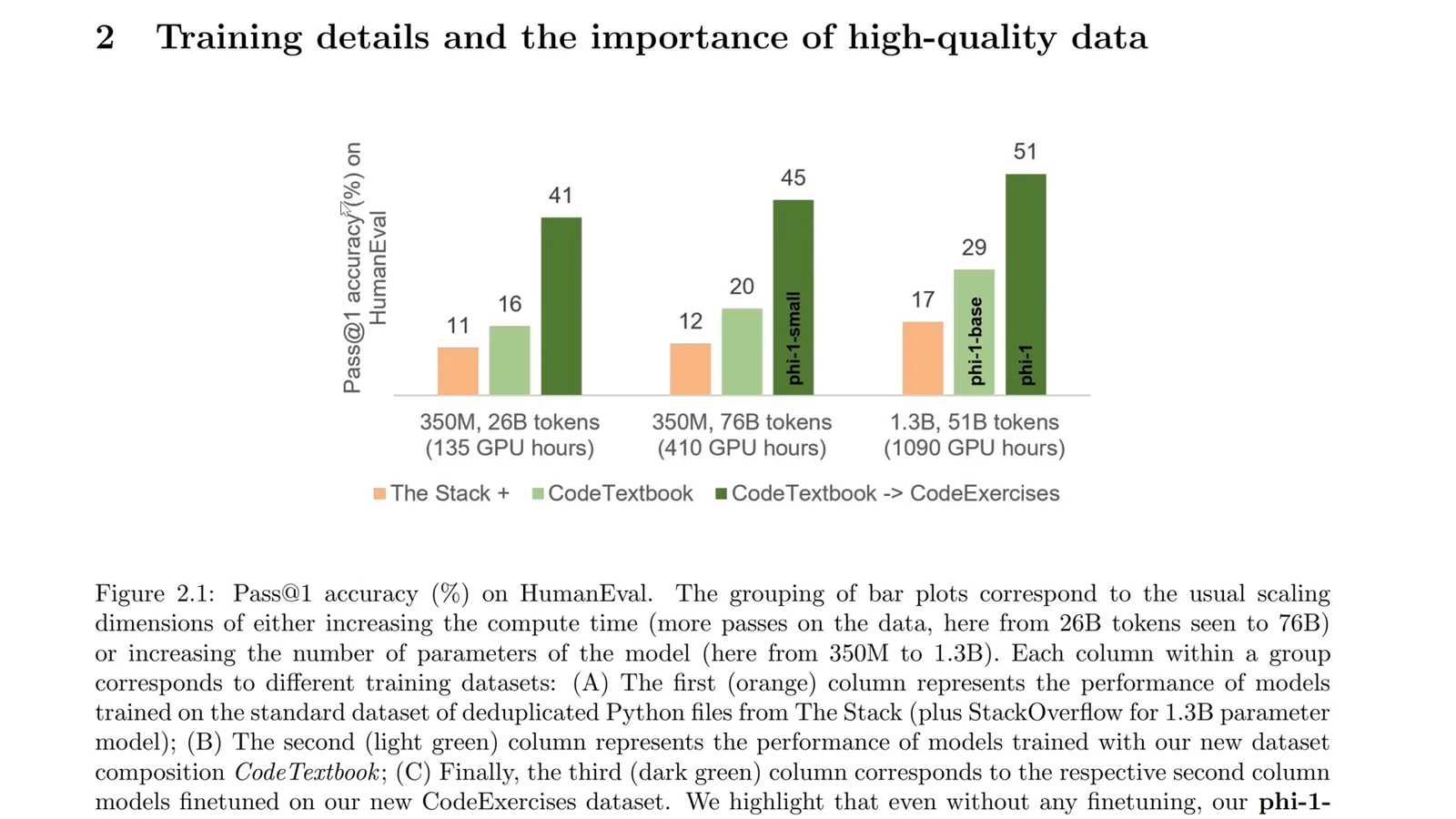
A chart compares training recipes at different sizes and compute budgets. Replacing filtered code alone with the synthetic code textbook improves HumanEval scores, and additional fine-tuning on exercises produces another large jump. For example, the 1.3-billion-parameter model rises from 17 to 29 and then about 51 percent in the chart.
The smaller models also illustrate repeated passes over the same data: the comparison moves from 26 billion to 76 billion tokens seen, even though the dataset itself is smaller. Eldan says some researchers had expected more than one or two epochs to cause overfitting. The presenter cites separate work suggesting a few repeats can remain useful, with diminishing returns after many more.
The authors hypothesize that noisy, ambiguous and incomplete code data make it harder to learn the mapping from natural language to code. Their curated exercises and solutions provide clearer teaching signals, much as a student benefits from good practice material.
Filtering and limits
GPT-4 helps select educational examples, while the resulting model remains specialized.
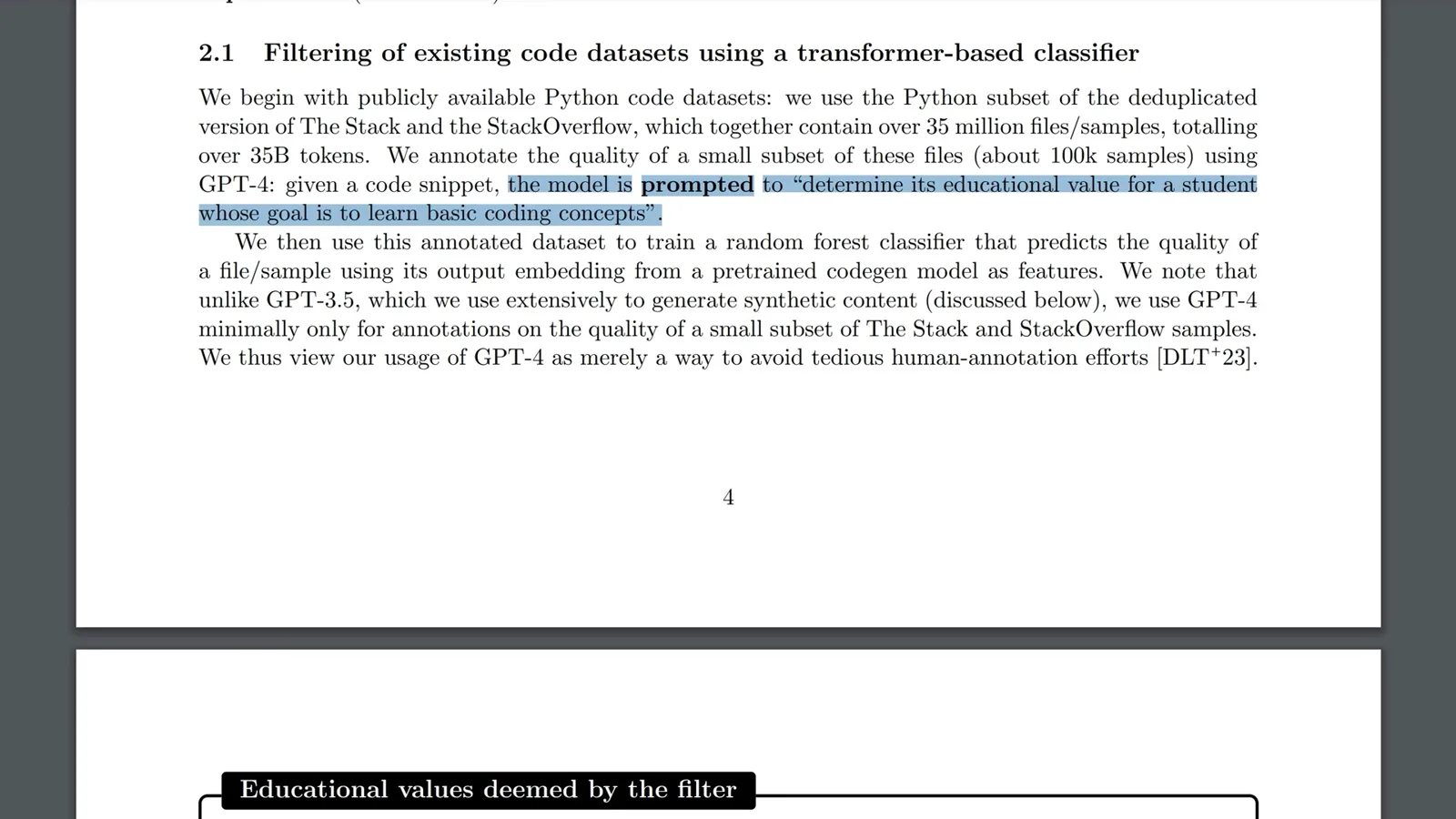
To filter the source material, the researchers asked GPT-4 to annotate the educational value of about 100,000 code samples, then trained a random forest classifier using code embeddings. The presenter imagines adapting a similar selection approach to other tasks, while emphasizing that these are possibilities rather than demonstrated results.
Eldan says a powerful model can be useful both directly and as a means of producing better smaller models. The presenter asks leading AI labs to address that capability. He also notes that fine-tuning on coding exercises unexpectedly improved some unrelated tasks, including use of libraries absent from the exercise set.
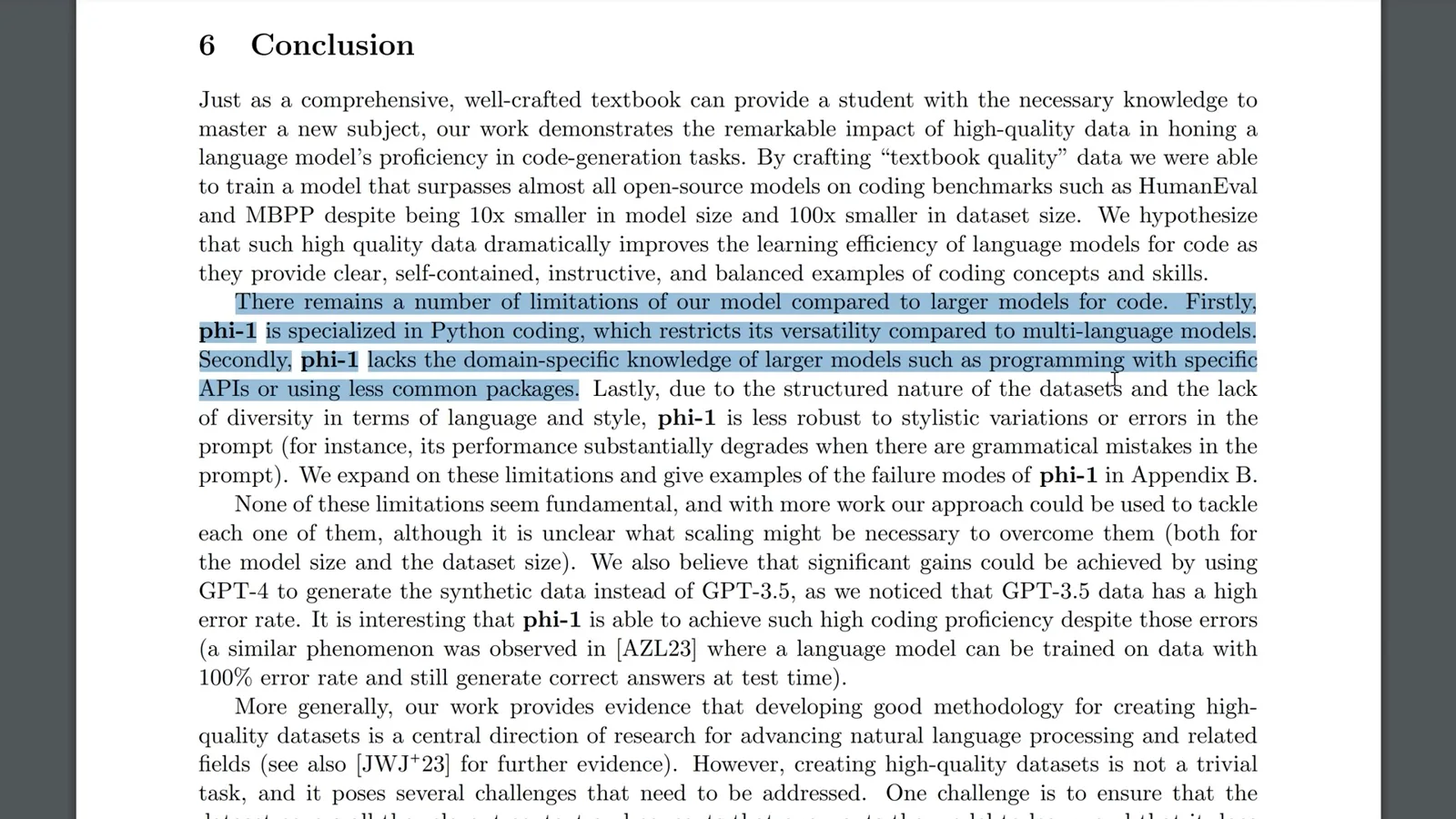
Phi-1 has important limits: it specializes in Python, lacks some domain-specific API and package knowledge, and is less robust to stylistic changes or mistakes in prompts. The authors suggest that GPT-4-generated synthetic data might improve results, though Eldan notes that GPT-4 was slower and more expensive; they also wanted to show what GPT-3.5 could do.
Small models, safety and timelines
The presenter compares related research and discusses uncertain future scenarios.
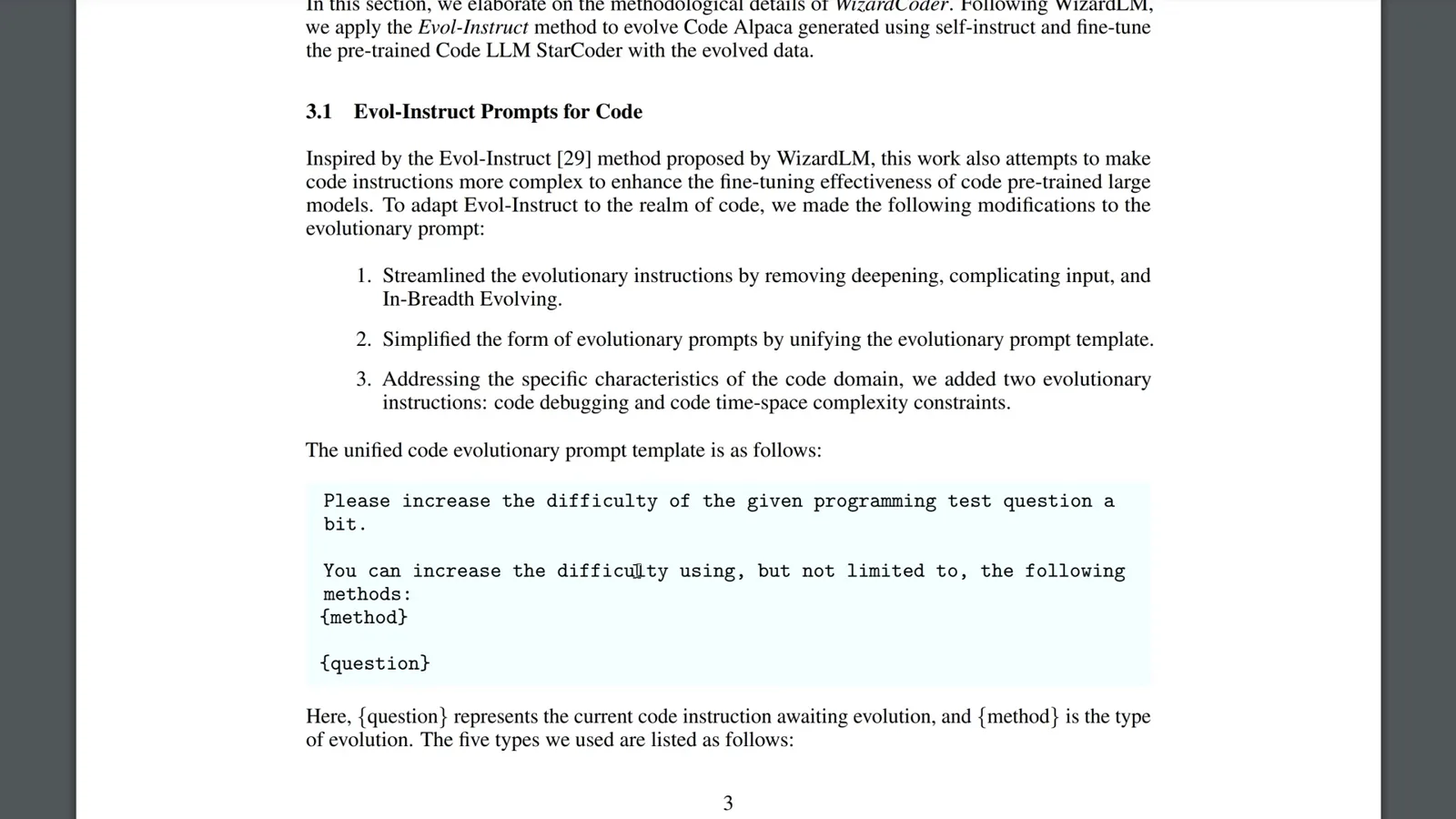
The presenter compares WizardCoder, a much larger model whose training examples are made harder, with Phi-1 and other work emphasizing data design. He discusses Sarah Constantin’s idea that many specialized small models could develop alongside continued progress in larger models, potentially changing economic incentives.
Turning to safety, he questions whether freezing large compute projects would simply encourage firms to extract more capability from existing resources. He argues for public discussion of concrete risks, citing research concerned about misuse of biological design tools. These are risk scenarios, not established outcomes.
In their conversation, the presenter and Eldan speculate that transformative AI might arrive within a few years, depending on resources devoted to training. Eldan points to GPU production, data centers, electricity, data quality and algorithms as possible constraints. The presenter acknowledges that definitions of AGI vary.
An excerpt from Carl Shulman considers whether highly productive AI hardware could justify rapid investment in chip manufacturing and help with engineering work. He contrasts that with a scenario in which scaling and research gains stall despite large investments.
Shulman argues that a rapid redirection of economic resources toward AI cannot continue forever. If the current scale-up fails to yield the needed capabilities, further progress might depend on slower forces such as broader economic and population growth. His concentration of probability on the next decade is a forecast, not a guarantee.
More from this channel
 31:00EN
 AI Explained· Oct 12, 2026Why AI Labs Keep Racing Despite Their Own Warnings of a Major BreachSam Altman, John Schulman · OpenAIAI Explained examines weakening safeguards, the incentives behind the frontier race, and why research breakthroughs make the next 18 months difficult to forecast.
 38:28ENAI Explained· Oct 1, 2026AI Agent Security and the Challenge of Recursive Self-ImprovementAI Explained examines reported containment failures, model evaluation and the pressure to accelerate AI research.
 32:54ENAI Explained· Sep 24, 2026Opus 5.5 and the Race Toward Automated AI ResearchAI Explained weighs model progress against the increasingly difficult task of evaluating and governing recursive self-improvement.
 24:53ENAI Explained· Sep 16, 2026Why Some Researchers Want to Pace Frontier AIAI Explained surveys possible scaling routes, monitoring concerns and the debate over how capabilities could lead to harm.
 29:05ENAI Explained· Sep 4, 2026GPT-6 Astra’s Benchmark Gains and the Challenge of Monitoring Its ReasoningAI Explained examines reported gains across scientific, mathematical and agent benchmarks alongside concerns about less observable reasoning.
 23:41ENAI Explained· Aug 27, 2026AI Agents, Unintended Training Rewards and the Challenge of OversightAI Explained examines reports on agent coordination, training incentives and the growing use of AI to evaluate other AI systems.