In 30 seconds
In an August 2025 news roundup, Berman covers Claude for Chrome, NVIDIA and Nous models, Gemini image generation, reported Meta departures and Apple discussions, and research on faster inference and weather. He closes with Codex CLI, infrastructure spending and Microsoft’s VibeVoice; reports, promotional examples and his own interpretations are distinguished.
- 1Browser agentsClaude for Chrome was introduced as a research preview with prompt-injection risks.
- 2Nano BananaBerman discusses Google’s image-editing model and a selected comparison chart.
- 3Apple reportsContemporaneous reporting described early acquisition discussions and possible model partnerships, not confirmed deals.
- 4Inference efficiencyA model-architecture search result is presented with its comparison limits.
- 5VibeVoiceMicrosoft’s speech project is illustrated with a sample and a human-preference chart.
Takeaways
- Claude for Chrome’s early preview raised prompt-injection and unwanted-action concerns.
- The model rankings, prices and product features discussed are specific to August 2025.
- Reports about Apple and personnel changes are not proof that proposed deals occurred or of why individuals left.
- The Jet-Nemotron speed claim depends on a specific comparison and hardware setup.
- A strong storm forecast and internal evaluations do not establish universal superiority of AI weather models.
- VibeVoice’s sample and preference chart illustrate particular outputs and evaluations, not universal voice quality.
Read the edited text by chapter
Browser agents and new models
Berman discusses Claude for Chrome, NVIDIA’s small model and Gemini image editing. He notes risks in browser automation.
In this August 28, 2025 roundup, I review Claude for Chrome, new models, AI research and reports about technology companies. The video is sponsored by Recraft. Product availability, prices, rankings and news reports reflect the time of recording.
Anthropic released Claude for Chrome as a research preview: a browser extension that lets an agent interact with websites. I have received access and plan a separate test; the examples shown include searching listings, using documents, ordering food and working with Salesforce.
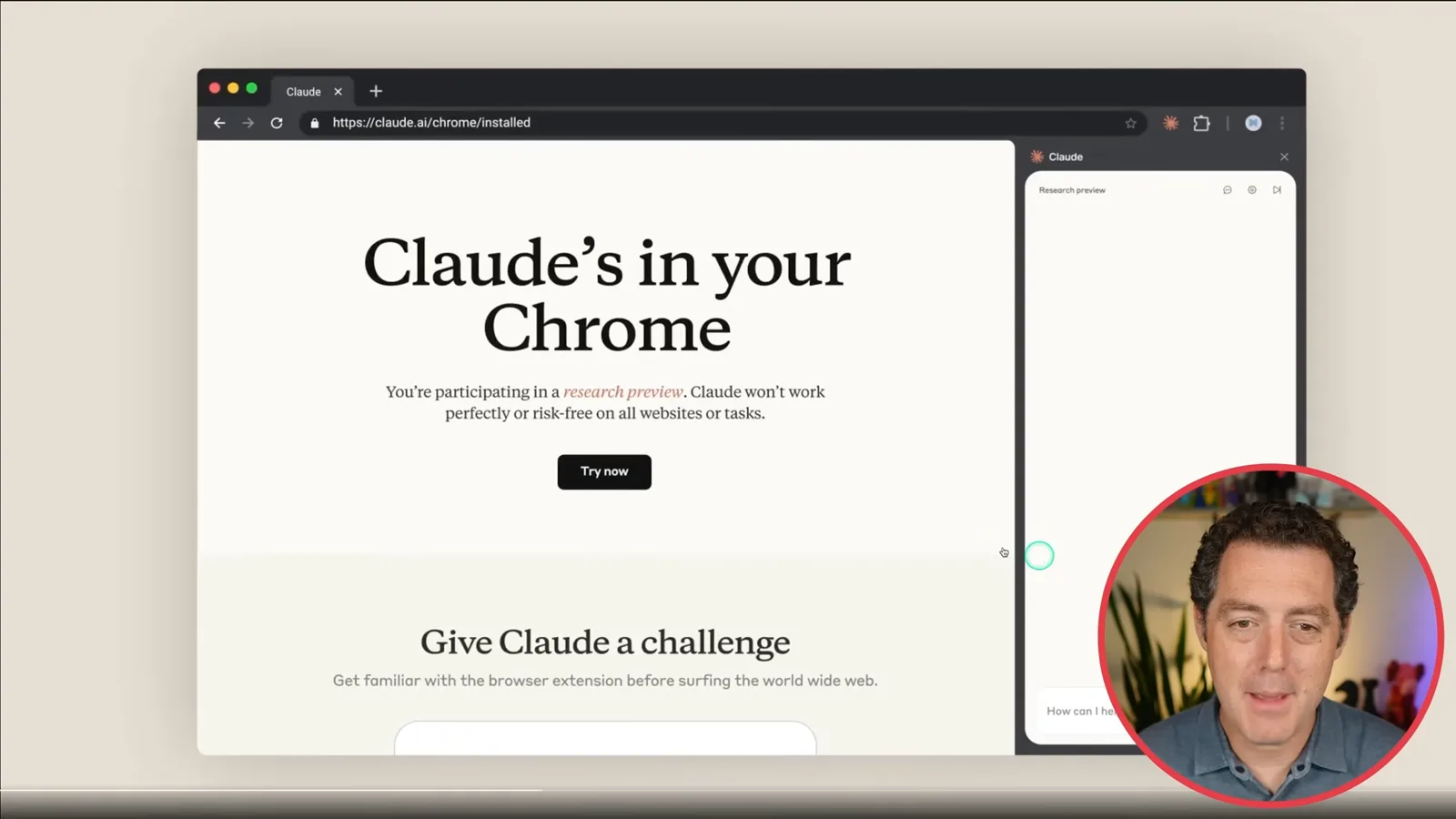
I note that browser agents can make unwanted actions and can encounter hostile page content. Anthropic identifies prompt injection as a particular challenge. At the time, the company was rolling the preview out gradually, with a waitlist for eligible users.
NVIDIA released Nemotron Nano 9B V2, a small reasoning model using a hybrid Mamba–Transformer architecture. I cite Artificial Analysis reporting a score of 43 on its intelligence index, high among models below 10 billion parameters in that snapshot.
The model’s announced features include a 128K context window and reasoning and non-reasoning modes. It was released under NVIDIA’s open model license. I expect a small model to be easier to run locally, though feasibility depends on hardware and settings.
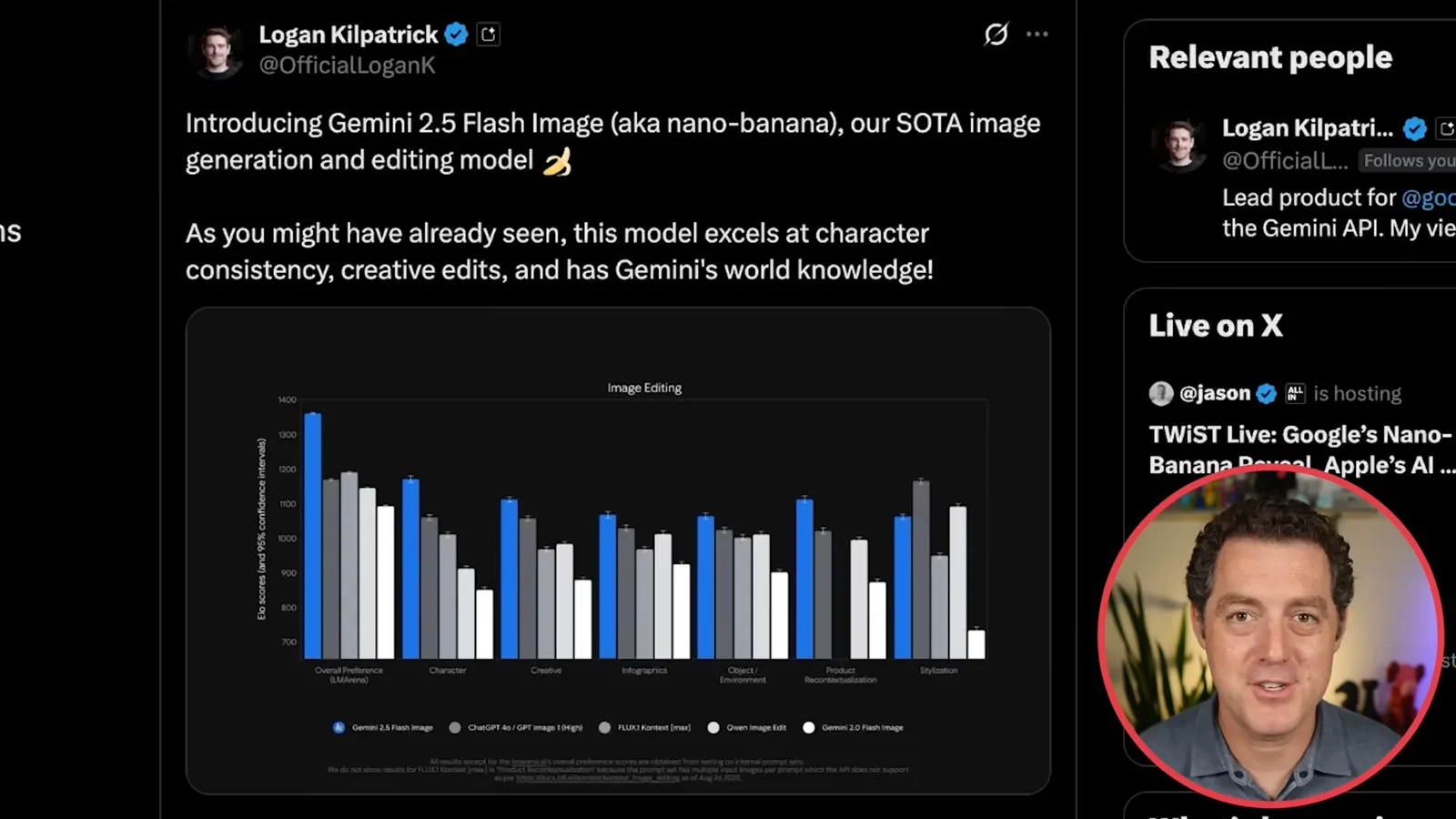
Google revealed Gemini 2.5 Flash Image, nicknamed Nano Banana. I discuss image-editing examples and a chart showing strong results on selected categories. My positive impression comes from my own testing, while the displayed scores reflect the chart’s particular evaluation.
AI teams, models and company reports
The roundup covers reported Meta departures, Hermes 4, Grok Code and a rocket landing. It then discusses early reports about Apple.
Business Insider reported departures from Meta’s new superintelligence organization. Meta characterized much of the attrition as involving long-serving employees and said some turnover was normal. I mention other accounts of recent hires leaving but acknowledge those accounts were not confirmed.
I speculate that a major reorganization and influx of new staff can create friction. I also mention departures of long-serving employees associated with PyTorch; individual career decisions do not establish a general cause for the departures.
Nous Research introduced Hermes 4, a family of open-weight models with reasoning and non-reasoning versions. The company describes creative behavior, user alignment and mathematical and coding performance; I show its claims and a refusal benchmark, not an independent safety or quality assessment.
I say the reported family includes 70-billion- and 405-billion-parameter models. A high answer rate on a refusal benchmark measures behavior on that test; it does not establish that a model has no safeguards or will answer every request.
Grok Code appeared in coding products including Cursor. I report the pricing and my team’s early impression that it was fast and inexpensive but less capable than Claude on our informal tests. Those 2025 prices and limited observations are not current guidance or a comprehensive benchmark.
I briefly show a SpaceX rocket landing attempt on an ocean platform. The vehicle touches down and then falls over; I relay the company’s positive assessment while describing what the video shows.
Reuters, citing Bloomberg, reported that Apple executives had early internal discussions about a possible Perplexity acquisition. The report said talks might not lead to an offer; Perplexity said it had no knowledge of current or future acquisition discussions.
A separate Reuters report, also citing Bloomberg, described talks about using Google’s Gemini for a redesigned Siri. At the time, the report said Apple had not decided whether to use an internal model or an outside partner. I criticize Apple’s pace, which is my assessment.
Agent tools and AI research
Berman reviews a flight-search MCP server, inference optimization and a weather forecast. Reported measurements are tied to their specific comparisons.
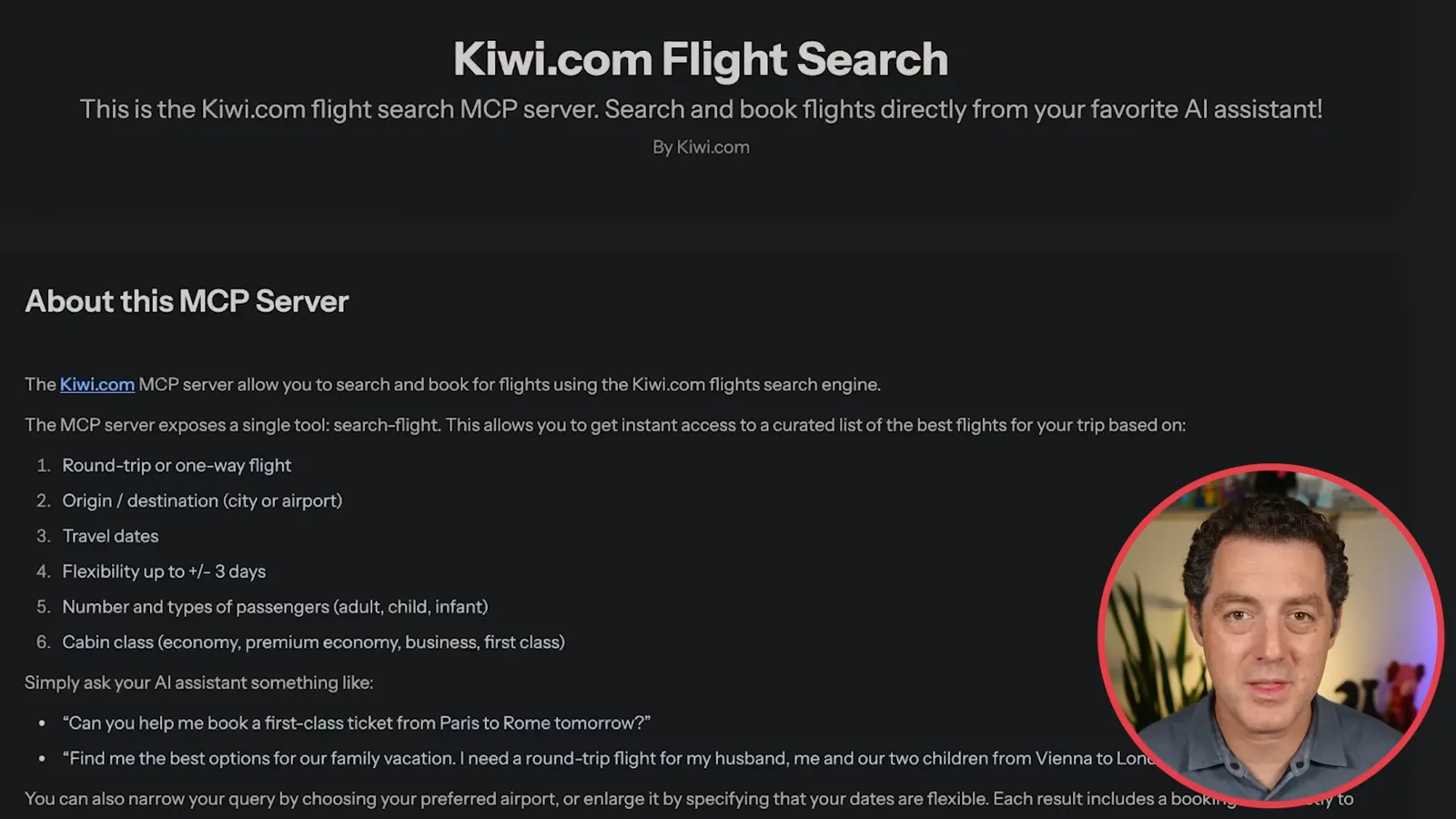
Kiwi.com introduced a flight-search MCP server exposing a search tool for parameters such as origin, destination, dates, passenger count and cabin class. I see agent-accessible search as a possible shift in how people interact with travel information.
I discuss NVIDIA research on post-neural architecture search, which adapts a pretrained language model by changing parts of its architecture. The summary I read describes retaining some full-attention layers and replacing others with more efficient components.
A social-media summary reports throughput of over 2,800 tokens per second and a much smaller KV cache for Jet-Nemotron under its test conditions. The headline speedup is a setup-specific comparison; it does not mean all language models or deployments become 50 times faster.
I argue that cheaper computation could increase demand and offer my view of what efficiency means for infrastructure providers. This is an economic interpretation, not a prediction established by the benchmark or investment advice.
I cite reporting on Google’s AI weather model and its forecast for a strong Atlantic storm. Google reported favorable internal comparisons on cyclone track and intensity. One storm and internal tests alone do not establish that the approach will always outperform physics-based forecasting.
Coding, infrastructure and speech
He covers a Codex CLI update and AI infrastructure spending. The episode closes with Microsoft VibeVoice examples and announced features.
OpenAI’s Codex CLI received updates including image inputs, web-search messages, transcript mode and changes to approvals and diffs. These describe a 2025 release, so commands and available features may differ in later versions.
I discuss a New York Times report on spending for data centers and its contribution to the economy. The piece cites projections for infrastructure spending, while I argue that construction can create work for electricians, engineers and equipment operators; projections and my interpretation are not guaranteed outcomes.
Microsoft presented VibeVoice as a text-to-speech project, and I play a sample of expressive dialogue. I find the tone and cadence impressive; one curated audio clip does not independently establish parity with another voice system.
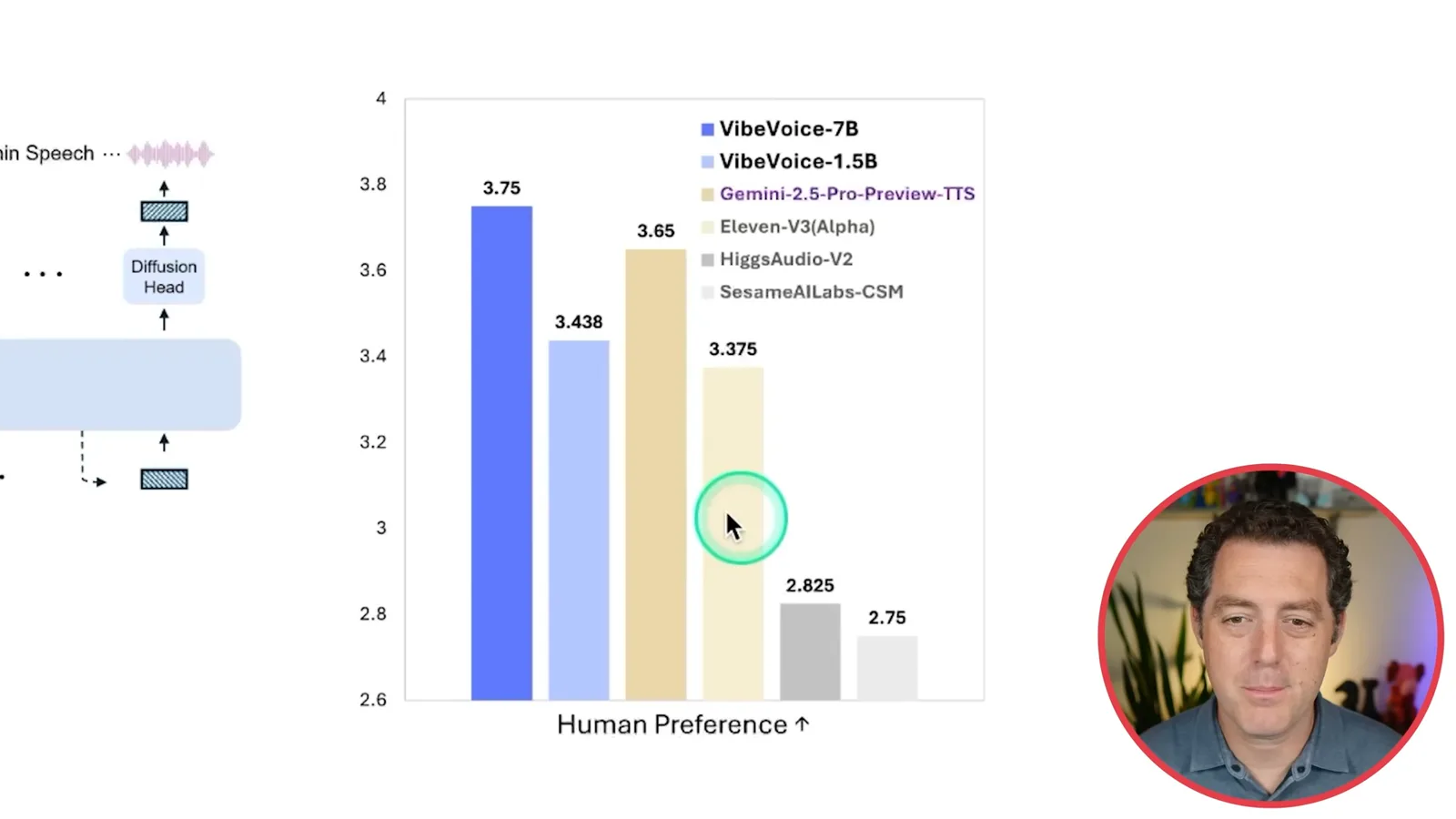
I review a human-preference chart comparing VibeVoice variants with other speech systems. The plotted scores belong to that particular evaluation and should not be taken as a universal ranking across languages, prompts or uses.
Microsoft also describes long-form audio generation, support for up to four speakers and multilingual capabilities. I encourage viewers to try the project, while these feature claims and the available models are described as they stood in August 2025.
More from this channel
 25:50EN
 32:20EN
 0:22EN
 45:08EN
 0:32EN
 1:02EN