In 30 seconds
3Blue1Brown explains how mass-weighted velocity space connects elastic block collisions to π, derives the angle governing the count, and explains why the claim for arbitrarily many decimal digits requires more than a small-angle approximation.
- 1Collision counts resemble πMass ratios 1, 100, 10,000 and 1,000,000 yield 3, 31, 314 and 3,141 collisions in the ideal model.
- 2Energy becomes a circleMass-weighted velocity coordinates turn the conserved energy ellipse into a circle.
- 3An exact countThe count is the largest integer N with Nθ < π, where θ = arctan √(m₂/m₁).
- 4The all-digits caveatA small approximation error does not by itself prove matching for every possible digit.
- 5Why idealize?Simple models can be refined and reveal connections between different problems.
Takeaways
- The result assumes frictionless motion and perfectly elastic collisions.
- Mass-weighted velocities turn energy conservation into a circle and collisions into geometric steps.
- The exact count is ⌈π/arctan √(m₂/m₁)⌉ − 1 for the stated setup.
- The small-angle explanation does not by itself prove the decimal-digit pattern for all mass ratios in the sequence.
Read the edited text by chapter
The collision puzzle
Idealized blocks produce counts that resemble digits of π.
Two colliding blocks can produce counts that begin with the digits of π. This lesson revisits the idealized physics, turns it into a geometry problem, and explains a subtle qualification about claiming the pattern for arbitrarily many digits. A later video explores an analogy with Grover’s quantum search algorithm.
Place a small stationary block between a wall and a larger block moving toward it on a frictionless surface. Count every block–block and block–wall collision. Equal masses give 3 collisions; a 100:1 mass ratio gives 31; 10,000:1 gives 314; and 1,000,000:1 gives 3,141.
The model assumes perfectly elastic collisions and ignores friction. The sounds in the animation are artistic: perfectly elastic collisions would not lose energy as sound. At very large mass ratios the small block would reach speeds where relativistic and other real-world effects matter, so the calculation is an ideal classical puzzle.
Conservation and state space
Energy and momentum transform the motion into geometry.
A problem-solving strategy is to list relevant laws. The total kinetic energy E = ½m₁v₁² + ½m₂v₂² remains constant. The blocks’ total momentum m₁v₁ + m₂v₂ is conserved during a collision between them, but changes when the small block hits the wall because momentum is transferred to the wall.
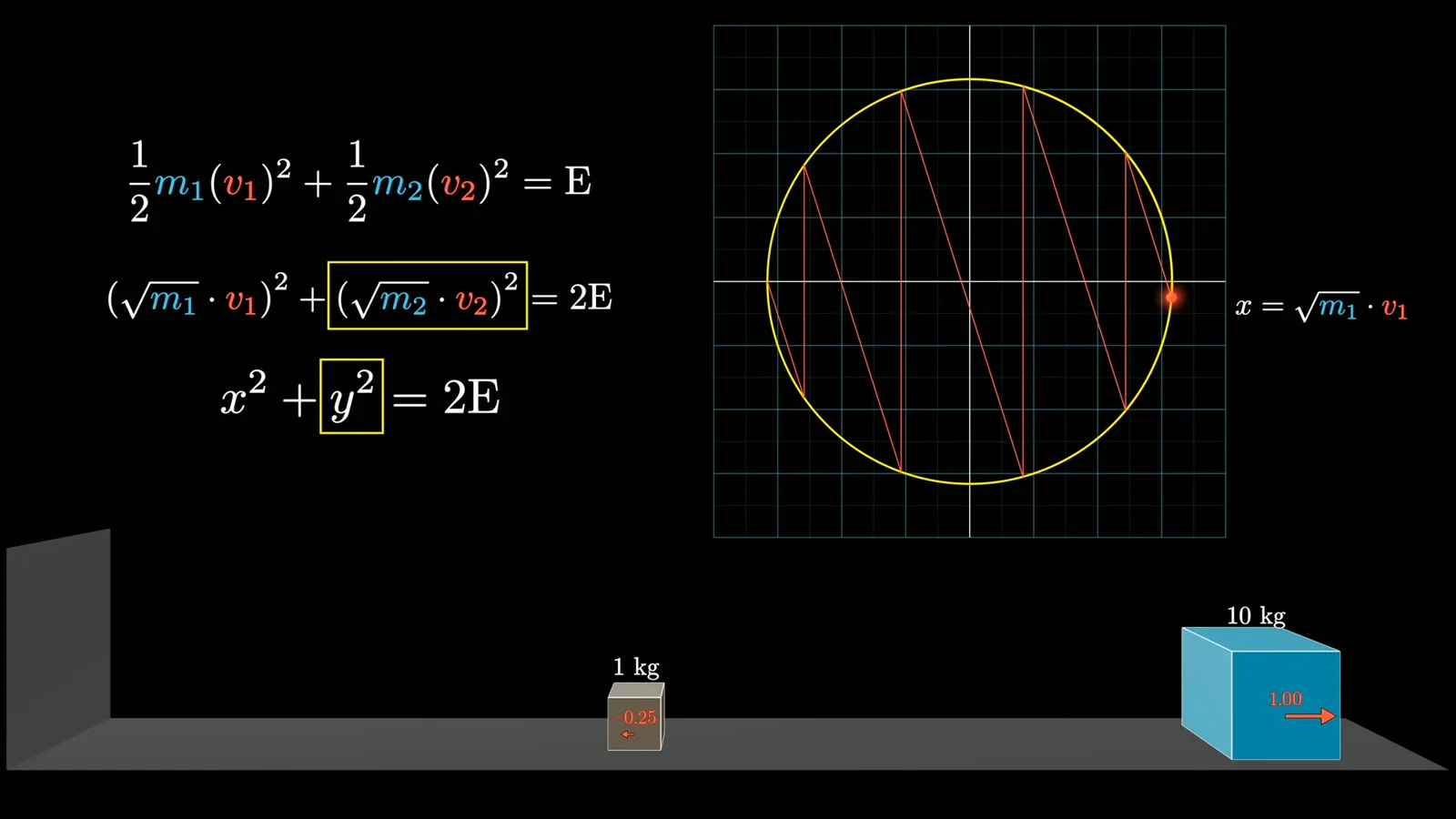
Represent the two velocities as a point in a plane. As collisions change v₁ and v₂, the point moves. In these coordinates, constant kinetic energy gives an ellipse; initial speed changes the scale and timing but not the collision count.
Rescale the coordinates to x = √m₁ v₁ and y = √m₂ v₂. Now energy conservation becomes x² + y² = 2E: a circle. This change of coordinates makes the symmetry behind π visible.
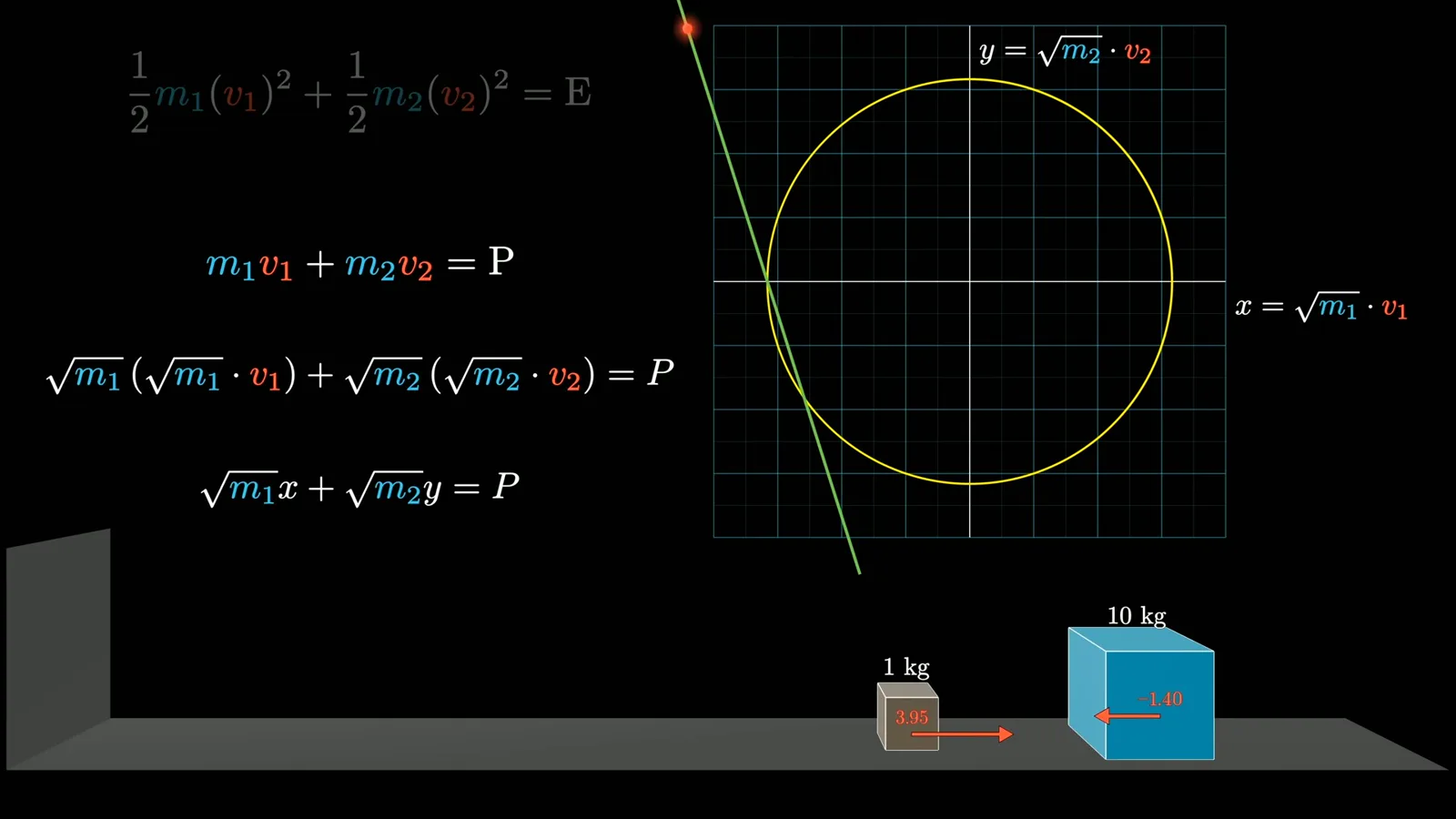
In the rescaled plane, constant momentum is a straight line √m₁x + √m₂y = P with slope −√(m₁/m₂). A block–block collision moves the state between the two intersections of that line and the energy circle. A wall collision flips the sign of y and changes the blocks’ total momentum.
Counting on a circle
Equal arcs and an end region determine the collision count.
The sequence ends when both blocks move away from the wall and the smaller one cannot catch the larger one. In state space this is a wedge between the positive x-axis and the line corresponding to equal velocities. The physical problem is now a sequence of straight-line moves around a circle.
The inscribed-angle theorem shows that successive relevant arcs span equal angles of 2θ, where θ is the angle between the vertical direction and a diagonal collision line. Counting collisions becomes a question of how many such steps fit before reaching the end region.
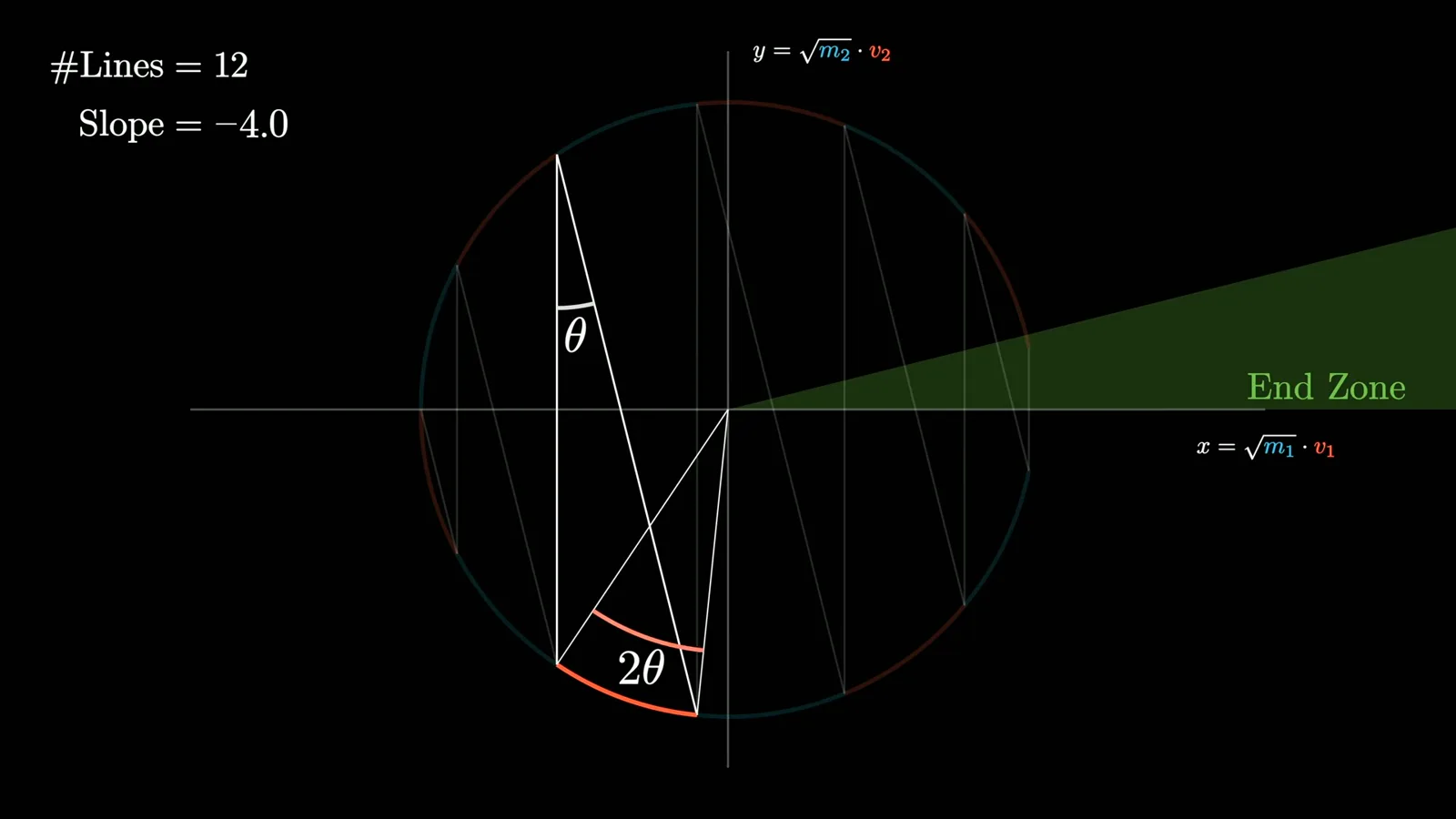
Equivalently, the count is the largest integer N for which Nθ < π. The strict inequality matters if π/θ happens to be an integer: in general N = ⌈π/θ⌉ − 1. This is an exact geometric count for the stated ideal setup.
Small angles and the caveat
The arctangent approximation explains the pattern but needs care for a universal claim.
The slope gives tan θ = √(m₂/m₁), so θ = arctan √(m₂/m₁). If the mass ratio is 100:1, θ = arctan(0.1), not exactly 0.1. For small angles arctan x is close to x, explaining why the count resembles digits of π.
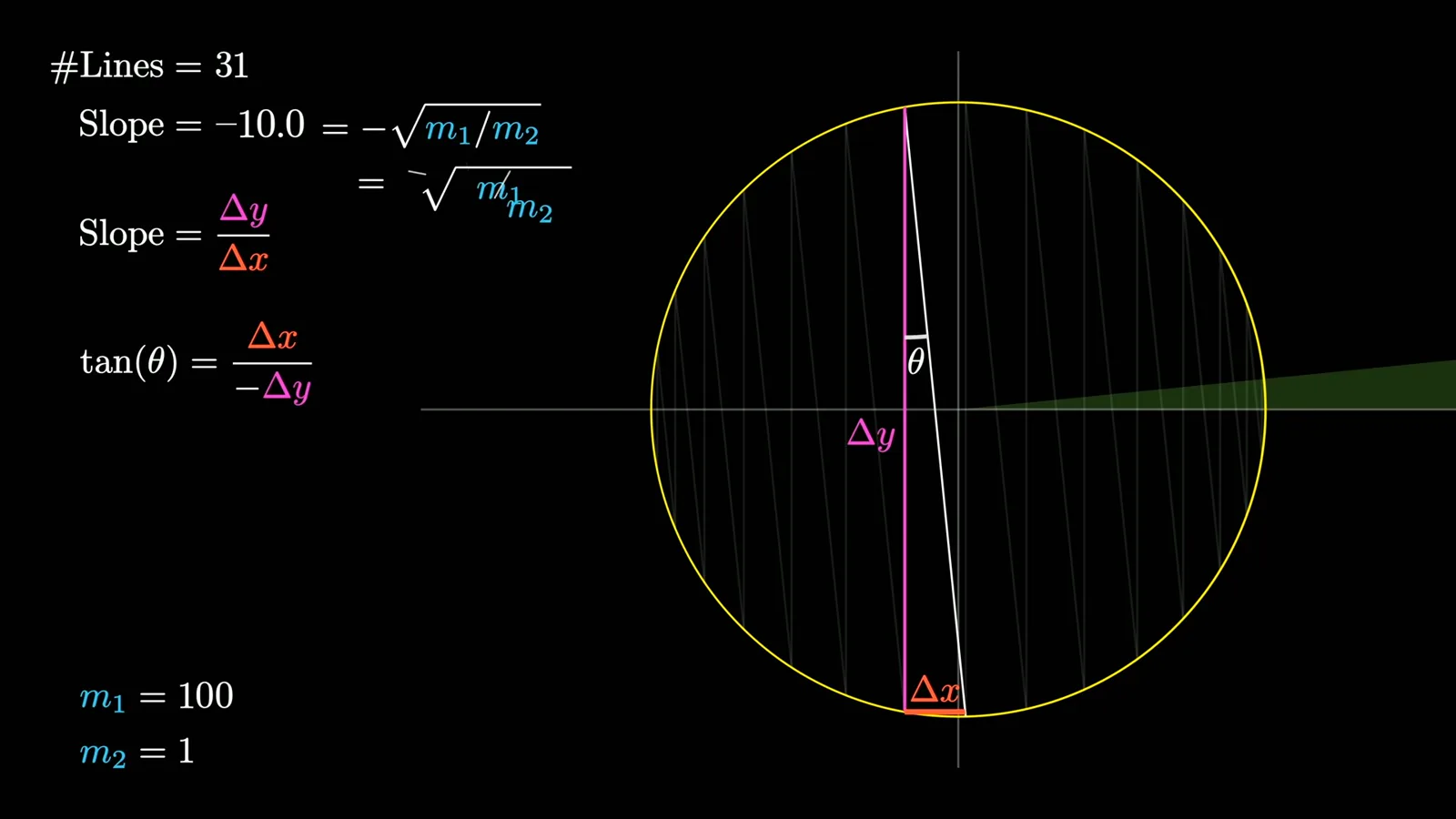
On a unit circle, a small angle in radians is close to its arc length and to the vertical displacement; the horizontal coordinate is close to one. This geometric picture explains the small-angle approximation used in the argument.
Close is not automatically enough to prove every digit. A tiny approximation error could change the integer count if a multiple lands sufficiently close to π. The video notes a possible off-by-one issue related to unusually long runs of nines in π’s decimal expansion; it says a general proof for all powers of 100 remains open.
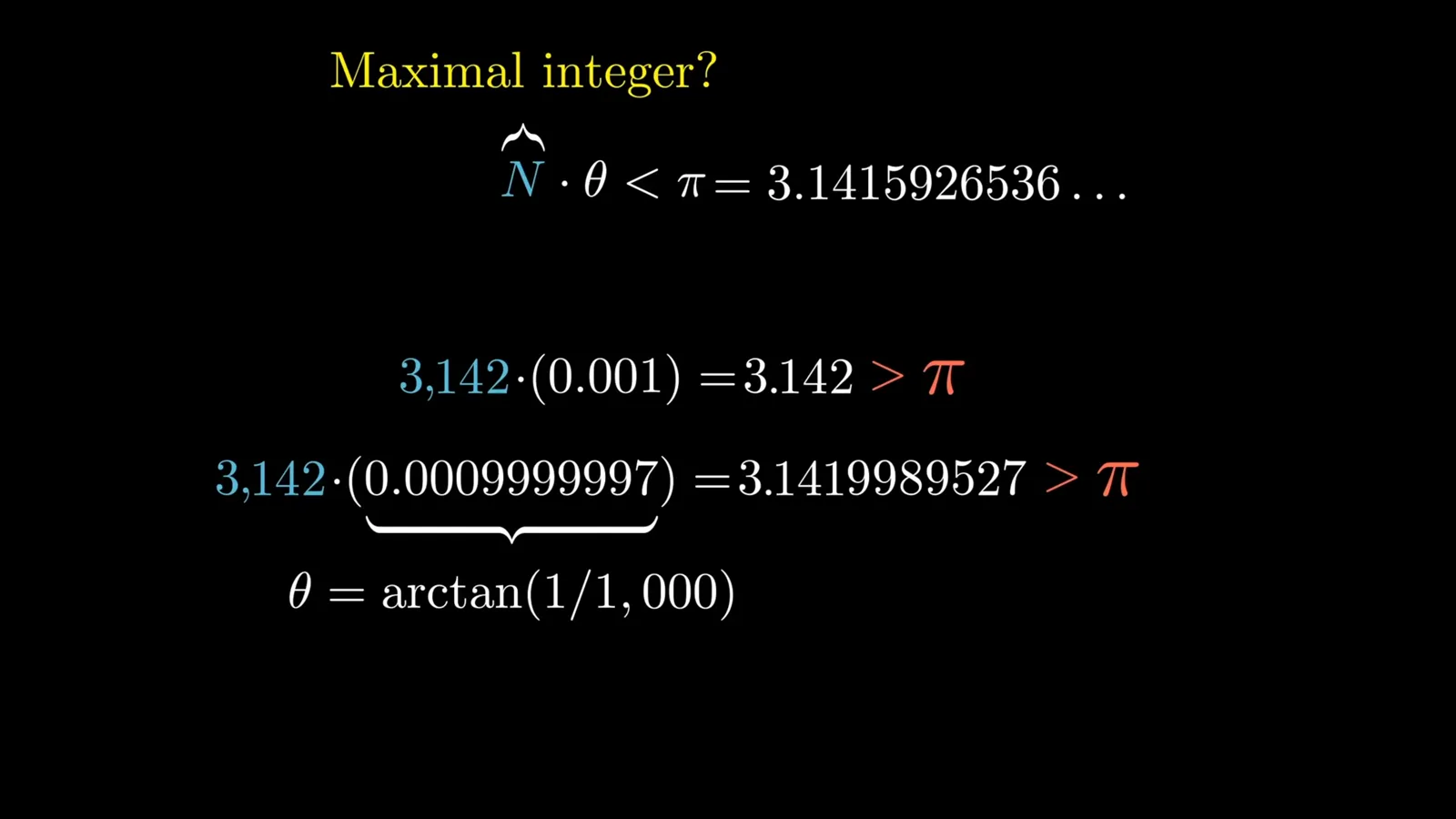
The collision count itself has an exact formula, so the physical model is not mysterious or unsolved. The unresolved issue described in the video is the universal digit-matching claim. Other number bases have analogous mass-ratio constructions, such as powers of four for binary digits.
The value of idealization
Simple models reveal connections and can later incorporate real effects.
Idealization has two uses. A simple solution can be refined to incorporate real effects, such as energy loss; it can also expose connections hidden by physical detail. The presenter points to Gregory Galperin’s mirror analogy and a separate forthcoming explanation of the Grover algorithm connection.
Distilling a problem to its essential structure can reveal a clearer version of the same difficulty in another setting. Those connections are a source of mathematical progress, even when the original physical experiment is impractical at extreme scales.
More from this channel
 40:44EN
 3Blue1Brown· Oct 16, 2026Grant Sanderson: There's never been a better time to go into mathGrant Sanderson, Constantin Kogler · 3Blue1BrownStudents fear AI has solved mathematics. Grant Sanderson argues the opposite: even if machines prove theorems better than we do, the institution of math stays valuable—and this is a rare moment when newcomers can reshape it.
 51:55EN3Blue1Brown· Sep 18, 2026The last IMO problem AI could not solveGrant Sanderson · 3Blue1BrownGrant Sanderson walks through IMO 2025 Problem 6 — a tiling puzzle that frontier models missed — and the visual patience it takes to prove a construction is optimal.
 0:55EN3Blue1Brown· Jul 24, 2026The 64 Sugar Cubes Puzzle: Six Equal DistancesA 4×4×4 block has three colors; prove that six same-colored pairs share a distance.
 2:25EN3Blue1Brown· Jun 12, 2026How Shannon Measured the Entropy of EnglishA guessing game helped Claude Shannon estimate how much information English text contains, and why prediction is central to compression.
 1:02EN3Blue1Brown· Jun 10, 2026A Robot Walk and the Puzzle of Optimal Binary EncodingHow few bits does it take to send directions that occur with unequal frequencies?
 32:19EN3Blue1Brown· Jun 7, 2026Reinventing Entropy: Why Prediction Helps Compress LanguageA robot’s movement code leads from prefix-free encoding to Shannon information and the entropy of language.