In 30 seconds
Every’s early-access team found Astra 6.2 less useful for editorial feedback than its predecessor: it often jumped to replacement copy and compressed sentences until they became hard to read. Its score on the team’s senior-engineer benchmark matched Astra 6, but testers said end-to-end builds sometimes stopped early. Design defaults looked polished yet repetitive; a generated town nevertheless showed an unexpected way to add detail by projecting 2D images onto a 3D scene. The presenter offers these as the team’s practical test results and labels the proposed cause of model caution as speculation.
- 1Concise writing can lose meaningThe presenter says the updated model compressed some passages until their connections became hard to follow.
- 2Replacement copy displaced the requested editorial critiqueA comparison of feedback on the same article showed Astra 6 leading with critique and 6.2 leading with replacement text.
- 3A matched benchmark score did not mean identical coding experienceThe team reported approximately 39 on its senior-engineer test, but found some end-to-end work stopped too early.
- 4Design defaults were strong but repetitiveIn lightly guided design tasks the presenter saw less variation than in a competing model.
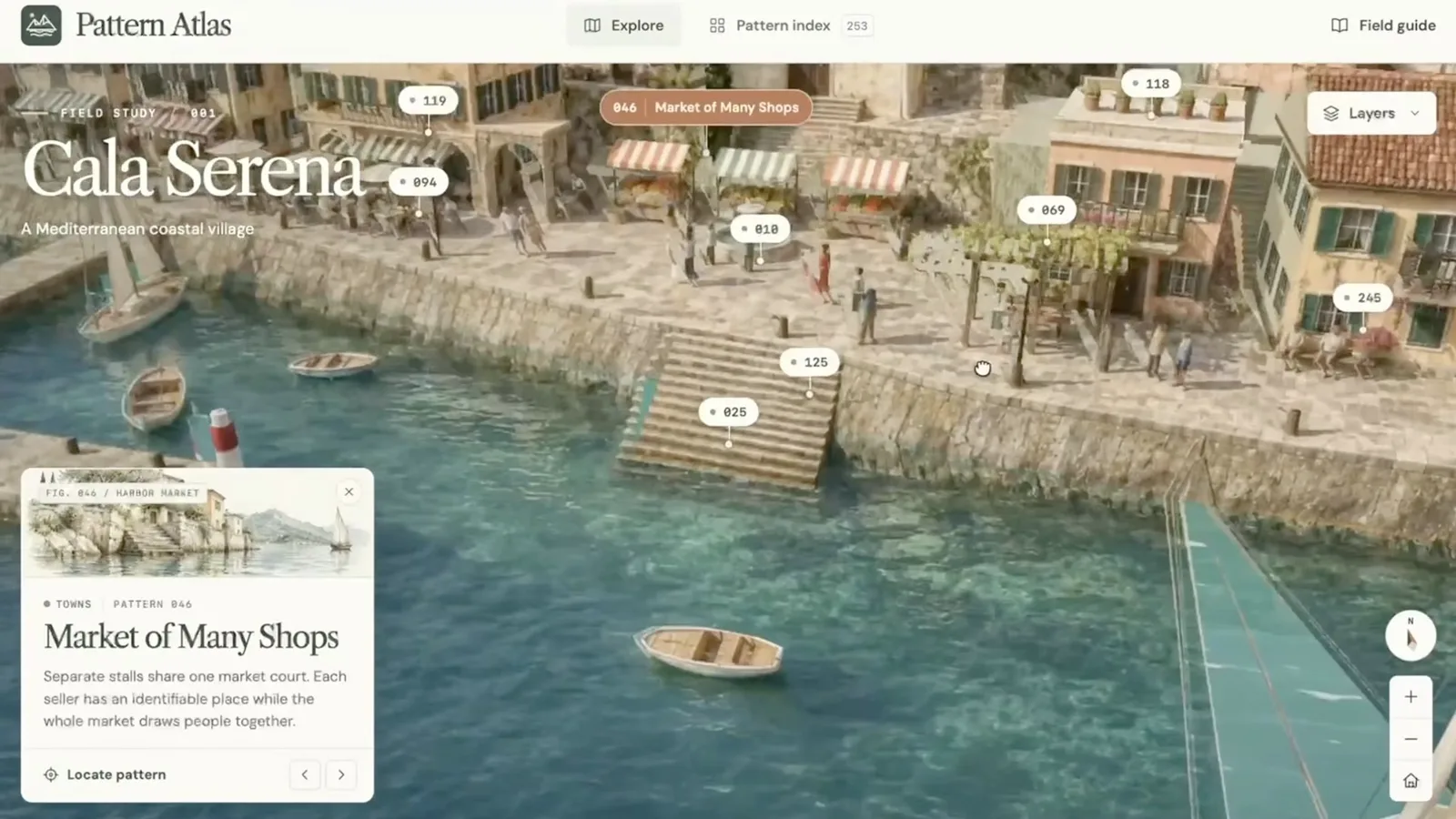
- 5A model town combined 3D geometry with projected 2D detailThe presenter highlights a zoomable town as an unexpected technique that emerged with additional prompting.
Takeaways
- Ask for depth explicitly when a model jumps to replacement copy instead of editorial analysis.
- Every’s senior-engineer test put Astra 6.2 at about 39, the same as Astra 6; testers still found some complete builds stopped early.
- The team observed limited visual variation but a creative use of 2D projections in a 3D scene.
Read the edited text by chapter
The team’s early-access assessment
Every tested the model on real work and reports mixed results.
Every's team tested Astra 6.2 on real coding, writing, design and knowledge-work tasks. The presenter says none of the testers preferred it overall: writing regressed, designs lacked variety, and some coding projects stopped too early.
Every receives early access and free token usage from OpenAI and other model developers for this testing. The presenter says its assessments are independent.
Why the editorial feedback fell short
A comparison shows the trade-off between actionable copy and deeper critique.
The presenter favors Gemini Argon and Hydrogen for storytelling and detailed arguments, while generally valuing OpenAI models for clear, concise prose. In this test, Astra 6.2's brevity sometimes sacrificed meaning and readability.
For an editorial test, the team asked the models to review the headline and opening of Laura Entis's article about token use. The older Astra led with its critique, while 6.2 led with replacement copy and treated notes as secondary.
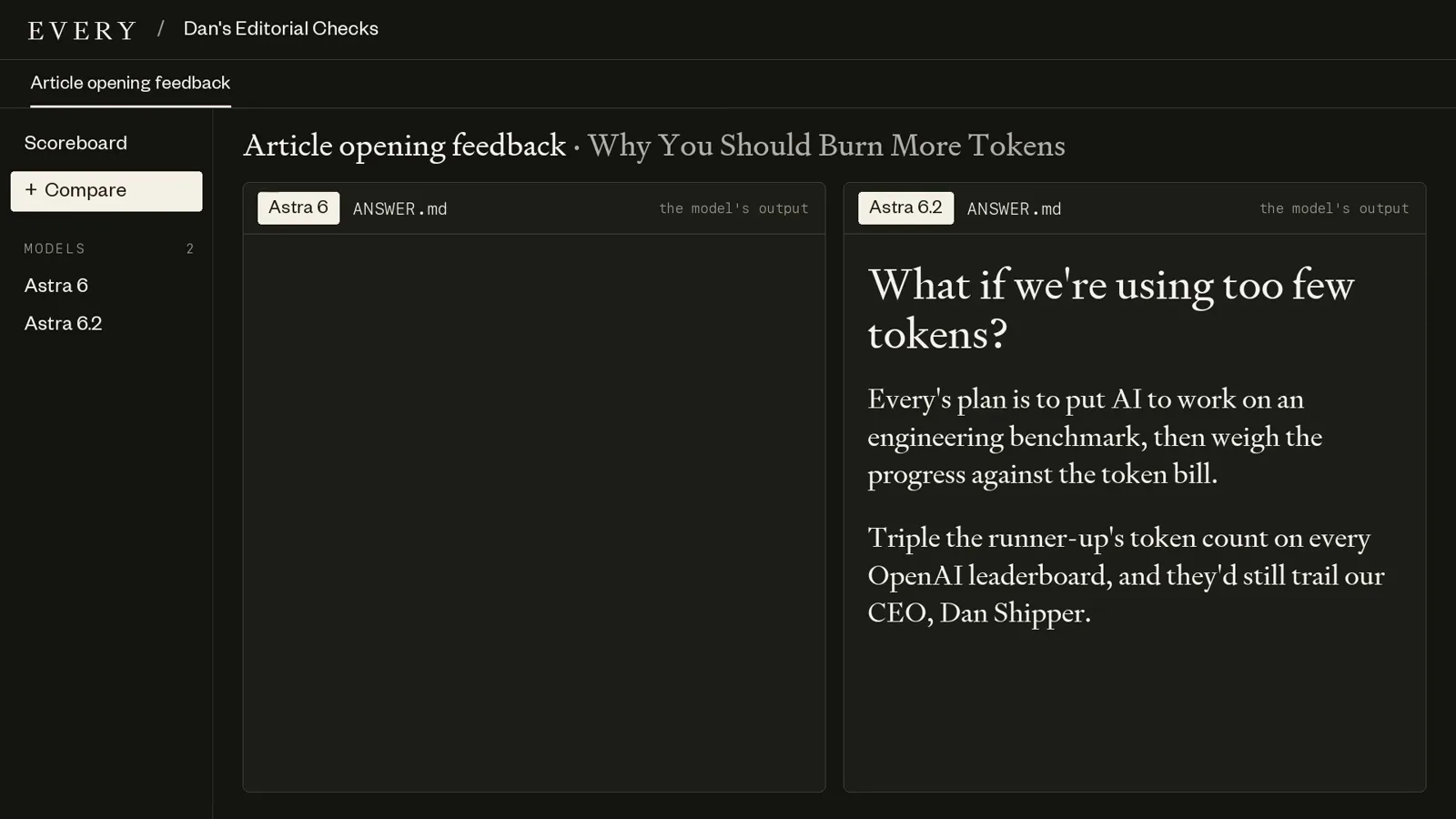
The prompt did request suggested copy, but primarily asked for feedback. The presenter understands the push toward actionable output, yet prefers Astra 6's suggested headline and finds a sentence from 6.2 too compressed to follow easily.
Coding scores and incomplete builds
The team compares benchmark results with its practical development experience.
On Every's senior-engineer benchmark, Astra 6.2 scored about 39, matching Astra 6 and trailing several other models at 40–41. The presenter treats this as a result of the team's own benchmark, not a universal ranking.
On a junior-engineer task, it checked whether backlog items had already been done and researched thoroughly. But the team found Fable's code easier to merge and more trustworthy, and says Astra 6.2 often stopped early on end-to-end builds.
The presenter speculates that added caution may reflect OpenAI's security and alignment work. This is an interpretation, not a demonstrated cause; they expect existing Astra coding users may still like the update.
Design variation and a 3D experiment
The model had repetitive defaults but produced a creative projected-image scene.
Designer Tyler Nishida tests models with limited design guidance to expose their defaults and variation. The presenter says Astra 6.2 produced sound defaults but similar-looking results, while Fable 5.2 showed more variety.
On the team's Millennium Falcon 3D test, 6.2 was its strongest OpenAI model so far, though not the best overall. Its result included details the team says earlier OpenAI models often missed.
Senior editor Jack Cheng tested a zoomable model town. The presenter says the model projected generated two-dimensional images onto a 3D scene to create apparent detail; changing the viewpoint exposes the technique.
The limits of over-optimizing for concision
The presenter argues that practicality needs clarity and creative range.
The presenter concludes that optimizing for concise, practical responses can go too far if it reduces clarity or creativity. They see potential in the model, but say it takes more prompting to bring that out.
More from this channel
 31:06EN
 Every· Nov 16, 2026Podcast · 3 speakersAI Adoption Starts With the Work Experts Cannot Fully ExplainGuest Hugh Wimberly, Jeremy Hadfield · Host Willie WilliamsHugh Wimberly and Jeremy Hadfield describe watching real workflows, measuring errors and letting early users demonstrate what AI can do.
 31:31ENEvery· Nov 13, 2026Podcast · 5 speakersNursa gave every employee AI building tools; its first prototypes became real productsGuest Lauren Rhode, Curtis Anderson · Host Brian DellA nursing-staffing company reports savings and new applications, while its leaders confront governance, quality and resistance.
 26:47ENEvery· Nov 11, 2026Podcast · 2 speakersDan Shipper: AI makes generating ideas cheap; people still choose what mattersHost Natalia QuinteroThe Every co-founder uses one customer survey to explain why different perspectives can produce different work from the same model.
 16:57ENEvery· Nov 9, 2026PodcastFable 5.2 excels at ambitious builds, but its token costs add upEvery’s early tests found strong coding and creative work; a single documentary run used 1.4 billion tokens.
 46:14ENEvery· Nov 4, 2026Podcast · 2 speakersKevin Roose on Reporting AI History and Choosing What to DelegateGuest Kevin Roose · Host Natalia QuinteroThe journalist discusses The AGI Chronicles, interviewing a secretive industry, AI-assisted research and his distinction between weightlifting and forklifting.
 50:51ENEvery· Oct 29, 2026Podcast · 3 speakersFred Graver on Using AI as a Writers’ Room, Not a GhostwriterGuest Fred Graver · Host Dan Shipper, Natalia QuinteroThe writer and producer explains how he develops ideas and uses AI feedback.