In 30 seconds
Sean Carroll offers a tentative view on extraterrestrial intelligence and discusses uncertainty about its form and detectability with Lex Fridman. Their examples are speculative.
- 1A personal estimateCarroll’s rarity argument is a hypothesis, not a measurement.
- 2Different formsLife and intelligence might differ from familiar human examples.
- 3Search limitationsRadio searches cover only part of the space of possible signals or artifacts.
Takeaways
- Carroll’s estimate of rarity is a personal hypothesis.
- Intelligence need not imply human-like technology.
- Our searches reflect assumptions about possible signals.
- Speculation about artifacts is not evidence that they exist.
Read the edited text by chapter
Rarity and unfamiliar intelligence
Lex Fridman asks physicist Sean Carroll whether intelligent life exists elsewhere. Carroll offers his personal guess that there is no other technological intelligence in the observable universe, while acknowledging the uncertainty.
Lex Fridman asks physicist Sean Carroll whether intelligent life exists elsewhere. Carroll offers his personal guess that there is no other technological intelligence in the observable universe, while acknowledging the uncertainty.
Carroll reasons that if technological civilizations were very common, we might expect evidence of them, whereas a large bottleneck could make them extremely rare. This is an interpretation of the Fermi question, not a measured probability or proof of absence.
Fridman asks whether intelligence could have forms, sizes or timescales very different from ours. Carroll agrees that definitions of life and intelligence are unsettled and that such possibilities deserve humility.
He distinguishes intelligent species from technological civilizations: an ocean-dwelling species might have sophisticated cognition without developing space travel or tools like ours. Such life could be harder to detect.
Carroll also speculates about unfamiliar environments and much slower timescales, while noting that shared physical constraints could favor some scales. He presents both as possibilities, not observed examples.
How might we detect it?
They consider the limits of radio searches. Carroll argues that a long-lived civilization might choose methods other than broadcasting signals in every direction, so the absence of a detected signal does not exhaust all possibilities.
They consider the limits of radio searches. Carroll argues that a long-lived civilization might choose methods other than broadcasting signals in every direction, so the absence of a detected signal does not exhaust all possibilities.
He imagines probes or artifacts placed in other solar systems as one speculative alternative. He emphasizes the long timescales involved; the conversation offers no evidence that such artifacts exist in our solar system.
More from this channel
 3:34:27EN
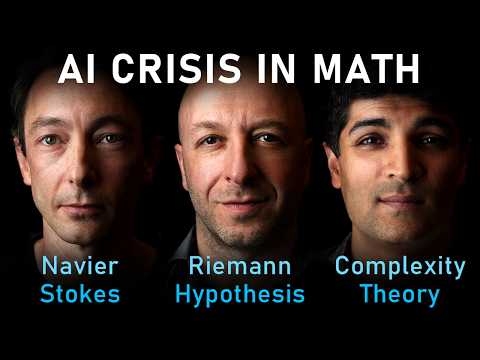
 Lex Fridman· Oct 26, 2026Podcast · 4 speakersAI, Mathematics, and the Meaning of a ProofGuest Steven Brunton, Ankur Moitra, Alex Kontorovich · Host Lex FridmanLex Fridman and three mathematicians discuss recent AI-generated research, hard open problems and what human understanding contributes.
 3:36:56ENLex Fridman· Sep 16, 2026PodcastPsychiatry Has Never Found Its PenicillinHost Lex FridmanHistorian Andrew Scull tells Lex Fridman why the field can ease symptoms, has never cured a major mental illness, and keeps paying for overconfidence with patients' lives.
 5:15:51ENLex Fridman· Aug 26, 2026Podcast · 2 speakersDHH Did Not Write a Line of Omarchy QuattroGuest DHH · Host Lex FridmanThirteen months after a skeptical conversation with Lex Fridman, the Rails creator describes how Opus 4.5, a swarm of coding agents, and a one-minute Linux installer ended his era of hand-chiseled Ruby.
 3:12:58ENLex Fridman· Aug 12, 2026Podcast · 2 speakersOne Cold Shower, Twenty Champions: How Khabib Nurmagomedov Was ForgedGuest Khabib Nurmagomedov · Host Lex FridmanIn a Makhachkala school gym, seventy men shared one shower, and the water was only cold.
 3:46:18ENLex Fridman· Jul 28, 2026Podcast · 2 speakersIf You Take Slavery Out of the Picture, There Is No Civil WarGuest Gary Gallagher · Host Lex FridmanIn 1860, enslaved people were worth more than every railroad and factory in the United States combined.
 3:51:47ENLex Fridman· Jun 30, 2026Podcast · 2 speakersForty-Six Percent of Emperors Were Overthrown. The Empire Lasted AnywayGuest Anthony Kaldellis · Host Lex FridmanHistorian Anthony Kaldellis walks Lex Fridman through 2,200 years of Roman history and argues that what we call Byzantium was Rome itself.