In 30 seconds
Theo Browne discusses Anthropic’s May 2026 announcement of separate programmatic usage credits and its implications for Agent SDK integrations. He helps build the affected T3 Code project, and his estimates and interpretations of motives are personal rather than verified cost figures. Anthropic later announced [monthly API credits for eligible subscribers](https://www.anthropic.com/claude-haiku-5-5); consult current terms for actual access and billing.
- 1An affected developer’s perspectiveTheo helps build T3 Code, which integrates Claude components and is affected by the announced usage distinction.
- 2A separate allowanceThe announcement described a programmatic credit and optional additional API-rate usage, not a blanket ban.
- 3Subscription comparisons are estimatesAPI-equivalent calculations depend on actual usage and do not reveal Anthropic’s internal costs.
- 4Interactive and programmatic overlapA human can use a third-party interface that calls an SDK programmatically, complicating the billing boundary.
- 5Policies changed after the videoAnthropic later announced separate API credits for eligible plans; current official terms govern.
- 6Integration choices require current termsTheo considered an interactive terminal option, but a planned interface does not establish eligibility or deployment.
Takeaways
- Programmatic credits and interactive subscription limits were described as separate allowances.
- A third-party interface can be interactive to its user while calling an SDK programmatically.
- Subscription-to-API comparisons depend on assumptions and do not reveal provider costs.
- Developers need clear terms for local tools, automation, and spending controls.
- Policy and eligibility may change, so verify the current official documentation.
Read the edited text by chapter
A policy change affecting T3 Code
Theo discloses his role in an affected open-source application. The announced credit changes billing rather than banning all programmatic use.
Anthropic announced a separate monthly credit for programmatic use by paid Claude subscribers, including Agent SDK and non-interactive Claude Code use. I am upset about the implications for T3 Code, an open-source app I help build. This is my perspective as an affected developer, and the terms discussed here reflect the May 2026 announcement.
For months, developers had asked what a Claude subscription could be used for in local applications, SDK integrations, and automation. T3 Code wraps official Claude components to offer another interface. I had understood that approach to be supported, so the announced change felt like a reversal after we invested work in it.
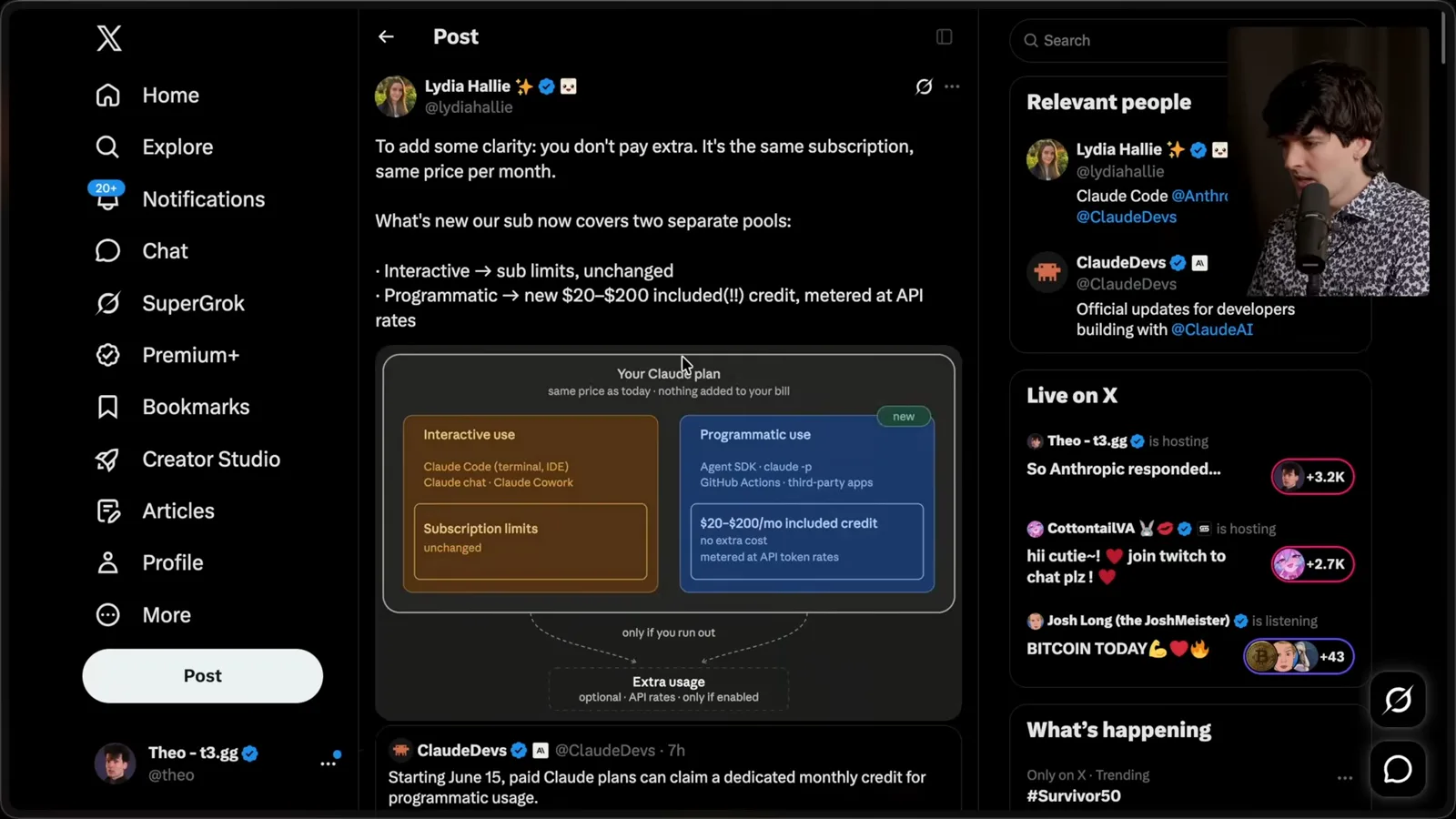
The announcement described a credit that users would claim, with programmatic usage drawing from a separate budget and interactive subscription limits reserved for interactive use. It described credits corresponding to the paid plan tiers and resetting each billing cycle. These figures and eligibility are historical; current product terms may differ.
The announcement also described optional additional usage at API rates after the included credit was exhausted, and a pause if that extra spending was not enabled. That is not a blanket prohibition on programmatic use: it changes the allowance and billing path. Users should check the current terms and spending controls for their own accounts.
The spectrum of Claude usage
Interactive chat, coding tools, wrappers, SDKs, and API calls offer different levels of control and resource usage. Theo discusses estimated subscription economics.
At one end of the spectrum is chatting on Claude's website with a subscription. At the other is building a product that calls the API and pays for tokens. Between them are Claude Code, headless commands, local wrappers, SDK applications, and automated workflows; the difficult question is where each belongs.
Claude Code use can vary greatly: a short local question is different from a complex coding task or an automated workflow triggered by repository events. Anthropic has different degrees of control over its own interfaces and third-party integrations. A subscription provider has to decide how to manage that variation.
The gap between subscription usage and public API pricing is central to my argument. I estimate that a heavy subscriber could receive an API-price-equivalent amount much larger than the subscription fee. Those estimates depend on usage, model, and cache assumptions; they are not published entitlements or Anthropic's actual cost.
I speculate that a provider may use subscriptions to encourage adoption while allocating scarce compute among consumer and enterprise customers. That is an interpretation of possible incentives, not evidence of Anthropic's internal accounting, margins, or motives. Different plans and contracts can have very different economics.
Harnesses and the Agent SDK
Theo describes alternative interfaces, caching trade-offs, and the earlier ambiguity around personal and third-party usage.
Tools such as OpenCode offer alternative harnesses and interfaces. I prefer some of those experiences, including the ability to work with multiple providers and open-source code. Those preferences are subjective; the relative reliability, quality, and cost of any harness depend on the task and implementation.
I discuss caching and context pruning as one example of how harnesses can affect cost. Removing old tool output may invalidate some cached context, but it can also reduce the amount of context processed later. The net result depends on the workload and cache behavior; my cited experience is not proof that one method is always cheaper.
The Agent SDK sits between an interactive tool and direct API access. It lets developers use agent capabilities programmatically, configure tools, pass prompts, and receive results. Examples include a code-review workflow or a bot that starts a task from another application.
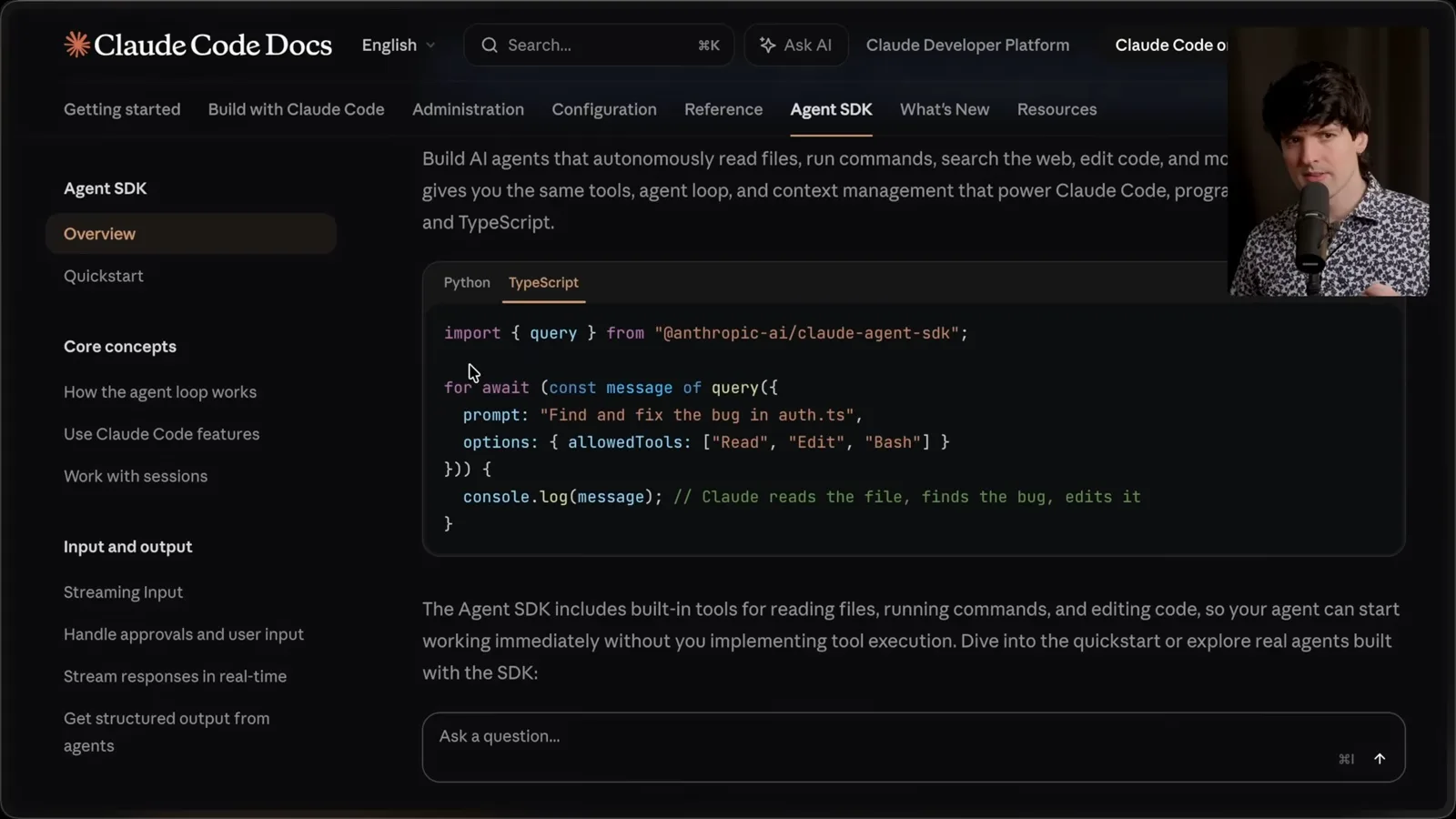
The previous guidance I saw distinguished personal experimentation from building a business on the SDK, and also cautioned third-party developers about offering Claude subscription login. I found the boundary unclear for open-source local applications and had asked for clarification along with other developers.
The ambiguity matters in ordinary situations: a developer might call Claude Code non-interactively on their own machine, package a personal workflow for others, or run an agent in CI. A policy needs to explain which identity and billing mechanism applies to each case, rather than relying on labels alone.
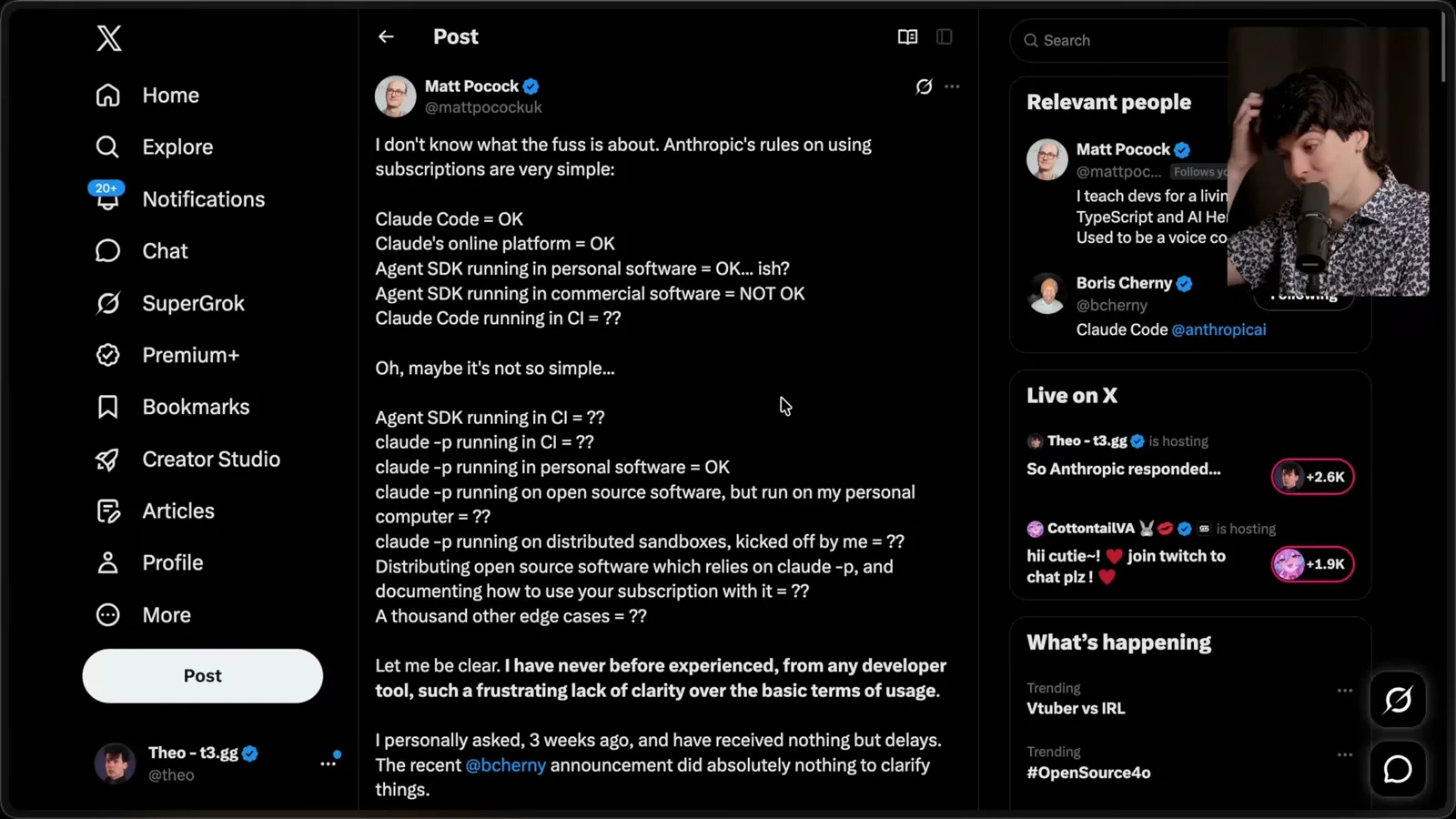
I see a spectrum from interactive Claude Code through headless use and the Agent SDK to independent harnesses and direct API calls. My criticism of the SDK's developer experience is based on our integration work. It should be distinguished from a factual claim that no one can build a useful product with it.
Where to draw the boundary
He acknowledges a provider needs limits but disputes treating local coding interfaces like unattended automation.
To make the strongest case for Anthropic, it has to draw some boundary between subsidized subscriptions and metered API use. An unattended automation can consume resources differently from a person interacting with a tool. I understand the need for controls even though I disagree with where the announced boundary falls.
Different harnesses may also manage context and cache differently, while scheduled agents can keep running without a user watching. I suggest that rate limits might address some heavy usage. That is a design alternative, not proof that it would solve the provider's cost or abuse problems.
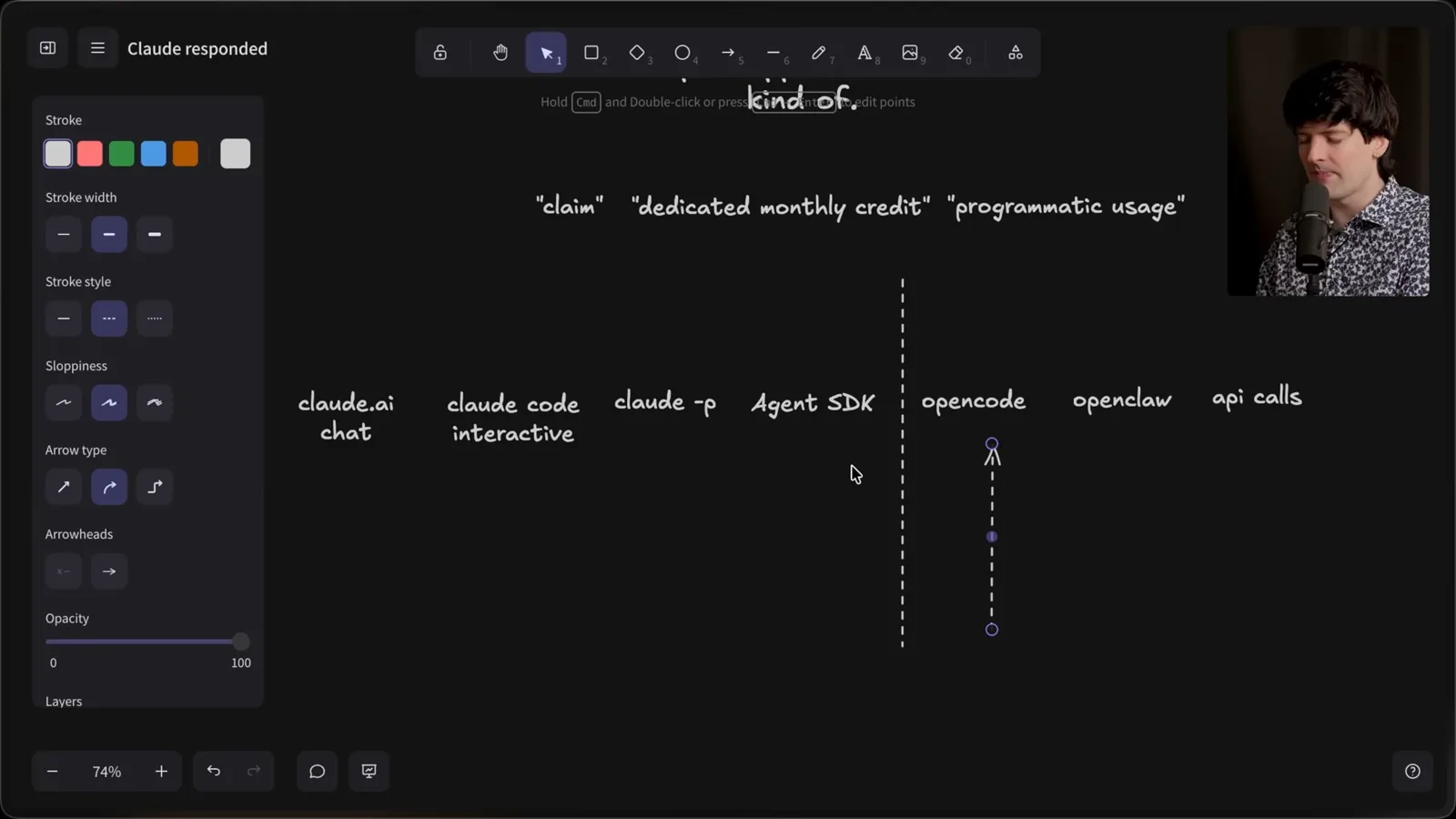
Our team and other developers built integrations around Anthropic's own components because we understood that to be the supported route. For T3 Code, the purpose was to give people another interface for coding, not to resell a subscription as an API. I feel the new boundary fails to distinguish that from unattended automation.
The announced distinction is interactive versus programmatic. In my view, a person using a third-party graphical interface can still be interacting with the agent, even if the application calls the SDK programmatically. How the policy applies depends on the implementation and terms, not simply whether a tool is open source.
Programmatic credits and alternatives
Theo compares estimated subscription value with a separate credit and identifies a useful experimentation case. His ratios are estimates, not universal entitlements.
I compare the old subscription experience with the newly described programmatic credit and argue that heavy users of wrappers could receive much less effective usage. My 25-to-40-times figures are rough API-equivalent estimates, not a measured guarantee for all users or a precise billing change.
The separate credit has an appealing use case: it could let subscribers experiment with agents or integrations without immediately becoming ordinary API customers. I welcome that idea for prototypes, audits, and CI. My disagreement is with applying the same bucket to alternative interfaces for everyday coding.
The announcement's credit was described for specific programmatic surfaces, and I wanted broader direct API access. Product terms can change: Anthropic later announced separate monthly API credits for eligible Max and Team subscribers. Readers should use the current official documentation rather than assume the video describes today's eligibility.
Integration choices and uncertainty
He discusses headless use, a possible T3 Code terminal option, and effects on other integrations. Predictions about enforcement remain unverified.
A headless Claude Code invocation is not identical to a bare model API request: it can carry the coding agent's tools, settings, and workflow. I nevertheless question a distinction that charges different buckets when a person supplies the same task through a different interface.
I speculate about future enforcement and company motives, but I do not have evidence for specific technical restrictions or a plan to retaliate against my criticism. Developers should follow the actual terms and documentation; predictions about how a company will implement a policy are not the policy itself.
For T3 Code, I consider exposing an interactive terminal option alongside the SDK-based interface so users can choose a workflow. That was a planned response at the time of the video, not a guarantee that it shipped or that any particular integration qualifies for subscription usage. The applicable terms still matter.
Other tools, including editor integrations built on the Agent SDK, may face similar questions about which allowance they consume. I characterize this as harmful to open-source interfaces, but the announced credit still supports certain programmatic uses. It is more accurate to describe the billing distinction than to call every integration banned.
CI, scripts, and agent-to-agent review are among the examples I worry about. Under the announced approach, the programmatic bucket and optional paid usage are relevant to these workflows. Their actual cost depends on model usage and settings, so a single multiplier cannot predict the impact on every project.
Trust and next steps
Theo explains his frustration and recommends evaluating other workflows. Readers should check current policy and spending controls.
I feel particularly frustrated because we spent time integrating an officially provided SDK after seeking clarity. That experience affected my trust in future guidance. Other developers may reasonably reach different conclusions based on their own usage, and some interactive users may value the additional programmatic credit.
I encourage users to evaluate other providers and interfaces, including the integrations available in T3 Code. I use Codex heavily myself. Those recommendations reflect my preferences and my role in building T3 Code; they do not establish that another provider's pricing or policies will always fit every workflow.
Matt Pocock describes the clarification as welcome but the reduced programmatic allowance as disappointing, and says he plans to try another tool. I share that disappointment and say I have canceled my plan. The practical takeaway is to check current terms, expected token use, and spending controls before choosing an integration.
More from this channel
 38:47EN
 Theo - t3․gg· Oct 28, 2026Theo’s Long-Running Agent Experiments: Verification, Compute and CostTheo Browne · Ping LabsA skateboard game and two compiler projects show how repeated checks and flexible compute can sustain agent work—and how expensive those loops can become.
 36:07ENTheo - t3․gg· Oct 27, 2026Theo on Token Costs, Coding Agents, and the Price of AI CapabilityTheo Browne · Ping LabsA viral estimate of Lauren's AI spending prompts a closer look at cache pricing, benchmarks, and the changing work of coding agents.
 30:37ENTheo - t3․gg· Oct 26, 2026Theo’s Three Skills for Reviewing and Shipping with Coding AgentsTheo Browne · Ping LabsHow sol-loop, full-send and full-stop encode review, verification and different levels of merge authority.
 0:43ENTheo - t3․gg· Oct 23, 2026Theo Distinguishes Security Vulnerabilities from Active AttacksTheo Browne · Ping LabsA short explanation of why disclosed software flaws and reported attacks are different kinds of security news.
 29:22ENTheo - t3․gg· Oct 22, 2026Theo on Security Vulnerabilities, Stolen API Keys and AITheo Browne · Ping LabsA look at the gap between vulnerability disclosure and patching, and a speculative account of why stolen inference keys may be valuable.
 31:13ENTheo - t3․gg· Oct 20, 2026Theo on Why Smarter Models Help More Than DevelopersTheo Browne · Ping LabsFrom game modifications to compiler experiments, Theo revisits his assumptions about who benefits from more capable AI.