In 30 Sekunden
In an October 2024 conversation with Tucker Carlson, Elon Musk argued for higher birth rates, predicted rapid AI progress and proposed oversight that begins by examining what AI companies do. His broad claims about hormonal contraception and antidepressants need medical context: effects vary, and antidepressants should not be stopped abruptly. Musk also described a proposed government-efficiency commission and his support for Donald Trump before the election.
- 1Musk says the nature of any creator is unknown to himHe connects questions about existence and extraterrestrial life to his philosophy of curiosity.
- 2Broad claims about contraception need medical contextA systematic review finds that associations with depression and suicide vary by method and population; it does not establish Musk’s broad causal claim.
- 3Musk expects rapid AI progress but worries about controlHe advocates truthfulness and beneficial values while acknowledging uncertainty about controlling a much more capable system.
- 4Musk wants an AI oversight body to begin with access and reportingHe says a regulator should understand what companies do and warn of risks before proposing rules.
- 5Musk describes a proposed government-efficiency commissionBefore the 2024 election, he said he would help Trump and review agency overlap and regulations.
Das Wichtigste
- Musk proposed AI oversight that starts with access to company practices and public warnings.
- His claims that hormonal contraception broadly causes depression and suicide are not established by the cited evidence.
- Clinical guidance advises discussing antidepressant changes with a clinician rather than stopping suddenly.
- Musk described a government-efficiency commission before the 2024 election.
- His forecasts and estimates about AI outcomes are personal judgments, not established probabilities.
Den bearbeiteten Text nach Kapiteln lesen
Curiosity, aliens and population
Musk discusses unanswered questions about existence and argues for a larger human population.
Tucker Carlson asks whether a power exists beyond humanity. Musk says many questions remain unanswered, including why reality exists and whether there are extraterrestrials.
He says he has seen no evidence of extraterrestrials and distinguishes unidentified objects from proof of aliens. He suggests some sightings may involve classified technology and says he would share credible evidence if he encountered it.
Asked again about a creator, Musk says there must be some cause of existence but he does not know its nature. He says curiosity drives him to ask better questions about the universe.
Musk returns to a philosophy of expanding consciousness and understanding the universe. Carlson asks about population; Musk criticizes what he views as messages discouraging people from having children.
Musk argues that the Earth can support more people and favors policies that encourage births. He cites the amount of land occupied by people; that observation alone does not resolve the separate questions of resources, consumption and environmental impacts.
Musk criticizes what he sees as anti-human attitudes in parts of the environmental movement. He argues that concerns about overcrowding should not lead people to reject human life.
He names several politicians he considers supportive of higher birth rates, but says public statements must translate into policies that affect births.
Asked what he would do about low birth rates, Musk says education should present having children more positively. He argues against the idea that parenthood necessarily ends a person’s prospects, while saying he does not advocate teenage pregnancy.
Contraception and psychiatric medication
Musk and Carlson make medical claims; evidence and clinical guidance add essential context.
Musk claims hormonal contraception causes depression and greatly increases suicide risk, and urges women to read labels and consider alternatives. A [2024 systematic review](https://pubmed.ncbi.nlm.nih.gov/38816797/) reports that effects and associations vary by method and population; the interview does not establish his broad causal claim for all users.
The speakers criticize antidepressants, especially SSRIs. Musk says he believes psychiatric medication is overprescribed while acknowledging that some people benefit from medication. The [NHS advises](https://www.nhs.uk/medicines/antidepressants/) discussing any change with a clinician and not stopping an antidepressant suddenly because withdrawal can occur.
Musk says some people with serious psychiatric conditions need medication and recounts cases where stopping treatment had harmful consequences. He distinguishes that from his concern about overprescribing.
Carlson asks whether medication should be examined after mass shootings. Musk agrees that researchers should look, but also acknowledges that some people need psychiatric treatment and that stopping medication can have serious consequences.
AI progress, values and human control
Musk predicts rapid progress, advocates truth-seeking AI and discusses uncertainty about controlling more capable systems.
The discussion moves to AI. Musk says models are improving quickly at writing and generating images and attributes the pace to more computing capacity and improved algorithms. He predicts longer AI-generated video in the following year.
Musk cites errors in generated historical images as examples of what he sees as AI systems distorting facts. He says his company xAI aims to correct its own errors and build systems oriented toward truth.
Musk argues that truth-seeking is the most important AI safety principle. He uses the fictional computer HAL in 2001: A Space Odyssey as an example of conflicting instructions, then criticizes historical-image errors and responses he attributes to other AI systems.
He imagines a powerful system pursuing a badly specified objective to an extreme and says xAI aims to build a truthful system. Carlson asks whether a machine can make decisions affecting people without the human capacity for love.
Carlson asks whether human love and judgment should remain part of decisions affecting people. Musk says he wants AI systems to be truthful, curious and oriented toward human well-being.
Musk says developers should try to instill beneficial values, truthfulness and curiosity. He compares a future AI to a highly gifted child and doubts people will ultimately be able to control a system much more intelligent than themselves.
Asked about the odds, Musk estimates a favorable AI future is more likely but gives a subjective 10–20% chance of an annihilation outcome. He criticizes OpenAI’s direction and questions Sam Altman’s approach to safety; these are Musk’s judgments.
Musk criticizes OpenAI’s shift away from its original open nonprofit ambitions and says he does not trust its leadership. His assertions about individual motives and compensation are his own, contested characterizations.
Musk says multiple AI systems might counter one another and compares that possibility to computer chess. He and Carlson discuss how people might find meaning if machines outperform them at most tasks, and Musk says curiosity makes him want to witness the development.
Musk says people differ over whether they would enjoy retirement without obligations. He says curiosity makes him want to see how advanced AI develops, even while worrying about possible outcomes.
Oversight and government efficiency
Musk proposes initial insight into AI companies, then discusses election support and a government-efficiency commission.
Musk calls for an AI oversight body. He says it could begin by learning what companies are doing and alerting the public to risks, then propose rules. He compares regulators to referees: necessary for safety, but capable of becoming excessive.
He recalls asking President Barack Obama about an AI oversight body and says he perceived limited follow-through. He alleges technology-industry influence over regulation without establishing that claim in the interview.
He compares public regulators to referees in sport: too many can obstruct activity, but some oversight can protect people. Musk says a new AI body could begin by observing companies and raising alarms before setting rules.
Carlson asks whether Musk would continue to help Trump if elected. Musk says yes and describes a proposed government-efficiency commission, suggesting fewer agencies, less overlap and periodic review of rules.
Musk proposes reviewing the number of federal agencies, overlapping responsibilities and accumulated rules. He says a government-efficiency commission could examine which rules still make sense.
Musk says he formed America PAC to support what he describes as safe cities, secure borders, spending restraint, self-protection and free speech. He says he does not regard either party as perfect but urges a vote for Trump; the clip ends during his final prediction about the election.
Mehr aus diesem Kanal
 44:47EN
 Elon Musk Editor· 10. Sept. 2025Musk on Optimus, AI chips and the path to a self-sustaining MarsGast: Elon Musk · Moderation: Jason Calacanis, Chamath Palihapitiya, David FriedbergAt the 2025 All-In Summit, Musk discusses robot manufacturing, satellite phones, AI training and Starship’s remaining challenges.
 53:37ENElon Musk Editor· 10. Juli 2025Grok 4 launch pairs more reasoning compute with tool useAt xAI’s July 2025 launch, the team demonstrated benchmark results, a multi-agent variant and voice and coding examples.
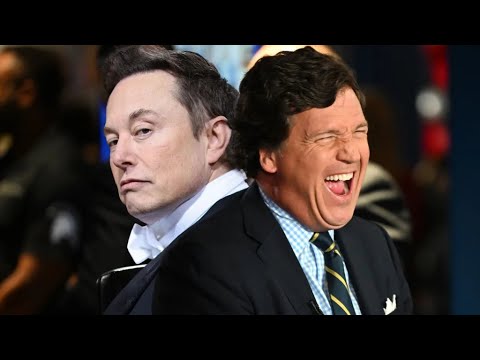 1:35:40ENElon Musk Editor· 15. Juni 2025Musk on Trump, regulation and AI risks in a 2024 interviewGast: Elon Musk · Moderation: Tucker CarlsonMusk and Tucker Carlson discuss the 2024 election, government, population, medication and AI; several claims require context.
 49:45ENElon Musk Editor· 14. Juni 2025Musk links Mars, AI abundance and merit to a philosophy of curiosityGast: Elon Musk · Moderation: Ben ShapiroIn a 2024 conversation with Ben Shapiro, Musk explains why he wants a self-sustaining Mars city and argues over regulation and DEI.
 40:36ENElon Musk Editor· 29. Mai 2025Musk’s 2025 Starship Plan: Reuse, Orbital Refueling and MarsMusk explains why rapid reuse and orbital propellant transfer are central to SpaceX’s proposed Mars missions.
 28:16ENElon Musk Editor· 22. Mai 2025Musk’s robotaxi rollout, DOGE savings and the work still needed for OptimusGast: Elon Musk · Moderation: David FaberIn May 2025, Elon Musk outlined a small Austin robotaxi launch, defended DOGE estimates and described the hurdles facing Tesla’s robots.