In 30 Sekunden
In May 2025, Elon Musk said SpaceX’s route to Mars depended on rapidly reusing both Starship and its Super Heavy booster, transferring propellant in orbit, and making a reliable reusable heat shield. Booster catches had already been demonstrated, but catching the ship and orbital refueling remained goals. Musk estimated a 50–50 chance of sending uncrewed Starships in the late-2026 Mars window if refueling were ready, and described a much longer-term vision of a self-sustaining settlement.
- 1The launch tower is intended to shorten booster turnaroundMusk says the same arms can catch the booster and return it to the launch mount. His one-to-two-hour turnaround is an in-principle goal, not a demonstrated cadence.
- 2Orbital refueling is a prerequisite for the proposed Mars missionMusk describes sending tanker ships to replenish a payload-carrying Starship in orbit before departure. He hoped to demonstrate transfer the following year.
- 3A reusable heat shield remains a difficult engineering problemMusk says tiles must withstand reentry repeatedly without cracking or falling off, and wants to test the same design on Earth before Mars.
- 4A late-2026 Mars attempt depended on refueling being readyMusk gave the uncrewed launch opportunity a 50–50 chance in May 2025. Human missions would follow only if early landings succeeded, he said.
- 5Musk’s mass estimate for a self-sustaining settlement was uncertainHe guessed a million tons might be needed on Mars, while acknowledging it could be ten million or more.
Das Wichtigste
- Musk said catching the booster at its launch tower could reduce turnaround by avoiding transport and landing-leg handling.
- The ship catch, orbital refueling and reusable heat shield were still development goals in the 2025 presentation.
- A Mars-bound Starship would need other ships to replenish its propellant in orbit, under the plan Musk described.
- Musk estimated the late-2026 uncrewed Mars opportunity at 50–50, conditional on orbital refueling.
- His estimate of roughly one million tons for a self-sustaining Mars settlement was explicitly a guess, possibly much higher.
Den bearbeiteten Text nach Kapiteln lesen
Starbase and the proposed scale of production
Musk describes the growth of the Texas facility and ambitious production goals. He frames progress around the long-term objective of a self-sustaining Mars settlement.
Elon Musk introduces the SpaceX update at the newly incorporated Starbase, Texas. He says its long-term purpose is to develop technology for taking life and civilization to another planet.
A video shows the site’s early development. Musk says SpaceX built launch facilities and a rocket factory there over roughly five or six years, and notes that a public highway passes the production and launch sites.
Musk says the facility can produce a ship roughly every two or three weeks, although upgrades interrupt that cadence. He sets a much larger long-term goal of 1,000 ships a year and describes planned large production buildings in Texas and Florida.
To illustrate the scale he has in mind, Musk compares future Starship and satellite production with aircraft manufacturing and the much larger production volumes of car companies. He argues that such numbers are unusual for spaceflight but achievable in other industries.
Musk says SpaceX measures progress against the time needed to establish a self-sustaining settlement on Mars. His stated aim is a settlement able to continue growing even if shipments from Earth stop, providing a second location for human civilization.
He argues that having self-sustaining populations on two planets could improve civilization’s resilience to human-caused or natural disasters. Beyond Mars, he imagines exploration of the Moon, asteroid belt, outer-planet moons and eventually other star systems.
To lower the cost per flight and per ton to Mars, Musk says rockets need to be rapidly reusable and reliable. He congratulates the SpaceX team on catching the Super Heavy booster multiple times with the launch tower’s arms, and shows footage of a catch.
Catching both stages for rapid reuse
Musk explains the booster catches and why SpaceX wants to return hardware directly to the launch mount. Catching the ship remained a future demonstration.
Catching the booster at the tower avoids moving a huge vehicle from a landing pad and stowing landing legs, Musk explains. The same arms could return it to the launch mount. In principle, he says, propellant could be loaded in 30–40 minutes and the booster flown again in roughly one or two hours; this is a turnaround goal.
SpaceX also needs to catch the ship, Musk says; that had not yet been done. In May 2025 he hoped to demonstrate it later that year, perhaps within a few months. Because a ship must orbit until its ground track returns to the launch site, its turnaround differs from the booster’s, though he hopes it can fly multiple times a day.
Raptor 3, orbital refueling and the heat shield
Musk describes engine changes, a proposed tanker architecture and the difficulty of making a heat shield that survives repeated reentries.
Musk introduces the Raptor 3 engine. He says its design integrates fluid circuits and electronics and avoids the need for a separate basic engine heat shield, reducing mass. He expects improvements in efficiency, payload capability and reliability as the engine matures.
Another essential technology is transferring propellant between Starships in orbit. Musk compares it to aerial refueling: a ship carrying payload would reach orbit, then tanker ships would replenish its oxygen and fuel before it departs for Mars or the Moon. In 2025 he hoped to demonstrate the transfer the following year.
Musk calls the reusable heat shield one of the hardest problems. Tiles must withstand extreme reentry heat and pressure repeatedly without cracking, eroding or falling off. He contrasts that goal with the extensive inspection and refurbishment required by the space shuttle’s tiles.
He says Mars’s carbon-dioxide atmosphere creates a challenging chemical environment during reentry, and SpaceX tests heat-shield materials accordingly. He wants to use the same basic shield on Earth and Mars so it can be tested many times on Earth before a Mars flight.
The next Starship design and payload goals
Musk outlines a taller booster, changes to staging and a longer ship. He presents performance and reuse figures as goals for future versions.
Musk describes a next-generation booster with a more open integrated structure between booster and ship. During hot staging, the ship’s engines ignite while the booster is still firing; the openings let the exhaust escape. He says the new interstage would return with the booster rather than be discarded.
He gives approximate future dimensions and propellant capacities, noting that these may increase as designs evolve. The booster would expose Raptor 3 engines at the base without a separate heat shield, while the longer ship would carry more propellant and have smoother heat-shield boundaries.
Musk says Starship version 3 is intended to combine rapid reuse, reliability and orbital refilling. In May 2025 he aimed for its first launch at the end of that year. He describes later versions as further increases in size, performance and efficiency.
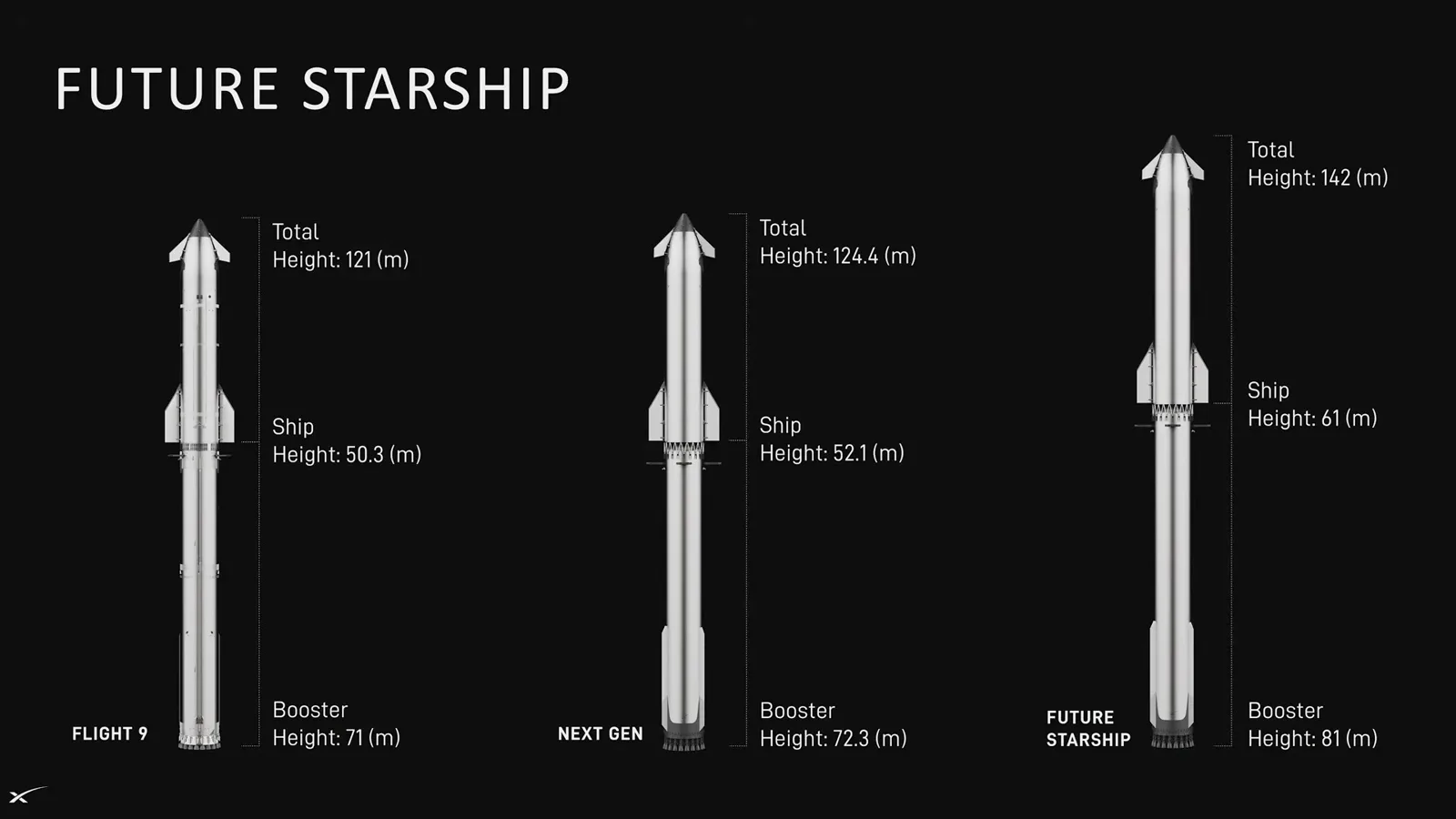
Musk presents a goal of about 200 tons to orbit with full reuse, or roughly 400 tons without reuse, and compares the reusable target with Saturn V. He also imagines a Moon base as a scientific station on the way to more distant destinations.
Mars windows, cargo and settlement
Musk lays out a conditional schedule for uncrewed and later crewed missions. He discusses possible landing areas, communications and infrastructure at a speculative settlement.
Earth–Mars launch opportunities occur about every 26 months. Musk says the next opportunity would be late 2026 and estimates a 50–50 chance of using it, conditional on developing orbital refueling in time. His proposed first Mars flights would be uncrewed.
He illustrates the elliptical transfer orbit from Earth to Mars and says Starlink revenue helps fund SpaceX’s Mars ambitions. The trajectory must be timed so the ship and Mars meet at the appropriate point in their orbits.
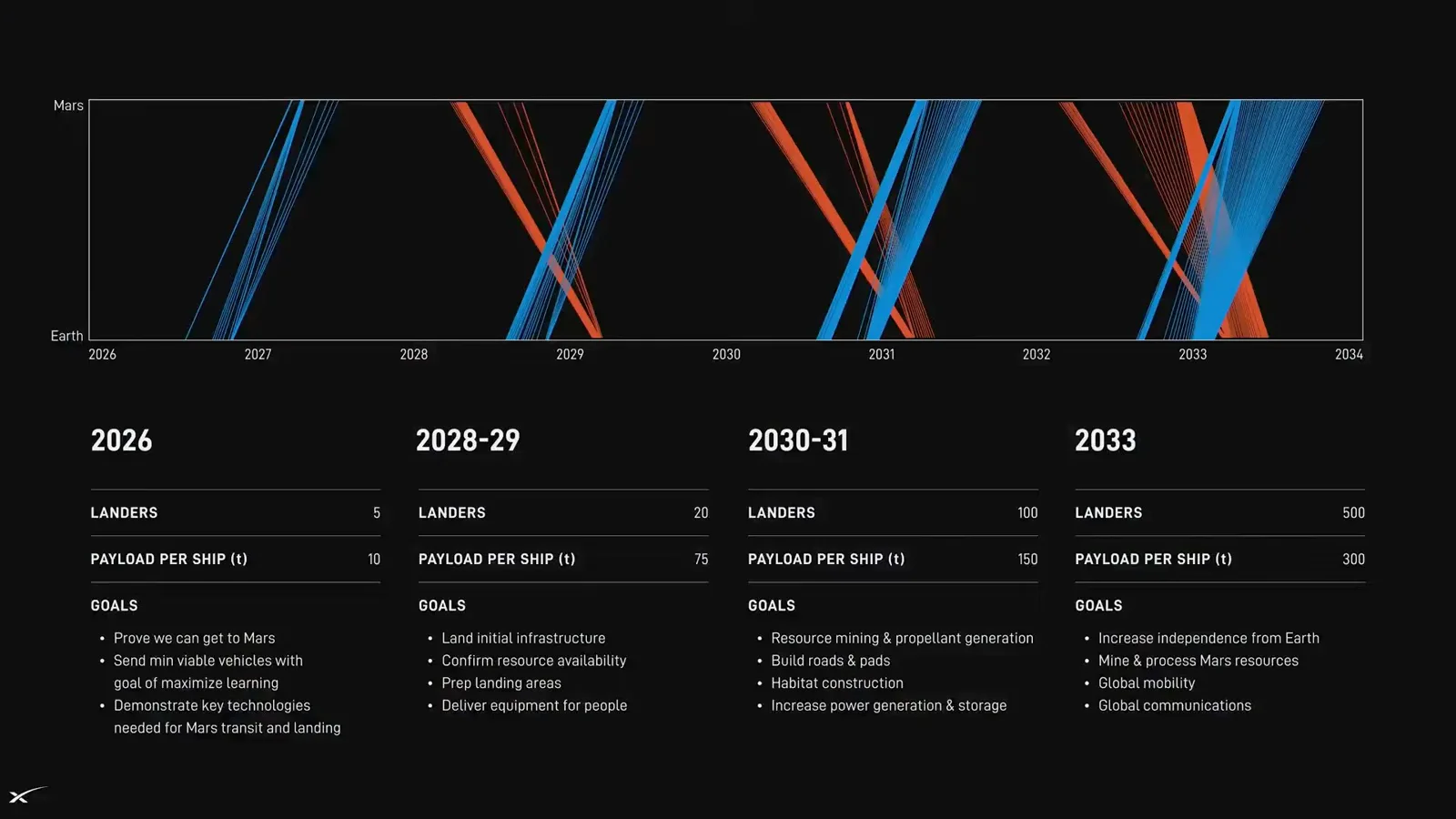
Musk shows a tentative plan to increase the number of ships in successive Mars windows. He guesses that a self-sustaining settlement might require roughly a million tons of material on the surface, but says it could be ten million and hopes it is not 100 million.
He identifies the Arcadia region as a leading candidate because a site needs access to water ice, manageable terrain and a suitable distance from the poles. Musk hopes early uncrewed ships could carry Optimus robots to explore and prepare, with arrival following the launch window.
If initial missions land successfully, Musk says humans might fly in the next opportunity, though he also considers sending robots in two windows before a crew. He imagines a Mars version of Starlink for local communications and notes the several-minute to more-than-20-minute delay for signals between Earth and Mars.
For an early settlement, Musk anticipates solar power, protective suits and enclosed habitats. He imagines eventually transferring more than a million tons in each launch window.
Musk imagines a fleet of a thousand or two thousand ships assembling in orbit for each transfer window, requiring many launch and landing pads. He says the exact logistics of handling thousands of incoming ships will have to be solved later.
He closes with an image of a first city on another planet. Musk says its inhabitants would have an opportunity to decide how to organize their society and what rules to adopt.
Mehr aus diesem Kanal
 44:47EN
 Elon Musk Editor· 10. Sept. 2025Musk on Optimus, AI chips and the path to a self-sustaining MarsGast: Elon Musk · Moderation: Jason Calacanis, Chamath Palihapitiya, David FriedbergAt the 2025 All-In Summit, Musk discusses robot manufacturing, satellite phones, AI training and Starship’s remaining challenges.
 53:37ENElon Musk Editor· 10. Juli 2025Grok 4 launch pairs more reasoning compute with tool useAt xAI’s July 2025 launch, the team demonstrated benchmark results, a multi-agent variant and voice and coding examples.
 1:35:40ENElon Musk Editor· 15. Juni 2025Musk on Trump, regulation and AI risks in a 2024 interviewGast: Elon Musk · Moderation: Tucker CarlsonMusk and Tucker Carlson discuss the 2024 election, government, population, medication and AI; several claims require context.
 49:45ENElon Musk Editor· 14. Juni 2025Musk links Mars, AI abundance and merit to a philosophy of curiosityGast: Elon Musk · Moderation: Ben ShapiroIn a 2024 conversation with Ben Shapiro, Musk explains why he wants a self-sustaining Mars city and argues over regulation and DEI.
 28:16ENElon Musk Editor· 22. Mai 2025Musk’s robotaxi rollout, DOGE savings and the work still needed for OptimusGast: Elon Musk · Moderation: David FaberIn May 2025, Elon Musk outlined a small Austin robotaxi launch, defended DOGE estimates and described the hurdles facing Tesla’s robots.
 30:31ENElon Musk Editor· 8. Mai 2025Elon Musk’s 2010 plan to take Tesla from sports cars to mass marketGast: Elon Musk · Moderation: Bambi FranciscoMusk explains Tesla’s staged product strategy, its financing and his aspirations for SpaceX in a 2010 Vator interview.