In 30 Sekunden
Musk’s Terafab proposal starts with a shortage of AI chips, but building at its proposed scale would also depend on scarce fabrication equipment and suppliers, says investor Dave Blundin. The Moonshots panel disagrees over whether people will eventually be barred from driving and whether AI disruption means a broad stock-market collapse. They also discuss measuring AI work, model distillation and the trade-offs of running AI locally or in the cloud. Their forecasts describe possibilities, not completed deployments.
- 1Chipmaking equipment and suppliers constrain the planBlundin says advanced lithography and the wider supply chain are physical bottlenecks even if financing is available.
- 2The hosts disagree on whether human driving will be bannedBlundin predicts restrictions as autonomous systems improve; Wissner-Gross expects humans to retain a higher-level role instead.
- 3Token use is a disputed measure of AI productivityDiamandis asks how to prevent wasted tokens; the group proposes examining actual work and prompt histories, alongside spending.
- 4Disrupted business models need not mean a market-wide collapseBlundin and Wissner-Gross argue capital may move to firms and infrastructure that adapt, even as some existing advantages erode.
- 5Distillation trades a large model for a smaller studentWissner-Gross explains how outputs from a larger model can train a faster, cheaper one and discusses the possibility of local use.
Das Wichtigste
- Advanced chip manufacturing requires constrained equipment and a complex supplier network, regardless of the size of a proposed factory.
- The hosts disagree on whether autonomous transport will lead to bans on human driving.
- Token spending alone does not settle whether AI use is productive; the panel debates reviewing the underlying work.
- Blundin and Wissner-Gross expect capital to move toward adaptable companies even as some established advantages weaken.
- Local AI offers control and privacy at the cost of maintenance; cloud computing offers easier scaling with shared-resource trade-offs.
Den bearbeiteten Text nach Kapiteln lesen
The Terafab ambition and its constraints
The panel examines proposed chip output, manufacturing bottlenecks and the assumptions behind projected value.
Peter Diamandis opens Moonshots with Dave Blundin and Alexander Wissner-Gross; Salim Ismail joins shortly afterward. Their first topic is Musk’s Terafab proposal, which they discuss as an ambitious plan rather than an operating factory.
Diamandis describes Musk’s stated ambition to produce chips associated with a terawatt of annual AI computing capacity, compared with an estimated 20 gigawatts of current global output. The hosts discuss chips for vehicles, robots and space systems; these figures describe an aspiration and their comparison, not achieved production.
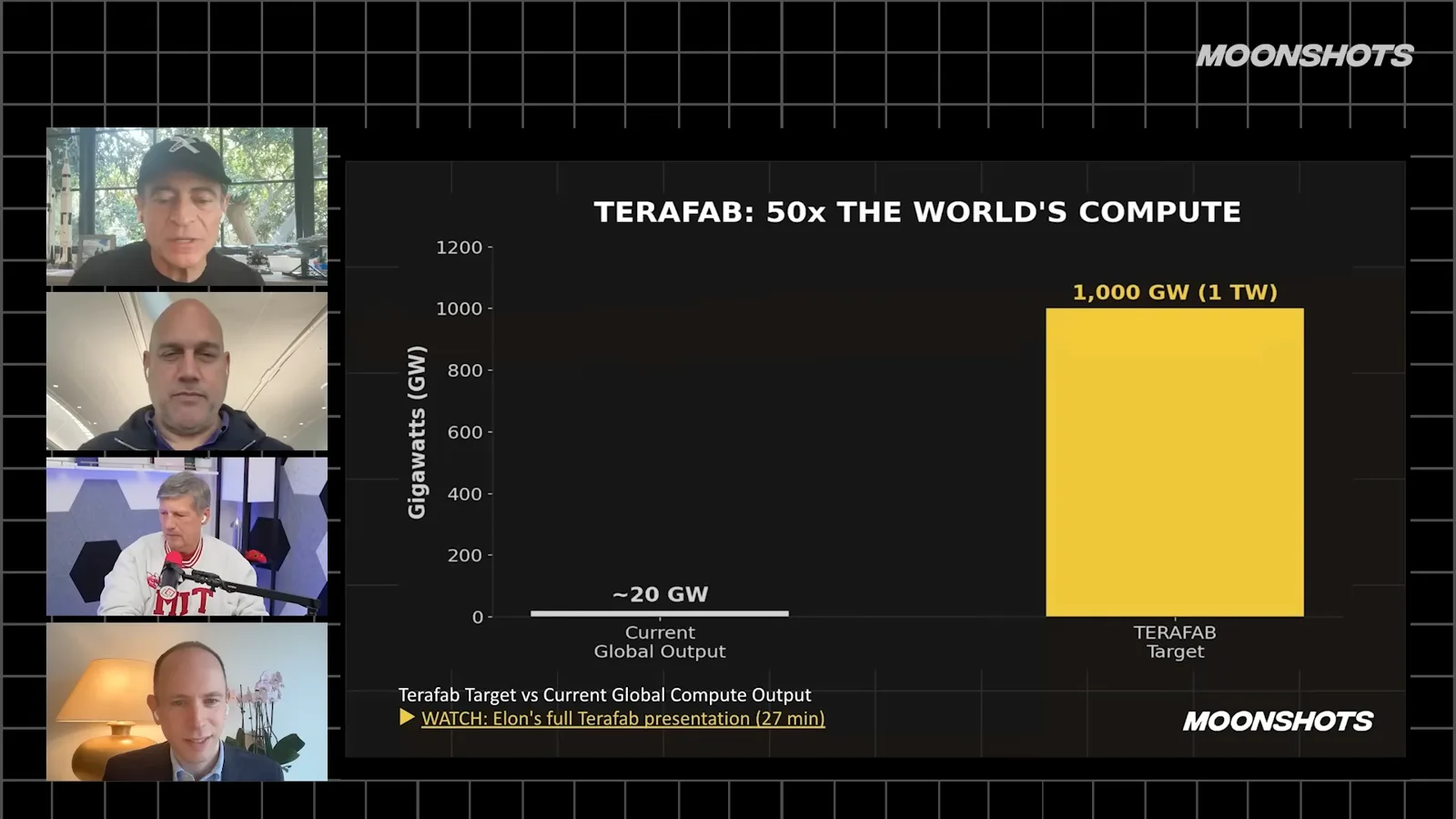
Blundin says the challenge is the supply chain: advanced fabrication equipment, including ASML’s lithography machines, is constrained and chipmaking depends on many suppliers. The group discusses how an in-house facility might coexist with large orders from Samsung rather than immediately replacing them.
Diamandis calculates that sending 10 million tons to orbit each year on Starship would require roughly 274 launches a day under his assumptions. Wissner-Gross considers geopolitical implications if capacity were actually built and speculates about much larger lunar manufacturing.
The hosts speculate about how Tesla, SpaceX and xAI might share costs and output, and about how such investment could affect their value. Ismail notes that Musk’s schedules often slip and questions whether the timing of the announcement could also help generate interest ahead of a potential offering.
Asked whether space computing would displace terrestrial data centers, Blundin expects demand to be high enough for both. He argues that countries would still need ground-based computing for resilience, while Wissner-Gross speculates that the manufacturing challenge could encourage alternative fabrication techniques.
The discussion turns to valuation. Diamandis presents calculations of possible savings from chips used in robots and vehicles, while the others suggest much higher values if the most ambitious capacity targets were reached. These estimates depend on a project and markets that did not yet exist at that scale.
The group also raises monopoly concerns. One speaker suggests competition and antitrust scrutiny would still be possible; Wissner-Gross argues it is premature to call a project monopolistic before it is built. They return to the broader idea that a production bottleneck can also be a business opportunity.
The transportation debate
The hosts differ on human driving bans and imagine effects of robotaxis and electric aircraft on cities.
Diamandis moves to transport and cites Waymo’s reported autonomous driving and crash data, plus investment in robotaxi fleets. He also describes Joby and Archer’s electric vertical-takeoff aircraft and expects air-taxi services to become more visible in coming years.
Ismail predicts restrictions on human driving could start in city centers and broaden. He sees shorter travel times as a way to make more land accessible. Blundin expects autonomous aircraft to advance quickly, while Diamandis notes that early aircraft are expected to have human pilots.
Blundin predicts that safety concerns will eventually push voters to restrict human driving, though he thinks chip supply could delay deployment. Wissner-Gross disagrees that driving will become illegal: he expects the meaning of driving to change as people direct increasingly capable assistance systems.
The hosts imagine competition among robotaxi providers and lower travel costs. Ismail predicts more intensive vehicle use could reduce the number of cars needed and change maintenance and service businesses; these are scenarios, not established effects.
Diamandis suggests households could repurpose garages if access to an autonomous ride became easy. Others discuss more distant homes, former parking lots and the possibility that travel costs would change real-estate demand.
Wissner-Gross imagines autonomous homes or offices that move to coordinate meetings and overnight travel. Diamandis discusses connecting electric aircraft to ground transport through local landing hubs, while the group considers hyperloop and point-to-point rocket travel.
Work, agents and token metrics
They debate automation, consulting business models and whether AI use can be assessed by token spending.
The next topic is work. The group cites estimates of tasks exposed to automation, reports of firms pushing AI adoption and a job posting for an AI agent. Ismail predicts companies could operate with far fewer people per firm, while hoping new firms would offset some job losses.
Wissner-Gross says established consultancies face difficulty changing from billing for hours to charging for outcomes. He interprets an agent job listing as a possible early example of work designed for software rather than for people.
Diamandis describes inviting entrepreneurs to challenge an established company’s business model and funding promising alternatives. The speakers also discuss private-equity owners using automation to reduce costs before reinvesting or acquiring new businesses.
Blundin says companies he controls are setting targets for AI spending relative to payroll. Diamandis asks whether token use is a good measure because tokens can be wasted; Wissner-Gross suggests evaluating the underlying work rather than relying only on a count.
The group discusses retaining prompt histories so AI systems can review work and help identify training needs. Blundin describes using a cloud service for this; the discussion treats the approach as their management proposal, not proof that token spending measures productivity.
Valuing companies when advantages change
The panel considers a proposed market repricing and disputes whether disruption implies a broad collapse.
The hosts examine an argument that AI could shorten the life of business advantages and therefore reduce the value assigned to future cash flows. Diamandis presents a scenario in which lower valuation multiples would substantially reduce the aggregate value of the S&P 500.
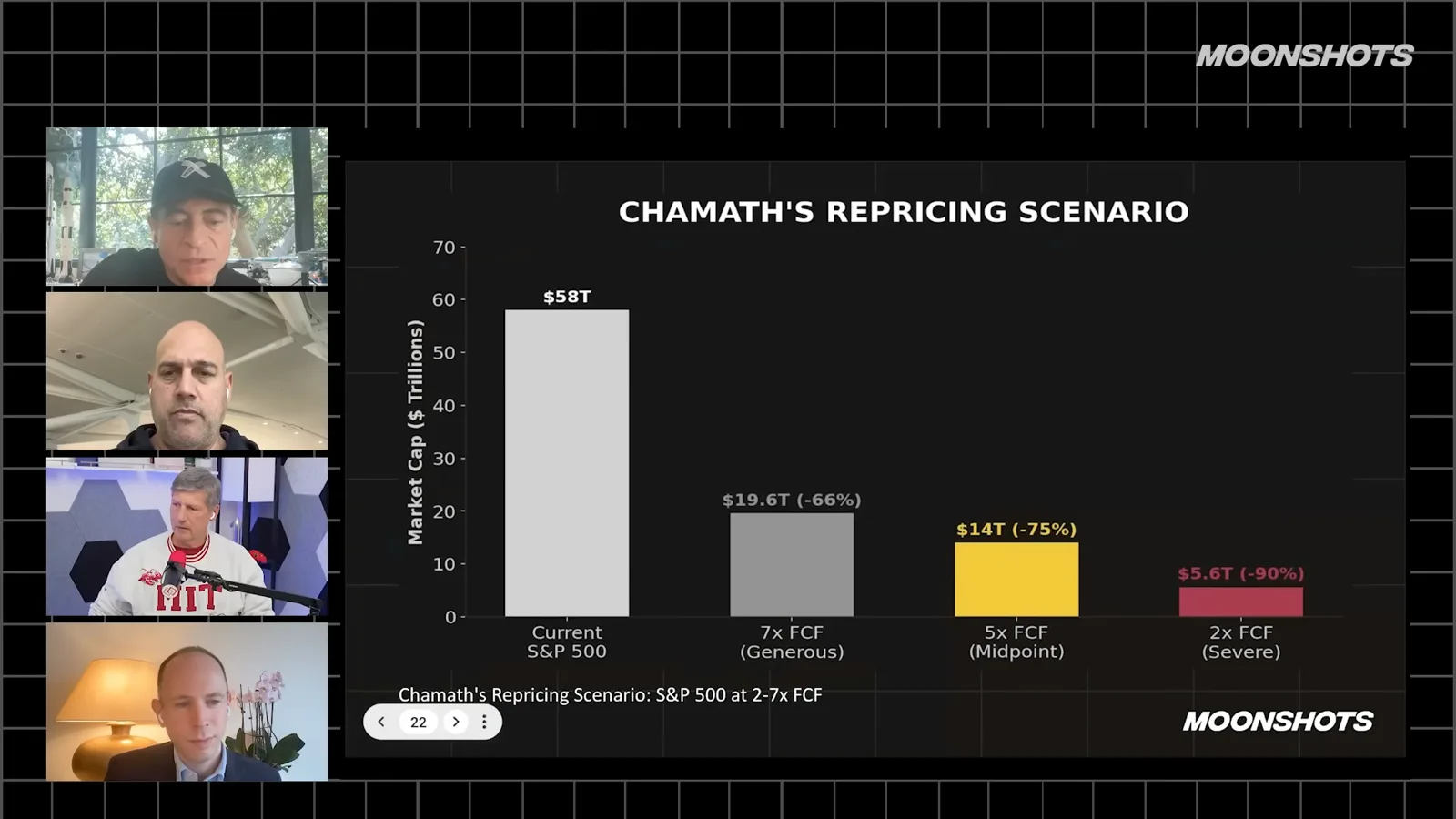
Blundin agrees that established companies can lose their advantages but rejects the conclusion that the whole market must collapse. He expects capital and growth to shift toward companies that adapt, and says investors should examine a management team’s capacity to change.
Wissner-Gross similarly argues that money can move from disrupted software firms to infrastructure or other uses. Ismail says organizational learning and adaptability may matter more than past scale, while predicting a shift toward agent-based work.
The panel imagines using AI to analyze companies, propose transformations and support activist investing. Diamandis says boards should give leaders room to change business models; the group treats these tools as a possible way to speed up such reviews.
The Moon and life’s ingredients
Artemis, reusable rockets and asteroid chemistry prompt speculation about space and possible life elsewhere.
Turning to space, Diamandis previews Artemis II, a crewed lunar flyby scheduled for April 2026, and compares NASA’s SLS with SpaceX’s Starship. He expects reusable rockets to change the economics, while the panel discusses China’s lunar ambitions.
The speakers discuss nucleobases found in samples from asteroid Ryugu and speculate about how life’s building blocks might travel through space. They distinguish this speculation from an actual discovery of life elsewhere, which the conversation does not report.
They consider whether hypothetical Martian life might share an origin with life on Earth, and what an independent origin on Europa would imply. The group also discusses impacts as a possible way to move material between planets, as well as their destructive effects.
Model competition and machines designing chips
The speakers explain model distillation, data advantages and a reported AI-assisted processor design.
The conversation shifts to AI models. Diamandis recounts that the anonymous Hunter Alpha was identified as an early Xiaomi MiMo-V2-Pro model, after speculation about its origin. The group sees smaller and cheaper models as part of an increasingly crowded market.
Wissner-Gross explains distillation as using a larger model to generate training data for a smaller, faster model. He says it is striking that useful capabilities can be retained across successive rounds, while imagining the possibility of powerful models running locally.
Blundin argues that proprietary data can remain an advantage even when models proliferate. Wissner-Gross questions whether model brand, researchers or user distribution will remain defensible and expects more value to move toward applications and higher-level tools.
The group discusses a reported AI-assisted RISC-V processor design completed in 12 hours. Wissner-Gross notes that standard tests make it easier to check candidate designs; Blundin predicts lower design costs could make specialized chips practical for more uses.
Research policy, data centers and preservation
They discuss science funding, local data-center opposition, chip exports and brain preservation.
The hosts discuss a US Department of Energy AI science initiative. Wissner-Gross welcomes public support for large research challenges, while Diamandis asks whether the investment is large enough compared with China’s ambitions.
A proposed Ohio restriction on large data centers prompts disagreement with the proposal. The hosts discuss community concerns about electricity and water, and argue for other ways to address them; their claims about local impacts are their own views.
The panel discusses US approval for sales of Nvidia H200 chips to China. They debate whether restrictions encouraged domestic alternatives and whether renewed sales would change China’s incentive to build its own chips.
On brain preservation, Wissner-Gross discusses work by Nectome, a company he says he informally advises, and compares it with another preservation approach. He encourages listeners to consider cryonics; preservation of tissue structure is not evidence that a person can be revived.
Questions on AI, robots and medicine
Audience questions cover where to run AI, robot shapes, negotiation, treatment access and investing.
In audience questions, Wissner-Gross compares local AI hardware, cloud computing and devices: local systems offer more direct control and privacy but require maintenance, while cloud services offer easier scaling and shared-resource trade-offs.
Asked whether humanoid robots are over-engineered, Blundin says many tasks could use specialized machines. He thinks humanoid designs attract capital and talent, which could also support the wider robotics supply chain.
Diamandis suggests using language models to prepare negotiations by articulating another party’s perspective. Wissner-Gross describes commercial negotiations in which parties consult models; both present this as a potential aid, not a guarantee of impartiality or agreement.
Asked when AI-discovered treatments might reach patients, Wissner-Gross predicts rapid progress but acknowledges that clinical approval can take years. His suggestion that future pressure might change the amount of clinical testing is a prediction, not an existing approval pathway.
Blundin talks about examining public fund holdings and looking for companies exposed to AI infrastructure, chip design and energy. He predicts pressure on wage income and stronger returns for some assets, then the hosts close the discussion.
After the closing music, Diamandis and his co-hosts thank listeners and sign off.
Mehr aus diesem Kanal
 24:05EN
 Peter H. Diamandis· 12. März 2026Podcast · 2 StimmenMusk Predicts a Tenfold Economy as AI and Robots ExpandGast: Elon Musk · Moderation: Peter DiamandisIn a March 2026 conversation, Elon Musk discusses AI self-improvement, Optimus production and a possible age of abundance.
 30:28ENPeter H. Diamandis· 25. März 2024Podcast · 2 StimmenMusk’s 2024 forecasts for AI, Neuralink and reusable StarshipGast: Elon Musk · Moderation: Peter H. DiamandisMusk weighs superintelligence risks against abundance and describes early Neuralink progress and goals for Starship reuse.
 1:17:00ENPeter H. Diamandis· 4. Jan. 2024Podcast · 2 StimmenMusk's case for abundant energy and truth-seeking AIGast: Elon Musk · Moderation: Peter H. DiamandisIn 2024, Musk argued that solar power and storage could support abundance, while advanced AI should be curious and seek truth.