In 30 Sekunden
Elon Musk predicts that the economy could be more than ten times its current size within a decade if present trends continue without a major war. Speaking with Peter Diamandis in March 2026, he says AI models already help build successors but the process is not fully automated. Musk also expects Optimus production to start slowly in summer 2026 and imagines AI and robots eventually producing enough goods to make money less important. These are forecasts, not established outcomes.
- 1AI-assisted model building is not fully automatedMusk says earlier models help build later ones, with people still involved, and predicts further automation.
- 2Musk predicts a tenfold economy in a decadeHis March 2026 forecast assumes current trends continue and a major war does not intervene.
- 3Optimus production was projected to start slowlyMusk expected initial production in summer 2026 and high volume about a year later; both were forward-looking targets.
- 4Musk expects AI output to put downward pressure on pricesHe argues goods and services could grow faster than the money supply and imagines a future where money matters less.
Das Wichtigste
- Musk’s ten-year, tenfold economic forecast assumes continued trends and no major war.
- He says AI-assisted model development is underway but not yet fully automated.
- His Optimus timetable called for slow initial production in summer 2026 and higher volume about a year later.
- Musk predicts AI and robots could increase supply faster than money grows, putting downward pressure on prices.
Den bearbeiteten Text nach Kapiteln lesen
Longevity and AI self-improvement
Musk discusses healthy lifespan, SpaceX and xAI, and the role current models play in building future ones.
Peter Diamandis asks Elon Musk about longevity. Musk says he is interested in extending healthy life rather than prolonging a period of severe frailty, though he is unsure about the desirability of everyone living forever.
Diamandis congratulates Musk on SpaceX’s acquisition of xAI and asks about a timeline for data centers in space. Musk declines to provide details, saying SpaceX is in a quiet period.
Asked about recursive AI improvement, Musk says successive models are already helping build later ones, with humans gradually less involved, but the process is not fully automated. In March 2026 he suggests full automation might arrive by the end of that year or the next.
Musk says AI progress already feels like a rapid takeoff. He describes Grok as strong on some prediction tests but behind competitors in coding, and says his team is working to catch up by the middle of 2026.
He imagines an AI economy using far more energy than today’s civilization and argues that the Sun’s output makes expansion into space significant. He predicts that much greater intelligence could eventually address problems such as longevity.
A tenfold economic forecast
He describes overlapping cycles of AI progress and predicts rapid economic growth and lunar infrastructure.
Musk expects AI and robots to increase economic output by orders of magnitude and predicts human intelligence will become a small share of the total. He connects that forecast to the possibility of collecting much more solar energy beyond Earth.
When Diamandis asks how far ahead anyone can predict, Musk describes technological progress as a series of overlapping S-curves: a breakthrough accelerates, then returns diminish until another breakthrough arrives.
Musk predicts the economy will be more than ten times its current size in about ten years if present trends continue and a major war does not intervene. He also expects a lunar base, people on Mars and possibly a lunar mass driver within that period.
Optimus and a high-income future
Musk gives production expectations, discusses Tesla’s workforce and argues that AI and robots could make goods abundant.
Diamandis asks when Optimus 3 might be sold or leased. Musk says the design is nearing completion and predicts production will begin slowly in summer 2026, with high-volume production around summer 2027. He says Tesla aims to improve the design annually.
Asked when robots will build robots, Musk says Tesla still employs many people in manufacturing. He estimates about 100,000 workers build products or manage that work and says the company plans to increase headcount while raising output per employee.
Diamandis asks how society might move toward what they call universal high income and raises the possibility of a difficult transition. Musk says outcomes are uncertain and people should not be complacent, although he assigns a high probability to a positive future.
Musk argues that AI and robots could produce goods and services faster than the money supply grows, leading to falling prices. He predicts a future in which the capacity to satisfy people’s wants makes money less relevant.
He compares that possibility with the abundance depicted in Iain M. Banks’s Culture novels and suggests advanced AI may be constrained more by energy and materials than human currency. These are his projections about a distant economy.
When Diamandis remarks on Musk’s wealth, Musk says the figure largely reflects ownership stakes in companies rather than cash sitting in a bank account. The interviewer then asks whether democratic institutions can keep up with technological change.
Institutions, health and a lighter ending
The conversation turns to uncertainty, medical hopes and a miniature mammoth.
Musk says it is difficult to know what happens through a technological singularity. He also predicts AI and robotics could help address fiscal problems, and says optimism should be paired with active work to make outcomes better rather than complacency.
He hopes advanced robotics and AI will improve medical care and mentions his own experience with repeated neck surgery and continuing back pain. He says solving back pain would be valuable, but does not present an established new treatment.
Diamandis mentions early research and a clinical program associated with David Sinclair, speculating that related work might eventually help with joint or back problems. ER-100’s initial human study concerns optic neuropathies; the conversation does not establish that it treats back pain.
The discussion ends lightly: Musk says he would like a miniature woolly mammoth as a pet and would visit a real-world version of Jurassic Park. Diamandis says he will pass the idea to Colossal’s Ben Lamm and thanks Musk.
Mehr aus diesem Kanal
 2:09:58EN
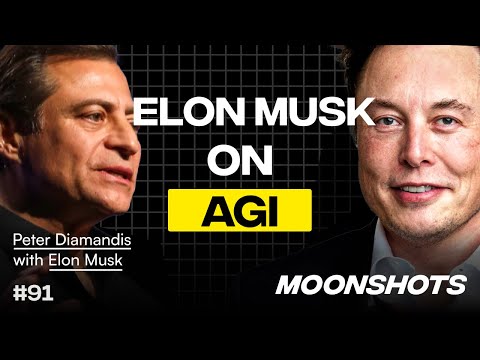
 Peter H. Diamandis· 26. März 2026Podcast · 4 StimmenThe Chip Bottleneck Behind Musk’s Terafab AmbitionModeration: Peter Diamandis, Dave Blundin, Alexander Wissner-Gross, Salim IsmailThe Moonshots panel debates chip supply, autonomous transport, AI job disruption and how quickly business advantages can disappear.
 30:28ENPeter H. Diamandis· 25. März 2024Podcast · 2 StimmenMusk’s 2024 forecasts for AI, Neuralink and reusable StarshipGast: Elon Musk · Moderation: Peter H. DiamandisMusk weighs superintelligence risks against abundance and describes early Neuralink progress and goals for Starship reuse.
 1:17:00ENPeter H. Diamandis· 4. Jan. 2024Podcast · 2 StimmenMusk's case for abundant energy and truth-seeking AIGast: Elon Musk · Moderation: Peter H. DiamandisIn 2024, Musk argued that solar power and storage could support abundance, while advanced AI should be curious and seek truth.