In 30 Sekunden
In August 2024, Matthew Berman reviews Google’s Gemini and Pixel announcements, contrasting event demonstrations with his own mixed experience. He covers Gemini Live, on-device processing, the Pixel Studio image generator and Add Me photo composition, while noting failures in a live calendar demonstration.
- 1A live demo with retriesA poster-and-calendar request failed twice before the presenter succeeded on another device.
- 2Gemini LiveGoogle demonstrated an interruptible voice conversation and a choice of voices; Berman planned his own testing.
- 3On-device Gemini NanoGoogle presented a multimodal model on Pixel 9 and claimed up to 45 tokens per second.
- 4Pixel StudioThe presentation showed a party invitation generated and edited with on-device and cloud components.
- 5Add MeA guided capture combines two photos so the photographer can appear in the group image.
Das Wichtigste
- Google demonstrated Gemini across apps, Android and smart-home contexts.
- Some sensitive tasks were described as on-device, while other requests used cloud services.
- The live poster-and-calendar demonstration failed twice before succeeding on another device.
- Pixel Studio combined on-device and cloud image-generation components in the presentation.
- Add Me combines separate captures into a composite group photo.
Den bearbeiteten Text nach Kapiteln lesen
Gemini and Google’s ecosystem
Berman discusses his model tests, app integration, smart-home examples and the appeal of on-device processing.
Matthew Berman reviews the AI announcements from Google’s August 2024 Made by Google event. He plays selected presentation clips and adds his reactions, focusing on Gemini integration, voice interaction and Pixel features.
Berman says his own tests of Gemini 1.5 Pro and an experimental version were disappointing, and recalls responses cutting off in AI Studio. Google cites a leaderboard result, but he places more weight on his own practical tests. His experience and the displayed benchmark are different kinds of evidence.
He argues that Google’s strength lies in its Android hardware ecosystem and widely used apps. He imagines an assistant able to carry out tasks across those services, while expressing enthusiasm for on-device models that could reduce latency and limit the data sent elsewhere.
Google describes Gemini features in Search, Docs, Gmail and Chrome. Berman has found email-thread summaries and Sheets formula suggestions useful, though he says he has not used the integrations extensively. He has also tried Gemini on Android and finds it useful but imperfect.
A home demonstration asks what disturbed a vegetable garden and retrieves relevant camera clips. Berman finds the capability impressive while noting its privacy implications. Google also presents Gemini Nano as a model for on-device experiences.
Google describes Gemini on Android and says some sensitive tasks can be handled on the device, while other complex requests use Google’s cloud. Berman favors local processing and predicts that smaller models will handle a large share of tasks, reserving cloud processing for harder cases; that share is his forecast.
Assistant actions and a live demo
He compares his own Android experience with a poster-and-calendar demonstration that needs several attempts.
Berman says his Android assistant sometimes refused to control lights even though the earlier Google Assistant could do so. He appreciates added language capabilities but sees the loss or unreliability of familiar actions as a practical drawback.
In a live demonstration, a presenter photographs a concert poster and asks Gemini to check the calendar for a conflict. The request fails twice; the presenter tries another device and eventually gets a result. Berman sees both the promise of combining vision and calendar information and the rough edges of a complex live workflow.
The presenter follows with a reminder and a shopping-list update. Berman says reminders had failed for him on previous occasions. He also notes the inconvenience of preferring an iPhone while keeping much of his data in Google’s applications.
Gemini Live and Pixel hardware
Google demonstrates voice conversation and describes Gemini Nano on Pixel 9.
Google introduces Gemini Live as a voice conversation mode that can be interrupted or redirected. Berman compares the launch with OpenAI’s voice demonstrations and asks whether differences in release timing reflect differences in testing; he offers no evidence establishing that.
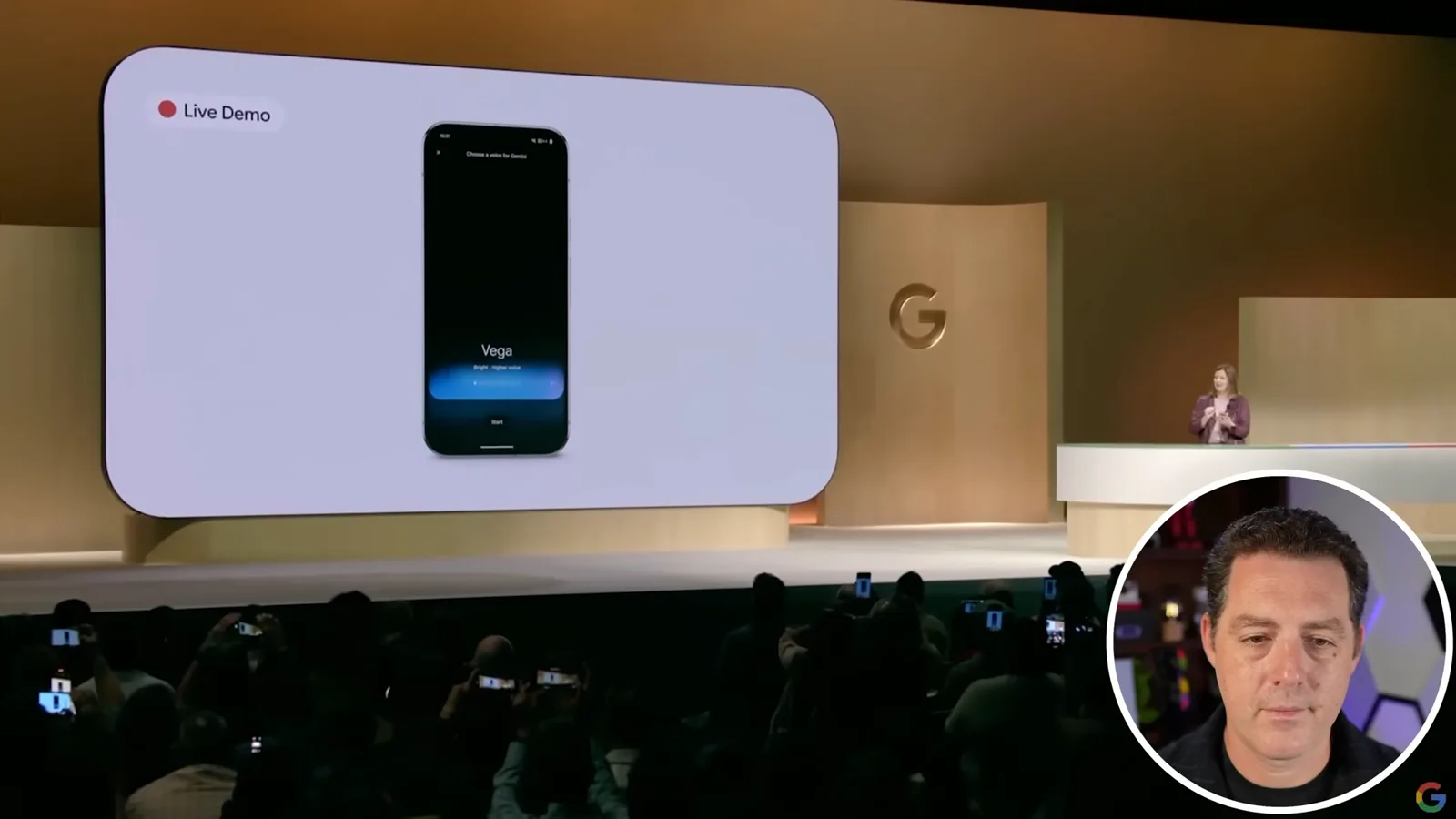
The event shows a choice of voices and a conversation about educational activities for children. Berman likes the response latency but finds the demonstrated voices less natural than the GPT-4o voice demo. That is his impression of a presentation, not a controlled comparison.
Berman says Gemini Live launched at the event and plans to test it himself. The event then turns to Pixel 9 and Google’s Tensor G4 chip, designed with on-device AI in mind.
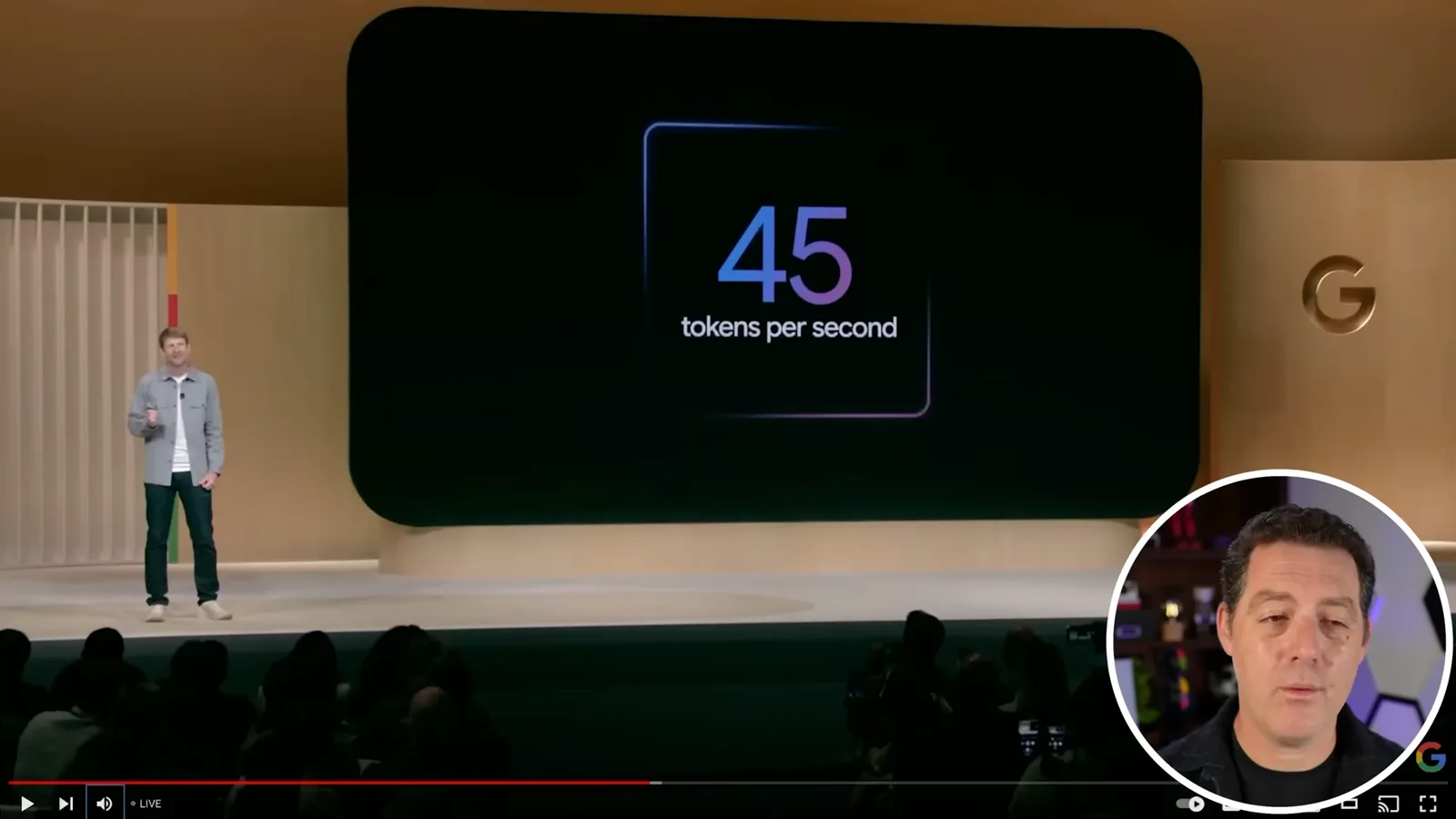
Google says Pixel 9 runs multimodal Gemini Nano and presents a claimed output rate of up to 45 tokens per second. Berman welcomes the hardware and local model but wants to test real-world performance before drawing conclusions.
Pixel applications and composite photos
The presentation shows weather summaries, Pixel Studio and Add Me, prompting Berman’s reflections on usefulness and photographic reality.
A Pixel weather demonstration produces a natural-language report. Berman questions whether a paragraph is more useful than a visual weather interface for this particular task. Google also mentions spam-call features that he notes were not entirely new.
Pixel Studio is demonstrated as an image generator using an on-device diffusion model together with Google’s Imagen 3 in the cloud. The presenter creates a beach-party invitation, adds the Golden Gate Bridge and fireworks, and changes the visual style. Berman likes the speed and flexibility shown.
The event also shows Add Me: one person takes a group photo, then switches places with the photographer, and the phone combines the captures. An augmented-reality overlay helps align the second shot. Berman finds it useful and reflects on how composite images complicate the idea of a photograph as a record of one moment.
Berman concludes that the event included useful but, in his view, not revolutionary announcements. He is excited to see language models reach phones and plans further testing of Gemini and Apple Intelligence. His judgments and availability references reflect August 2024.
Mehr aus diesem Kanal
 14:45EN
 Matthew Berman· 29. Okt. 2026Matthew Berman Examines Google’s Gemini 4 Carbon AnnouncementMatthew Berman · Forward FutureMatthew Berman reviews Google’s reported benchmark results, staged rollout and pricing for Gemini 4 Carbon, while noting he has not yet used the model.
 21:11ENMatthew Berman· 28. Okt. 2026Matthew Berman tests DeepSeek V4.1 Flash: coding, vision and local appsMatthew Berman · Forward FutureA hands-on tour of visual coding, image reasoning, local applications and provider economics reveals both impressive results and visible flaws.
 34:21ENMatthew Berman· 27. Okt. 2026Matthew Berman Examines Anthropic’s IPO Filing, AI Growth and GovernanceMatthew Berman, Sam Altman · Forward FutureThe presenter reviews the S-1’s financial metrics, compute strategy and voting structure while questioning the tension between rapid AI development and safety.
 0:26ENMatthew Berman· 25. Okt. 2026Sam Altman on Human Values and Problem-Solving in an AI WorldSam Altman · OpenAIIn a short interview excerpt, Altman considers the enjoyment of solving hard problems and the human role in interpreting results.
 0:36ENMatthew Berman· 25. Okt. 2026Kimi K3.1 and a Rubik’s Cube Solver DemonstrationMatthew Berman · Forward FutureMatthew Berman shows a scrambled virtual cube being solved and gives the Kimi K3.1 test a favorable assessment.
 0:21ENMatthew Berman· 24. Okt. 2026An AI-Generated Kimi Benchmark Chart Used Invented ScoresMatthew Berman · Forward FutureMatthew Berman asks for a graph of Kimi K3.1 Pro benchmarks, then discovers that the displayed figures are illustrative placeholders.