In 30 Sekunden
Theo - t3.gg discusses OpenAI’s proposed termination of its Cursor partnership after the SpaceX acquisition. He separates the companies’ statements from his own interpretation of the motives, critiques their public dispute, and considers how users might combine direct subscriptions with a shared interface.
- 1A proposed end to direct accessOpenAI announced a proposed November 12, 2026 end to Cursor’s direct access after its acquisition by SpaceX.
- 2Astra and the contractOpenAI cited its upcoming model and a change-of-control cancellation window. Theo interprets the implications but does not have the private contract.
- 3Other access routesOpenAI described using a personal API key or its IDE extension as routes that should remain available.
- 4The uncertain 5%Cursor’s reported traffic share did not specify the underlying measure, so it cannot be converted into user share with confidence.
- 5One interface, multiple providersTheo discusses open-source agent interfaces while distinguishing them from a single subsidized subscription.
Das Wichtigste
- OpenAI proposed ending Cursor’s direct access to its models on November 12, 2026, after the acquisition by SpaceX.
- OpenAI said users could continue using their own API key or its IDE extension in Cursor, subject to the applicable terms.
- The stated 5% of Cursor traffic is hard to interpret without knowing how traffic was measured.
- Token efficiency varies by model and benchmark, so token share cannot directly establish user share or value.
- Theo’s explanation of Astra and distillation as motivations is an inference rather than a confirmed sole cause.
- A unified interface can coexist with separate subscriptions or API arrangements.
Den bearbeiteten Text nach Kapiteln lesen
The announced split
OpenAI proposed ending direct model access after Cursor’s acquisition. Theo discloses his relationships with the companies.
OpenAI says it is ending its partnership with Cursor following Cursor’s acquisition by SpaceX, with direct model access proposed to end on November 12, 2026. I like both companies, so the news is frustrating. I have spoken with people at both and want to explain what was announced, what remains uncertain, and what users can do.
I will also discuss the public disagreement between people at the companies and the difficulty of using several providers through one product. There are alternatives, although a single interface and a single subscription are different things.
SpaceX acquired Cursor after an earlier proposed partnership. I was an early Cursor investor, and I may make money from the acquisition; I intend to sell my equity when I can. I have no financial stake in OpenAI, though I pay for its products. Those relationships are useful context for my views.
Contracts, competition and data
Theo reviews OpenAI’s stated rationale and relevant industry history. His explanation of the companies’ incentives is an interpretation.
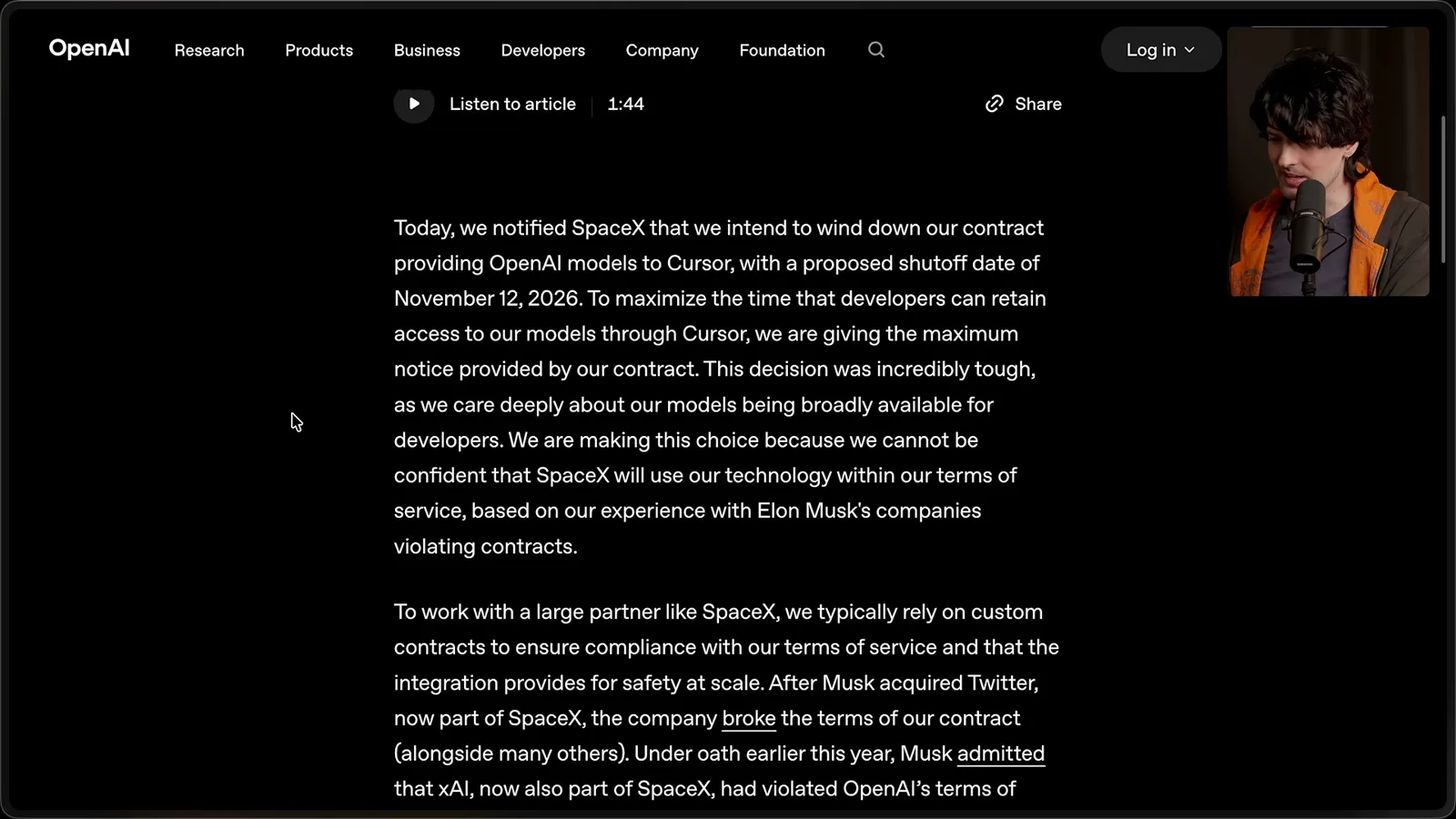
OpenAI’s statement says it notified SpaceX of its intention to wind down the contract, proposing November 12 and giving the maximum contractual notice. OpenAI says it cannot be confident SpaceX will use its technology within its terms, citing previous experiences with Musk’s companies.
My reading is that the change-of-control provision gave OpenAI a limited window to act. Deals between model providers and large customers can have negotiated terms, so outsiders should be cautious about assuming they know the contract or its economics.
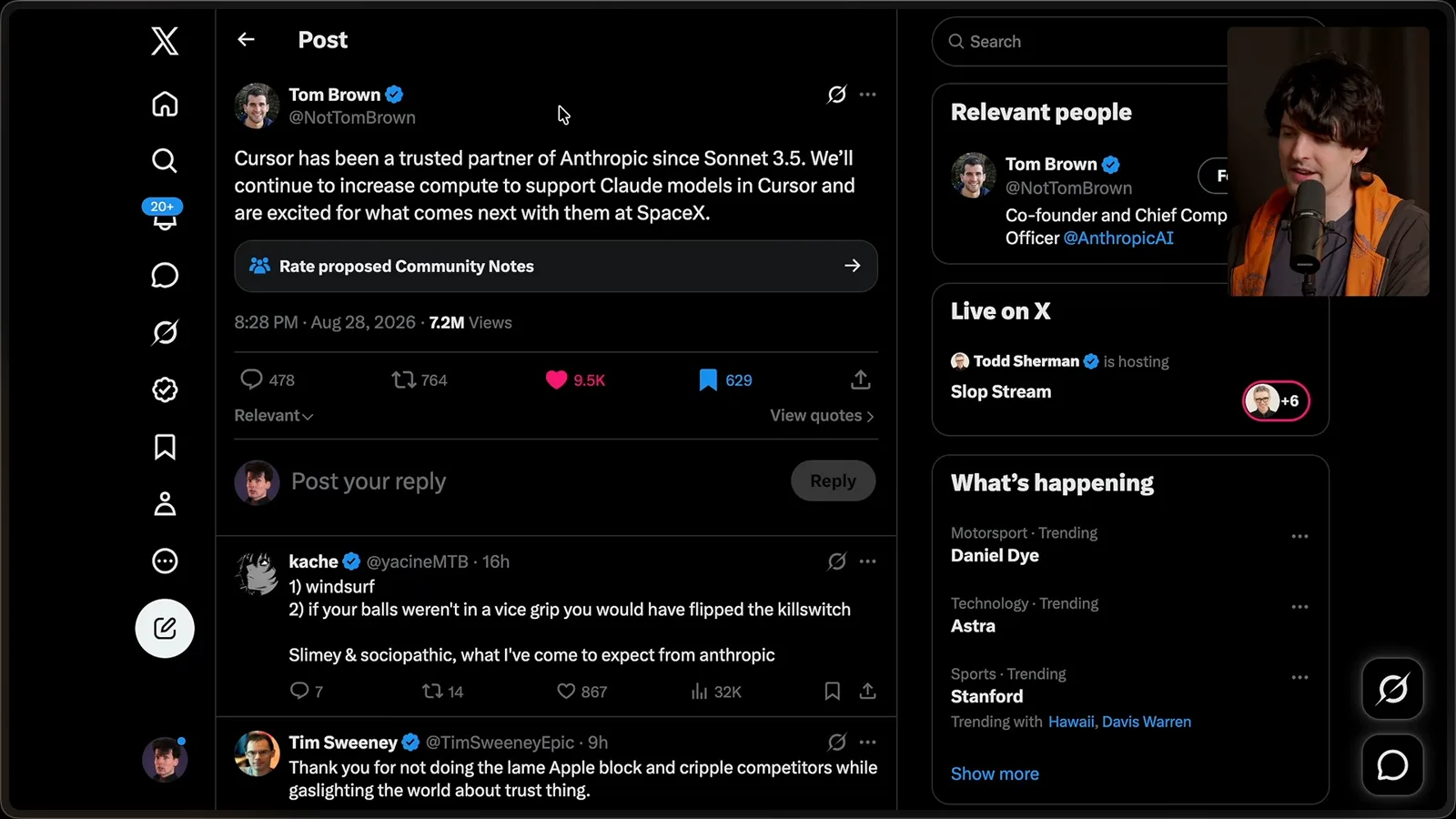
Anthropic’s compute chief, by contrast, publicly said the company would continue increasing capacity for Claude in Cursor. I see that statement alongside Anthropic’s reliance on SpaceX for compute and its separate changes to Claude Code limits; my explanation of the companies’ motives is an interpretation.
Ending this relationship may also cost OpenAI significant revenue. I can only guess at Cursor’s negotiated inference rates and the relative subsidies in individual subscriptions. Those estimates are not disclosed contract terms.
OpenAI points to trust and compliance with its terms. I think a major concern is whether a competitor could use model outputs as training data, often called distillation. That is my reading of the dispute, not proof of what Cursor or SpaceX did with any particular user’s data.
There is a history of model companies restricting competitors’ access. I cite Anthropic’s past restrictions involving Windsurf, xAI and OpenAI as examples, while noting that the circumstances of each case differ. These precedents help explain the industry context, not the private facts of this agreement.
OpenAI’s statement cites earlier contractual disputes and says Musk acknowledged xAI had violated OpenAI’s terms. I take a different view of distillation: I think paying to use models to generate data should be reasonable. That is a policy opinion, not a conclusion about the legal rights or obligations in this case.
Astra and the partnership history
The announcement mentions future models and a change-of-control clause. Theo recalls Cursor’s earlier role in OpenAI’s coding work.
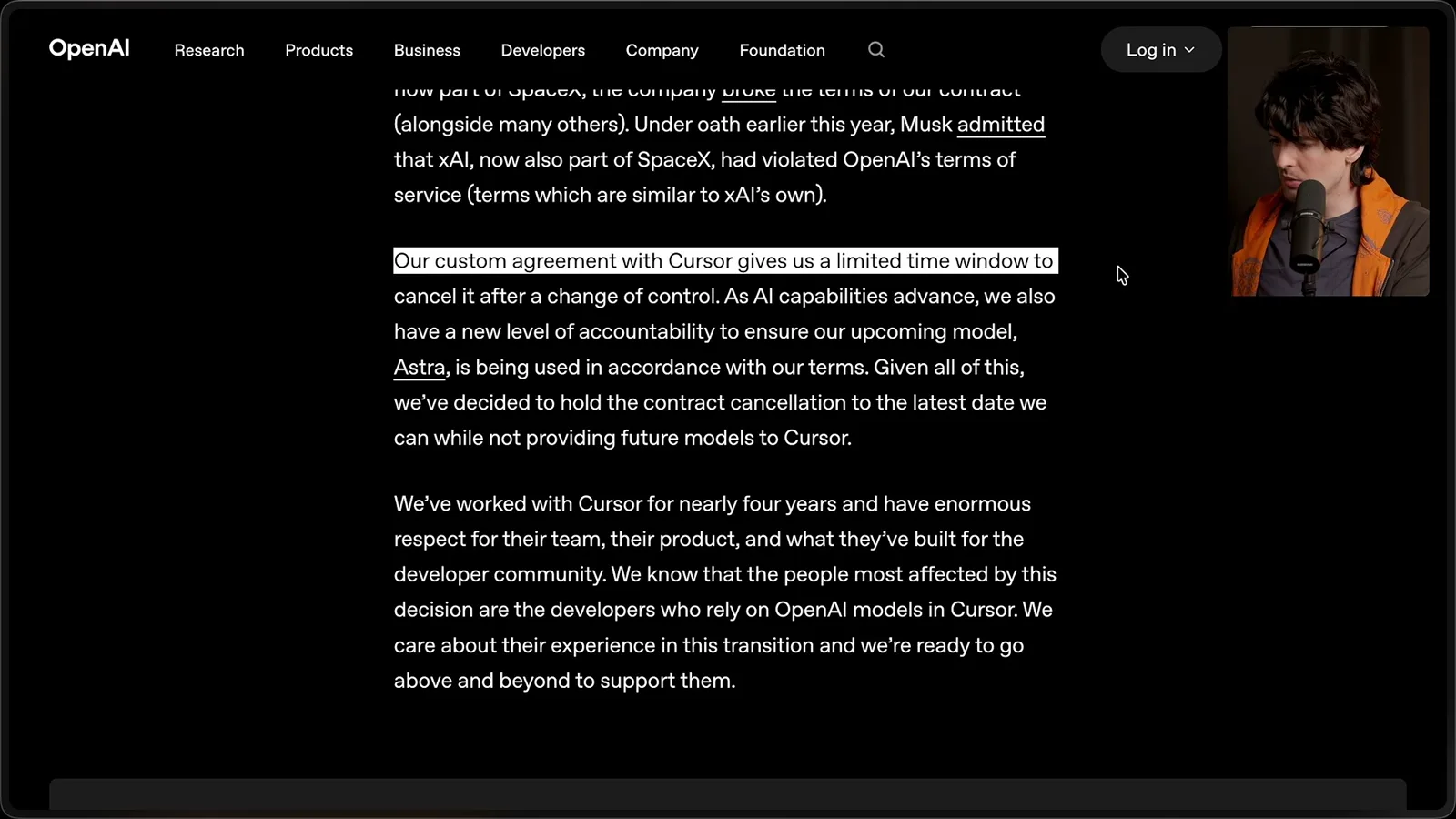
The detail I think people missed is OpenAI’s reference to its upcoming Astra model. The statement says its agreement allowed cancellation after a change of control and that it would not provide future models to Cursor. I infer that protecting access to Astra matters to this decision; OpenAI does not say distillation was the sole cause.
A popular coding product can generate large amounts of useful interaction data as customers use models. I think that possibility gives Cursor and its new owner a potential advantage. What data is actually retained or usable depends on the relevant settings, agreements and facts; my description is not an audit of those practices.
Cursor has also been important to OpenAI’s history in coding. When I visited OpenAI for early GPT-5 access, the instructions I received explained how to use it in Cursor. It is strange to see a long partnership end as the companies also compete more directly.
Access options and public responses
OpenAI described alternative access routes. Theo criticizes how the companies’ representatives framed the dispute.
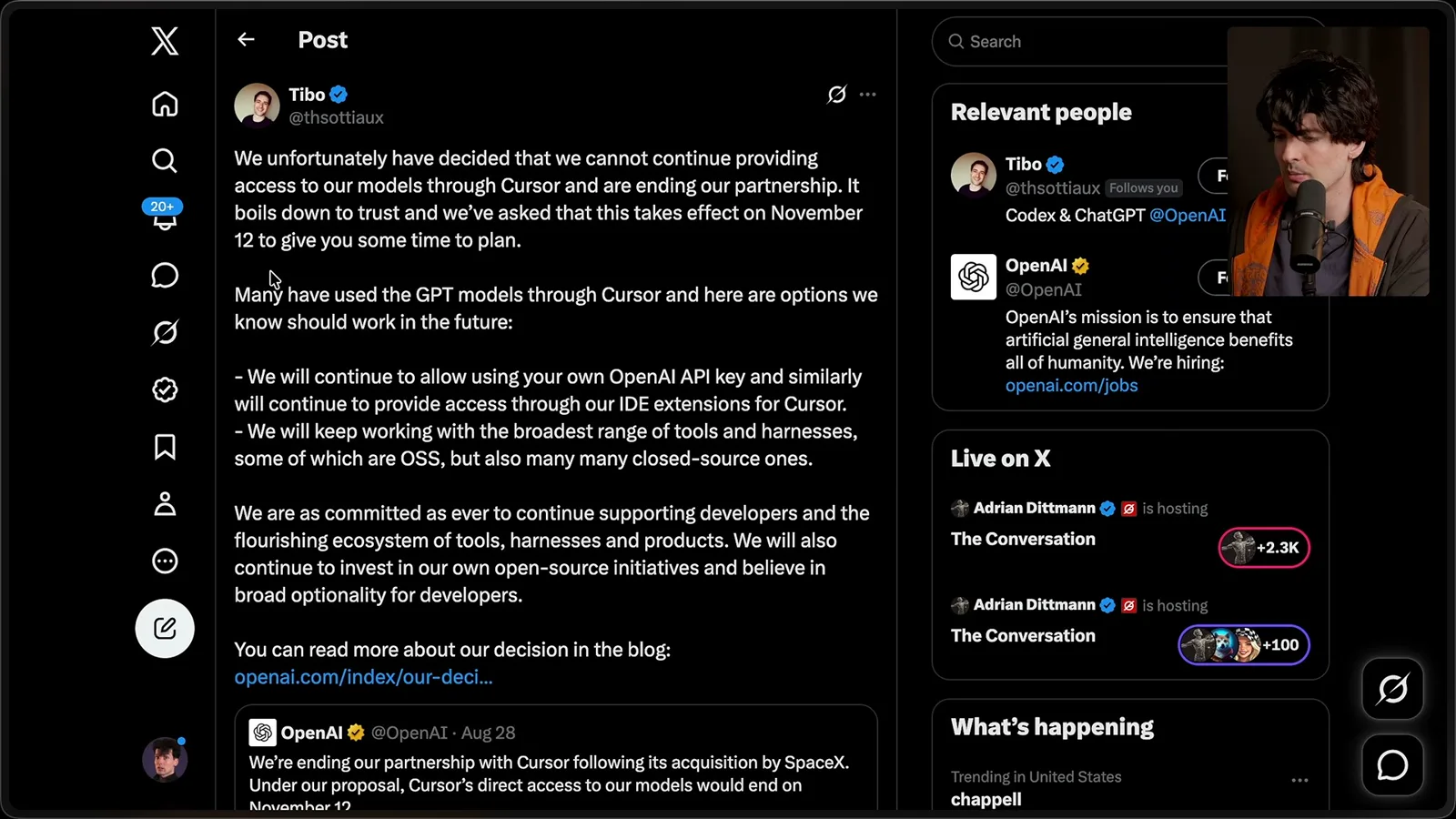
OpenAI’s Tibo said users should still be able to use their own OpenAI API key and access OpenAI’s IDE extension in Cursor. Those are separate routes from the direct access included through Cursor’s partnership, and availability and terms can change.
An OpenAI contact also told us that the change would not affect T3 Code and that OpenAI intended to keep supporting projects like ours. I am involved with T3 Code, so that is a report of what I was told, not an independent guarantee of future support.
I know and respect Cursor’s Michael Truell and have helped the team for years, but I think his response was unnecessarily combative. Saying that Cursor users would be blocked from OpenAI models can obscure the fact that OpenAI described other routes, such as a user’s own API key.
What does 5% of traffic mean?
A traffic figure is hard to interpret without its denominator. Theo compares token usage in two benchmark displays.
Michael also said OpenAI models served about 5% of Cursor user traffic. The post did not explain whether that means users, requests, tokens or something else. Without that denominator, it is hard to tell how many people or workflows would be affected.
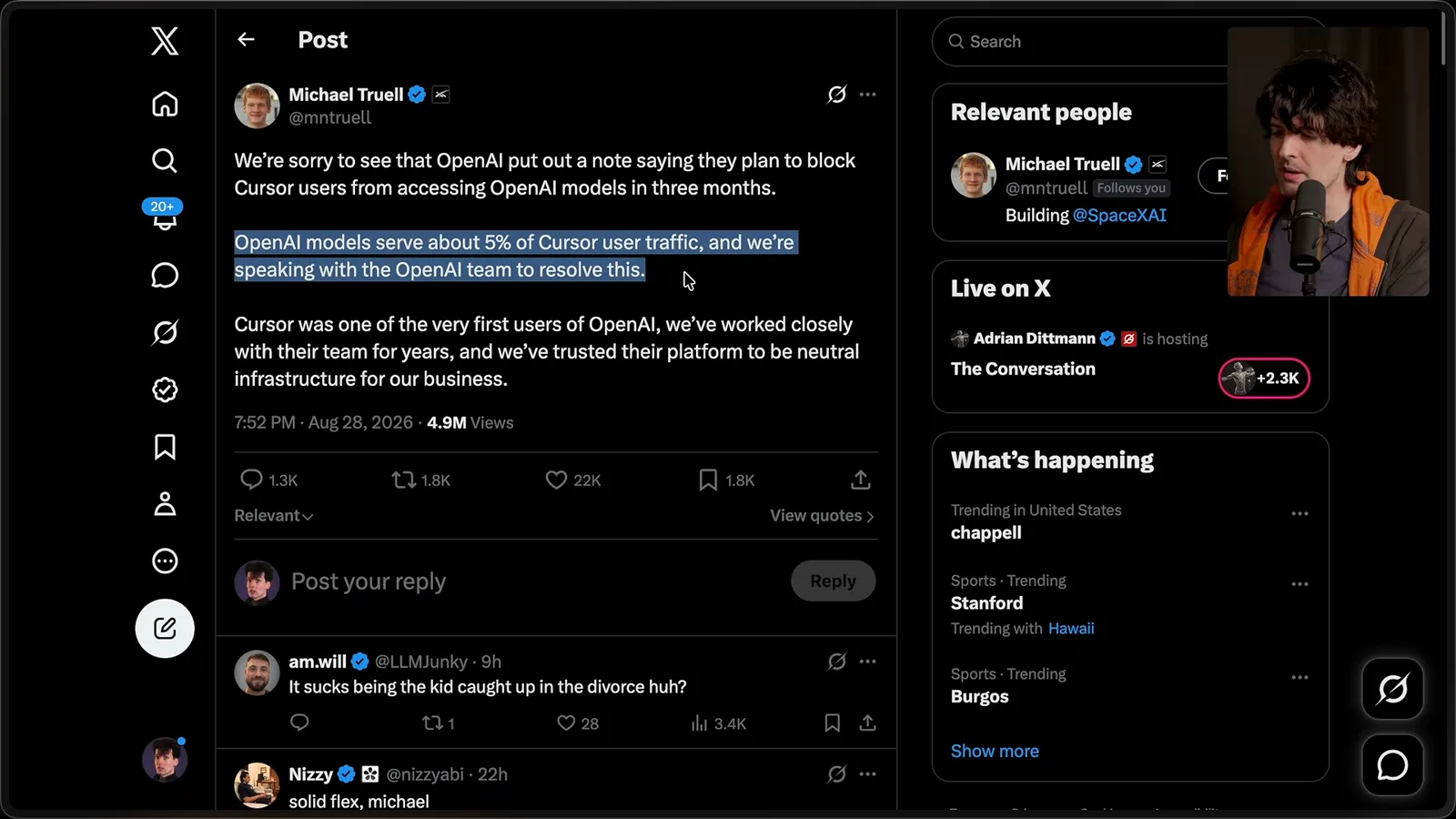
Token use matters because different models can consume different amounts while solving a task. If traffic is measured in tokens, a more efficient model could look smaller by that measure than it would by requests or users. But we cannot convert the 5% into a reliable user share without knowing the underlying data.
I still prefer Fable 5 for writing and landing code, despite the strong performance of GPT-5.6 Sol. The Artificial Analysis results I show compare scores, cost per task and output token use. Benchmark results depend on the tasks and settings, and do not settle which model is best for everyone.
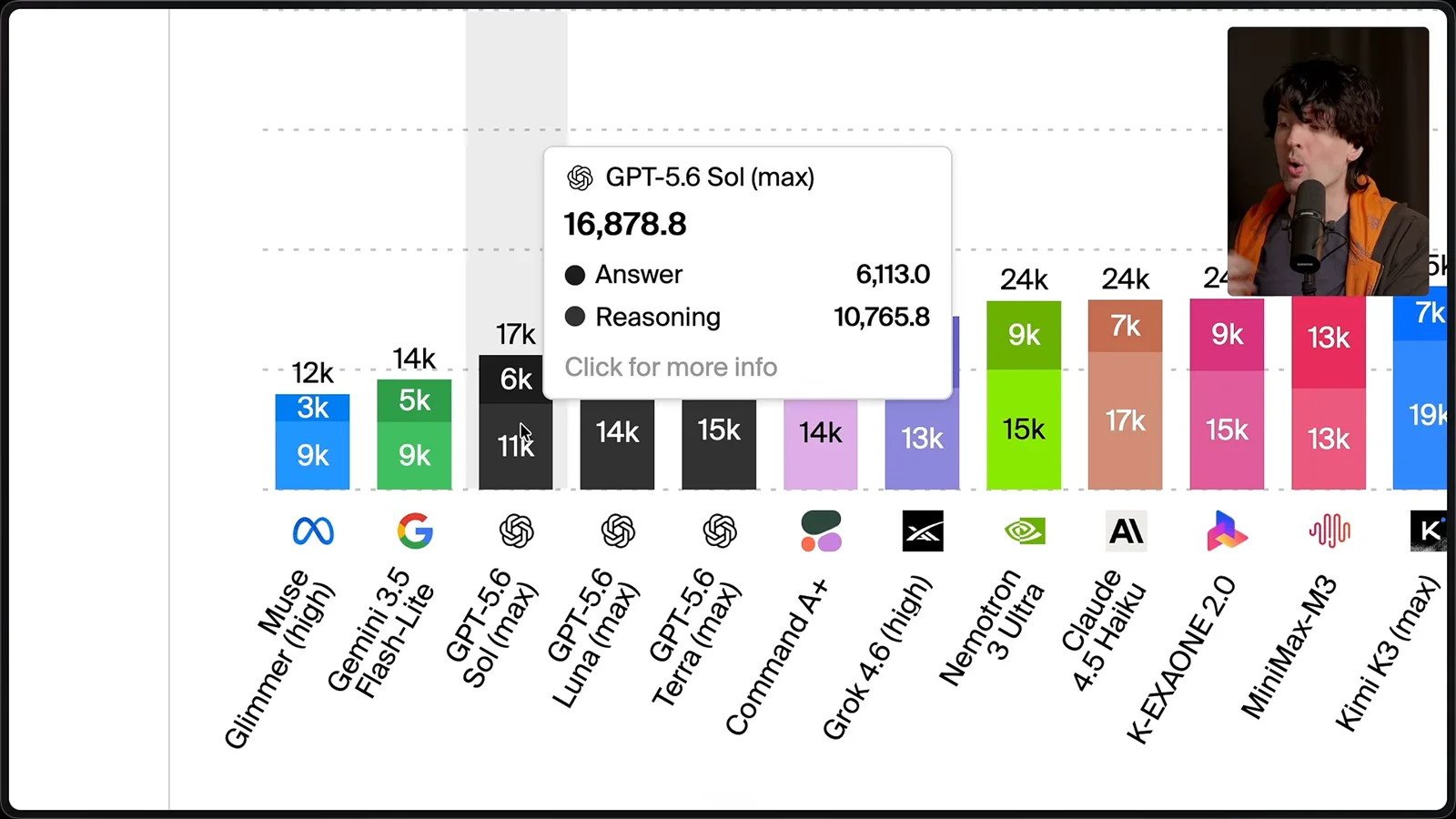
In the displayed Artificial Analysis test, I point to roughly 17,000 output tokens per task for Sol and 36,000 for Fable. That difference helps illustrate why token counts and completed work are not interchangeable measures.
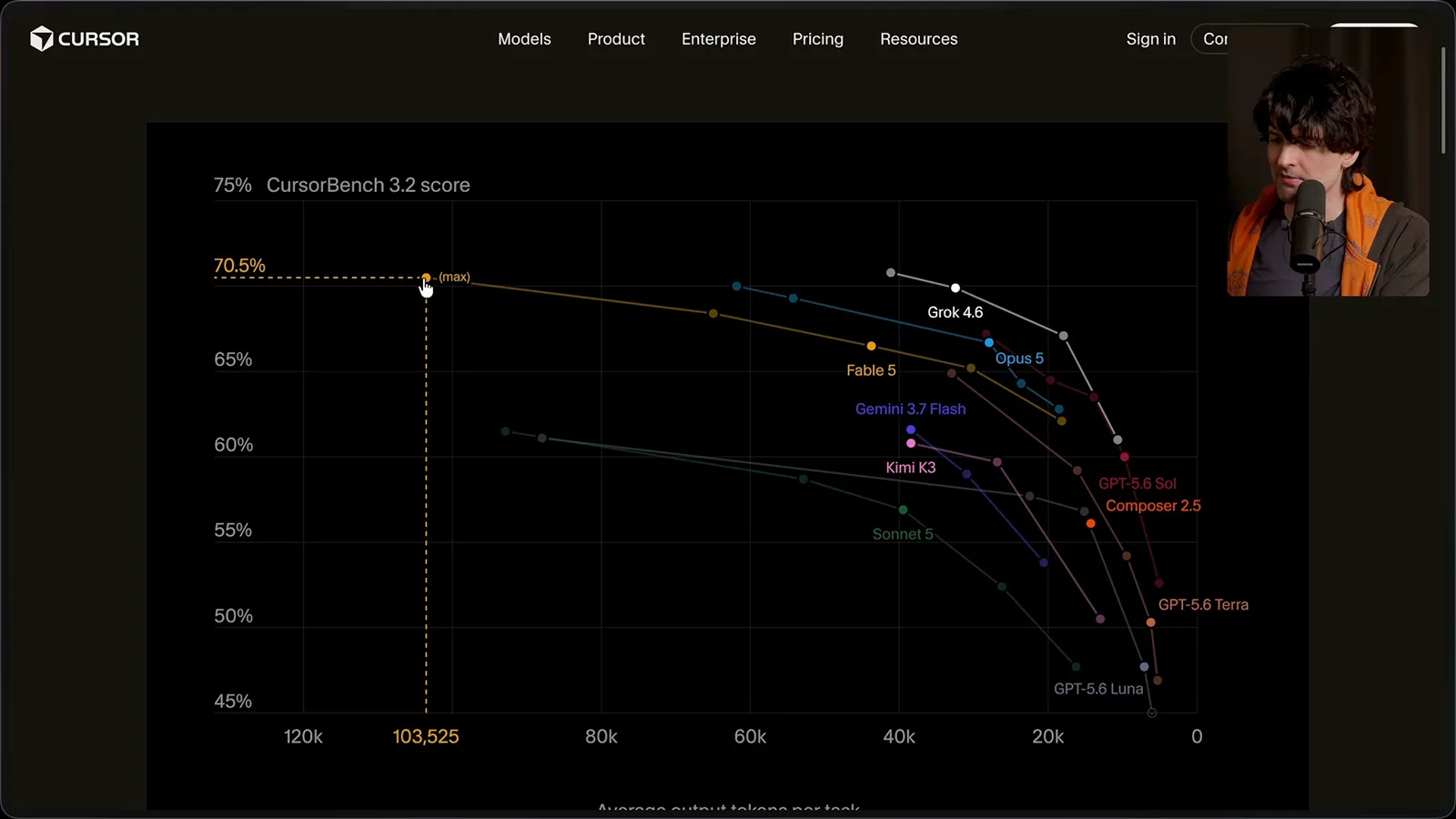
Cursor’s own benchmark shows Fable 5 at 70.5% with roughly 103,000 output tokens per task at the displayed setting; I compare it with Sol at about 67.2% and 28,000 tokens. These are examples from a particular benchmark and configuration, not a universal conversion factor for traffic.
Tibo also challenged the 5% figure, arguing that tokens are not a proxy for revenue or value. I agree that the metric needs context, but I do not think senior people at either company need to turn this into a personal fight. Customers are the ones whose workflows are affected.
Subscriptions and alternatives
Theo considers the economics of direct plans and all-in-one products. He points to interfaces that can bring different tools together.
What should users do? A single subscription for every frontier model is difficult when model providers subsidize their own plans more heavily than intermediaries can. We have run into that problem with T3 Chat; my figures for provider margins are estimates rather than verified financial disclosures.
Cursor could offer several models in one place, and I believe the value of data was part of the business equation. Grok can handle many real coding tasks, but in my experience Fable and Sol require less hands-on orchestration for the work I do. Others may find a different tradeoff.
For heavy use of the models I prefer, I currently find direct provider subscriptions compelling. My own spending and estimated inference value are unusually high and should not be read as a typical user’s savings or a guaranteed return on a plan.
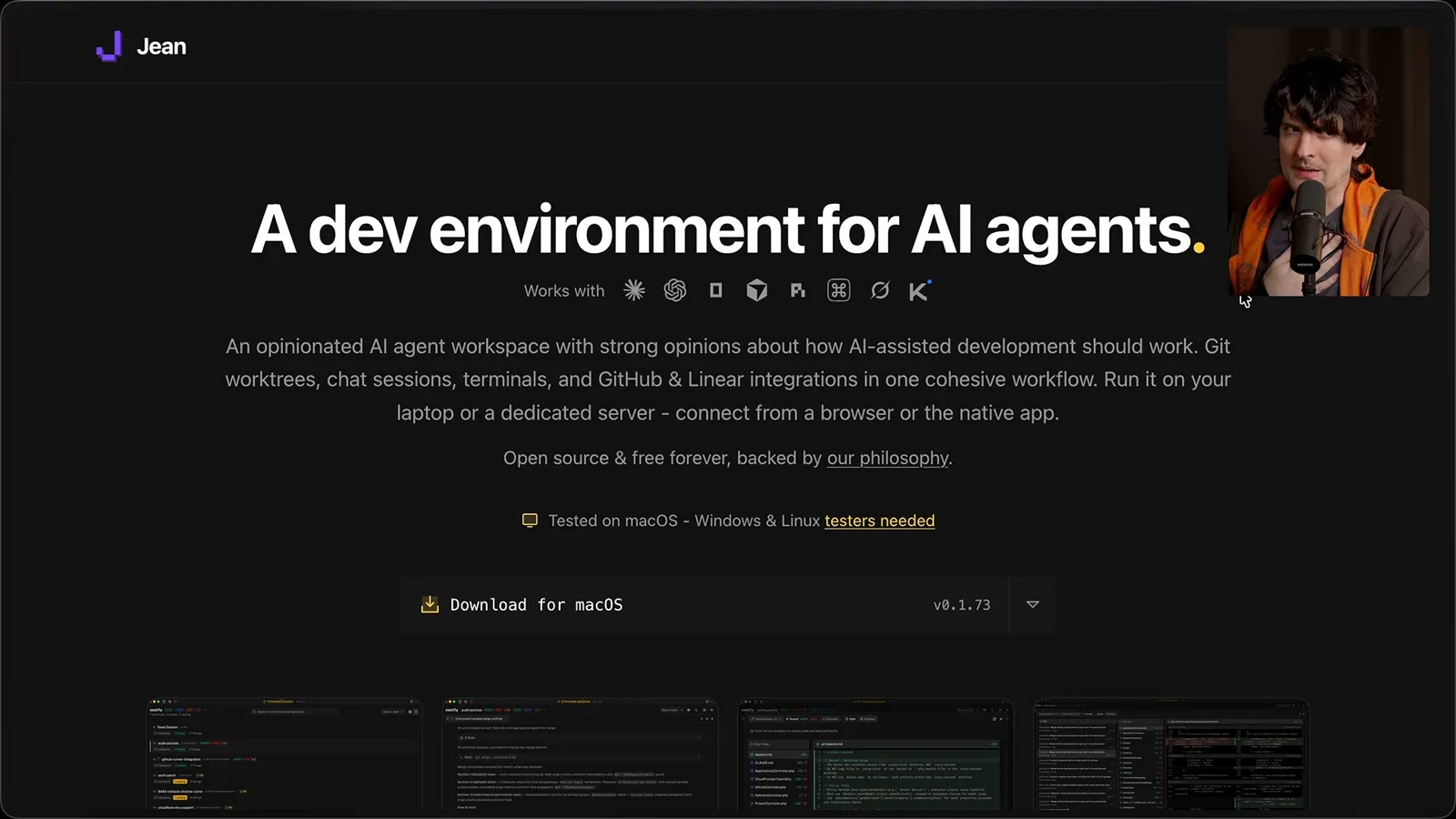
One interface is still possible even if one subscription is not. Alongside my own open-source T3 Code, I mention Jean, Superset and Herder as projects that offer different ways to manage coding agents. Check each product’s current integrations and the provider’s terms before relying on a setup.
Cursor was attractive because it combined a capable harness, cloud features and access to several models. Losing a direct provider relationship makes that convenience harder to sustain. I want users to retain control over their tools and avoid depending on a single intermediary for every model.
I suspect similar restrictions will recur across the industry, though that is a prediction. I am also frustrated with Google’s restrictions around subscription integrations and with its tooling. Those are my views of the situation at the time, not a guarantee about current product policies.
This is a bad moment for people who rely on Cursor as a single place to use different models. Under the announced proposal, direct access to existing OpenAI models would end in November, and future models would not be supplied through that partnership. OpenAI also described alternative access routes, so the effect depends on how each user connects.
Mehr aus diesem Kanal
 36:07EN
 Theo - t3․gg· 27. Okt. 2026Theo on Token Costs, Coding Agents, and the Price of AI CapabilityTheo Browne · Ping LabsA viral estimate of Lauren's AI spending prompts a closer look at cache pricing, benchmarks, and the changing work of coding agents.
 30:37ENTheo - t3․gg· 26. Okt. 2026Theo’s Three Skills for Reviewing and Shipping with Coding AgentsTheo Browne · Ping LabsHow sol-loop, full-send and full-stop encode review, verification and different levels of merge authority.
 0:43ENTheo - t3․gg· 23. Okt. 2026Theo Distinguishes Security Vulnerabilities from Active AttacksTheo Browne · Ping LabsA short explanation of why disclosed software flaws and reported attacks are different kinds of security news.
 29:22ENTheo - t3․gg· 22. Okt. 2026Theo on Security Vulnerabilities, Stolen API Keys and AITheo Browne · Ping LabsA look at the gap between vulnerability disclosure and patching, and a speculative account of why stolen inference keys may be valuable.
 31:13ENTheo - t3․gg· 20. Okt. 2026Theo on Why Smarter Models Help More Than DevelopersTheo Browne · Ping LabsFrom game modifications to compiler experiments, Theo revisits his assumptions about who benefits from more capable AI.
 31:47ENTheo - t3․gg· 18. Okt. 2026Theo on Asking Agents for Outcomes and Building the Tools They NeedTheo Browne · Ping LabsA tool-call report, a troubleshooting playbook and connected data show how prompting can reshape product engineering.