In 30 Sekunden
Tim Tyler argues that enterprises need more than software protocols to govern autonomous agents. He presents an accountability framework in three stages—assignment, alignment and administration—covering unique identity, named human sponsors, constrained authority, continuous oversight and graduated recourse.
- 1Identity and ownershipA unique registry identity and a named human sponsor make an agent visible and accountable.
- 2Role versus missionThe sponsor sets the relatively stable role; the agent’s immediate mission can vary at runtime.
- 3Bound delegated accessPermissions should not grow along a chain of agents; shared results are constrained by the relevant scopes.
- 4Oversight as a scorecardRule compliance and task success are distinct and require different measures.
- 5Graduated recourseCorrection, restriction, escalation and suspension can be applied according to the situation.
Das Wichtigste
- Give every agent a unique identity in a shared registry and a named human sponsor.
- Define a stable role, current mission, budget and measurable success separately.
- Constrain access across delegated chains to the applicable scope of each participant.
- Monitor both adherence to rules and achievement of intended outcomes.
- Use graduated, confidence-aware recourse and adjust controls as evidence accumulates.
Den bearbeiteten Text nach Kapiteln lesen
The digital workforce problem
Tyler uses an implausible job posting to expose gaps in agent governance. He introduces a three-stage framework.
I am Tim Tyler from Gravitee. Imagine a job posting with no identity check, no manager, an obscure job description and shared passwords for key systems. The worker operates around the clock without supervision or consequences for mistakes. Few organizations would knowingly hire a person on those terms.
Yet many organizations are already deploying AI agents as a new digital workforce. Software protocols and standards remain necessary, but I suggest borrowing ideas from how enterprises assign, supervise and hold human workers accountable. We call this approach agent accountability.
A head of AI once told me that the CTO saw an agent as something other than a normal software application, while HR saw it as software. That gap suggests we need a different perspective. The framework has three stages: assignment, alignment and administration, with controls that can be audited.
Assignment: identity, team and sponsor
Each agent gets a registry identity, team context and an accountable human sponsor. Clear handoffs maintain that accountability.
Assignment establishes an agent’s presence in the organization. Start with identity: give each agent a unique ID in a known, shared registry. That identity becomes the point to which the rest of the framework can refer, much like an employee’s identification in a company system.
An agent is also part of a team, even if the team consists of one person and one agent. It needs context about goals, decisions and history, and should return context about what it is doing and learning. Treat it as a teammate rather than assuming an agent acting on your behalf is simply your digital clone.
Every agent also needs a named human sponsor who answers for it. In my example, Sven is responsible for agent 409: he defines its purpose, owns its costs and spending, and receives the call if something goes wrong. That person starts a line of accountability within the organization.
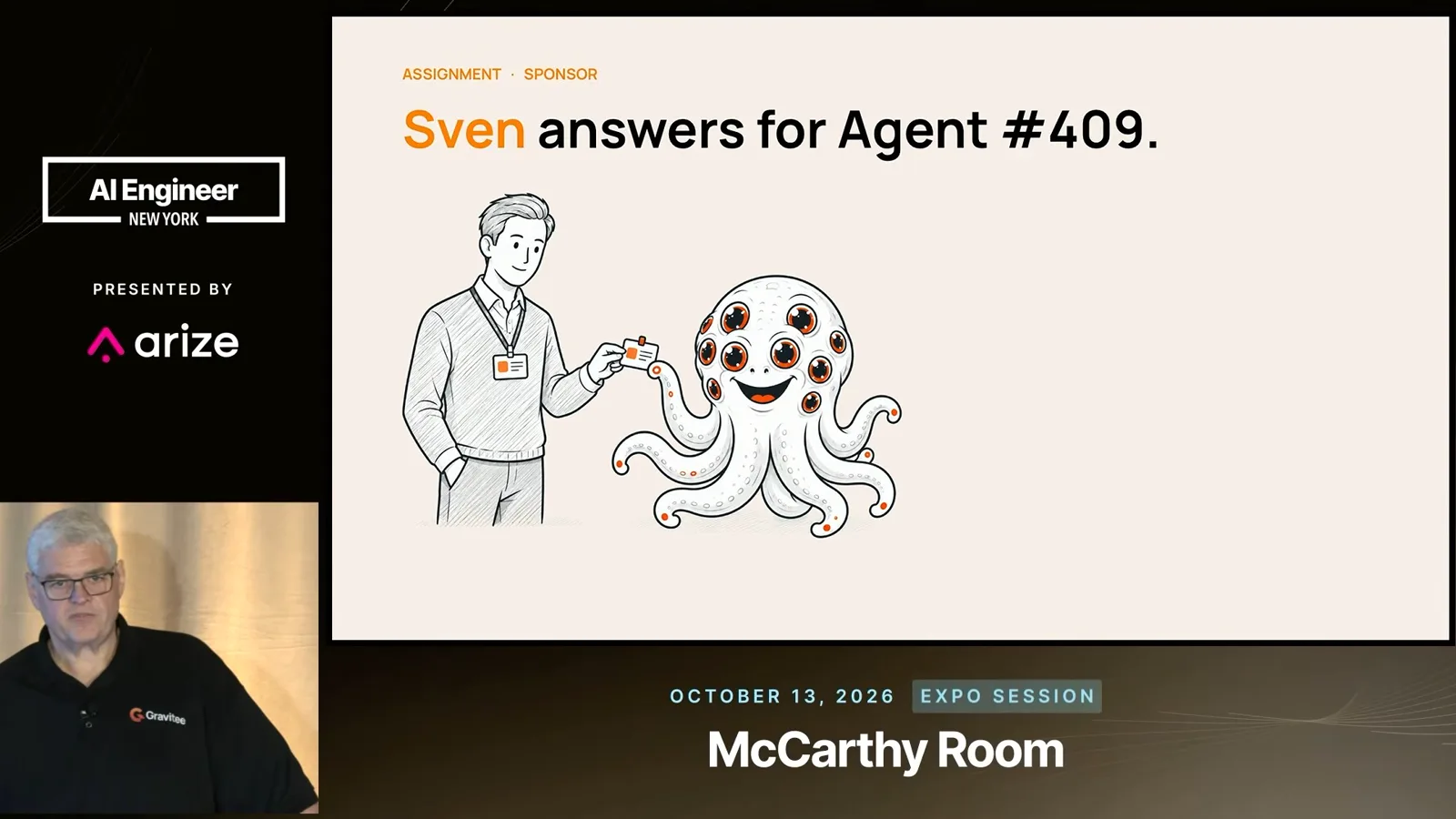
I compare sponsorship to watching children in a pool. When the responsible adult needs to leave, another trusted adult explicitly agrees to take over. The point is to make the handoff unambiguous: someone can say, “I have the agent.”
Alignment: role and authority
A stable role and runtime mission guide the work, while access is bounded across delegation. Tyler cautions against assuming inherited alignment.
Alignment defines what the agent should do and how. Its role resembles a job description: purpose, responsibilities, budget and what success looks like. A vague role that a human might clarify informally is a poor basis for an autonomous agent.
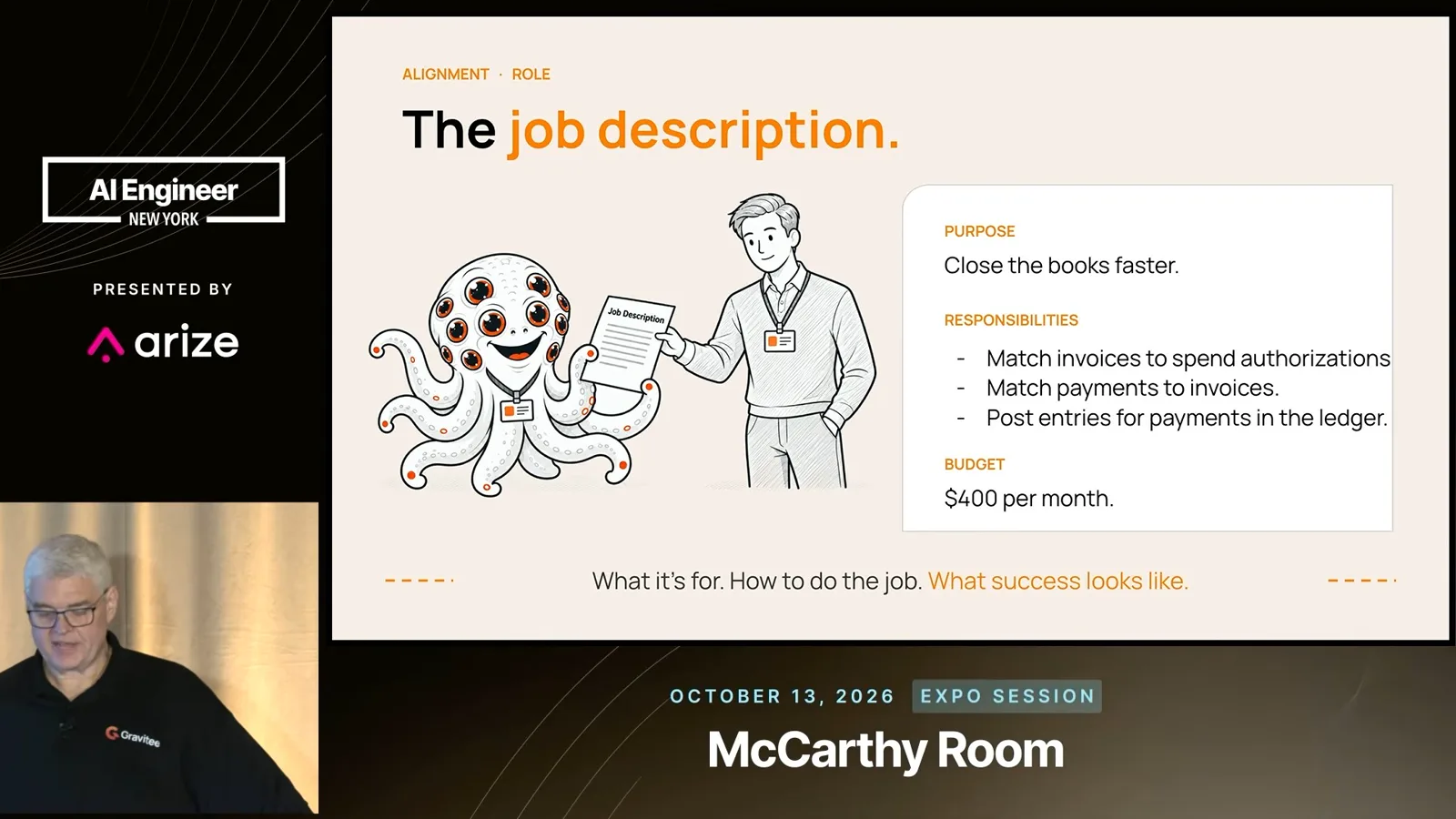
Distinguish the relatively stable role established at onboarding from the current mission at runtime. The agent may define a mission for a particular tool call, but its sponsor defines the role. The role should change deliberately rather than being rewritten with every task.
Authority specifies what the agent can see and do: which data, tools and other resources it may access. The sponsor decides which doors to open, potentially through IT or the team operating a database or MCP server. Boundaries and escalation paths belong in that definition.
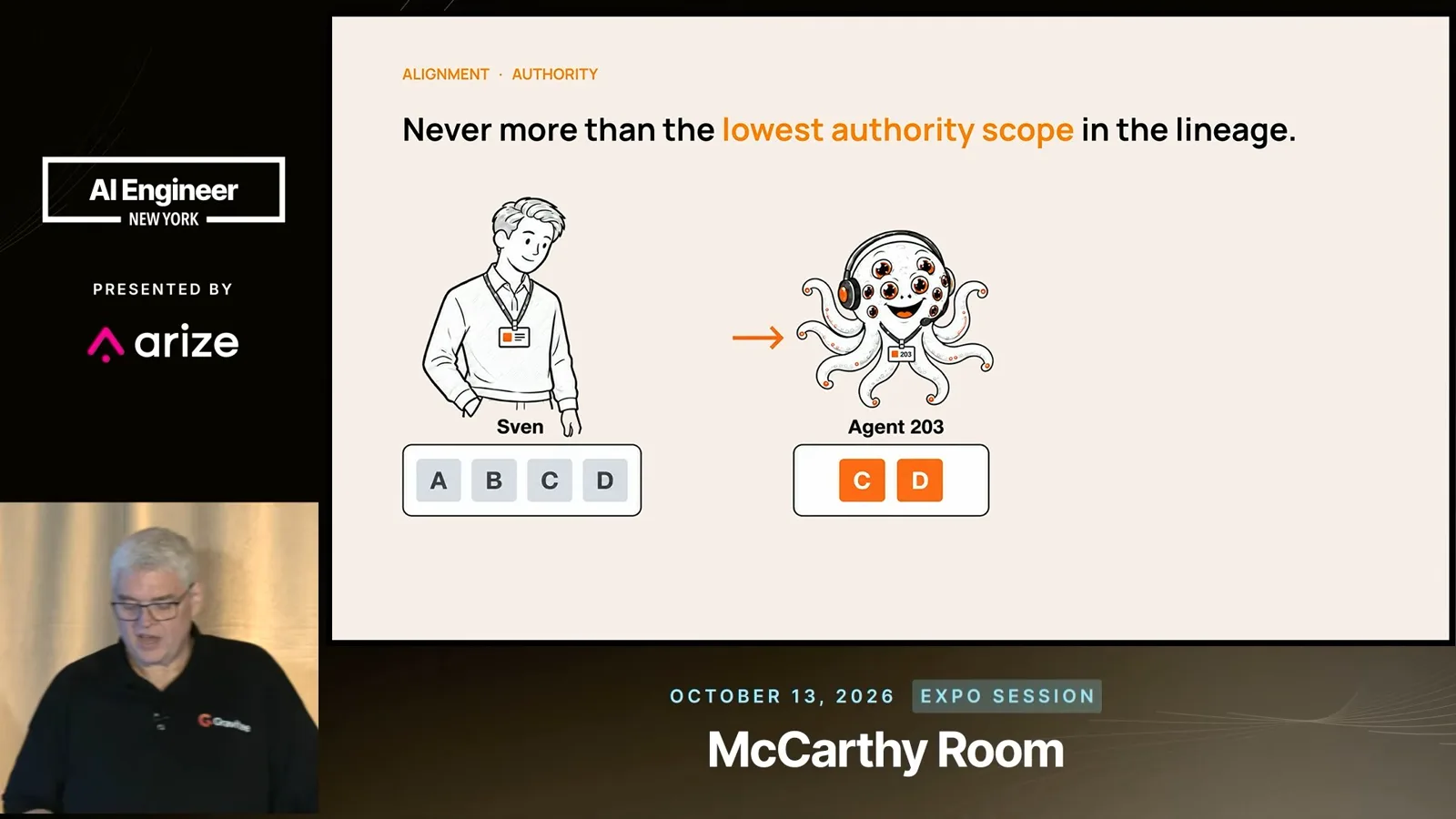
In a delegated chain, use the lowest applicable scope rather than expanding authority. Suppose Sven can access A through D, one agent can access C and D, and another can access D, E and F. Although the latter may use its own permissions to work, only D is shared across the chain and can return to Sven through that path.
Never assume alignment is inherited unchanged. A model comes with provider defaults, team context comes from elsewhere, and external agents may introduce their own context. The sponsor may not control those inputs, and they can change even when the sponsor cannot directly edit them.
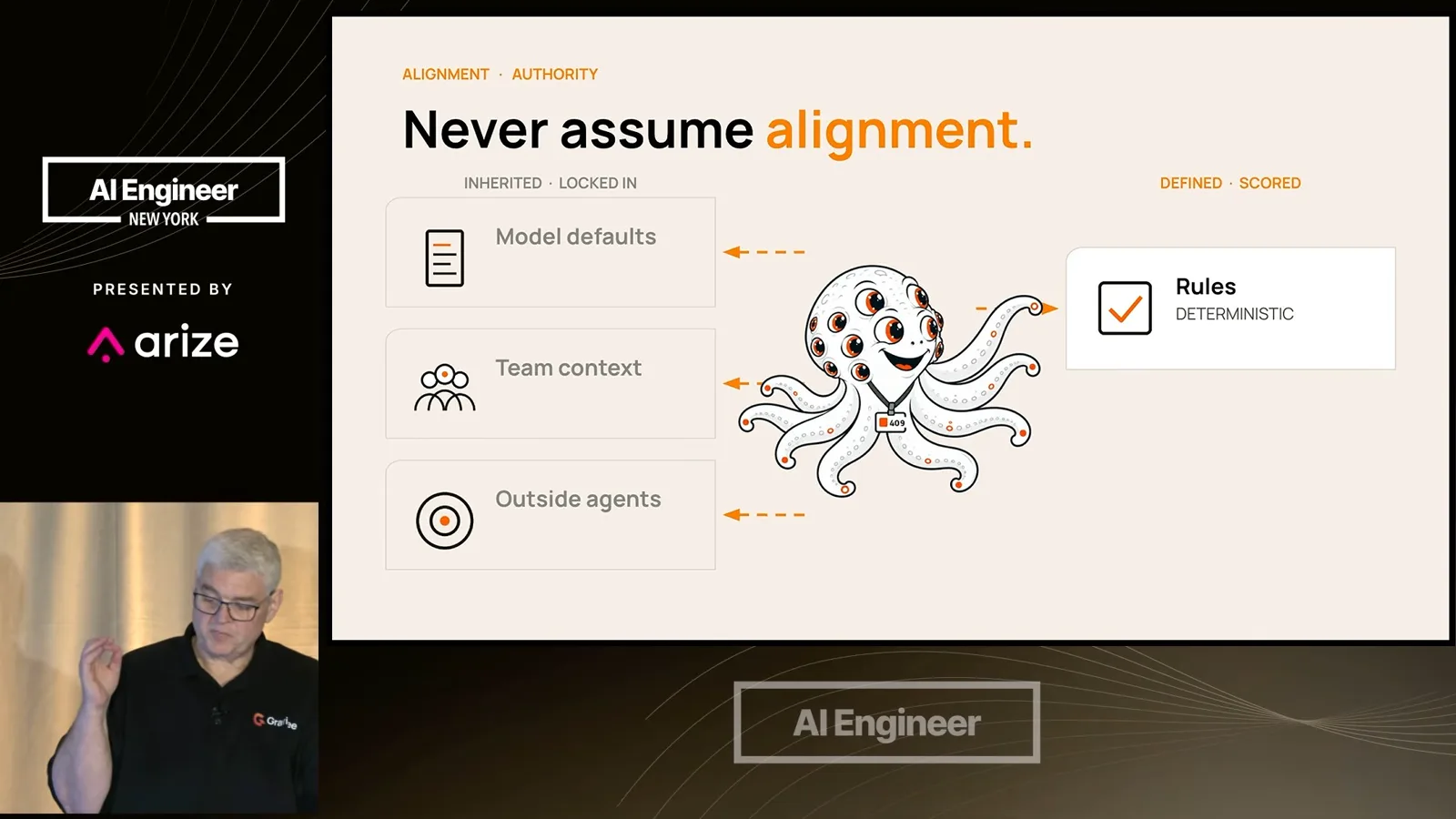
The sponsor can define deterministic rules as a floor, alongside intended outcomes that require probabilistic judgment. External agents should also be treated more like contractors: establish their identities and authorize their access rather than assuming they belong inside the organization.
Administration: oversight and recourse
Scorecards distinguish compliance from success. Continuous monitoring and graduated actions address problems at machine speed.
Administration is where the earlier definitions are enforced. Organizations verify the trust they place in human staff through devices, supervisors and other checks; agents likewise require oversight. But behaving within authority and succeeding at the assigned job are different things.
Use a scorecard rather than a single metric. Some authority rules are clear and deterministic—for example, an invoice limit—while role outcomes might include invoice matching accuracy or reconciliation time. Rules can be checked; intentions and quality often need judgment and confidence levels.
Humans dislike micromanagement, but agents need continuous supervision. I describe guardian agents that watch the model, incoming context and work product at machine speed. Waiting for a quarterly review can leave an enormous number of decisions unchecked.
When an agent goes off course, recourse should be graduated. For a person, the first step after a mistake is ideally a correction, not immediate dismissal. Similarly, a system might correct an agent, restrict authority, escalate or suspend it as behavior warrants.
For probabilistic judgments, confidence thresholds can trigger defined actions. My illustrative examples include redacting content at one threshold, asking a human at a lower confidence level and blocking at a still lower one. The exact steps turn uncertain judgments into predetermined responses.
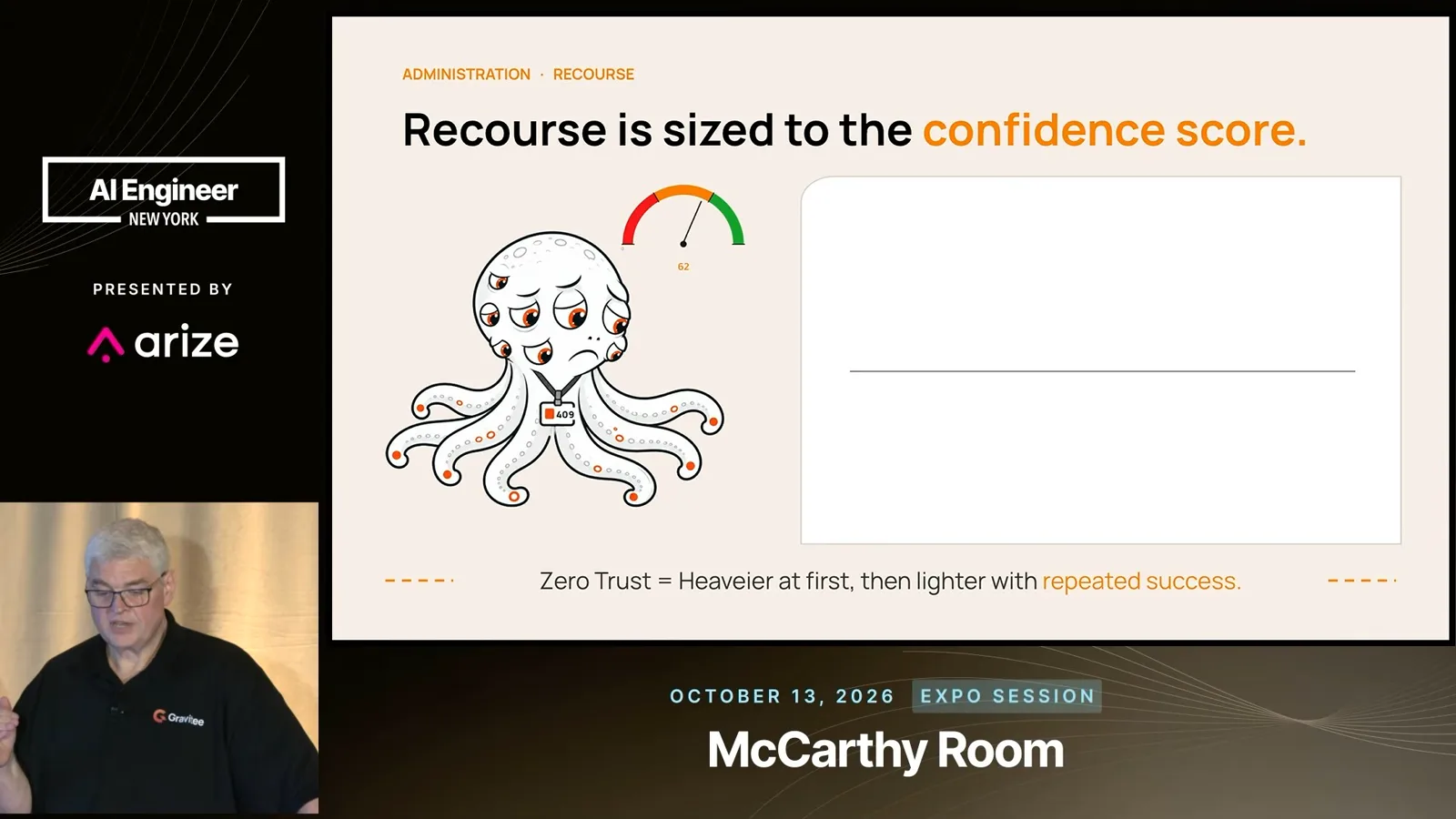
For a clear authority violation, the response might restrict authorization immediately, suspend access after repeated violations or suspend the whole agent if the pattern persists. I describe a zero-trust approach that begins with heavier supervision and can become lighter after repeated success.
Guardians, gateways and guardrails can restrict or suspend behavior at machine speed. The sponsor then applies human judgment as a coach, adjusting the role or authority so the agent performs better or stays within its boundaries. These definitions should evolve rather than be set once and forgotten.
The three stages can be summarized simply: name every agent through assignment, bound every action through alignment and trace every outcome through administration. Start by giving agents an identity; the framework’s controls can then be audited and supported by technical solutions.
Mehr aus diesem Kanal
 18:56EN
 AI Engineer· 27. Okt. 2026John Feminella: Five Controls for AI Agents, and the $900 Million Bank ErrorJohn Feminella · Two SigmaA payment mistake shows why good intentions and approval prompts are not enough. Feminella describes practical controls for giving agents useful autonomy.
 23:22ENAI Engineer· 27. Okt. 2026Noyan Tokgozoglu: How Optiver Builds an AI Platform for Fast, Measurable DecisionsNoyan Tokgozoglu · OptiverThe trading firm’s AI engineering lead explains same-day model adoption, on-premises infrastructure, cost controls and the limits of replaying agent evaluations.
 16:38ENAI Engineer· 27. Okt. 2026Aiden Sochowski: Securing 300 Agents in a 60-Person CompanyAiden Sochowski · RunlayerRunlayer’s founding engineer explains what session monitoring revealed about agent permissions, prompt injection, tool errors and runaway cost.
 56:01ENAI Engineer· 26. Okt. 2026Xander Song on Evaluating Agents with Harbor and PhoenixXander Song · Arize AIArize AI engineer Xander Song explains how Harbor runs realistic agent tasks in isolated sandboxes, and how his team uses Phoenix to compare prompt changes, inspect trajectories, and test a SQL tool.
 19:43ENAI Engineer· 26. Okt. 2026Jack Wotherspoon on Building a Team of Managed AgentsJack Wotherspoon · Google DeepMindGoogle DeepMind’s Jack Wotherspoon introduces Gemini Managed Agents: cloud sandboxes that let teams run coding and research agents with a single API call. He explains how persistent environments, reusable skills, proxy-injected credentials, schedules, and specialized agents fit together.
 53:04ENAI Engineer· 26. Okt. 2026Fuad Ali: Building a Feedback Loop to Improve AI AgentsFuad Ali · Arize AIAn Arize workshop connects traces, failure datasets, evaluations, proposed fixes and experiments while keeping human judgment in the loop.