In 30 Sekunden
Matthew Berman reviews BloombergGPT’s 50-billion-parameter architecture, financial and general training data, hardware and evaluation. He considers the commercial value of a finance-specialized model and the trade-offs of openness. The original paper’s data heading and table give inconsistent percentages; its table lists FinPile at 51.27% of the corpus. The authors explicitly said they were not releasing the model. The video contains no disclosed sponsor.
- 1A mixed corpusThe paper combines FinPile financial documents with public general-purpose sources.
- 2Percentage discrepancyThe paper’s section heading says 54.2%, while Table 1 gives FinPile 51.27% of the corpus.
- 3EvaluationThe displayed bits-per-byte comparison concerns held-out financial data; lower is better.
- 4Model opennessContrary to Berman’s interpretation, the authors explicitly say they are not releasing the model.
Das Wichtigste
- BloombergGPT combined approximately 363 billion financial tokens and 345 billion public general-purpose tokens.
- The paper’s table puts FinPile at 51.27% of the corpus, while a section heading gives a conflicting 54.2%.
- ALiBi permits longer-than-training sequences in principle, without guaranteeing quality at arbitrary lengths.
- The held-out financial language-modeling comparison favors BloombergGPT on the displayed data, but does not establish superiority on every task.
- The authors said they would not release the model, citing concerns including leakage of FinPile data.
- Berman’s predictions about access and pricing are speculation; no sponsor is disclosed in the video.
Den bearbeiteten Text nach Kapiteln lesen
The model and its training data
Berman introduces the 50B model and its mixture of finance-specific and general text. The paper contains an internal discrepancy in the reported financial share.
In April 2023 I review BloombergGPT, a 50-billion-parameter language model developed for finance. I am excited by the idea of combining a company’s specialized financial archive with general-purpose text, rather than training only on one or the other. Bloomberg published a research paper describing the model; that announcement alone did not mean its weights were publicly released.
The [paper](https://arxiv.org/abs/2303.17564v1) describes approximately 363 billion tokens of financial documents and 345 billion tokens from public general datasets. The financial collection, FinPile, includes English-language financial web pages, news, filings, press releases and Bloomberg archive material. These are corpus sizes, not a claim that every token is proprietary or that all data was consumed once during training.
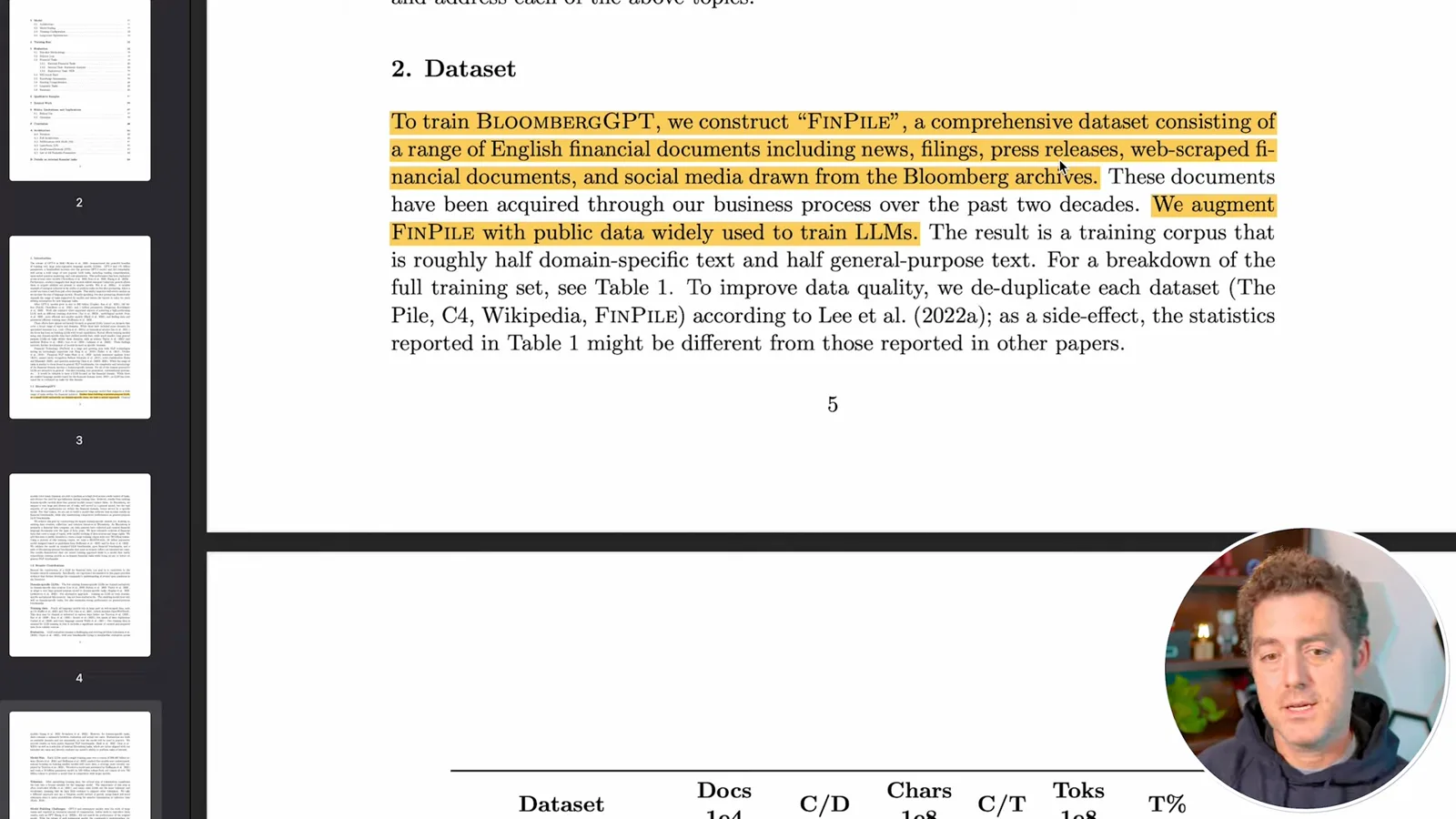
Bloomberg augments FinPile with public sources including The Pile, C4 and Wikipedia. Components shown include GitHub, Books3, FreeLaw, Stack Exchange, patent text, YouTube subtitles, Hacker News and Enron emails. Their inclusion in the table is not a claim about the quality or rights status of every item.
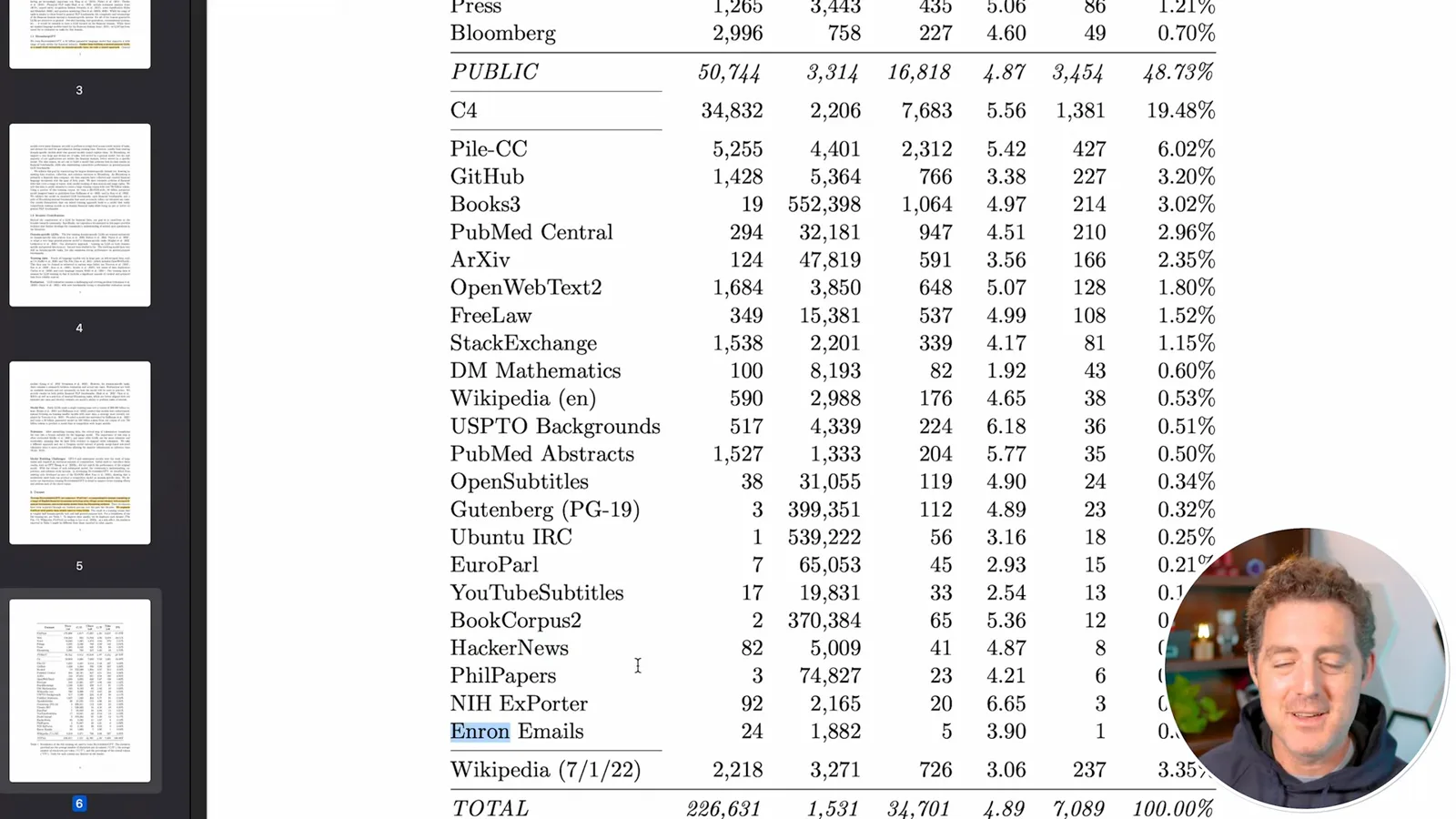
I cite a 54.2% figure for financial data from a heading in the paper. Its Table 1, however, lists FinPile as 51.27% of the 708.9-billion-token corpus and public data as 48.73%; the two figures in the paper are inconsistent. The table lists financial web text as 42.01% and C4 as 19.48% of the full corpus, not of the public subset.
Architecture, compute and evaluation
The video discusses ALiBi, SageMaker hardware and finance-specific evaluation. The authors’ proposed explanation for the filings gap remains a hypothesis.
The model uses ALiBi positional encoding; the paper says it can be applied to sequences longer than its 2,048-token training length. That is an architectural possibility, not a demonstrated guarantee of equally reliable performance at arbitrary context lengths.
Training used Amazon SageMaker instances with eight NVIDIA A100 40 GB GPUs per instance. I point out that such hardware is expensive and that training a model of this size requires substantial resources. My observations about GPU prices are anecdotal and reflect 2023.
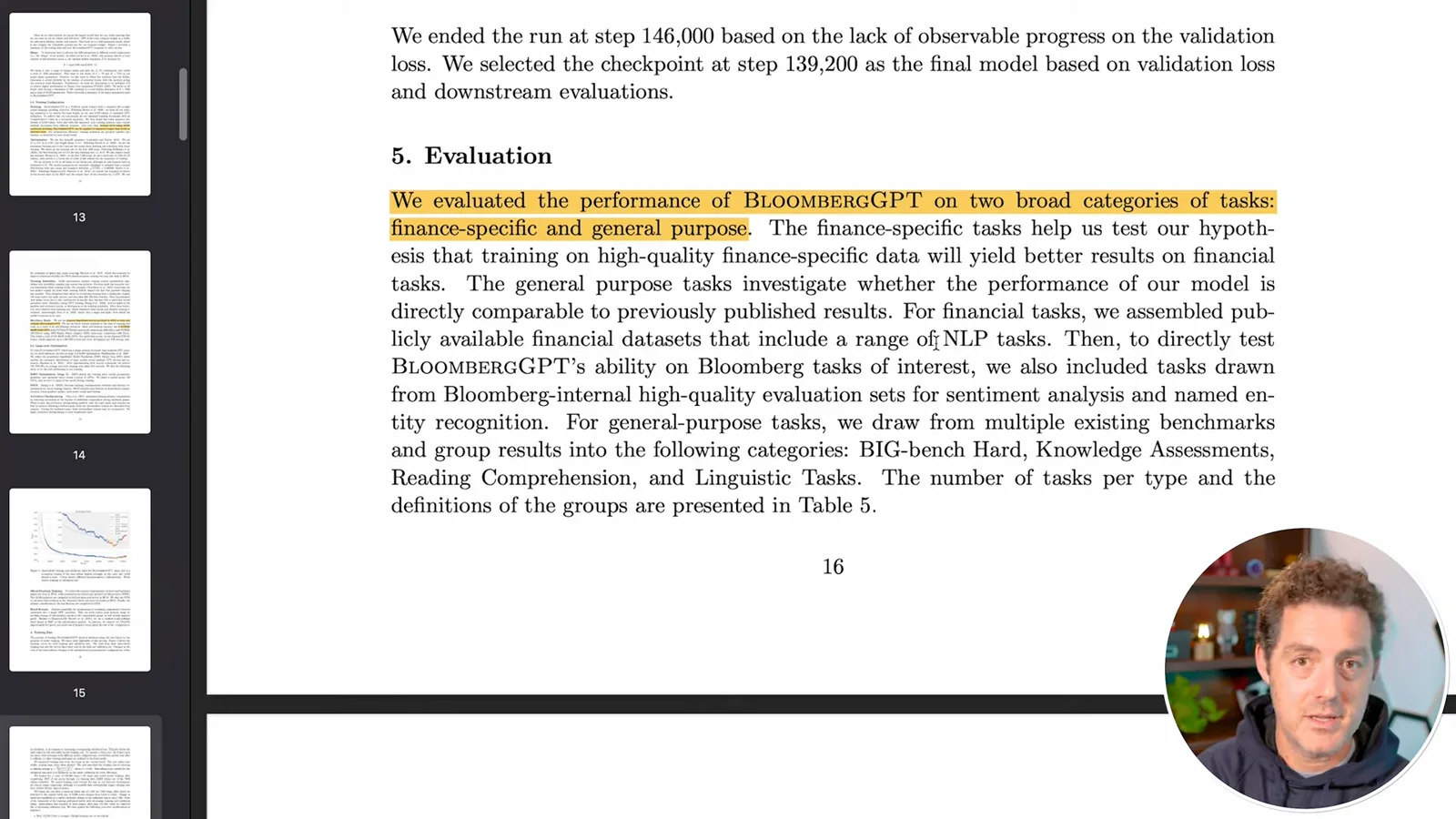
The researchers evaluate both finance-specific and general-purpose tasks, comparing BloombergGPT with GPT-NeoX, OPT and BLOOM. On a held-out FinPile language-modeling evaluation, the chart uses bits per byte, where lower is better. The researchers report that BloombergGPT performs better across the displayed categories; that is a specific evaluation, not proof it is best on every financial task.
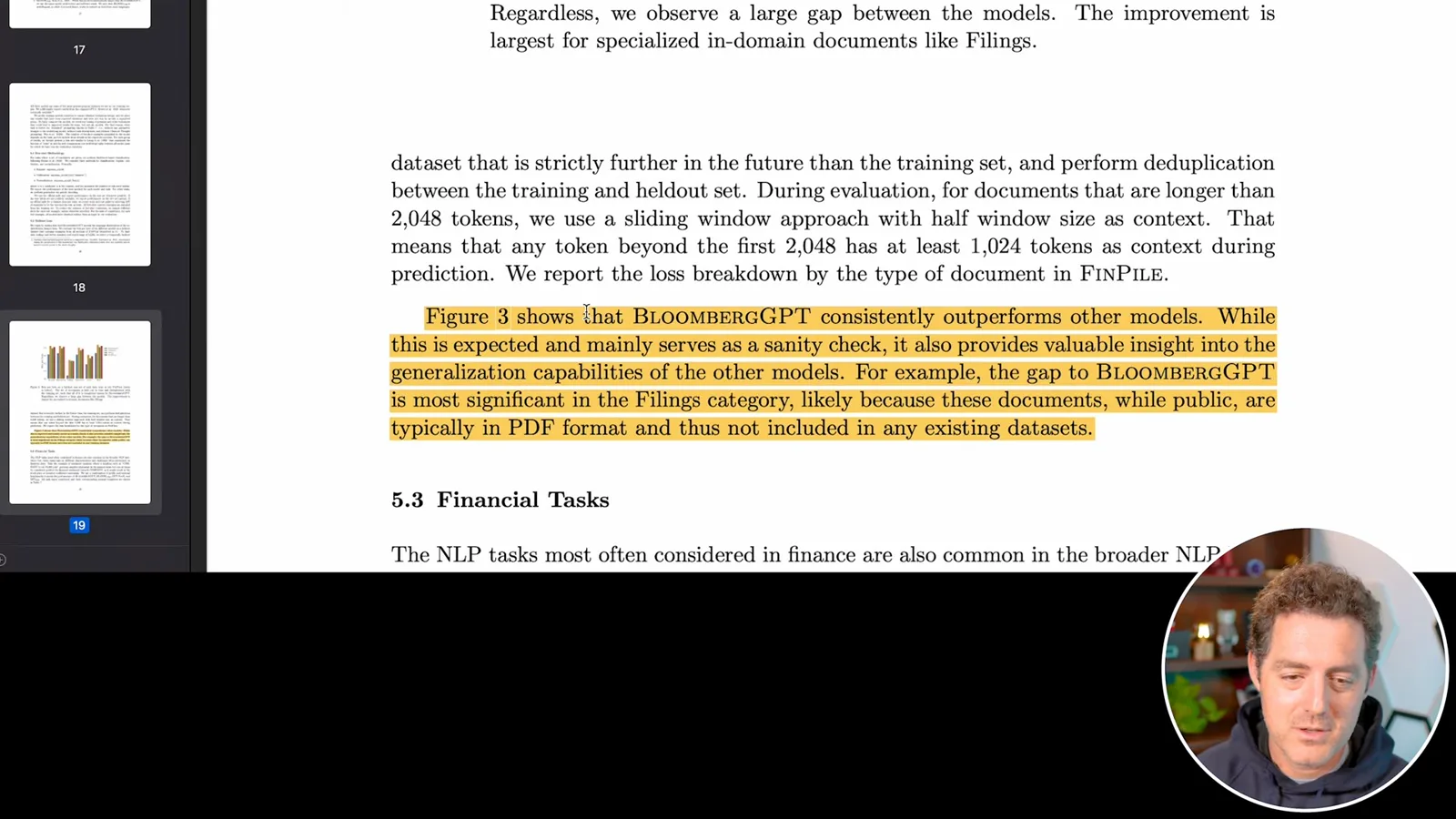
The biggest gap in the chart is on filings. The authors suggest a possible reason: public filings often appear as PDFs and may not have been included in existing datasets. This is their explanation for the observed difference, not proof that other models were incapable of parsing all PDFs.
Pricing speculation and openness
Berman speculates about commercial value and access. The paper actually says the authors are not releasing the model, citing data-leakage concerns.
I consider whether a model trained on valuable financial data might eventually be a paid product, drawing on Bloomberg Terminal as an example. My suggested pricing and access are speculation; my remark that a Terminal costs millions of dollars a year is not a substantiated per-user price and should not be relied on.
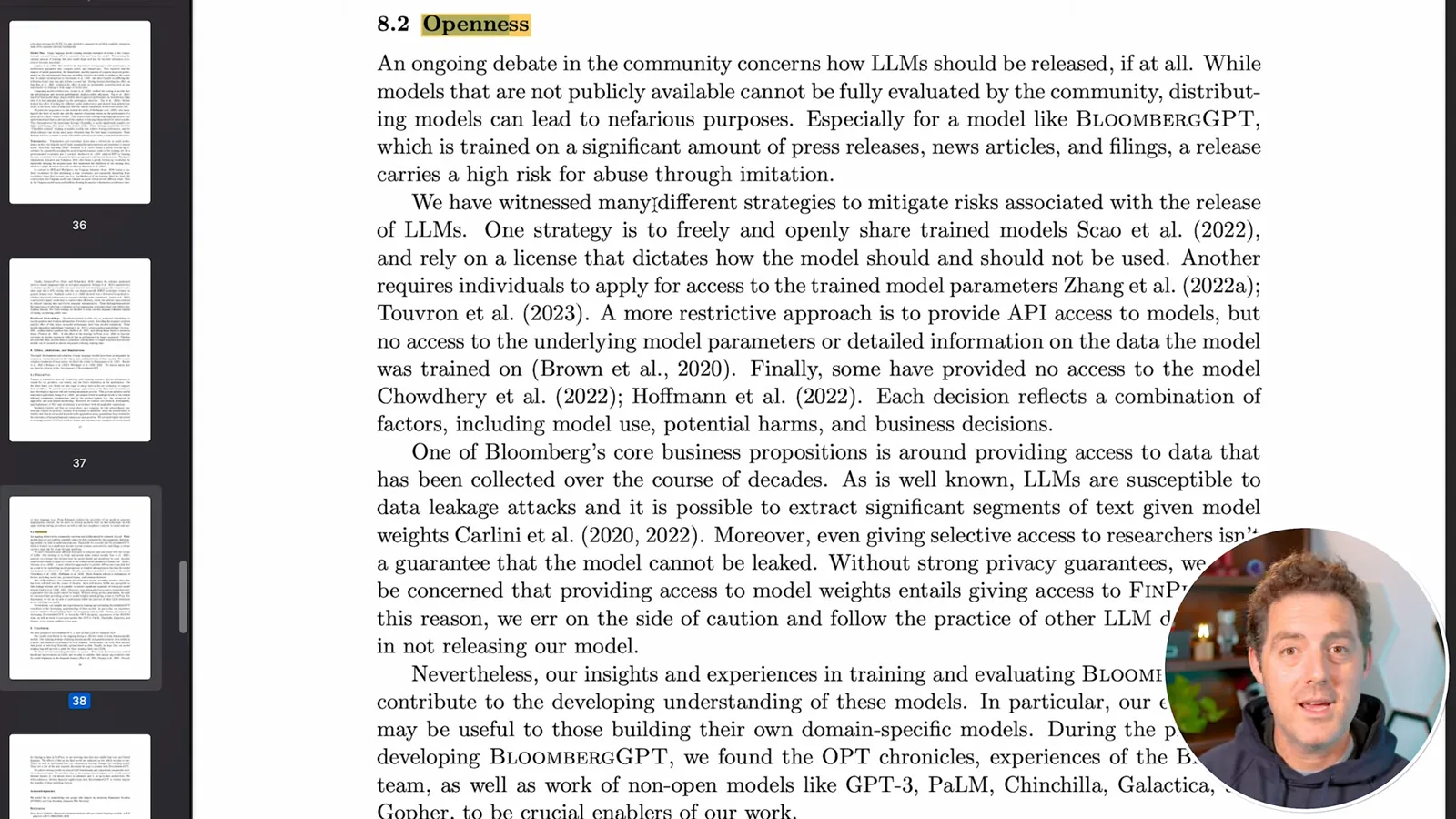
I say the paper does not specify whether it will release the model, but its openness section actually states that the authors were not releasing it, citing concerns including extraction of FinPile data from model weights. They also discuss the value of open evaluation and potential misuse. My prediction about expensive access is separate from that stated decision.
I generally prefer organizations to release models openly, and I am excited to see new specialized systems. The research describes benchmark results and a training approach; it does not establish that the model is the world’s most valuable or offer financial advice.
Mehr aus diesem Kanal
 34:21EN
 Matthew Berman· 27. Okt. 2026Matthew Berman Examines Anthropic’s IPO Filing, AI Growth and GovernanceMatthew Berman, Sam Altman · Forward FutureThe presenter reviews the S-1’s financial metrics, compute strategy and voting structure while questioning the tension between rapid AI development and safety.
 0:26ENMatthew Berman· 25. Okt. 2026Sam Altman on Human Values and Problem-Solving in an AI WorldSam Altman · OpenAIIn a short interview excerpt, Altman considers the enjoyment of solving hard problems and the human role in interpreting results.
 0:36ENMatthew Berman· 25. Okt. 2026Kimi K3.1 and a Rubik’s Cube Solver DemonstrationMatthew Berman · Forward FutureMatthew Berman shows a scrambled virtual cube being solved and gives the Kimi K3.1 test a favorable assessment.
 0:21ENMatthew Berman· 24. Okt. 2026An AI-Generated Kimi Benchmark Chart Used Invented ScoresMatthew Berman · Forward FutureMatthew Berman asks for a graph of Kimi K3.1 Pro benchmarks, then discovers that the displayed figures are illustrative placeholders.
 25:50ENMatthew Berman· 24. Okt. 2026Kimi K3.1 Pro Tested: Strong 3D Demos, Uneven Results and Competitive PricingMatthew Berman · Forward FutureMatthew Berman tests the open-weight model on coding, 3D rendering and visual explanations, then compares benchmark results and prices.
 32:20ENMatthew Berman· 23. Okt. 2026Who Is Local AI For? The Costs, Trade-offs and a Hybrid FutureMatthew Berman · Forward FutureMatthew Berman weighs data control and independence against hardware cost, setup complexity and inference speed.