In 30 Sekunden
At AI Engineer New York in October 2026, Coinbase AI product lead Lincoln Murr describes two kinds of agentic finance: paying for services and managing money. He traces Coinbase’s work from AgentKit to x402, and proposes micropayments as a possible way for publishers to charge agents. Murr also discusses human-directed trading, trust, product interfaces, and speculative self-sustaining agents. Adoption figures, product claims, and forecasts are his own; a trading anecdote does not establish safety or returns.
- 1From 402 to x402Murr presents an internet-native payment standard for machine transactions.
- 2Publisher micropaymentsHe proposes charging agents small amounts for access to content.
- 3Trading use casesHe outlines portfolio automation, event-driven execution, and natural language strategies.
- 4Trust over timeHis proposed progression begins with limited permissions and safeguards.
- 5A future thought experimentHe asks whether agents could earn enough to pay for their own computing.
Das Wichtigste
- AgentKit explored giving agents wallet access; x402 addresses a payment workflow.
- Micropayments could give publishers a way to charge for agent access, though adoption remains uncertain.
- Murr describes human-directed portfolio management and trade execution as possible use cases.
- He argues trust and permissions should develop gradually with safeguards.
- Agents paying for their own upkeep remain a thought experiment.
Den bearbeiteten Text nach Kapiteln lesen
Agent accounts and payments
Murr introduces AgentKit, x402, and reported adoption.
Coinbase AI product lead Lincoln Murr introduces his view of agentic finance: giving software agents access to financial accounts so they can pay or manage money under human direction.
He divides the space into two broad uses: agents paying for things and agents attempting to grow money. He describes trading as the newer of the two categories.
Coinbase's early AgentKit experiment connected a wallet to an AI framework. Murr says the team soon discovered that providing money was not enough if the agent had nothing useful to pay for.
He turns to HTTP status code 402, historically reserved for payment requirements, and presents x402 as a way to organize internet-native machine payments using stablecoins.
Murr reports rapid growth in x402 activity and names payment companies engaging with the standard. The transaction volumes are figures he presents, not independently verified measurements in the talk.
Micropayments for content
He proposes a publisher revenue model for agent access.
One application he finds interesting is micropayments for publishers whose content is consumed by agents. He argues that AI interfaces can reduce direct visits to sites that have historically relied on advertising.
In his proposed model, an agent could pay a tiny amount to access content while the user's subscription or service handles the details. He sees this as a possible way to compensate publishers.
He expects wider adoption over time but acknowledges that adoption was still limited at the time of his talk. The shift from ads to micropayments is his prediction, not a settled outcome.
Human-directed financial agents
He outlines trading examples and recounts a personal experiment.
The second category is agent-assisted trading and investing. Murr stresses that the examples he describes involve a person setting an objective or rules and granting authorization.
He outlines three possibilities: automate a chosen portfolio, execute a predefined response to events, and translate a broad natural-language idea into a financial strategy.
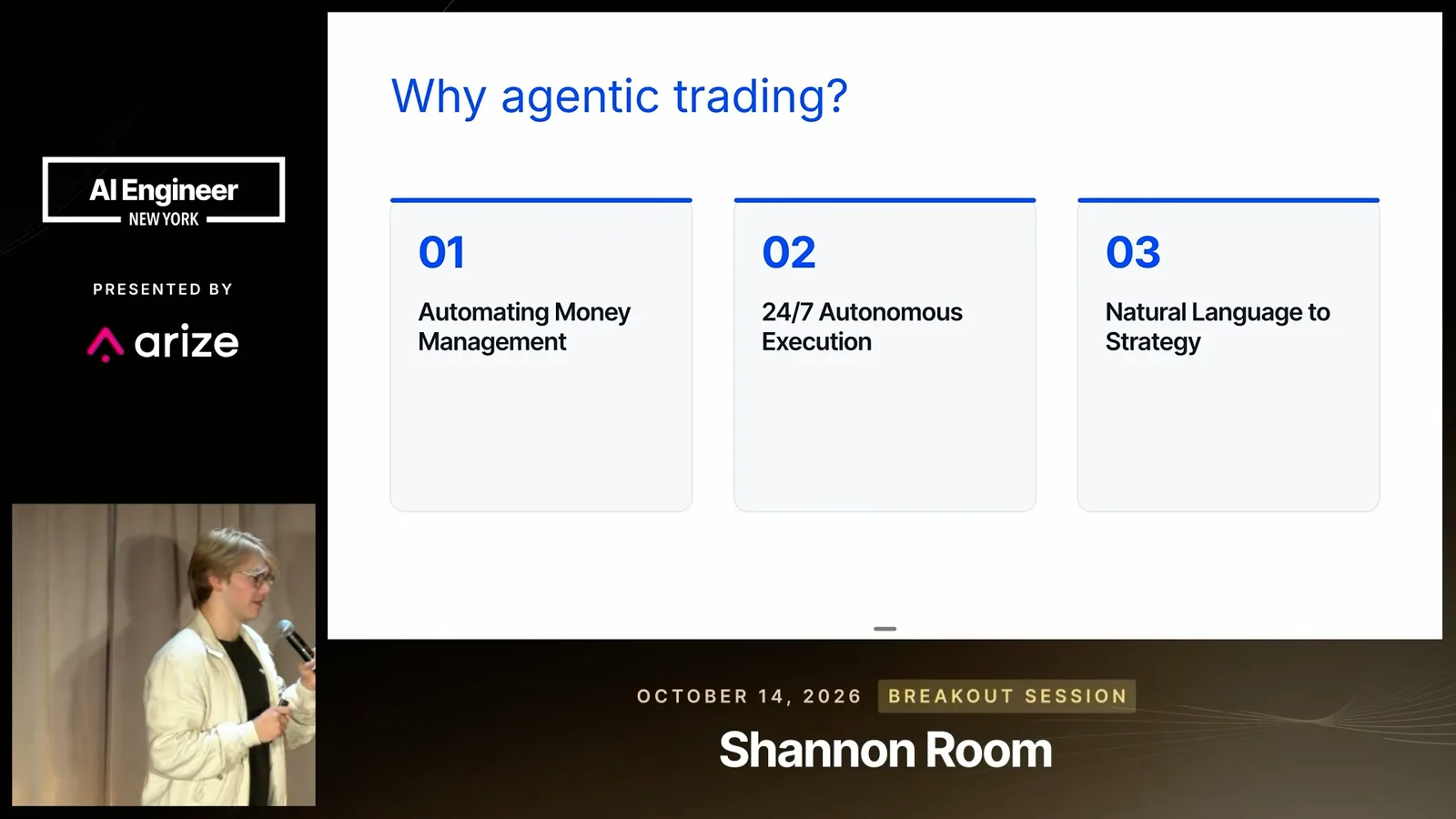
His portfolio example illustrates automation rather than proof of low risk or future returns. Authorization, guardrails, and the user's own judgment remain central to the scenario he describes.
For event-driven execution, a user could specify what to do in different scenarios rather than watch markets continuously. Murr also imagines agents turning broad themes into specific instruments.
He recounts using a voice instruction to initiate a weekend trade based on his interpretation of public AI news. It is one personal anecdote, not evidence that such a strategy will work for others.
He says the attraction was convenience: the same action could have been performed manually, but a conversational interface let him express an idea without walking through each step.
Trust and product design
He discusses gradual permissions, interfaces, and simulated trading.
After two years of work, Murr says trust and autonomy have to be earned gradually. People may start with limited tasks before considering larger permissions.
He imagines an escalation from small payments to an isolated portfolio with rules and safeguards. His anecdotal account of product experience does not establish that agents cannot cause losses.
Another proposed path is for an agent to earn money by providing a service and receive payment through the same payment infrastructure.
For financial products, he argues that AI is an enabling technology rather than the value proposition itself: users care about the service, accessibility, and their ability to obtain help.
He describes Coinbase Advisor as a product intended to make financial guidance available at scale. His statements about its regulatory status and reach are presented as company claims.
A blank chat box can leave users unsure what to ask. His team experiments with interface widgets that surface possible actions and insights to make the product easier to start using.
Murr says agent environments with persistent storage and command-line tools can let developers connect accounts through interfaces such as CLIs and MCPs.
He gives paper trading as an example: users can try a simulated strategy before giving an agent real money. His team can prototype such workflows through agent skills, though he does not claim this is always the most efficient implementation.
Longer-term possibilities
He imagines agents earning and paying for their own services.
Looking forward, Murr argues that access to payment could make agents more autonomous over time, with humans remaining involved in tasks requiring human judgment or regulated action.
He poses a thought experiment: could an agent earn enough from a service to pay for its own inference and computing? He describes this as a distant possibility, not an existing self-sustaining system.
He links that idea to decentralized autonomous organizations, imagining software following rules and managing a treasury while people perform tasks at the edges.
A self-driving vehicle paying for maintenance from its own revenue is another hypothetical example. Murr closes by predicting more machine-to-machine payments, without claiming a timetable for such systems.
Mehr aus diesem Kanal
 21:32EN
 AI Engineer· 29. Okt. 2026Shy Ruparel on AI agent reliability and recovery after failuresShy Ruparel · TemporalTemporal’s survey finds a gap between frequent agent use and dependable deployment. Ruparel demonstrates a synthetic payout workflow that resumes after workers stop.
 14:50ENAI Engineer· 29. Okt. 2026Cole Gannaway on code review, cross-repository risk and AI software factoriesCole Gannaway · QodoA one-line rename can pass local checks while affecting distant clients. Qodo’s Cole Gannaway explains how review context, shared rules and independent agents can expose those risks.
 11:47ENAI Engineer· 29. Okt. 2026Revolut’s David Abitbol on self-hosting AI coding models at scaleDavid Abitbol · RevolutAbitbol shares engineering delivery trends, GPU-serving costs and latency tuning, then describes controls for operating the tools in a regulated bank.
 21:47ENAI Engineer· 28. Okt. 2026Patrick Smyth on Open-Source Supply Chain Security in the AI EraPatrick Smyth · ChainguardChainguard’s Patrick Smyth discusses faster exploitation, malware in dependencies, zero-days and the expanding attack surface around developer workflows.
 14:09ENAI Engineer· 28. Okt. 2026Taylor Luttrell-Williams on Finding Logic Vulnerabilities with SonarQube Hunter AgentTaylor Luttrell-Williams · SonarSonar’s Taylor Luttrell-Williams explains how a security agent maps a codebase, investigates logic flaws and presents validated findings alongside conventional scans.
 16:29ENAI Engineer· 28. Okt. 2026Chris Vela on Benchmarking vLLM Configurations with Runpod BenchPodChris Vela · RunpodRunpod’s Chris Vela demonstrates a dashboard for comparing LLM serving configurations and choosing performance settings with workload-specific data.