In 30 Sekunden
Taylor Luttrell-Williams introduces SonarQube Hunter Agent as a complement to pattern-based static analysis. He describes its repository mapping, specialized agents and validation process, and announces Sonar’s participation in OpenAI’s Daybreak Cyber Partner Program. In a demonstration, he walks through scan results, access-control and multi-factor authentication findings, issue triage and scheduled scans. He also announces automatic remediation through a separate agent.
- 1The gap in pattern-based scanningLuttrell-Williams argues that valid code can still violate business logic, creating vulnerabilities that conventional pattern-based scanners are not designed to catch.
- 2Map, investigate, validateA repository-wide map guides three specialized agents. Sonar says adversarial validation and noise gates filter the results before they become issues.
- 3Daybreak partnershipSonar announced its participation in OpenAI’s Daybreak Cyber Partner Program, which the presenter says brings governed access to advanced cybersecurity models.
- 4The demo finds 46 open issuesThe example results group findings into broken access control, business logic, and authentication and session issues.
- 5Two concrete findingsThe demo shows a user-writable role field that can defeat an admin check, and protected routes reachable without completing multi-factor authentication.
- 6Automatic remediationLuttrell-Williams says eligible issues can be assigned to a separate remediation agent, including on a schedule.
Das Wichtigste
- Logic vulnerabilities can arise when valid code violates an application’s intended business rules.
- Hunter Agent maps a repository and uses specialized agents to investigate access control, business logic, and authentication and session issues.
- Sonar says adversarial validation and noise gates reduce false positives before findings reach developers.
- The demonstrated scan results appear alongside ordinary SonarQube issues, where teams can assess their effect on quality gates.
- Scans can be triggered on demand or scheduled, and Sonar announced automatic remediation via a separate agent.
Den bearbeiteten Text nach Kapiteln lesen
Why logic flaws escape pattern scans
Luttrell-Williams introduces SonarQube Hunter Agent and explains the difference between valid code and valid business intent. He argues that faster releases call for more frequent security investigation.
I’m Taylor Luttrell-Williams, and I create developer content at Sonar, the makers of SonarQube. SonarQube Hunter Agent is an AI security agent intended to find classes of vulnerabilities that traditional static application security testing, or SAST, cannot catch before attackers do.
In the agentic era, code is shipping at both agentic velocity and agentic volume. I argue that more vulnerabilities are reaching production as a result. Traditional pattern-based scanners are useful at detecting patterns, but some issues are about intent rather than a recognizable pattern in the code.
A logic-level vulnerability can exist even when the code is functionally valid. The problem is that its behavior contradicts the intended business logic. A scanner designed around conventional patterns may not recognize that the application is doing something its designers did not intend.
Many companies run penetration tests only once or twice a year, or perhaps quarterly. With attackers using better models and changes shipping more frequently, I believe teams need another way to detect these vulnerabilities and address them between tests.
How the agent investigates
A global repository map guides specialized agents, followed by adversarial validation and noise filtering. Findings are presented as assignable SonarQube issues.
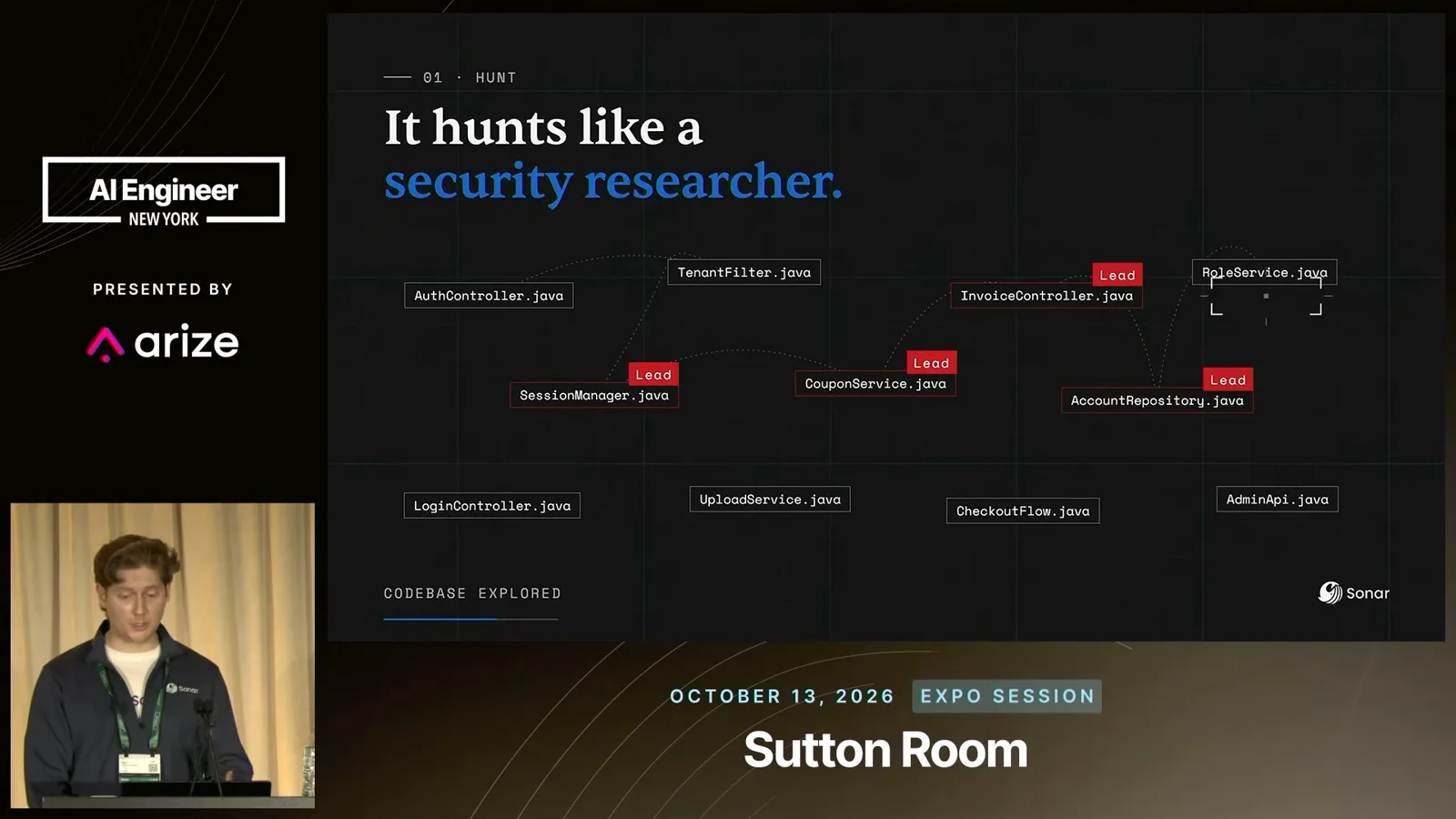
Hunter Agent first maps the repository globally. That map guides three specialized agents, each investigating a class of issue and the relationships among components. They try to establish the security expectations of the application rather than evaluating each piece of code in isolation.
The system then uses adversarial validation to check whether its leads are genuine and applies noise gates to reduce low-validity or intentional behavior reported as an issue. These playbooks handle the agent orchestration and produce findings that developers can be assigned to address.
For each finding, the product assigns a severity, describes its potential impact and points to the relevant location in the codebase. For existing SonarQube users, Hunter Agent issues appear alongside findings from its SAST tool, in the same issue workflow.
As the time between discovering and weaponizing a vulnerability shrinks, security teams need tools that can keep pace. Sonar is joining OpenAI’s Daybreak Cyber Partner Program; we expect it to bring governed access to advanced cybersecurity frontier models into products including Hunter Agent.
Daybreak and layered security
Sonar announces participation in OpenAI’s Daybreak Cyber Partner Program. The speaker positions Hunter Agent alongside static analysis and software composition analysis.
The playbooks run across the whole codebase, and Sonar says each lead is investigated and validated before it appears. We use the additional reasoning to make findings precise, repeatable and auditable. Our recommended approach combines Hunter Agent with SAST and software composition analysis as independent layers of security.
A scan from start to results
The demonstration shows on-demand scanning, the run pipeline and a results dashboard with three categories of findings.
For the demonstration, I scanned a simple Python application in SonarQube Cloud. The Hunter Agent page offers an on-demand scan and estimates the units needed for a deep pass over the project. The product also works with the self-hosted SonarQube Server.
A scan can take more than an hour depending on the size and complexity of the project, so I ran this one in advance. It securely clones the target repository, maps the application architecture and attack surfaces, builds a threat model, and then runs contextual scans across the codebase.
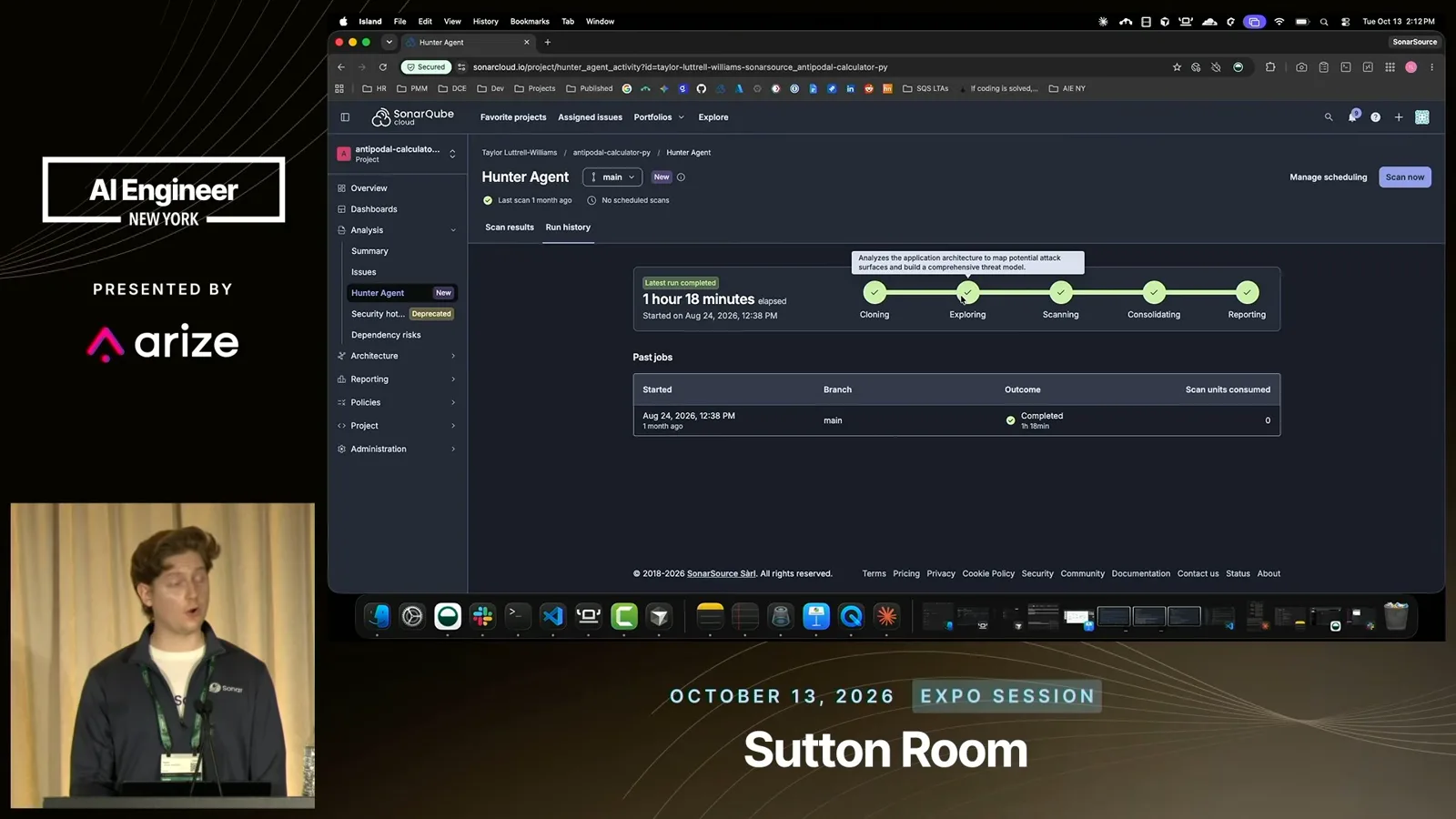
The specialized agents look for issues such as insecure direct object references, broken access control and business logic flaws. Their findings are aggregated and deduplicated, and validated vulnerabilities are logged in the existing SonarQube issue list.
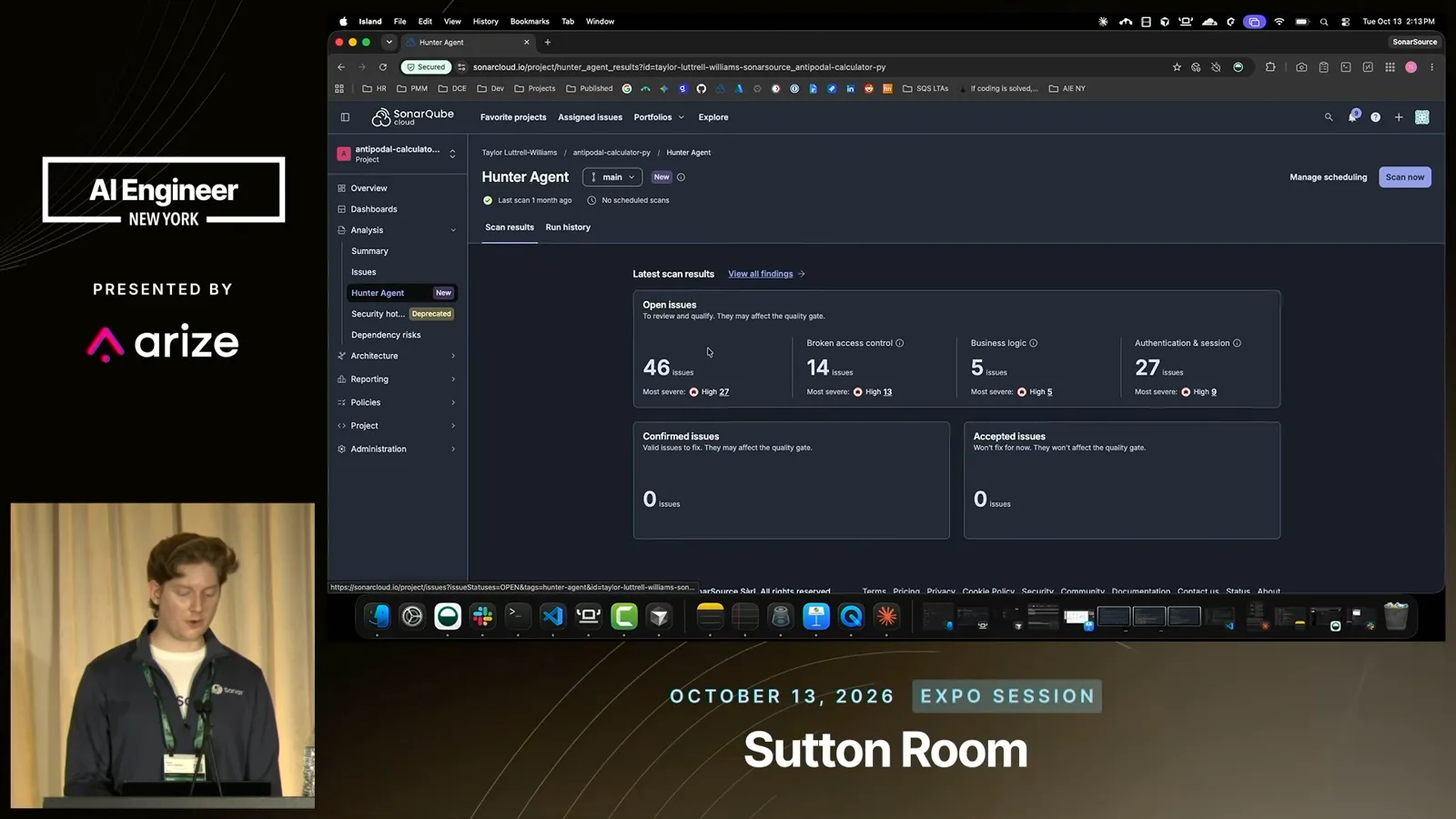
The example scan shows 46 open issues across three categories: broken access control, business logic, and authentication and session issues. The dashboard lets me open the results for a category and inspect individual findings in the same place as other SonarQube issues.
Broken access control can include insecure direct object references, missing authorization checks, privilege escalation, sensitive data exposure and cross-site request forgery. Business logic problems include skipped workflow steps, repeatable actions that can be abused, and missing rate limits.
Authentication and session findings can cover broken authentication, session fixation, sessions that do not expire, weak password recovery, missing multi-factor authentication and gaps that allow brute-force attempts. In the example, I open a high-severity access-control finding tagged as a Hunter Agent issue.
Investigating and triaging issues
Two examples show an authorization failure involving a writable role and protected routes accessible without completing MFA. The presenter explains issue states and scheduling.
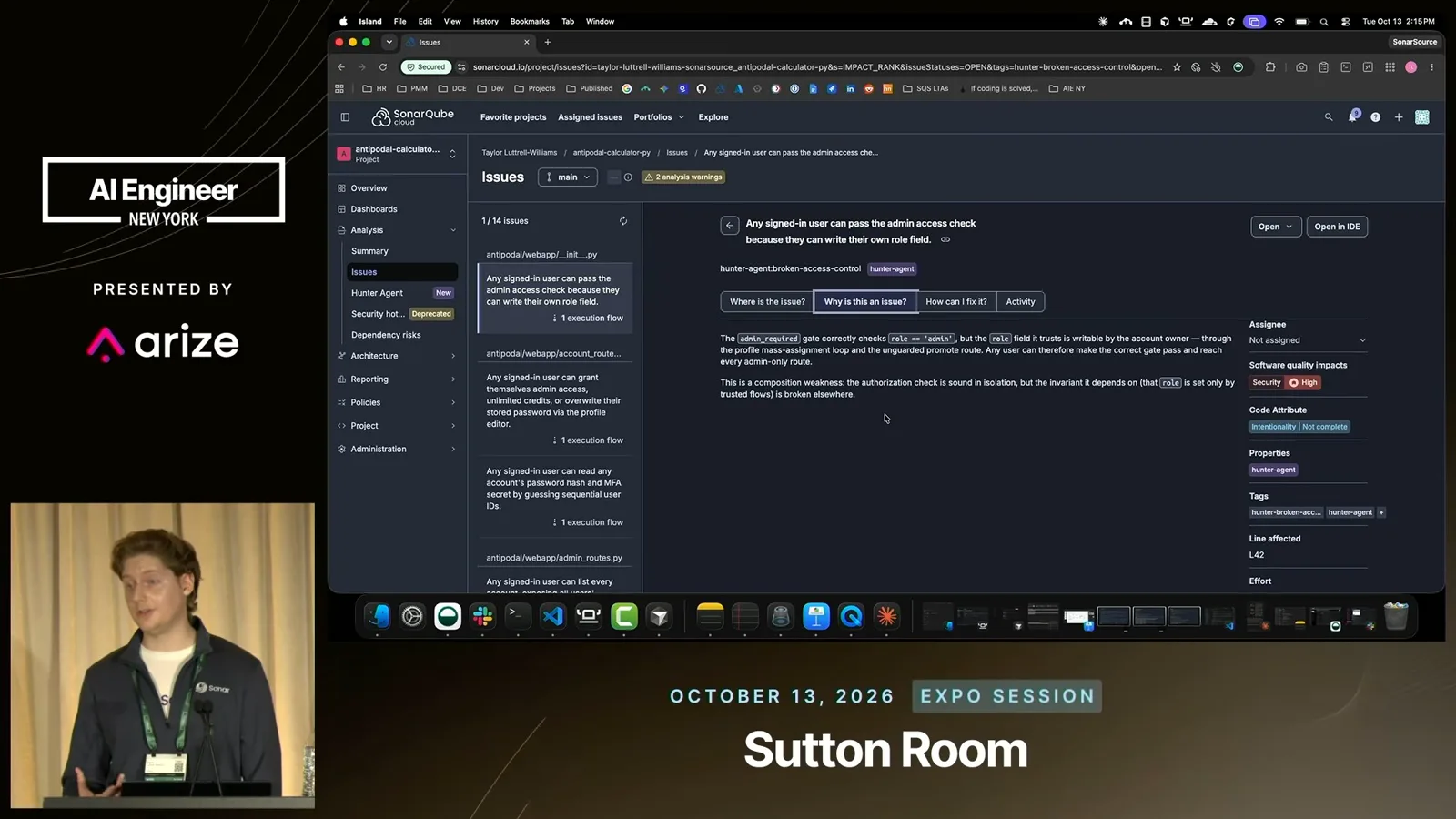
The issue view points to the affected code, explains the problem and suggests how to fix it. In this example, a signed-in user can write their own role field and thereby pass an admin access check. The check itself may look correct in isolation, but it relies on a field the user can change.
Issues begin in an open state and can be assigned to developers. A team can accept a valid issue without having it affect the quality gate, confirm it so that it does affect the gate, or mark it as a false positive after review.
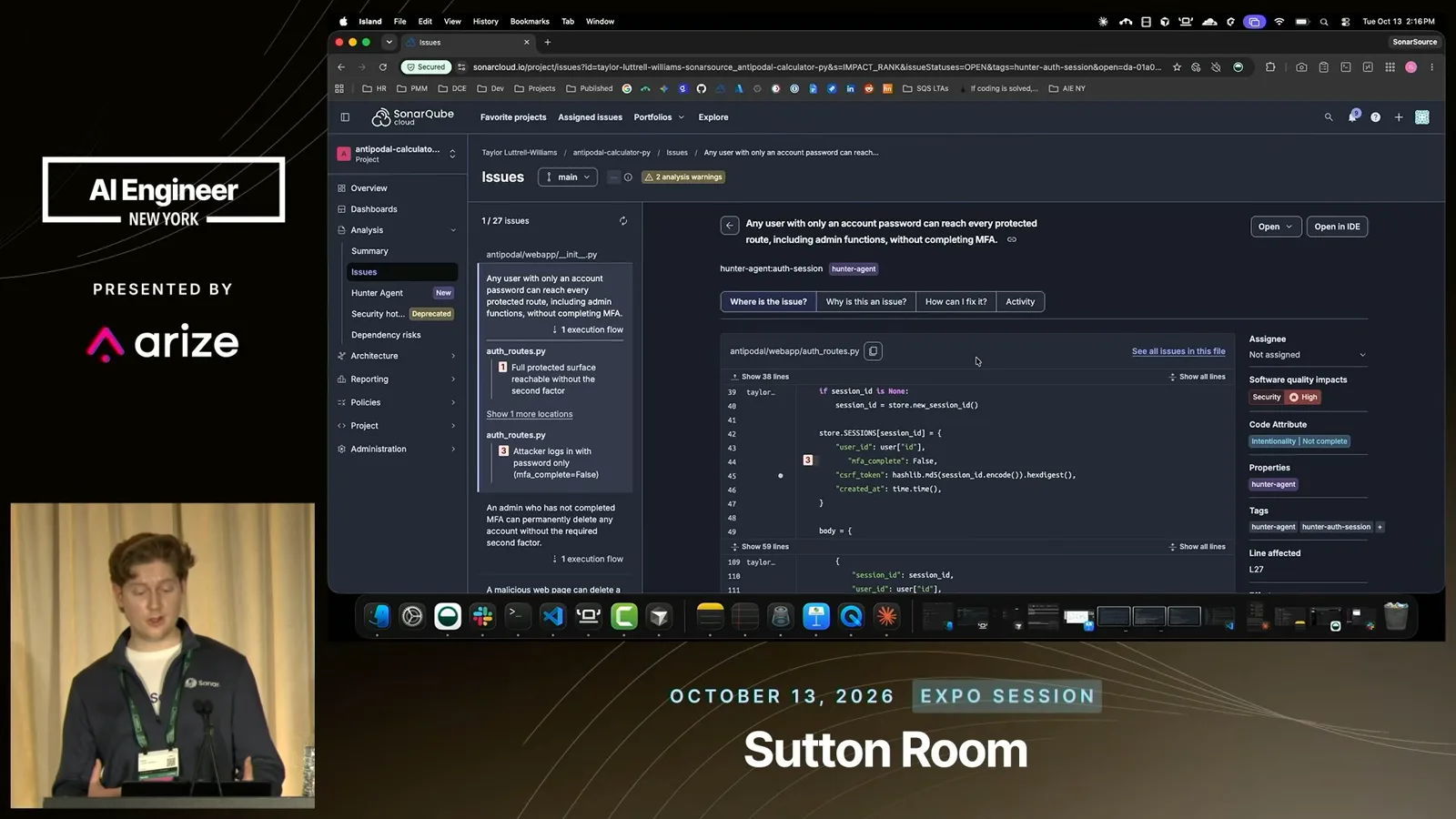
A second high-severity finding concerns a user who can reach protected routes, including admin functions, with only an account password and without completing multi-factor authentication. Again, the issue page shows the location, why it matters, possible fixes and the activity associated with the finding.
Hunter Agent can run on demand or on a schedule. The schedule is configurable by frequency, such as daily, weekly or monthly, and a team can choose a branch rather than scanning the main branch every time.
Remediation and conclusion
Luttrell-Williams announces automatic remediation through a separate agent and closes with the goal of finding logic flaws before attackers do.
Besides suggesting fixes for these business-logic-level vulnerabilities, Sonar is introducing automatic remediation. Issues can be assigned to a separate SonarQube remediation agent, which can perform remediation on a schedule. The aim is to help teams find these flaws before attackers do.
Mehr aus diesem Kanal
 21:32EN
 AI Engineer· 29. Okt. 2026Shy Ruparel on AI agent reliability and recovery after failuresShy Ruparel · TemporalTemporal’s survey finds a gap between frequent agent use and dependable deployment. Ruparel demonstrates a synthetic payout workflow that resumes after workers stop.
 14:50ENAI Engineer· 29. Okt. 2026Cole Gannaway on code review, cross-repository risk and AI software factoriesCole Gannaway · QodoA one-line rename can pass local checks while affecting distant clients. Qodo’s Cole Gannaway explains how review context, shared rules and independent agents can expose those risks.
 11:47ENAI Engineer· 29. Okt. 2026Revolut’s David Abitbol on self-hosting AI coding models at scaleDavid Abitbol · RevolutAbitbol shares engineering delivery trends, GPU-serving costs and latency tuning, then describes controls for operating the tools in a regulated bank.
 21:47ENAI Engineer· 28. Okt. 2026Patrick Smyth on Open-Source Supply Chain Security in the AI EraPatrick Smyth · ChainguardChainguard’s Patrick Smyth discusses faster exploitation, malware in dependencies, zero-days and the expanding attack surface around developer workflows.
 16:29ENAI Engineer· 28. Okt. 2026Chris Vela on Benchmarking vLLM Configurations with Runpod BenchPodChris Vela · RunpodRunpod’s Chris Vela demonstrates a dashboard for comparing LLM serving configurations and choosing performance settings with workload-specific data.
 18:52ENAI Engineer· 28. Okt. 2026Manish Kapur and Addy Osmani on Verifying AI Software FactoriesManish Kapur, Addy Osmani · SonarSonar’s Manish Kapur and Anthropic’s Addy Osmani discuss code review, evidence and layered checks as coding agents increase the pace of software changes.