In 30 Sekunden
Theo Browne challenges Elon Musk’s prediction that Grok 4.7 would outperform 4.6 and use tokens more efficiently. He cites selected benchmark comparisons and a per-task token count, but the short video does not provide enough methodology to establish a universal performance or cost comparison.
- 1The predictionTheo recalls Musk’s claim that the new model would exceed existing models.
- 2The efficiency claimHe challenges the prediction that Grok 4.7 would use tokens more efficiently than 4.6.
- 3A selected comparisonHe cites about 38,000 tokens per task for 4.6 x-high and 81,000 for 4.7, without detailing the full test conditions.
Das Wichtigste
- Musk had predicted that Grok 4.7 would improve on 4.6 and have better token efficiency.
- Theo says 4.7 scored lower than 4.6 on some benchmarks and used more tokens per task in a comparison he cites.
- A token-count comparison alone does not establish cost or performance across all workloads.
Den bearbeiteten Text nach Kapiteln lesen
Grok 4.7 expectations and results
Theo compares the expectations set before release with selected results. He argues that the token-use figures do not match the earlier efficiency prediction.
Elon Musk had been promoting Grok 4.7 for more than a month, saying it would exceed current models. I find it striking that, in the benchmarks I cite, it scores below Grok 4.6 on several tests. That is a comparison of selected benchmarks, not a claim that 4.7 is worse on every task.
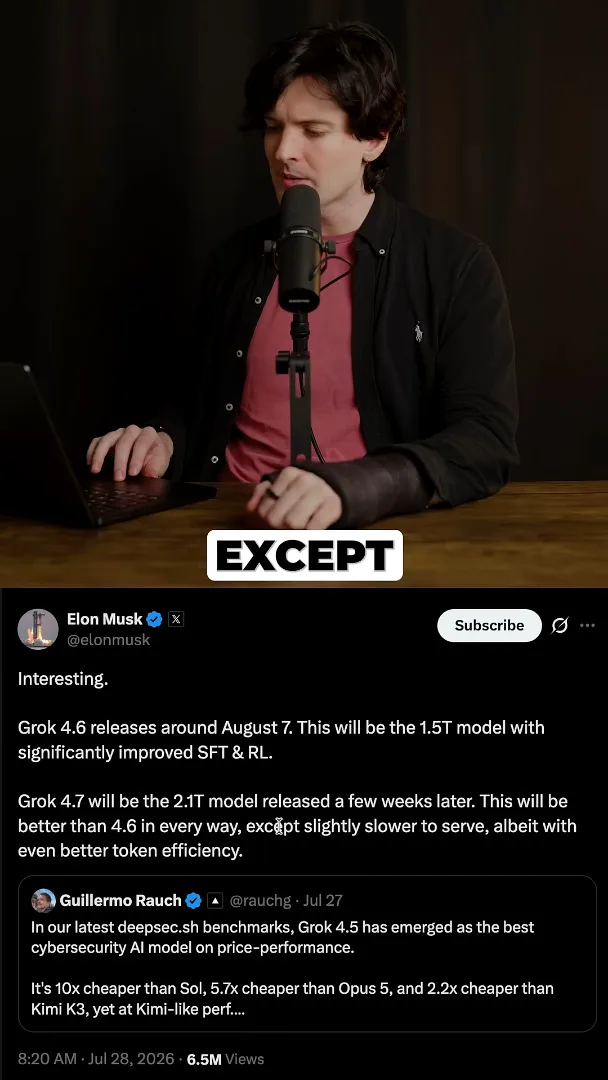
Musk also predicted that 4.7 would be better in every way except serving speed and would use tokens more efficiently. I dispute that prediction: I cite about 38,000 tokens per task for Grok 4.6 at x-high and 81,000 for 4.7. I describe this as roughly twice the cost, but the short does not give enough pricing or test details to establish a general cost ratio or intent to mislead.
Mehr aus diesem Kanal
 36:07EN
 Theo - t3․gg· 27. Okt. 2026Theo on Token Costs, Coding Agents, and the Price of AI CapabilityTheo Browne · Ping LabsA viral estimate of Lauren's AI spending prompts a closer look at cache pricing, benchmarks, and the changing work of coding agents.
 30:37ENTheo - t3․gg· 26. Okt. 2026Theo’s Three Skills for Reviewing and Shipping with Coding AgentsTheo Browne · Ping LabsHow sol-loop, full-send and full-stop encode review, verification and different levels of merge authority.
 0:43ENTheo - t3․gg· 23. Okt. 2026Theo Distinguishes Security Vulnerabilities from Active AttacksTheo Browne · Ping LabsA short explanation of why disclosed software flaws and reported attacks are different kinds of security news.
 29:22ENTheo - t3․gg· 22. Okt. 2026Theo on Security Vulnerabilities, Stolen API Keys and AITheo Browne · Ping LabsA look at the gap between vulnerability disclosure and patching, and a speculative account of why stolen inference keys may be valuable.
 31:13ENTheo - t3․gg· 20. Okt. 2026Theo on Why Smarter Models Help More Than DevelopersTheo Browne · Ping LabsFrom game modifications to compiler experiments, Theo revisits his assumptions about who benefits from more capable AI.
 31:47ENTheo - t3․gg· 18. Okt. 2026Theo on Asking Agents for Outcomes and Building the Tools They NeedTheo Browne · Ping LabsA tool-call report, a troubleshooting playbook and connected data show how prompting can reshape product engineering.