In 30 Sekunden
Matthew Berman reviews the January 2026 release of Kimi K2.5, focusing on visual coding, published benchmarks and a beta agent swarm that divides work among sub-agents. He watches demonstrations, tries a pricing-research task and considers running the model locally. The figures are Moonshot’s reported evaluations or Berman’s historical demonstration, not universal performance guarantees. The weights carry a modified MIT license with a branding condition for certain large commercial services.
- 1Multimodal open weightsMoonshot describes Kimi K2.5 as a visual and agentic model continued from K2-Base with approximately 15 trillion mixed visual and text tokens.
- 2Benchmark comparisonsBerman reviews vendor-reported results including 76.8 on SWE-bench Verified and 74.9 on BrowseComp with context management. These are configuration-specific measurements.
- 3Coding from visual inputThe demonstrations include recreating a website from visual input and solving a maze using Python.
- 4Parallel agent swarmA coordinating agent divides tasks among specialized sub-agents and combines their results. Moonshot’s reported runtime improvements are specific to its evaluations.
- 5Check benchmarks in practiceBerman notes that benchmark optimization is possible and says real-world testing matters alongside published scores.
- 6Price and hardwareBerman’s model-generated price comparison and memory estimate are historical examples, not verified current prices or universal hardware requirements.
Das Wichtigste
- Kimi K2.5 is a multimodal mixture-of-experts model with approximately one trillion total parameters and 32 billion active parameters per token.
- Moonshot reports strong results on selected agentic, coding and vision benchmarks, but comparisons depend on the evaluation and configuration.
- Agent Swarm decomposes work among parallel sub-agents; the claimed speedup is based on particular internal evaluations.
- Visual demonstrations include website reconstruction, maze solving with code and iterative visual debugging.
- Local deployment of the full model requires substantial memory, and exact requirements depend on quantization, runtime and workload.
- The model weights use a modified MIT license that imposes a display condition on certain very large commercial products or services.
Den bearbeiteten Text nach Kapiteln lesen
Kimi K2.5 and published benchmarks
Berman introduces multimodal capabilities, open weights and agent swarms. He reviews Moonshot’s reported agentic, coding, vision and cost comparisons.
Kimi K2.5 is an open-weight model from Moonshot AI that emphasizes coding, vision and agentic work. I am impressed by the release, particularly the beta Agent Swarm feature. The model can be accessed through Kimi’s services or downloaded for local deployment, subject to the resources needed to run it.
Moonshot describes a swarm that can coordinate up to 100 sub-agents and 1,500 tool calls, and reports up to a 4.5-fold reduction in execution time for its compared setup. Those numbers describe the company’s tests, not a guaranteed speedup on every task. I would like to try it with my own ClaudeBot, though I have not tested that integration yet.
According to Moonshot, K2.5 continues pretraining from Kimi K2-Base on approximately 15 trillion mixed visual and text tokens. It is natively multimodal and designed to handle visual inputs alongside language and tool use. In the published agentic comparisons, I see Kimi doing particularly well on BrowseComp and DeepSearchQA.
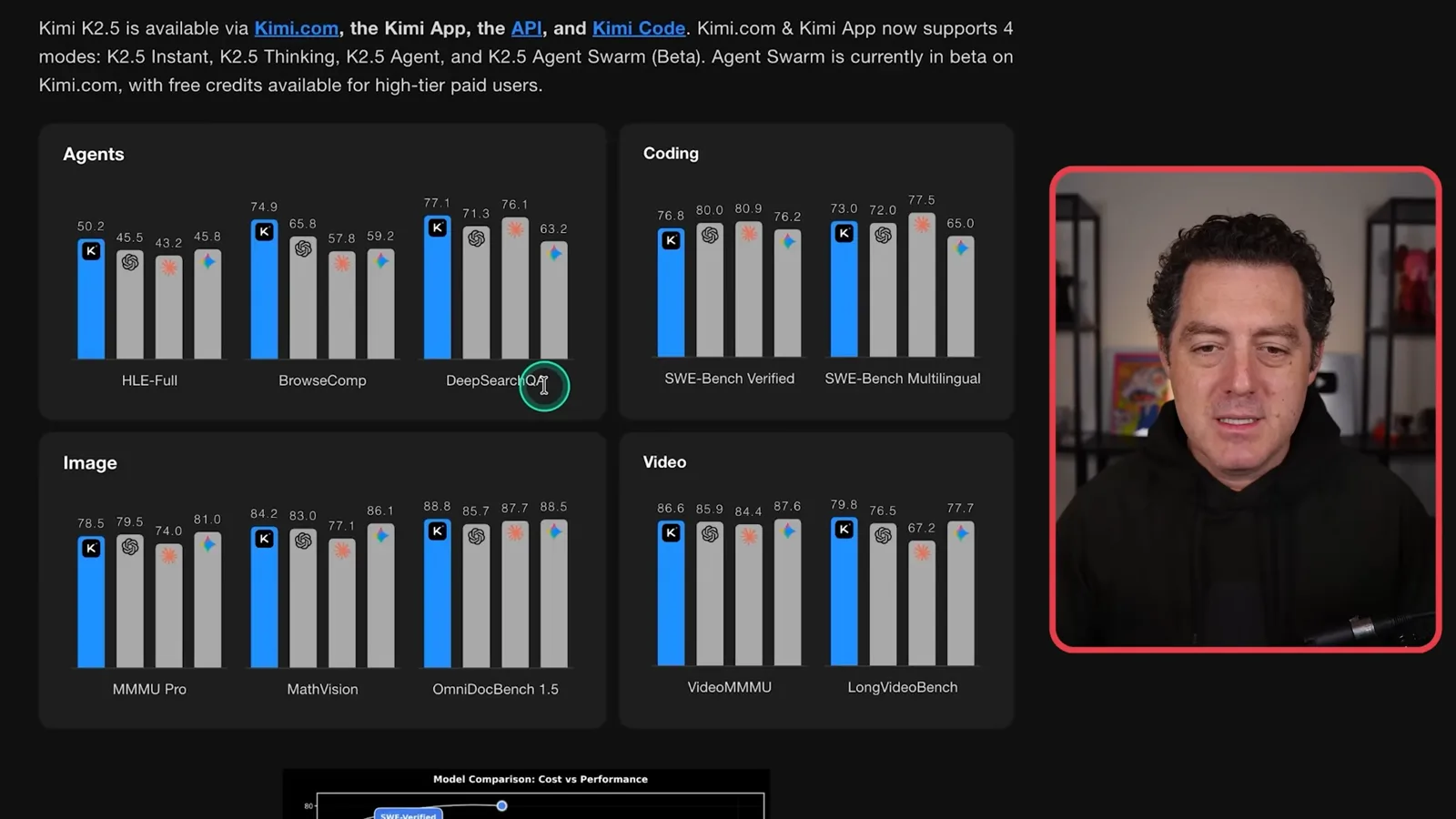
The displayed chart reports 74.9 on BrowseComp with context management, and 76.8 on SWE-bench Verified for coding. Kimi trails GPT-5.2 and Claude Opus 4.5 on that displayed coding comparison while exceeding the shown Gemini 3 Pro score. These are Moonshot’s reported results for specified model and test configurations, not a universal ranking.
The vision chart shows 78.5 on MMMU-Pro, behind the displayed GPT-5.2 and Gemini 3 results but above Claude Opus 4.5; the video tests also show strong results on the selected measures. I see different strengths across models, although one benchmark chart cannot establish that a model is best for all coding or visual work.
Cost is another part of the comparison. Moonshot’s chart places Kimi at a lower reported cost for several tasks, while Berman points to attractive benchmark performance. Price, test settings and the amount of compute used all affect comparisons, so the chart is a starting point rather than a fixed verdict.
Visual coding and maze demonstrations
Examples include recreating a website, finding a path through a maze and iterative visual debugging. The examples illustrate particular tasks rather than a general guarantee.
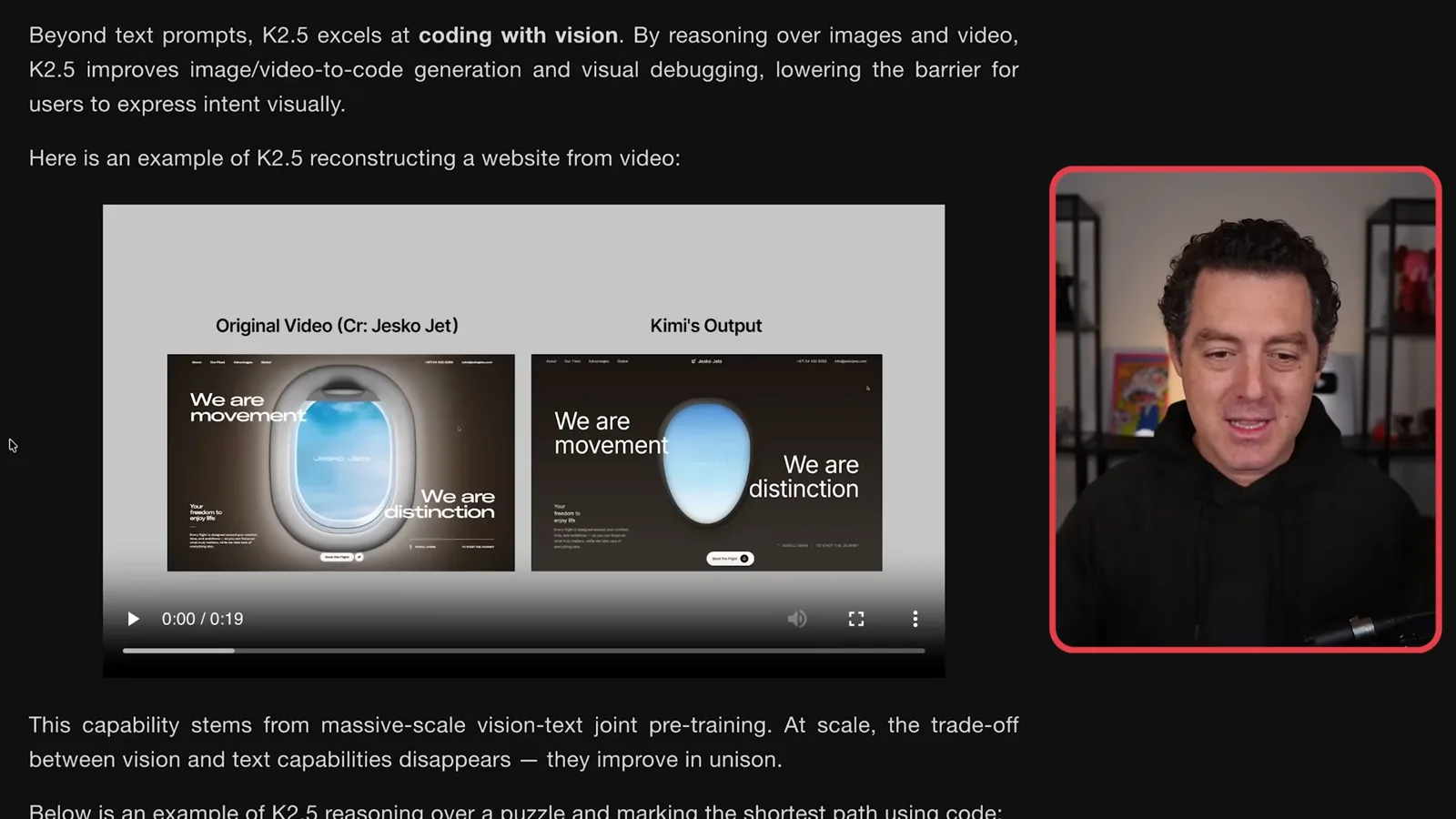
The release page shows examples of websites with smooth motion and colorful designs. In one visual-coding demonstration, Kimi recreates a site from visual input without being given its source code. Moonshot attributes this to joint vision-and-text pretraining; the example is a selected demonstration, not evidence that every design will be reproduced exactly.
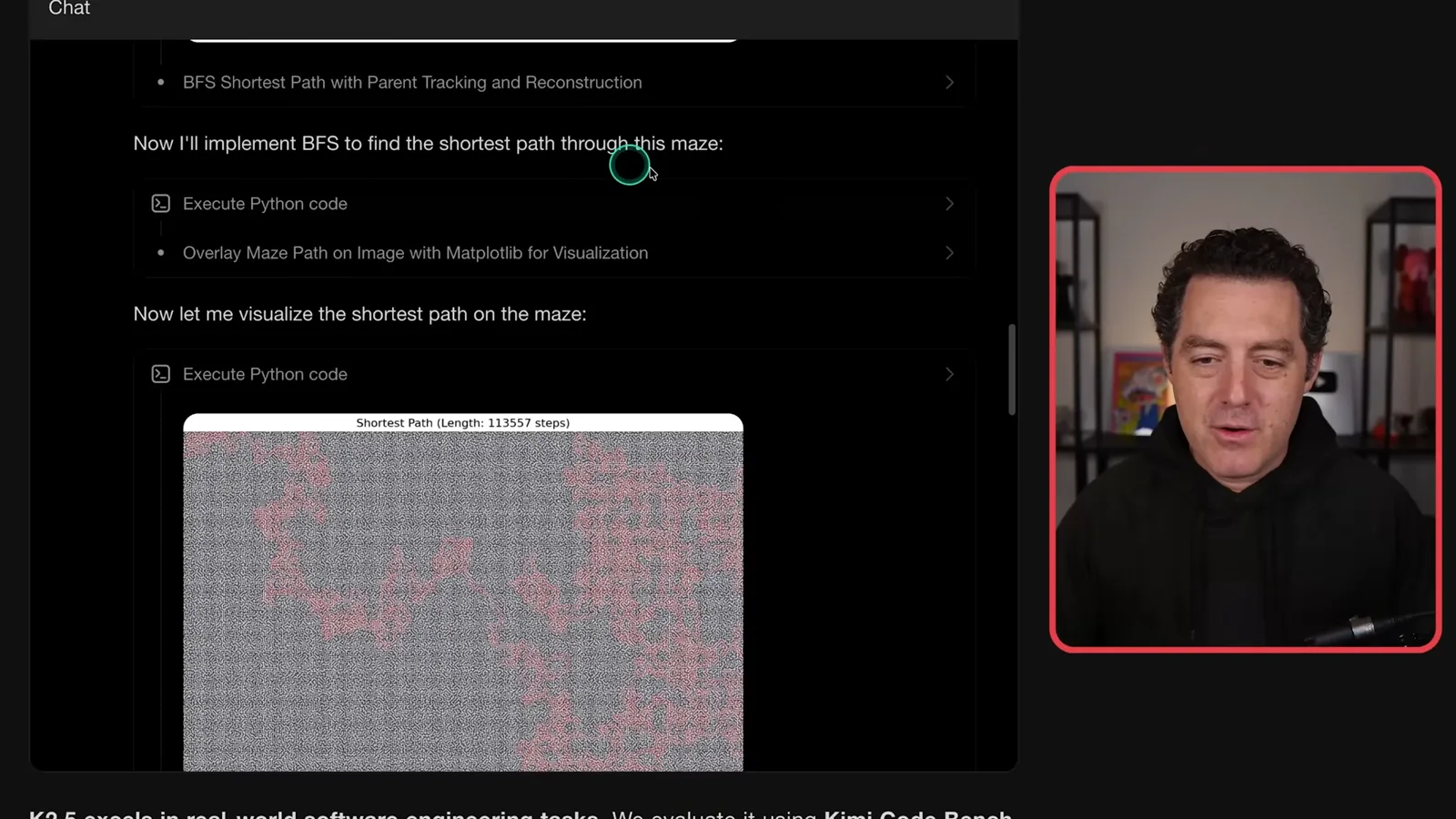
Another example asks the model to find the shortest route through a complicated maze image. It uses Python to process the image, implement breadth-first search and draw the route; breadth-first search is an algorithm, not a library. The displayed output labels the path as roughly 113,000 steps, and a closer view makes it easier to inspect.
A further Kimi Code demonstration translates the aesthetic of Matisse’s La Danse into an app. Berman describes an iterative visual-debugging loop: write code, inspect a rendered image, change the code and repeat. The shown sequence is sped up and illustrates the workflow rather than providing a controlled performance measurement.
How agent swarms divide work
Berman explains orchestration, sub-agent delegation and claimed runtime improvements. A sample workload distributes YouTube research across many fields.
Moonshot says its parallel agent reinforcement learning approach trains K2.5 to direct a swarm. An orchestrator breaks a complex job into parts, delegates them to specialized agents and combines their outputs. I compare that workflow with ClaudeBot and want to try it locally because I do not want to send my own ClaudeBot data to remote servers.
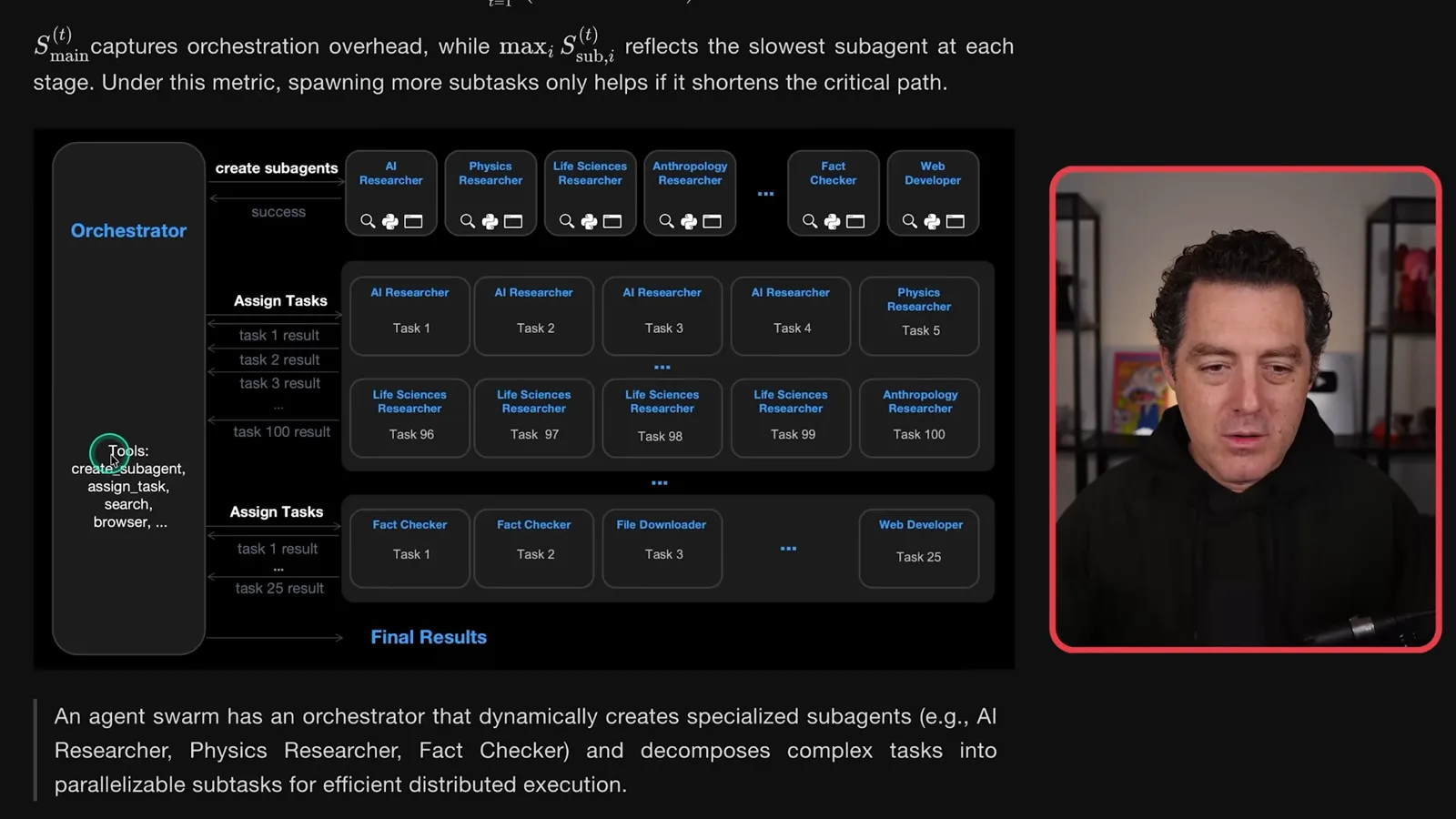
The orchestration diagram shows agents such as researchers, fact-checkers and web developers receiving assigned tasks. Moonshot reports up to an 80% reduction in end-to-end runtime in internal evaluations, with gains varying by workload. Parallel work can shorten the critical path, but coordination, dependencies and the slowest subtask still matter.
Berman reviews charts comparing agent performance and task complexity, then watches a demonstration assigning research across 100 YouTube subject areas. Each sub-agent produces an analysis and the coordinator assembles the responses. The visual shows how a broad task can be divided; it does not independently verify every result.
Office work and expanded benchmark tables
Moonshot shows documents, spreadsheets, PDFs and slides. Berman examines broader benchmark tables and cautions that real-world evaluation remains necessary.
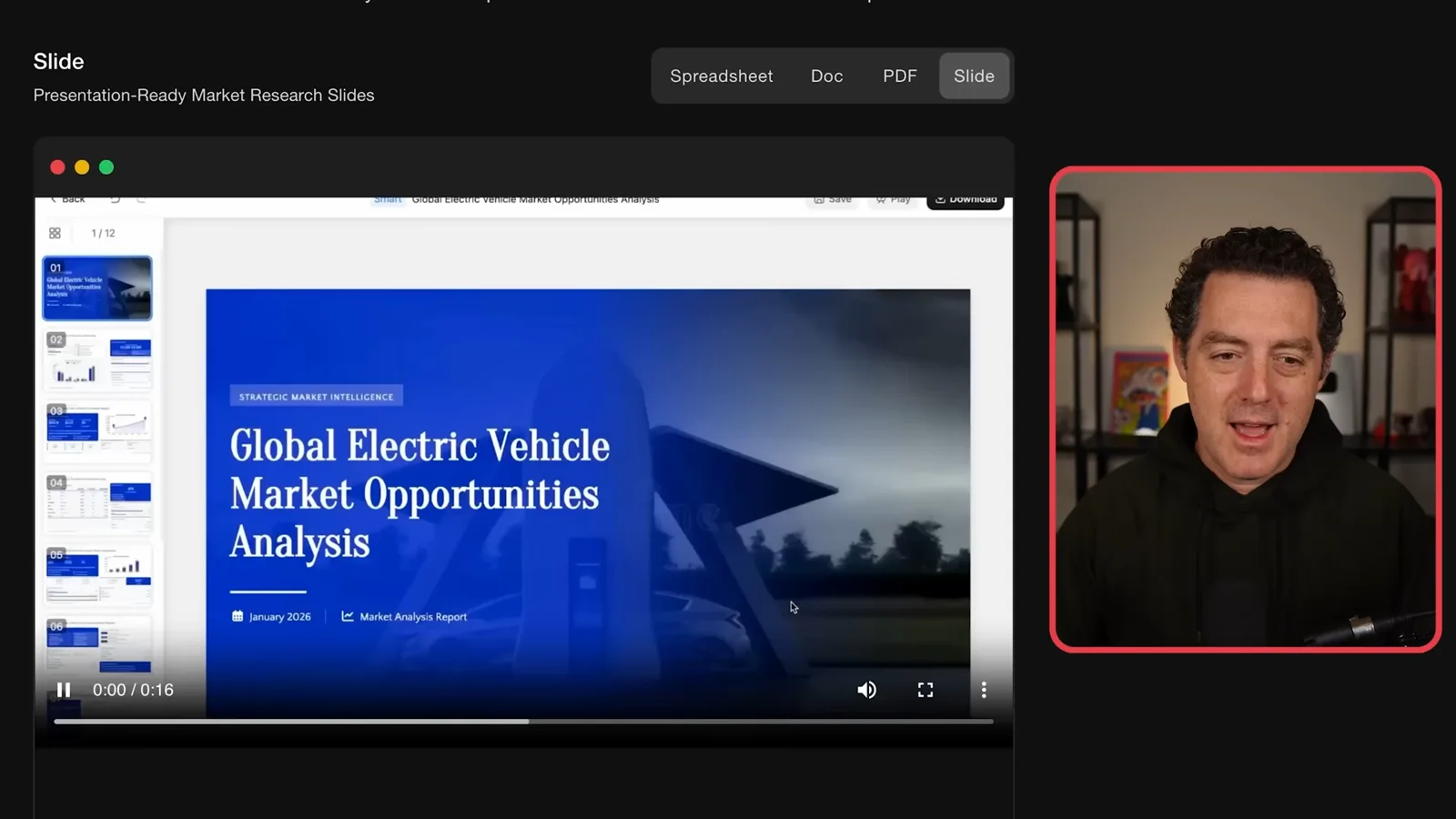
Moonshot also demonstrates knowledge-work tasks: annotating a Word document, constructing financial models with pivot tables, writing LaTeX equations in a PDF and creating a slide deck. Berman notes that some office-task comparisons use K2 Thinking as the baseline. A polished output still needs review for correctness.
The broader benchmark table compares K2.5 with several contemporaneous frontier models in reasoning, vision, coding and agentic search. Results vary by benchmark: the video highlights strong visual results and competitive coding, while some other models lead selected tests. For example, the vendor’s agentic search table distinguishes BrowseComp scores with and without context management and with Agent Swarm.
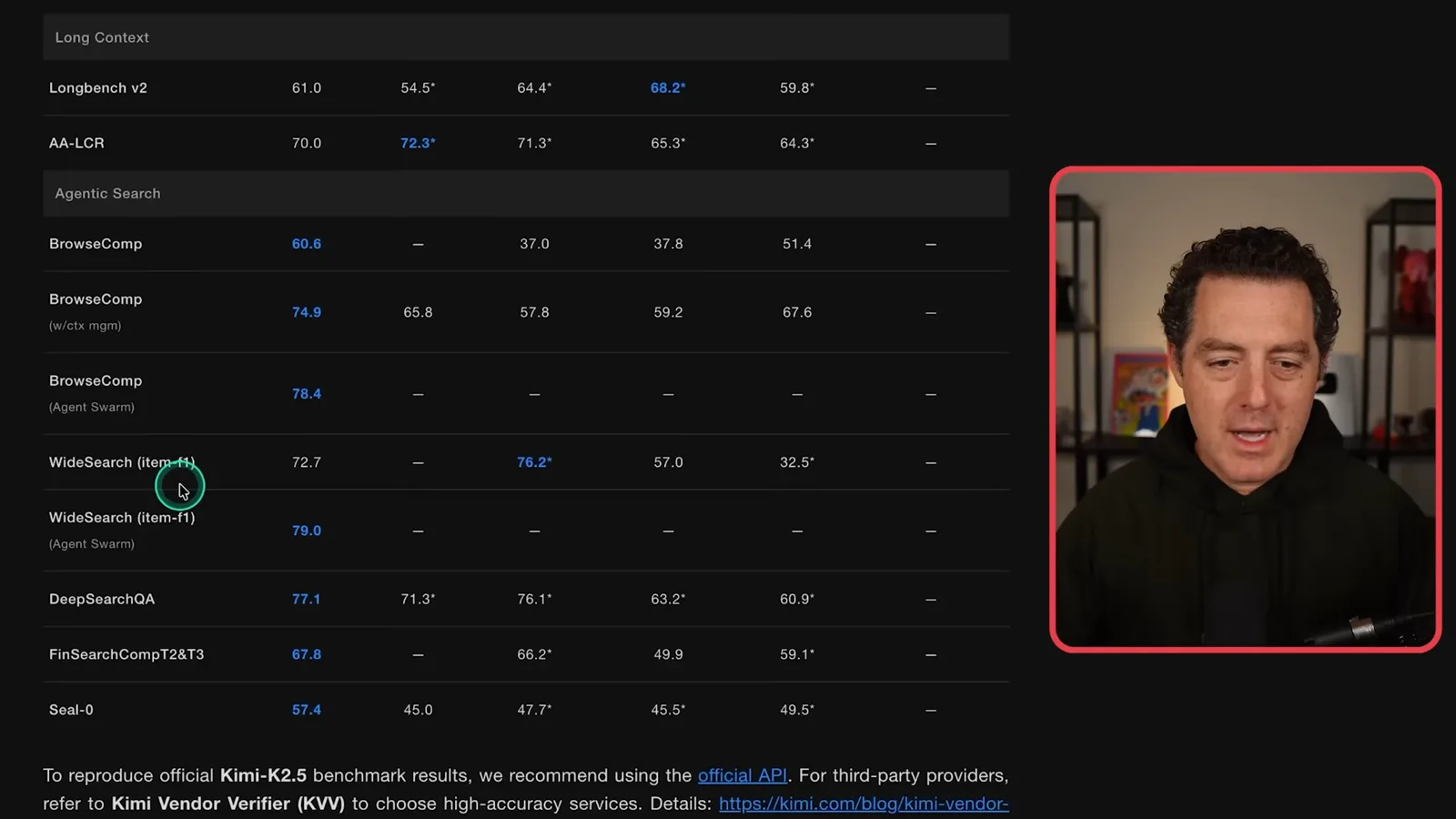
Benchmarks are useful as an initial signal, but Berman raises the possibility that models may be optimized for particular tests. I want to try the model on actual tasks, including building applications, rather than relying solely on the scorecard. Moonshot also makes an API available for people to run their own evaluations.
Pricing and running locally
Berman asks Kimi to research historical API prices and estimate local hardware requirements. He concludes that the full model is large and hopes to see further community builds.
For a live test, I ask Kimi to compare its API prices with Claude Opus 4.5, GPT-5.2 and Gemini 3. It searches the web, writes Python and produces a comparison chart. Berman estimates the response speed at around 40–50 tokens per second in this session; that is an observation, not a measured service guarantee.
The generated chart gives Kimi K2.5 prices of $0.60 per million input tokens and $3 per million output tokens, and Claude Opus 4.5 prices of $5 and $25 respectively. These are figures shown in a January 2026 model-generated comparison; pricing and conditions change, so readers should verify current provider rates before deciding.
I then ask how much memory local use requires. The answer shown estimates about 632 GB for one INT4 configuration; requirements vary with the weights, quantization, runtime, context and offloading. K2.5 has about one trillion parameters, not one trillion tokens, with about 32 billion activated per token. Downloadable weights do not make the full model easy to run on ordinary hardware.
I hope the community will produce more practical quantized builds. The code and weights are released under a [modified MIT license](https://github.com/MoonshotAI/Kimi-K2.5/blob/master/LICENSE), rather than without conditions: commercial products or services above the specified monthly-user or revenue thresholds must prominently display the Kimi K2.5 name. I am keen to test the model and see what people build.
Mehr aus diesem Kanal
 34:21EN
 Matthew Berman· 27. Okt. 2026Matthew Berman Examines Anthropic’s IPO Filing, AI Growth and GovernanceMatthew Berman, Sam Altman · Forward FutureThe presenter reviews the S-1’s financial metrics, compute strategy and voting structure while questioning the tension between rapid AI development and safety.
 0:26ENMatthew Berman· 25. Okt. 2026Sam Altman on Human Values and Problem-Solving in an AI WorldSam Altman · OpenAIIn a short interview excerpt, Altman considers the enjoyment of solving hard problems and the human role in interpreting results.
 0:36ENMatthew Berman· 25. Okt. 2026Kimi K3.1 and a Rubik’s Cube Solver DemonstrationMatthew Berman · Forward FutureMatthew Berman shows a scrambled virtual cube being solved and gives the Kimi K3.1 test a favorable assessment.
 0:21ENMatthew Berman· 24. Okt. 2026An AI-Generated Kimi Benchmark Chart Used Invented ScoresMatthew Berman · Forward FutureMatthew Berman asks for a graph of Kimi K3.1 Pro benchmarks, then discovers that the displayed figures are illustrative placeholders.
 25:50ENMatthew Berman· 24. Okt. 2026Kimi K3.1 Pro Tested: Strong 3D Demos, Uneven Results and Competitive PricingMatthew Berman · Forward FutureMatthew Berman tests the open-weight model on coding, 3D rendering and visual explanations, then compares benchmark results and prices.
 32:20ENMatthew Berman· 23. Okt. 2026Who Is Local AI For? The Costs, Trade-offs and a Hybrid FutureMatthew Berman · Forward FutureMatthew Berman weighs data control and independence against hardware cost, setup complexity and inference speed.