In 30 Sekunden
Matthew Berman explains Fable Studio’s 2023 Showrunner research demonstration, from simulated characters and prompted storylines to image generation, staging and voices. He finds the examples technically striking but argues they do not yet match human comedy writing; his predictions about industry disruption remain speculative.
- 1Characters in a simulationThe project builds on ideas from generative-agent research, with simulated character histories and interactions informing stories.
- 2An experimental imitationFable described the South Park material as research-only and did not release a public South Park episode maker.
- 3Separate visual and story systemsThe researchers describe custom image models alongside language-model and agent components for characters, scenes and dialogue.
- 4Connecting scenesThe proposed dramatic operators and plot patterns are intended to structure an episode and link scenes.
- 5Comedy remains a challengeBerman finds the examples impressive but says they lack the writing and timing of the human-created show.
Das Wichtigste
- The 2023 South Park-style output was a research demonstration, not an authorized South Park production or publicly released episode generator.
- Showrunner combined user direction, simulated agents, language models, image models and staging tools.
- The proposed plot patterns and dramatic operators aimed to improve continuity across scenes.
- The quality of a short demonstration does not establish reliable production of finished television.
- The video raises unresolved questions about creative labor and rights to existing characters and performances.
Den bearbeiteten Text nach Kapiteln lesen
A simulated television world
Berman introduces the 2023 Fable demonstration and the generative-agent research that inspired it. Its South Park imitation was a research example rather than an official show.
In July 2023, Fable Studio demonstrated a system for generating animated scenes in a simulated South Park-like world. A user can provide a story direction, while software assembles characters, dialogue, visuals and voices. The demonstration is a research prototype, not an official South Park production or evidence that anyone could already make a polished season from one prompt.
The idea builds on an earlier Stanford and Google research project in which 25 generative agents inhabited a simulated town. Their architecture stored and retrieved memories and used reflections to influence behavior. I previously thought this could make game characters more responsive, with events in their simulated lives affecting later interactions.
Fable’s Showrunner project applies a related multi-agent idea to entertainment. The researchers describe simulated characters with backgrounds, memories, goals and relationships, and use a higher-level story prompt to guide events. These are computational character representations, not evidence that the agents are living people.
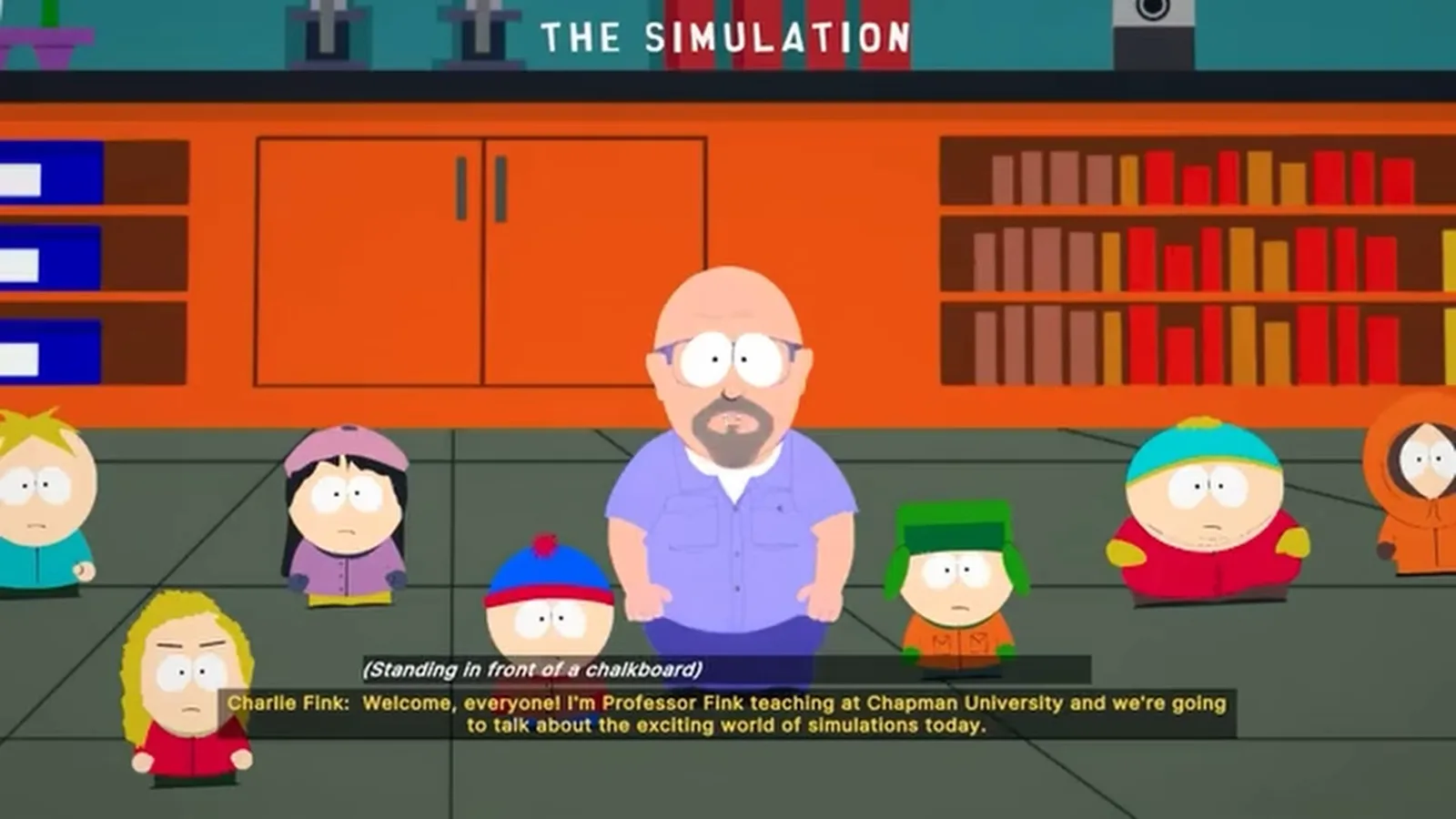
The clip shows a simulated classroom where a teacher and familiar cartoon characters discuss virtual worlds. The voices and animation evoke South Park, but the sample is an experimental imitation. Fable described its South Park work as research-only and said it would not release a tool for making public South Park episodes; the show’s creators did not authorize the demonstration.
From models and memories to scenes
The proposed workflow combines custom image models, character context and story instructions. Berman walks through how the system describes generating an episode.
Berman describes a pipeline using customized Stable Diffusion for imagery and language models and agent software for story generation. The research combines several components rather than relying on a single prompt alone. The creators supply a scenario and the resulting output still needs review; the demonstration does not establish a fully hands-off, broadcast-ready production process.
For the visual models, the paper describes training on approximately 1,200 character examples and 600 background examples associated with the show. Separate character and setting models allow the system to assemble scenes in its simulated world. These are the authors’ reported inputs for this prototype, not a claim that all visual rights were cleared.
For story and script, the researchers describe a system using language models, embeddings and character memories to maintain context. A user can specify a hero, setting, cast and broad story direction; the system then generates scenes and dialogue from those inputs and simulation data. The approach aims to turn character interactions into a coherent script.
The paper describes beginning with an idea, synopsis and major events across a simulated week, roughly three hours of simulation play time. Berman says the system selects material for an episode of about 22 minutes. That is the described research workflow and goal, not a guarantee that every run yields a complete, coherent episode of that length.
The Showrunner pipeline
User input and simulation data feed language-model prompt chains, casting and scene staging. Plot patterns and dramatic operators are meant to help with continuity.
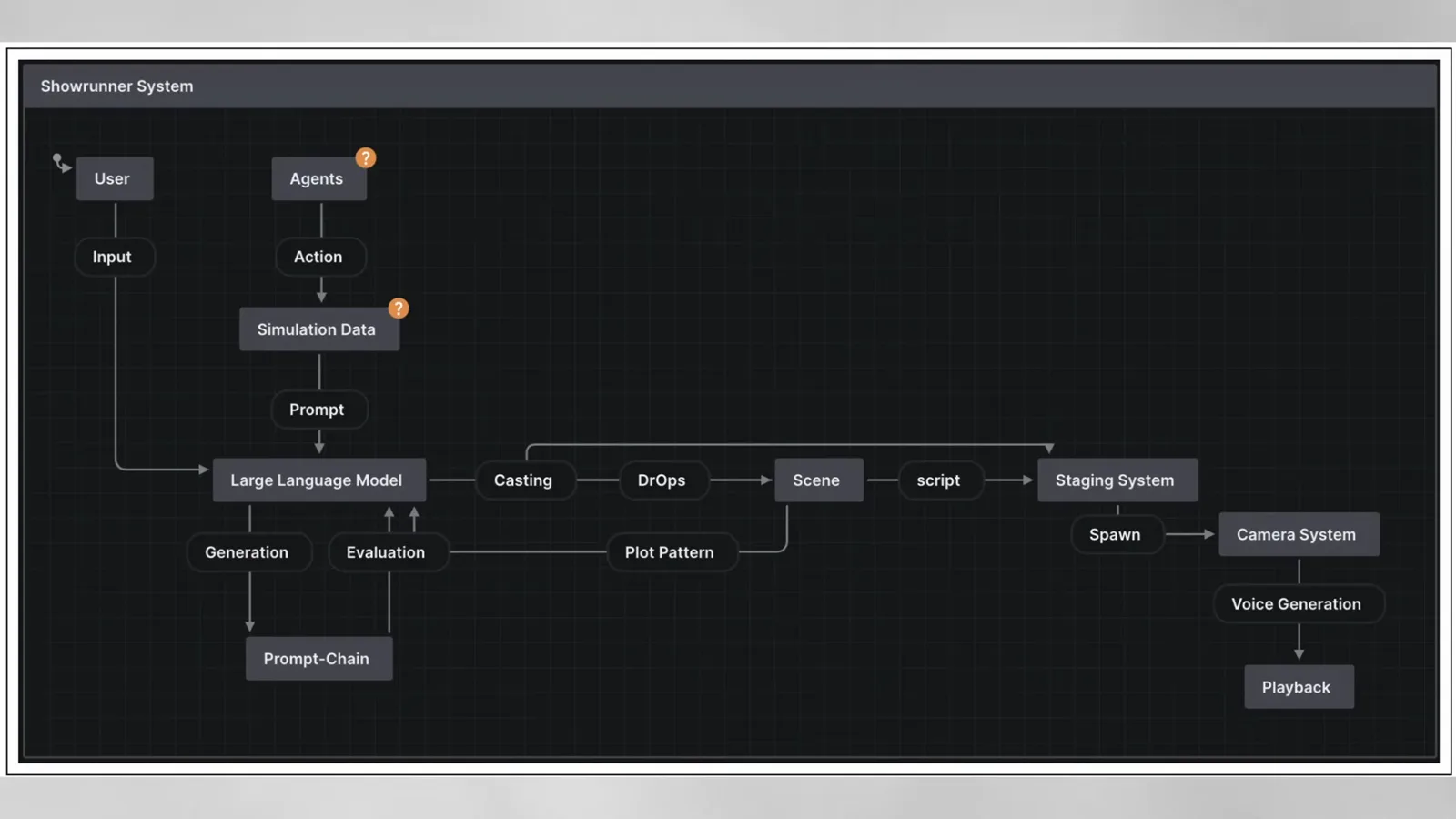
The workflow diagram separates the user’s direction from agent actions and simulation data. Those inputs feed language-model prompt chains and evaluation, followed by casting and scene construction. A staging system, camera and voice generation contribute to the final playback; multiple steps are involved beyond a short story prompt.
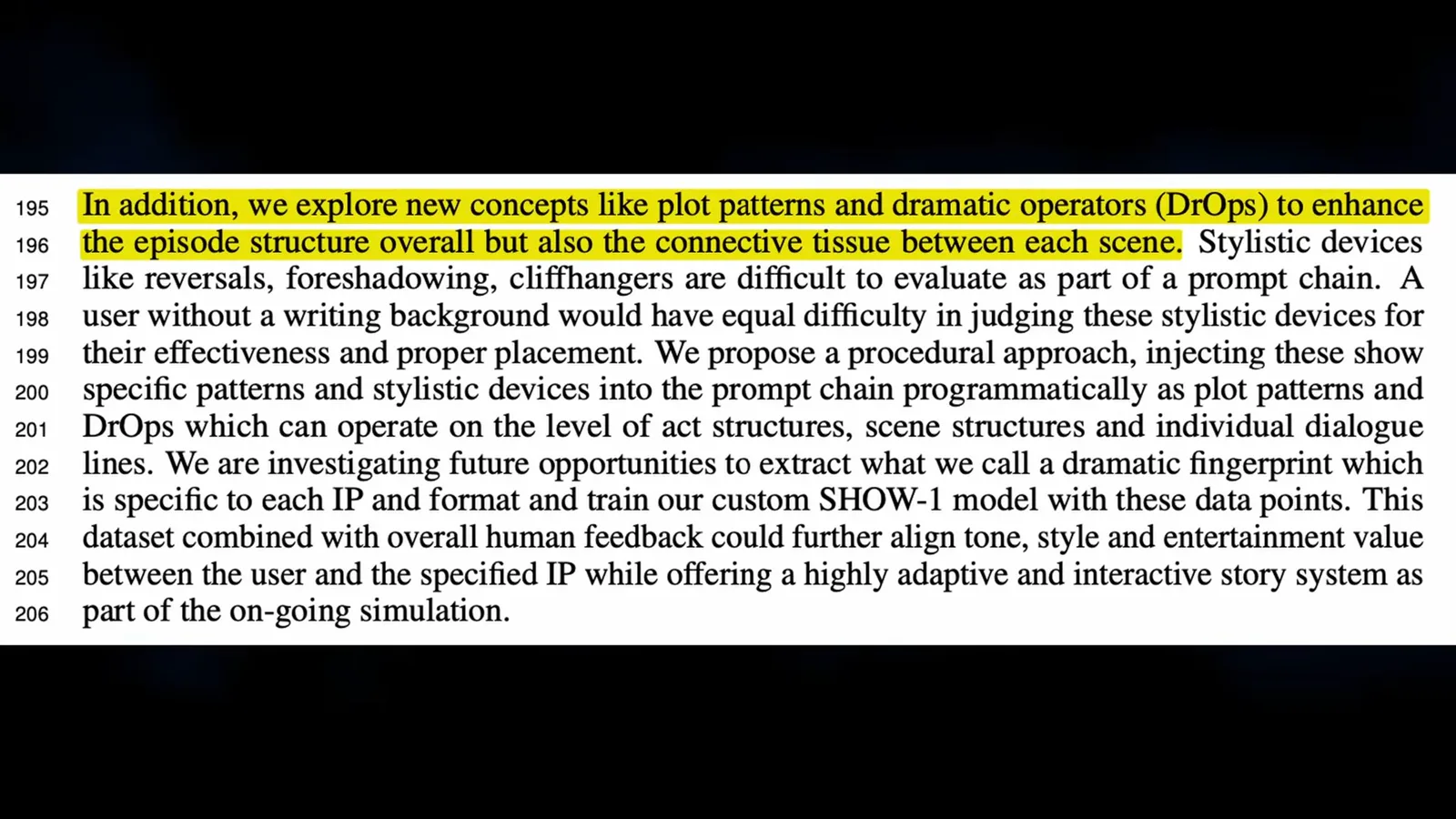
The researchers also propose plot patterns and “dramatic operators,” or DrOps, to help organize scenes and their connections. Devices such as foreshadowing or reversals can be incorporated into the prompt process. This is an attempt to address long-form structure, not proof that the system has solved continuity or dramatic writing.
Creative work and the limits of the demo
Berman considers writers, actors and other workers amid the 2023 strike. He judges the examples impressive but not yet a replacement for human comedy writing.
The demonstration raises questions for writers, actors and illustrators. At the time of this video, Hollywood writers were on strike, with AI among the issues in labor negotiations. The project also raises questions about the use of existing characters, performances and training material; the video does not settle those rights questions.
I watched several generated examples and found them impressive, but I do not think they replicate the human storytelling and comic timing that make South Park work. Looking and sounding like a familiar show is different from consistently matching its writing. That is my judgment of the examples, not a controlled quality assessment.
I expect AI to disrupt entertainment and affect jobs, while also helping people work more efficiently and creating new kinds of work. Those are predictions, not outcomes established by this prototype. Fable said it was exploring other shows; at the time of the video, I could not try the system because its code had not been released. The broader ethical and creative questions remain open.
Mehr aus diesem Kanal
 34:21EN
 Matthew Berman· 27. Okt. 2026Matthew Berman Examines Anthropic’s IPO Filing, AI Growth and GovernanceMatthew Berman, Sam Altman · Forward FutureThe presenter reviews the S-1’s financial metrics, compute strategy and voting structure while questioning the tension between rapid AI development and safety.
 0:26ENMatthew Berman· 25. Okt. 2026Sam Altman on Human Values and Problem-Solving in an AI WorldSam Altman · OpenAIIn a short interview excerpt, Altman considers the enjoyment of solving hard problems and the human role in interpreting results.
 0:36ENMatthew Berman· 25. Okt. 2026Kimi K3.1 and a Rubik’s Cube Solver DemonstrationMatthew Berman · Forward FutureMatthew Berman shows a scrambled virtual cube being solved and gives the Kimi K3.1 test a favorable assessment.
 0:21ENMatthew Berman· 24. Okt. 2026An AI-Generated Kimi Benchmark Chart Used Invented ScoresMatthew Berman · Forward FutureMatthew Berman asks for a graph of Kimi K3.1 Pro benchmarks, then discovers that the displayed figures are illustrative placeholders.
 25:50ENMatthew Berman· 24. Okt. 2026Kimi K3.1 Pro Tested: Strong 3D Demos, Uneven Results and Competitive PricingMatthew Berman · Forward FutureMatthew Berman tests the open-weight model on coding, 3D rendering and visual explanations, then compares benchmark results and prices.
 32:20ENMatthew Berman· 23. Okt. 2026Who Is Local AI For? The Costs, Trade-offs and a Hybrid FutureMatthew Berman · Forward FutureMatthew Berman weighs data control and independence against hardware cost, setup complexity and inference speed.