In 30 Sekunden
In this April 2024 review, Matthew Berman praises the Rabbit R1’s compact hardware and quick conversational responses, but finds battery life, connectivity and DoorDash ordering frustrating. Spotify worked well in his tests, while voice control of the device itself and promised agent workflows felt limited. The review is an early experience with one device; later software and service availability may differ. Berman says Rabbit did not sponsor the review, which includes a separate Careerist sponsorship.
- 1A personal reviewBerman says Rabbit did not sponsor the review; the video separately includes a Careerist advertisement.
- 2Hardware and controlsHe praises the compact design, physical button, scroll wheel and rotating camera.
- 3Battery concernsHe reports rapid standby drain on his unit and fast charging, without a controlled comparison.
- 4Voice and visionHe demonstrates spoken answers and camera-based identification and praises their speed.
- 5Connected servicesThe rabbithole portal stores interaction history and connects services; Spotify works for him, while DoorDash is slow and confusing.
- 6The early verdictBerman recommends the device to curious early adopters but says the agent experience needs work.
Das Wichtigste
- Berman likes the compact design, controls and build quality of the $199 R1, designed with Teenage Engineering.
- He reports significant standby battery drain on his unit, though the observation is not a controlled battery test.
- Voice responses and identifying a CPU through the camera felt fast in his demonstrations, without establishing general accuracy.
- Spotify worked in his test, while DoorDash was slow and difficult to navigate.
- He sees promise in agent-based automation but cautions against buying hardware solely for future updates.
Den bearbeiteten Text nach Kapiteln lesen
Design, controls and battery
Berman introduces his personal review and praises the R1’s industrial design and compact form. He raises a significant concern about standby battery drain.
Matthew Berman reviews the Rabbit R1 in April 2024, saying Rabbit did not sponsor his review and that he is offering his personal impressions rather than a formal technology assessment. The video also contains a separate paid Careerist segment. His findings describe one early unit and the software available at the time.
Berman likes the R1 as a standalone device, arguing that its physical form makes it feel personal in a way an app might not. He recognizes that whether the product could instead be an app is debatable, and treats his preference for the dedicated form as subjective.
He praises the small, light body, screen and solid construction, and notes that Teenage Engineering collaborated on the design. He likes the tactile button and scroll wheel, the speaker and the rotating camera, which can face either direction for vision requests.
The device has USB-C charging, a SIM slot, Wi-Fi and Bluetooth. A single button and scroll wheel provide physical input, while voice is the primary interaction. At the time of the review, Berman cites a roughly $199 price without a required device subscription.
Battery life is his main hardware complaint. He says his unit lost around one percent every five to ten minutes while idle and that mobile service appeared to drain it quickly, so he turned cellular connectivity off at home. He cannot tell whether his particular battery is defective; this is an informal observation, not a standardized battery-life result.
He says the device charges quickly, reaching full in under an hour in his experience. The home screen shows time, battery and an animated rabbit; holding the button opens voice input. A question about making Snake in Python produces spoken steps, which he stops partway through.
Voice, vision and device controls
The device answers questions and identifies a processor in demonstrations. Berman discusses the scroll wheel, settings and speaker.
Berman is impressed by the response speed, saying answers generally arrive within a few seconds in his tests. He also asks about reviews of the film Civil War and plays the device’s response. His examples illustrate the interaction rather than proving the speed or accuracy of every answer.
For vision, he double-taps the button to open the camera and asks it to identify a processor in his hand. The R1 identifies it as a CPU. Berman praises the speed and compares it favorably to complaints he had heard about the Humane AI Pin, without offering a controlled side-by-side measurement.
He shows that shaking the R1 opens settings for brightness, volume, Bluetooth, networking and other functions. Holding the button while using the wheel adjusts brightness. He likes these interaction choices but finds scrolling through the menu slower than he would prefer.
Berman says the speaker is adequate for spoken responses but less satisfying for music. Bluetooth provides an alternative through headphones or earbuds, which he says paired easily in his experience.
Setup, Spotify and DoorDash
He explores the rabbithole portal and connected services. Spotify works in his test, but he struggles with the food-ordering workflow.
Setup begins with an account in rabbithole, Rabbit’s web portal. Berman shows its journal of prior questions and vision interactions, then the connections page. At the time of his review, it offered Spotify, DoorDash, Uber and Midjourney; he connected the first two and notes that Midjourney required a paid account.
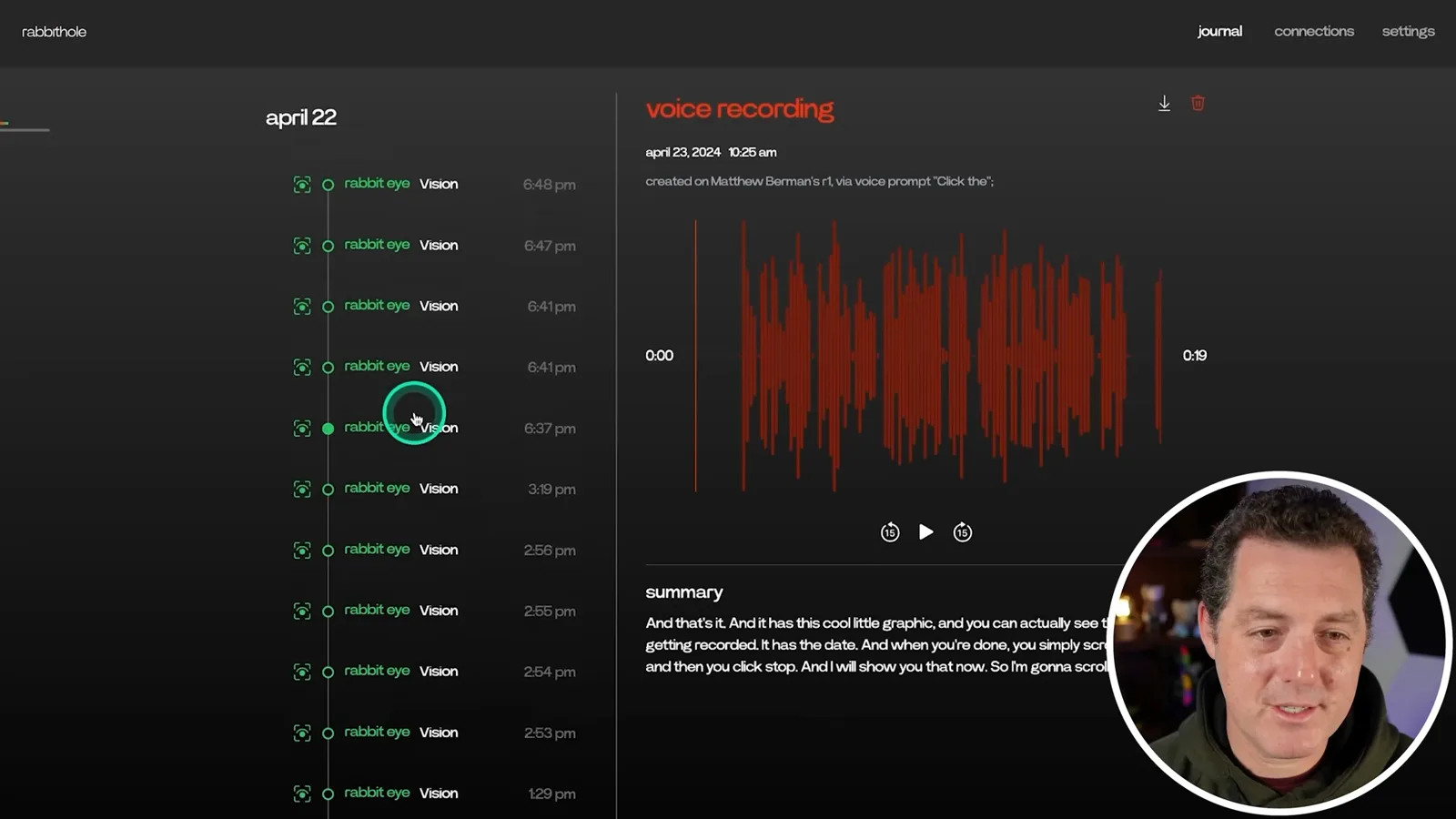
Berman describes Rabbit’s idea of agents operating services on a user’s behalf and characterizes the integration as clicking through apps rather than using APIs. Rabbit’s own contemporaneous description says its agents operate services through cloud sessions; the video does not establish the implementation of every integration or prove that no APIs are involved.
He asks the R1 to play Daft Punk and reports that Spotify begins playing quickly, with cover art displayed. He mutes or covers the music in the video for copyright reasons. The successful request is a single example, not a comprehensive test of the integration.
DoorDash is a different experience. Berman asks it to assemble a sushi order and encounters a warning that loading may take time and availability varies by region. He says it often takes roughly 30 seconds or longer to load in his attempts.
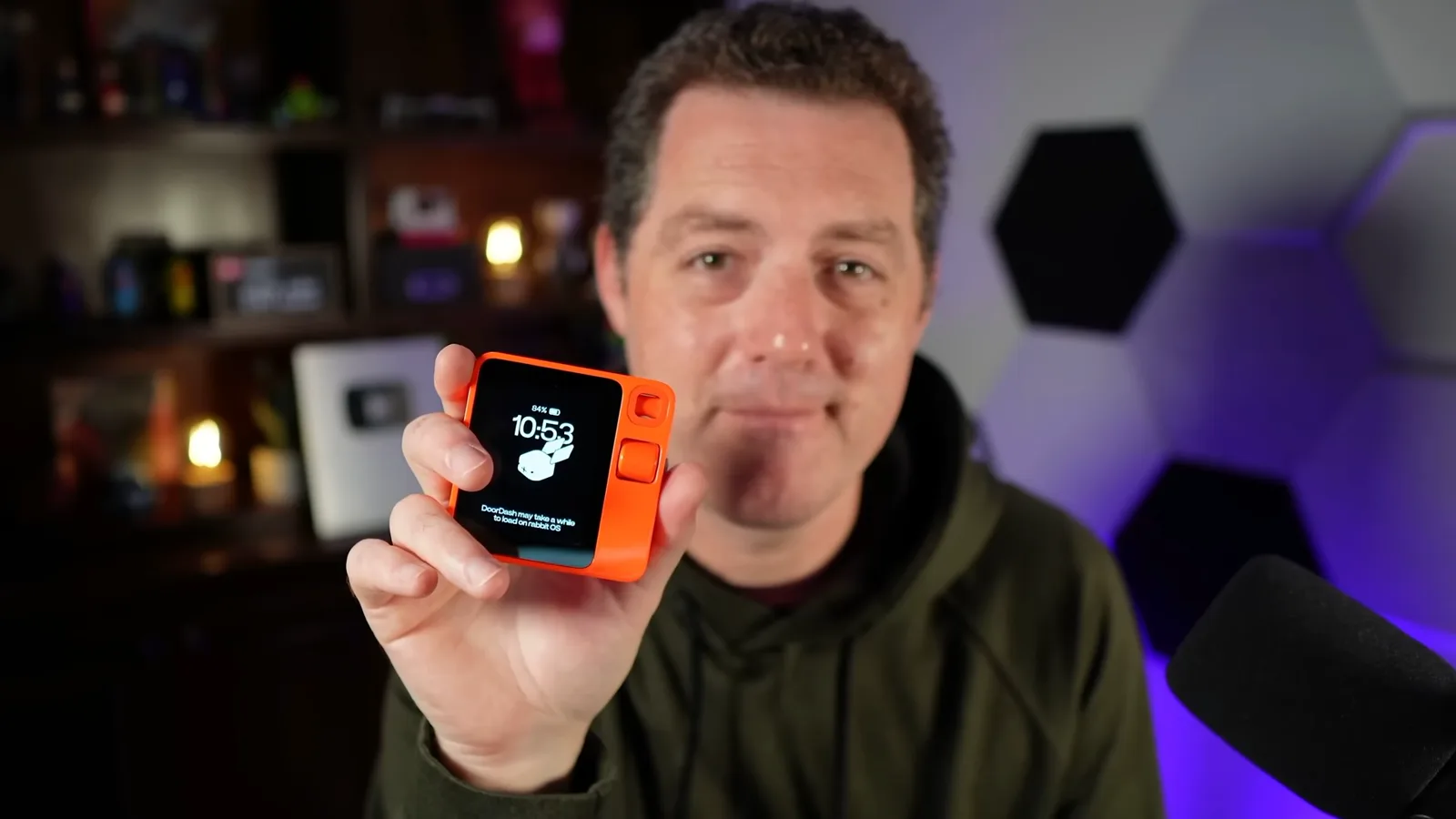
Once the ordering interface opens, he is unsure whether to use voice or the controls. Holding the voice button appears to leave the flow and start loading again, so he switches to the wheel and button. He questions why this process would be preferable to using the DoorDash phone app.
Berman would prefer to say how many people need food, hear a proposed order, refine it conversationally and then approve it. Instead he navigates a custom menu and cart manually. He calls the interface slow and unintuitive, while recognizing that he may have missed something in the workflow.
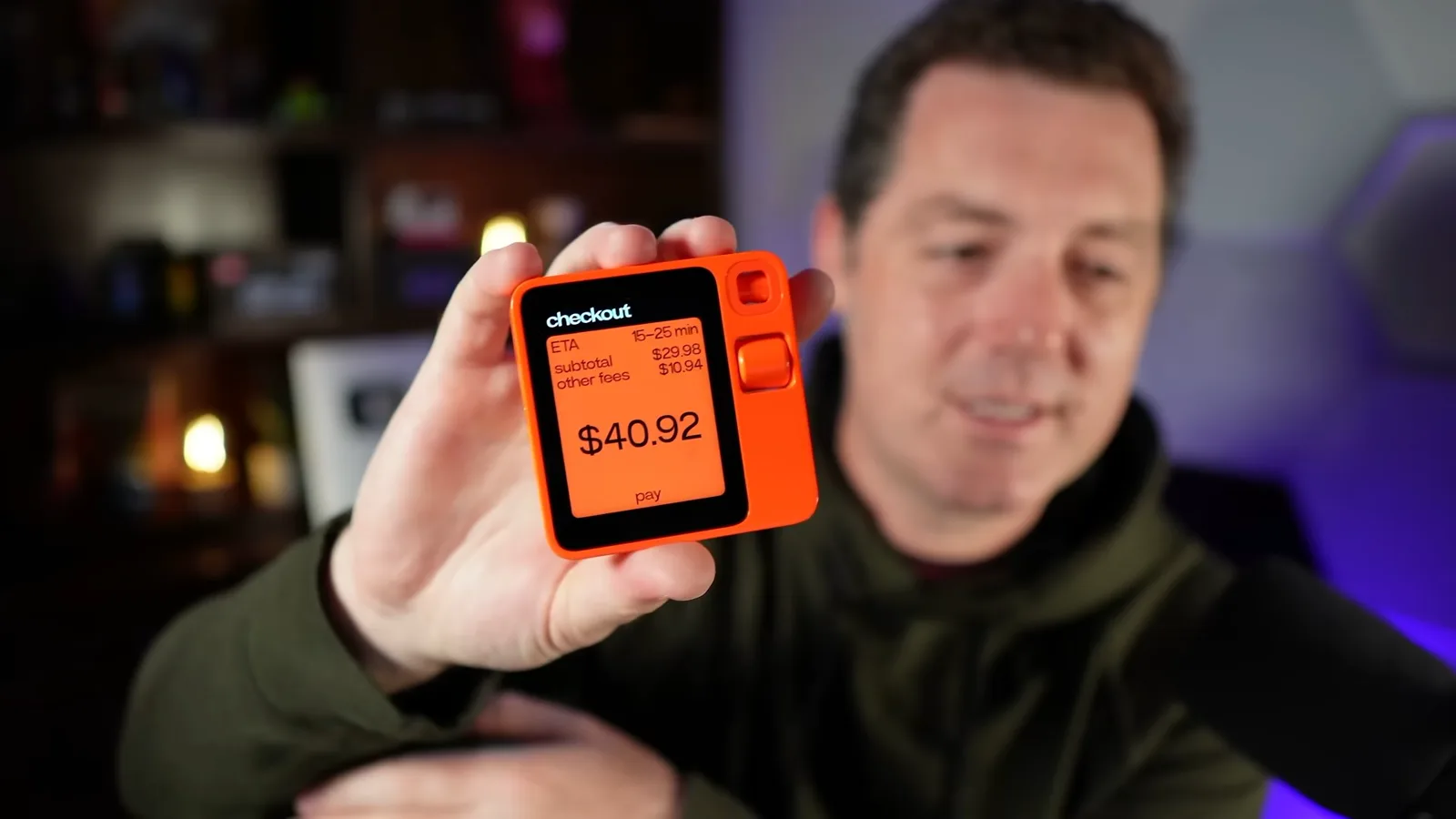
At checkout he is unsure whether pressing the control has placed an order or whether a password will be needed. He gets out of the screen and checks: no order was placed. The uncertainty is part of his criticism of the interface; it does not demonstrate that an unauthorized order occurred.
Voice control and overall verdict
Berman finds that some device settings cannot be changed by voice and encounters connection warnings. He weighs early capabilities against battery and software shortcomings.
He then tries to adjust volume and switch off Bluetooth by voice. The R1 directs him to its physical controls and settings instead. Berman considers voice control of the device itself an obvious improvement, and adds that the glossy exterior attracts fingerprints despite being easy to wipe clean.
His overall assessment remains positive about the compact, solid hardware, aside from battery life. The software, however, gives him frequent Rabbit OS or Wi-Fi connection warnings, and the agent features do not yet work as smoothly as he hoped. He considers Spotify a useful proof of concept but finds DoorDash much weaker.
For quick spoken questions, Berman finds the R1 faster and more useful than his experience with Siri or searching the web. He values conversational follow-up questions and context. His favorable accuracy and speed claims are personal impressions rather than measured comparisons across a representative set of tasks.
At $199 and without a required subscription at the time, he considers the device worthwhile for himself and potentially appealing to people who enjoy trying new technology or want fast voice access to AI. He does not recommend it as a mature tool for automating tasks on the user’s behalf.
Berman looks forward to updates but repeats the principle that a device should not be bought solely on promised future features. He is pleased that Rabbit shipped a real hardware product, and invites viewers to share their own experiences as the software evolves.
Mehr aus diesem Kanal
 34:21EN
 Matthew Berman· 27. Okt. 2026Matthew Berman Examines Anthropic’s IPO Filing, AI Growth and GovernanceMatthew Berman, Sam Altman · Forward FutureThe presenter reviews the S-1’s financial metrics, compute strategy and voting structure while questioning the tension between rapid AI development and safety.
 0:26ENMatthew Berman· 25. Okt. 2026Sam Altman on Human Values and Problem-Solving in an AI WorldSam Altman · OpenAIIn a short interview excerpt, Altman considers the enjoyment of solving hard problems and the human role in interpreting results.
 0:36ENMatthew Berman· 25. Okt. 2026Kimi K3.1 and a Rubik’s Cube Solver DemonstrationMatthew Berman · Forward FutureMatthew Berman shows a scrambled virtual cube being solved and gives the Kimi K3.1 test a favorable assessment.
 0:21ENMatthew Berman· 24. Okt. 2026An AI-Generated Kimi Benchmark Chart Used Invented ScoresMatthew Berman · Forward FutureMatthew Berman asks for a graph of Kimi K3.1 Pro benchmarks, then discovers that the displayed figures are illustrative placeholders.
 25:50ENMatthew Berman· 24. Okt. 2026Kimi K3.1 Pro Tested: Strong 3D Demos, Uneven Results and Competitive PricingMatthew Berman · Forward FutureMatthew Berman tests the open-weight model on coding, 3D rendering and visual explanations, then compares benchmark results and prices.
 32:20ENMatthew Berman· 23. Okt. 2026Who Is Local AI For? The Costs, Trade-offs and a Hybrid FutureMatthew Berman · Forward FutureMatthew Berman weighs data control and independence against hardware cost, setup complexity and inference speed.