In 30 Sekunden
In this episode, Sawyer asks how many rows of a randomly stepping marching band will be in step, leaving that challenge for viewers. He explains linearity of expectation and solves an earlier problem about monster damage, including an update after observing a first attack of four damage.
- 1A marching band puzzleForty musicians form ten rows of four and randomly choose a starting foot. The challenge asks for the expected number of rows in step.
- 2Linearity of expectationThe expected sum of random variables equals the sum of their expectations, and constants can be factored out.
- 3A mixed monsterThree equally likely monster types deal damage uniformly over ranges 1–6, 1–12, and 1–20; expected first-attack damage is 41/6.
- 4Update after four damageBayes’ rule changes the probabilities of timid, aggressive, and deadly monsters to 5/9, 5/18, and 1/6.
- 5Predict the second attackWeighting the type-specific mean damage by those updated probabilities yields 5.5.
Das Wichtigste
- Linearity of expectation lets us add expected values without computing the full distribution of a sum.
- Three standard dice have an expected sum of 10.5.
- The first monster attack has expected damage 41/6 under the specified mixture of monster types.
- A first attack of four damage changes the probabilities of the monster types through Bayes’ rule.
- After that observation, the expected damage of the second attack is 5.5.
Den bearbeiteten Text nach Kapiteln lesen
Marching bands and linearity
Sawyer poses a puzzle about rows of marching musicians. He introduces expected value and shows how linearity gives the mean sum of three dice.
Welcome back to Real Numbers. After introducing expected value last episode, we will use it to explore another problem involving a probabilistic average.
You are photographing a marching band with 40 members arranged in ten rows of four. Each musician independently chooses a left or right starting foot with equal probability. What is the expected number of rows whose four members march in step?

For the bonus, suppose exactly 20 students start on the left foot and 20 on the right, but all 40 are randomly arranged into the ten rows. What is the expected number of in-step rows? The episode leaves both questions for viewers.
Expected value is a probability-weighted average of the outcomes of a random process. Its useful linearity property says E[X + Y] = E[X] + E[Y], and E[aX] = aE[X] for a constant a.
A fair six-sided die has expected value 3.5. The distribution of the sum of three dice is more complicated, with middle values more likely than extreme values. But linearity gives E[X + Y + Z] = 3.5 + 3.5 + 3.5 = 10.5 without calculating that distribution.
Last week’s problem involved a video-game monster equally likely to be timid, aggressive, or deadly. Its damage is uniform from 1 to 6, 1 to 12, or 1 to 20 respectively. What is the expected damage of its first attack?
The first monster attack
Three equally likely monster types have different damage distributions. Direct calculation and linearity both give an expected first-attack damage of 41/6.
Calculate the unconditional probability of each damage value by summing over the possible monster types. For damage 1 through 6, all three types can produce each value, giving probability 1/10 per value.
Only aggressive or deadly monsters can deal damage 7 through 12, giving probability 2/45 per value. Damage 13 through 20 requires a deadly monster and has probability (1/3) × (1/20) = 1/60 per value.
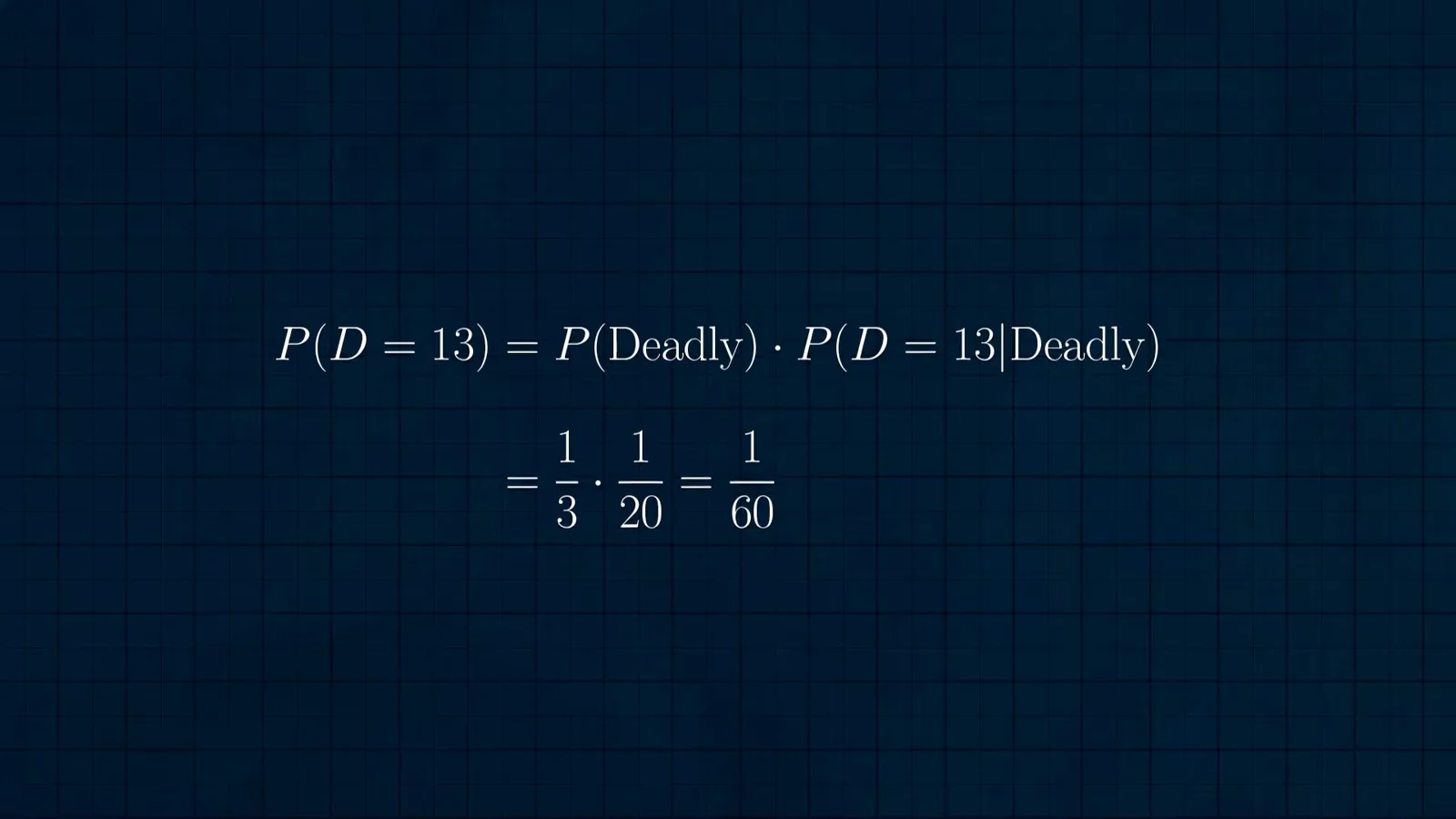
Multiply each damage value by its probability and add: (1+…+6)/10 + (7+…+12)×2/45 + (13+…+20)/60 = 41/6, or about 6.833.
A shorter method separates damage into timid, aggressive, and deadly contributions, only one of which is nonzero for a given monster. Their expected contributions are (1/3)×(7/2) = 7/6, (1/3)×(13/2) = 13/6, and (1/3)×(21/2) = 7/2. Linearity again gives 41/6.
Updating after an observation
Seeing four damage makes a timid monster more likely. Bayes’ rule produces a second-attack expectation of 5.5.
The bonus asks for the expected damage of the second attack after the first deals four. Although all three types could deal four, that observation changes how likely each type is. We must update the prior probabilities rather than simply reuse 41/6.
The unconditional probability of four damage is 1/10. Bayes’ rule gives P(timid | 4) = [(1/6)×(1/3)]/(1/10) = 5/9; similarly P(aggressive | 4) = 5/18 and P(deadly | 4) = 1/6.
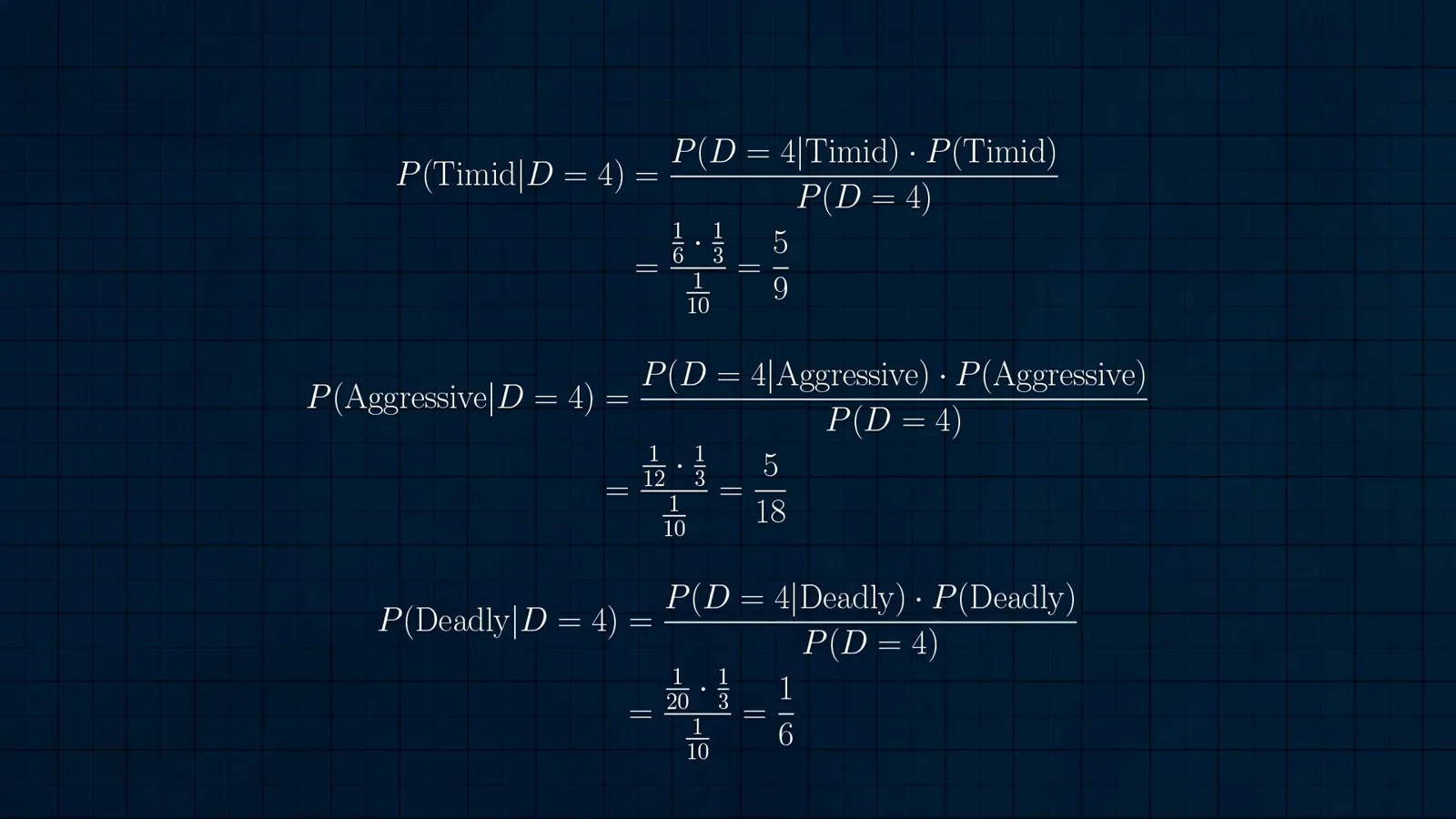
The probabilities sum to one, but now favor a timid monster. Four damage is possible for all types, yet it accounts for a larger share of the timid monster’s narrower range. In contrast, a first attack of 16 would identify the monster as deadly.
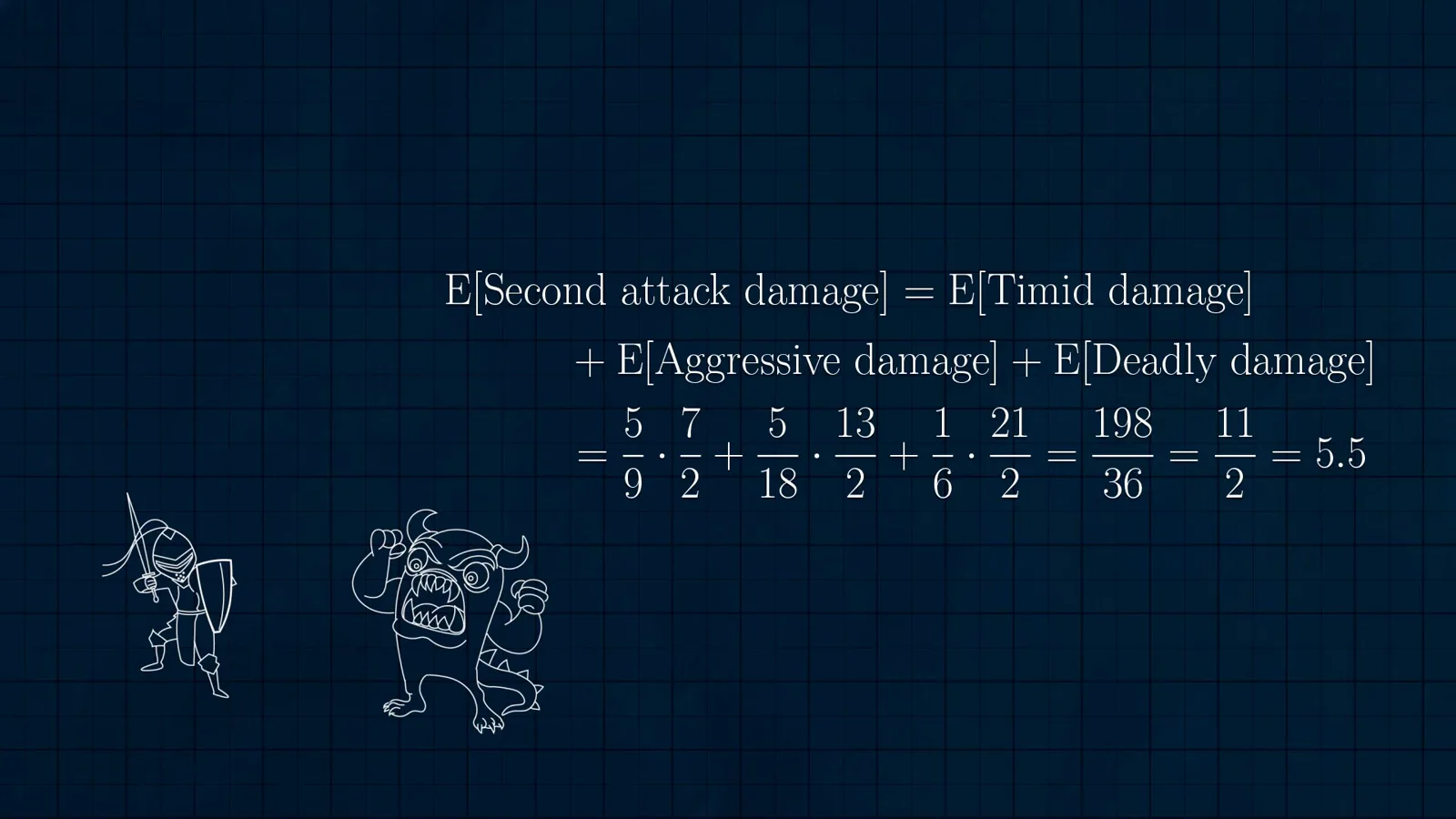
Assuming the second attack follows the same type-specific distribution, weight the means by the updated probabilities: (5/9)×(7/2) + (5/18)×(13/2) + (1/6)×(21/2) = 11/2 = 5.5.
Now return to the marching band: find the expected number of in-step rows when each musician chooses a starting foot independently, and then when exactly 20 choose each foot and the members are randomly arranged. Submit your reasoning.
Mehr aus diesem Kanal
 1:48:29EN
 1:36:37EN
 1:05:45EN
 1:25:00EN
 1:16:29EN
 27:39EN