In 30 Sekunden
AI can make creating software easier, but Jason Liu of OpenAI argues that the important work shifts toward owning the result and knowing how to improve it. He compares the change to photography: a new tool can produce more throwaway work while giving more people a way to create. To develop judgment, he studies typography, motion and industrial design so he can describe what he likes. He also uses AI to pursue interests he had set aside, from drumming software to 3D-printed parts.
- 1Ambition means ownership, judgment and curiosity, not more tokensLiu frames these three practices as responses to worries about low-quality output, weaker critical thinking and replacement.
- 2Photography made creation more accessible without removing the need for directionLiu compares directing an AI tool to selecting a camera angle and guiding a team. He says the creator remains responsible for the result.
- 3The greater danger is becoming a passive observer of your own workLiu urges engineers to use their products, notice what breaks and revise output. In his view, examples that look effortless are often the result of iteration.
- 4Taste requires language for what you like and expect others to likeHis art-school experience taught him that recognizing a problem is different from explaining how to fix it. He has since studied typography, motion and interaction design.
- 5Study examples before asking a model to make something beautifulLiu found his 3D-printed designs improved after he examined sports cars and industrial design and learned how to describe curves.
- 6AI can help developers return to fields they once set asideLiu describes using AI to learn music software and build drum tools and physical parts. He sees prior software judgment and a newcomer’s questions as complementary.
Das Wichtigste
- Take responsibility for AI-assisted work by using the product, noticing problems and iterating before shipping.
- Build the vocabulary to explain what you like and what should change; vague requests such as “make it better” provide little direction.
- Study games, tools and physical designs to develop judgment before asking a model to improve your own work.
- Make time for a team to explore and share examples if AI increases its productivity.
- Revisit a field you set aside and apply your existing skills while learning its unfamiliar concepts.
Den bearbeiteten Text nach Kapiteln lesen
Ambition after execution gets easier
Liu frames ambition as responsibility for the work, the ability to describe quality and curiosity about other fields. He asks how those habits address worries about low-quality output, critical thinking and replacement.
I joined OpenAI’s developer experience team in March, before the Codex app and Astra were available. As tools appeared for making applications, working with voice and computers, and tackling scientific and engineering problems, I began to think of my work as serving anyone who wants to make something.
Ambition is not just about how a task gets executed. It is about what you choose to make. Running thousands of agents or spending more tokens is not, by itself, the kind of ambition I mean.
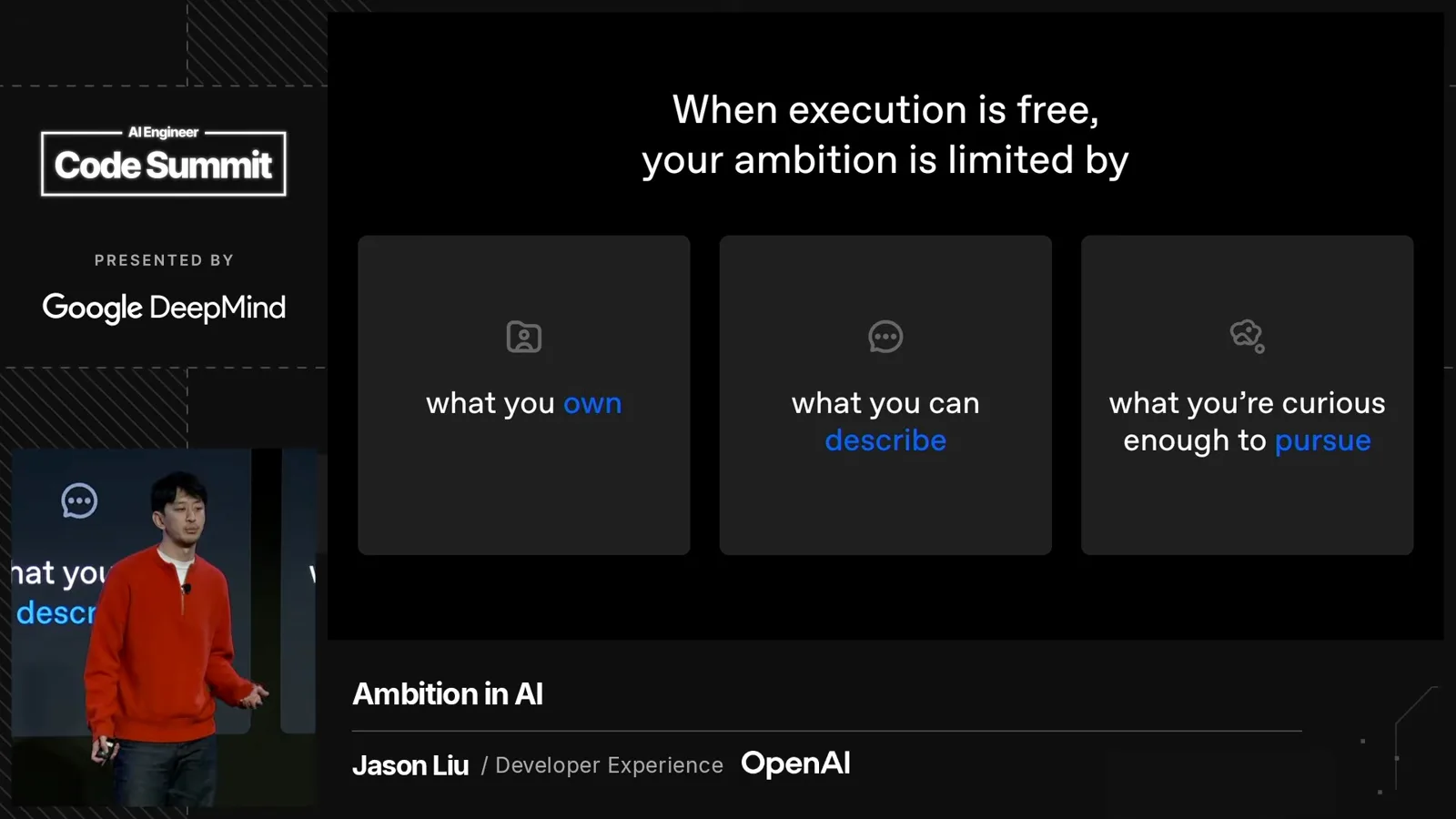
I return to three questions: do I believe I own the work I create? Can I describe my taste and what good looks like? Am I curious enough to explore fields beyond software? Those questions answer worries that AI will produce more slop, weaken thinking or replace people.
The camera and the responsibility to create
Photography widened access to image-making while changing art. Liu argues that AI-assisted creators must still direct and take responsibility for the work they publish.
More AI-generated slop is likely. But the arrival of the camera also worried painters whose skill lay in reproducing an image. Photography went on to change art and enable film, even if early examples were easy to dismiss.
Walter Benjamin described photography shifting work from the hand toward the eye. I think of using voice with AI in a similar way: a director can ask for a wider camera angle and work with a team to convey a feeling. The tools and helpers do not eliminate the need for a vision.
Most of the photos on my phone may never be viewed again, but a few capture important moments. My family could not afford a camera when I was young, and I would have welcomed that access, even if it came with many unremarkable pictures.
Ask whether you identify as a painter or as an artist. A brush, a camera, code or clay can all be media for making something. A director still owns a film made with a large crew, just as open-source maintainers remain responsible for quality even when many people or agents contribute.
The danger I worry about is self-erasure: becoming a passive observer while work is made in your name. A person creating many pull requests still has to care about the result and participate in its creation.
For an engineer, that means using your own product, noticing when it breaks and deciding when it needs another pass. Work that looks impressive online is often the product of repeated iteration, not a single prompt.
Ownership also raises a second question: how can I tell whether something is good enough? Receiving a camera does not remove the work of creation. I need language for what I see and for the change I want.
Learn the language of good work
Recognizing a weak result is different from explaining how to improve it. Liu studies design concepts and draws on examples to make his judgments actionable.
At art school I learned about space, value, shape and texture. If I did not understand negative space, I made sketches to explore it. My judgment often exceeded my practical skill: I could tell that I disliked a result without yet knowing how to make the thing I liked.
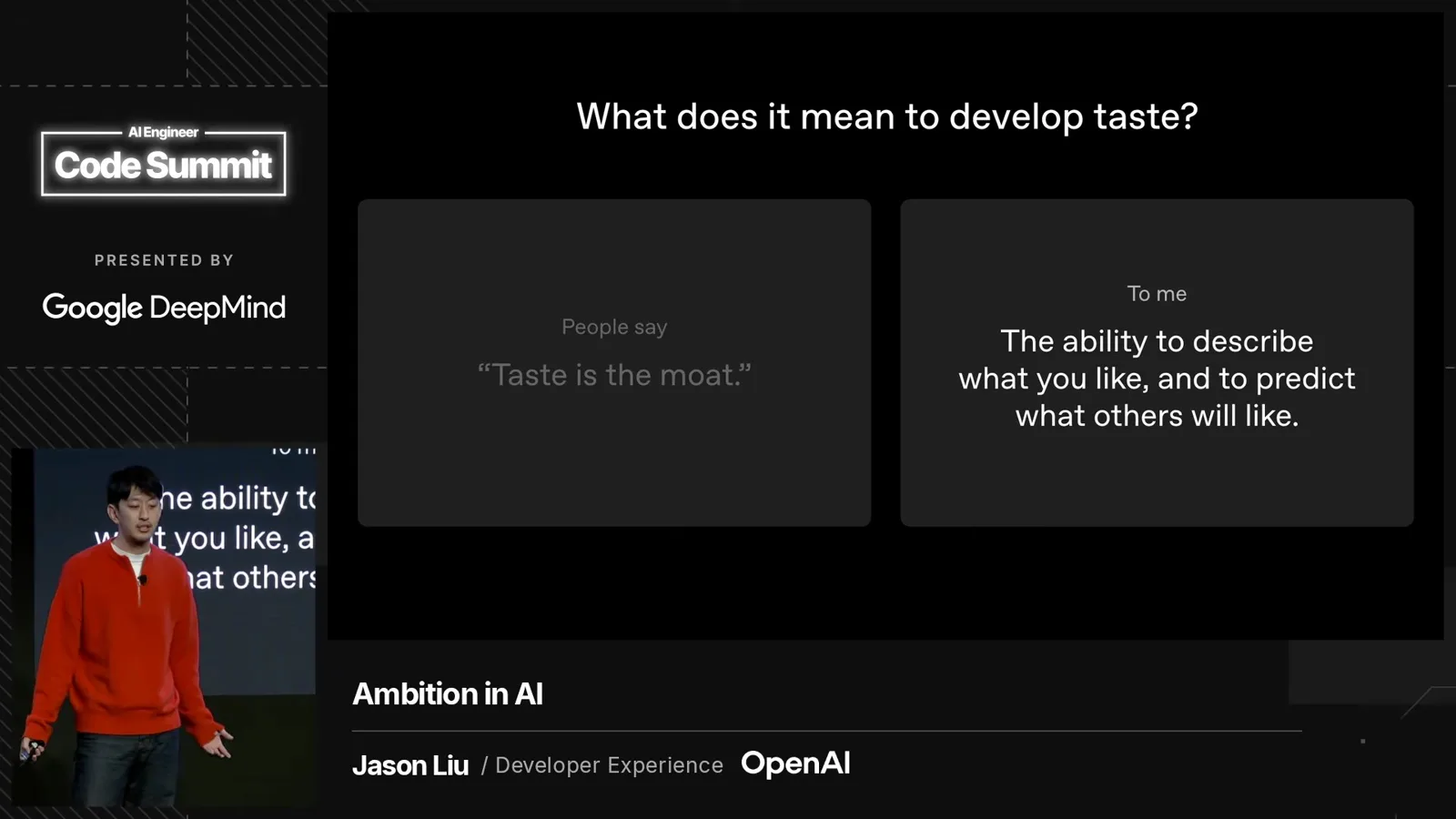
Telling myself to “make it pop” repeatedly did not supply that missing knowledge. To me, taste means being able to describe what I like and anticipate what others might like. That requires a model of the world and other people, and language to express it.
A post suggested asking a model to find implicit state machines in an app. I had to look up the term, but the example showed how a concept and a precise request could give people a new way to improve their software.
In machine learning, a generator creates outputs and a discriminator judges them. I think of people as the judge: when a model reaches the limit of my own taste, I have trouble helping it improve. To go further, I need to learn what a better result could look like.
Building applications led me to study typography because my websites looked ugly. I then learned about presenting information, animation and interaction patterns. That was not less thinking; it was time spent learning why something looks and feels good.
If you want good taste, you have to eat: go experience things. If you are making games, play games and notice which animations and stories work. If you build tools, try other people’s applications and ask what you like.
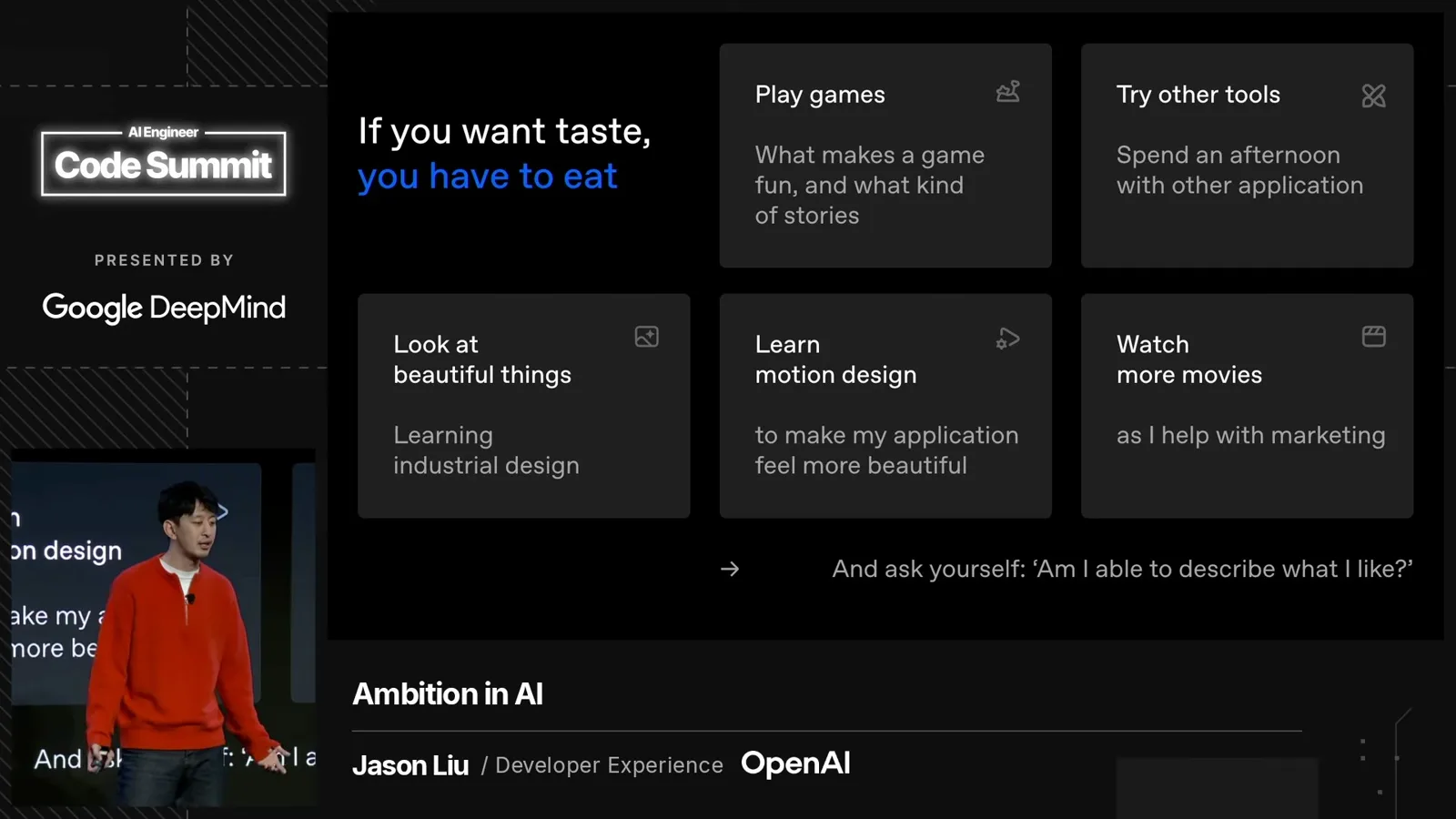
When I started using AI for 3D printing, my objects looked like rectangles stuck together. Repeatedly asking for something more beautiful was frustrating. Looking at sports cars and industrial design helped me understand and describe the curves I wanted.
Working with marketing prompted me to watch more advertisements and films as well. Exploring examples gives me a way to think about the stories I want to tell and makes the work more enjoyable.
If AI makes your team more productive, make space to explore the world, try applications and share inspiring work. That is how people can come back with a point of view rather than simply producing more.
Apply technical judgment in other fields
Liu sees AI lowering barriers between disciplines. His own explorations include drumming software, music production and 3D printing.
What did you put aside to pursue software? I think the experience and judgment developed as an engineer can be useful in many other fields. AI can lower the barrier to returning to those interests.
Creative disciplines have long crossed boundaries: an artist might design furniture, buildings, films and toys. Technical fields became harder to cross because of the knowledge required, but work in biology, the genome and neural networks has benefited from ideas moving between disciplines.
I have seen examples of a machine-learning consultant using AI and molecular biology in an effort to help a dog with cancer, and a public servant in Hokkaido using chat and computer vision to automate farm work. What inspires me is the curiosity to learn across fields.
A newcomer can ask questions that specialists might consider impossible. Bringing judgment from software into a new discipline, while using AI to help learn, can give someone the courage and means to pursue those questions.
In my own life I have been learning drums and building custom drumming software. AI helps me learn Ableton, connect a drum kit to MIDI and use unfamiliar software. I am also designing 3D-printed parts and exploring physical engineering.
Build things that inspire others
He encourages developers to pursue interests they set aside and make space to learn. Sharing work, he says, can inspire the next generation to solve larger problems.
The question is not whether every developer should become a biologist. It is whether you can find an interest, learn the language needed to judge work in it and actually make time to pursue it.
When people asked how to learn coding, I encouraged them to build a weather app or a note-taking app around a real problem. The range of problems people can attempt is now larger, so developers can share what they make and help others see that possibility.
The Codex app and Sites came from people who cared about their work and talked with users. Product managers can contribute engineering and engineers can participate in design. I want more people to have access to the technology so they can make their own contributions.
Own what you make, seek inspiration, develop the language to describe quality and stay curious enough to pursue new interests. That is what becoming more ambitious means to me.
Mehr aus diesem Kanal
 18:03EN
 AI Engineer· 26. Nov. 2026Justin McCarthy: Automate Existing Software, Discover New DemandJustin McCarthy · DiffusionKeep proven products fast and safe with continuous feedback, then use the freed capacity to find what customers will actually buy.
 18:43ENAI Engineer· 25. Nov. 2026Lance Martin: 1,000 Agents Coordinate a Formal ProofLance Martin · AnthropicA lead agent built its own coordination system; separate memory experiments show how reflection can repair mistakes.
 18:01ENAI Engineer· 25. Nov. 2026Quinn Slack: How Amp Built a Company Around AgentsQuinn Slack · AmpA year without hiring pushed Amp to ship in small steps, put customer work in agent threads and give 21 people broad ownership.
 22:29ENAI Engineer· 24. Nov. 2026Jarred Sumner: Independent Tests Made Millions of Agent-Written Lines ShippableJarred Sumner · AnthropicBun’s creator explains why existing tests, three-way comparisons and repeated measurement mattered more than code volume.
 21:22ENAI Engineer· 24. Nov. 2026Steve Yegge's software factory hit a human bottleneckSteve Yegge · Gas TownHis game-building agents produced more changes than players could absorb, while cost, accumulated context and stalled tasks demanded active management.
 20:24ENAI Engineer· 23. Nov. 2026Dex Horthy: software factories still need people to review the workDex Horthy · FactoryFaster agent-written code needs checks, proportionate planning and human review, especially when a codebase must remain maintainable.