In 30 Sekunden
A software factory can improve an existing product continuously, but automating the creation of an untested idea risks producing the wrong thing faster, says Diffusion founder Justin McCarthy. He proposes feedback loops that preserve a product’s existing commitments while making it faster, cheaper and safer. The harder challenge is finding demand: he suggests using agents to prioritize customer questions, synthesize answers and plan experiments so production does not outpace what customers want.
- 1Automating an idea before knowing what customers want can amplify wasteMcCarthy distinguishes product discovery from work on an existing product whose customers already demonstrate demand.
- 2Existing products supply promises and feedback for a continuous loopHe calls features, price and security promises that can be encoded as expectations. Customer use and support provide signals for maintaining and improving them.
- 3McCarthy expects agent factories to become simpler as models improveHe compares the progression to successive versions of a rocket engine with fewer visible components and higher performance.
- 4Make existing software faster, cheaper and safer without breaking its commitmentsHe says improvements that do not trade away other valued qualities are suitable for maintenance automation; deciding what is better may still require human judgment.
- 5More code is not the same as more customer valueCustomers may want better margins, more customers or differentiation, McCarthy says, rather than more screens and buttons.
- 6Agents could help turn customer signals into experimentsHis proposed demand factory would prioritize questions, synthesize responses, compare them with past feedback and choose experiments.
- 7Expand within the limits of what a brand can credibly promiseMcCarthy uses a sparkling-water brand as an example: adding caffeine might make sense, while motor oil would not.
Das Wichtigste
- Separate improving a proven product from discovering what customers want in a new one.
- Define the promises an existing product must keep, including features, price and security, and feed checks back into the work.
- Run maintenance loops continuously against existing customer commitments, McCarthy suggests.
- Use agents to organize customer feedback and choose experiments when engineering capacity exceeds known demand.
- McCarthy expects stronger models to simplify the machinery needed to run agent workflows.
Den bearbeiteten Text nach Kapiteln lesen
Early software factories needed elaborate hand-built loops
McCarthy describes assembling agent loops around earlier models at substantial token cost. The machinery has since become easier to build.
I am Justin McCarthy, founder and CEO of Diffusion. We are working to spread model capabilities through the economy, including by building software factories. This talk is aimed at people; I also have technical material at the end that their agents can pick up.
I began exploring this in July of the previous year with Claude 4 models. By looping them, our team could see signs that a software factory might work. It was expensive in tokens, however, and the loops needed an elaborate, hand-crafted arrangement to produce reliable results.
What we now call software factories has become more accepted, and some of that work needs less creativity and input to achieve. That is why I am saying, partly tongue in cheek but also seriously, that you should stop building software factories for every idea.
Use proven products as the basis for continuous improvement
He separates discovering a new product from maintaining software that customers already pay for. Existing usage and support feedback give the latter a source of evidence.
When we are creating something new, we often do not yet know what we want. Industrializing that uncertainty can give us the wrong thing, take too long or cost too much. First distinguish between discovering a new product and improving something that already has a working precedent.
An existing product has an advantage: customers are already paying for it and using it. Those signals, together with what customers say and perhaps their support tickets, can help preserve and improve a system whose value is already established.
Much of that existing software can be rewritten. Work that used to feel like an impossible backlog or technical debt slowing the team down becomes approachable. We do not have to rediscover every customer need when customers keep returning to the product they already use.
At Diffusion we use the word “promise” for something we guarantee or value in a product. A feature is a promise; cost, price and security can be promises too. Usually we do not want to regress on those commitments.
Keep product promises with feedback and continuous work
Features, cost and security are examples of commitments a product makes. A loop can check those expectations and apply work around the clock.
Once expectations are expressible, they can be put into feedback loops. A loop takes an input, produces an output and feeds information about that output back into the process. Like an amplifier with its feedback cut, a system without that correction can amplify noise.
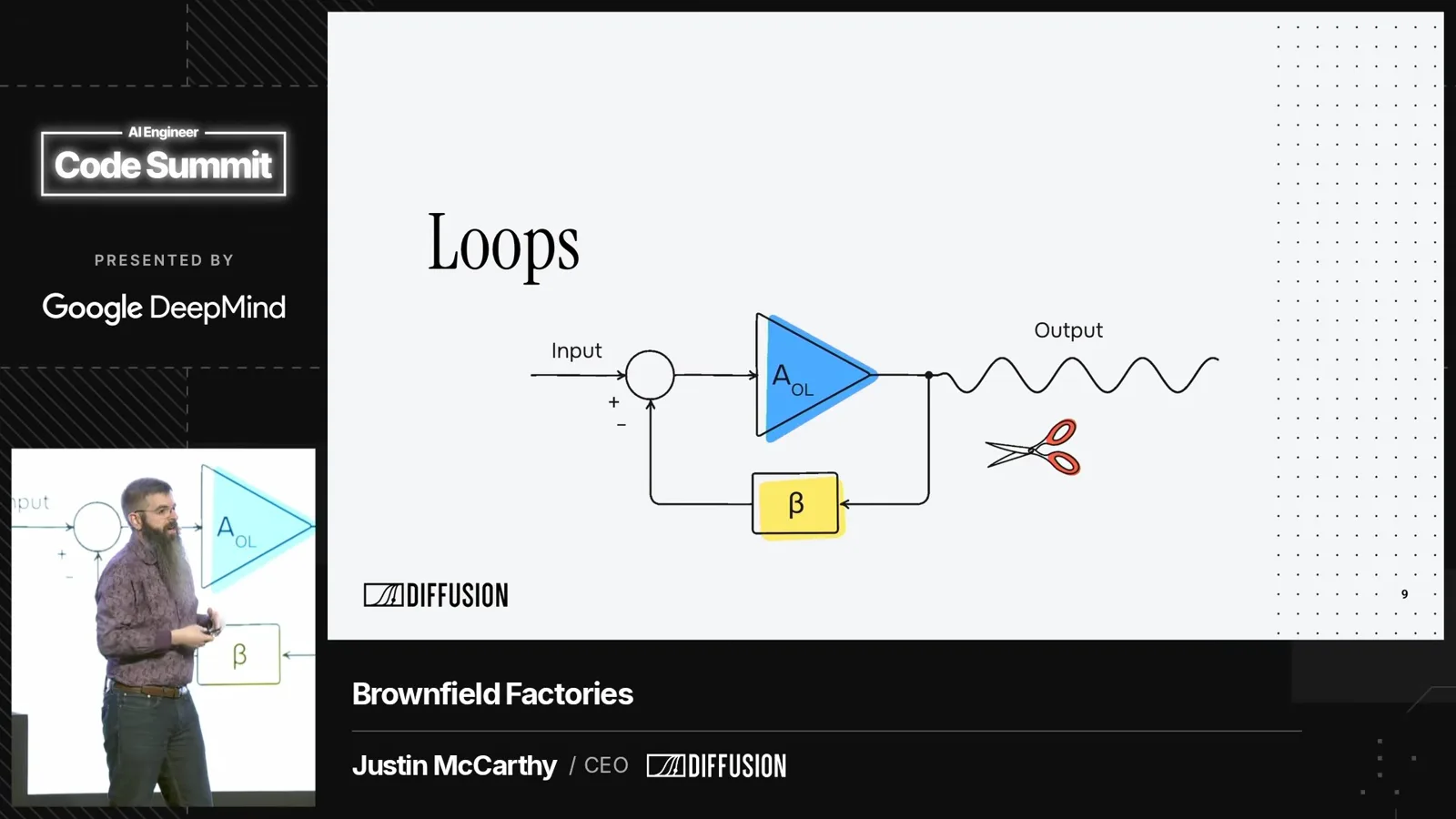
A factory working on an established product should also be continuous. Human code commits used to arrive in daily and weekly cycles. Agent-maintained loops can keep looking for slowness, insecurity and other problems around the clock.
The aim is a background system that keeps an existing set of promises while working continuously. That can free people to put more energy into new territory, where discovering what customers want needs a different kind of judgment and less rigid looping.
Simplify the factory and improve what already works
He expects stronger models to replace complicated machinery with simpler systems. The immediate goals for an established product are speed, cost and safety.
A year ago, making the system work required considerable engineering. Better models and more general tools are making it easier. We have seen the instructions given to agents become shorter, and I expect these factories to simplify further over time.
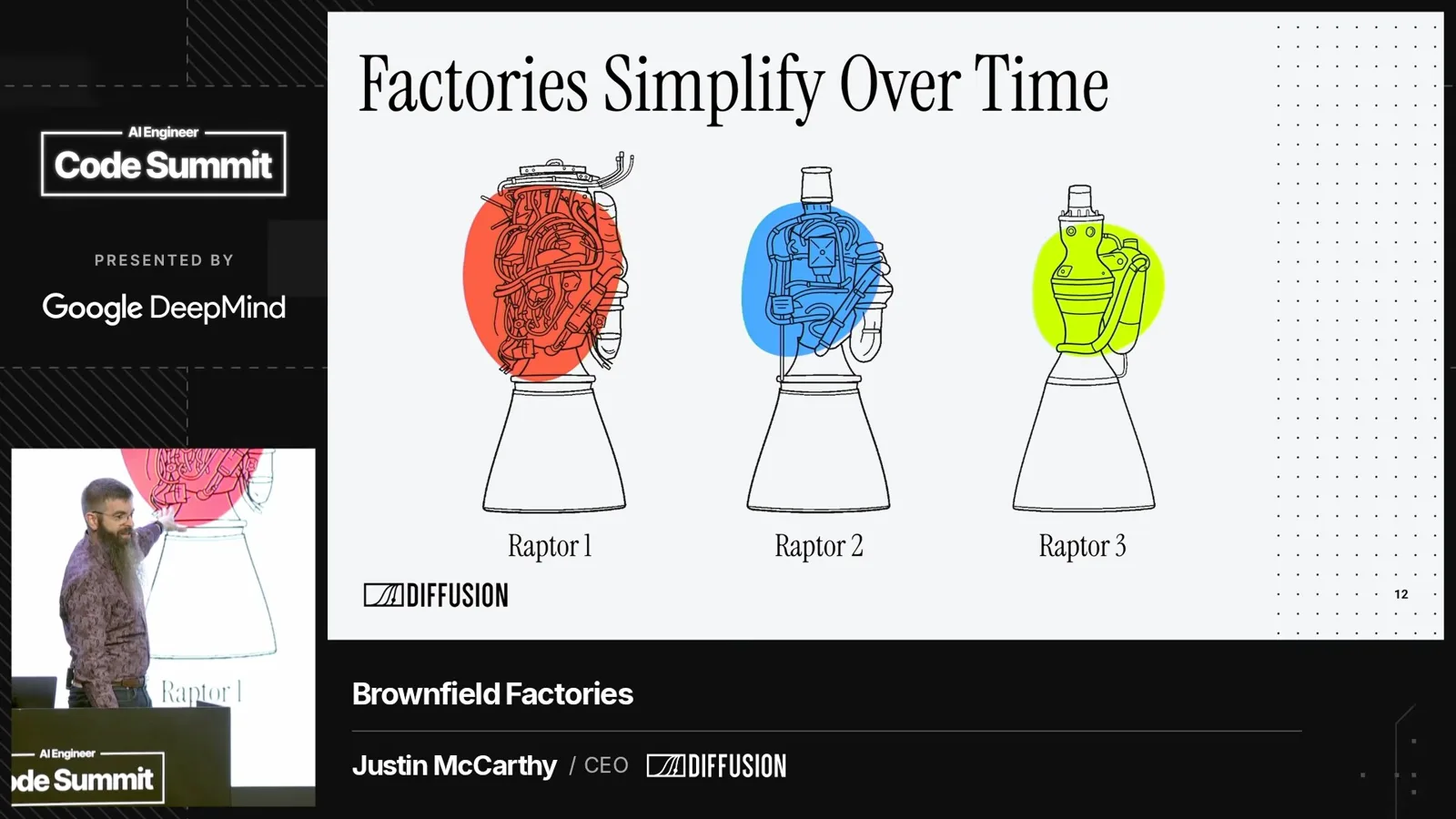
I compare that progression to successive Raptor rocket engines: the first was full of tubing, while later versions delivered more performance with fewer visible parts. Engineers concentrated intelligence on simplification; today better models can help simplify our factories too.
A future model or another pass by agents may leave a factory with fewer moving parts and better performance. If a system barely works today, I expect it to become smoother and more capable as the underlying models improve.
A useful instruction for an existing product is “the same, but faster.” Faster, cheaper and safer are desirable improvements when achieving one does not sacrifice another commitment. Deciding what is simply “better” can require more human intent and taste, so that may belong in discovery.
I think every team should have a factory for its existing commitments. In my experience, setting one up takes about a week. Once it is working, the next question is how to raise ambition beyond maintaining what is already there.
Use spare capacity to discover and serve demand
Customers seek business outcomes, not necessarily more software. McCarthy proposes a still-developing demand factory to ask questions, listen and choose experiments.
We are producing a great deal of working code, but customers may not have asked for more software. They may want higher margins, more customers or a more distinct brand. Giving them more windows and buttons does not necessarily deliver those outcomes.
Engineers are becoming fluent at communicating with models, while others in their organizations may not be. That creates an opportunity to help find demand. A factory maintaining an established product can keep its promises, but I do not think it can by itself create a competitive moat.
I do not yet have a complete definition of a demand factory. I imagine a system that helps match what the software factory can produce to what the market wants, so increased production does not simply spill unused software onto the floor.
Do not wait for sales and marketing to ask the questions. Engineers can help identify what else a company could credibly offer, then work out how to explain it through new language, images and product lines.
Agents could help prioritize questions for customers, synthesize their answers, compare them with previous feedback and recommend the next experiments. For instance, a team has limited capacity to test prices; models might help decide where that capacity is best spent.
I hope faster responses would encourage customers to ask for more. Even if competitors have access to the same models, getting started first may confer an advantage. The goal is to identify the full range of things a brand can credibly promise.
Find credible new offers within the brand
A sparkling-water example illustrates which product expansions might fit a brand. More customer signals and coherent product lines could help match demand with production.
Imagine a sparkling-water company that adds caffeine: that might fit its brand. Adding motor oil probably would not. Every company has a similar boundary, so find the plausible extension of your own offer.
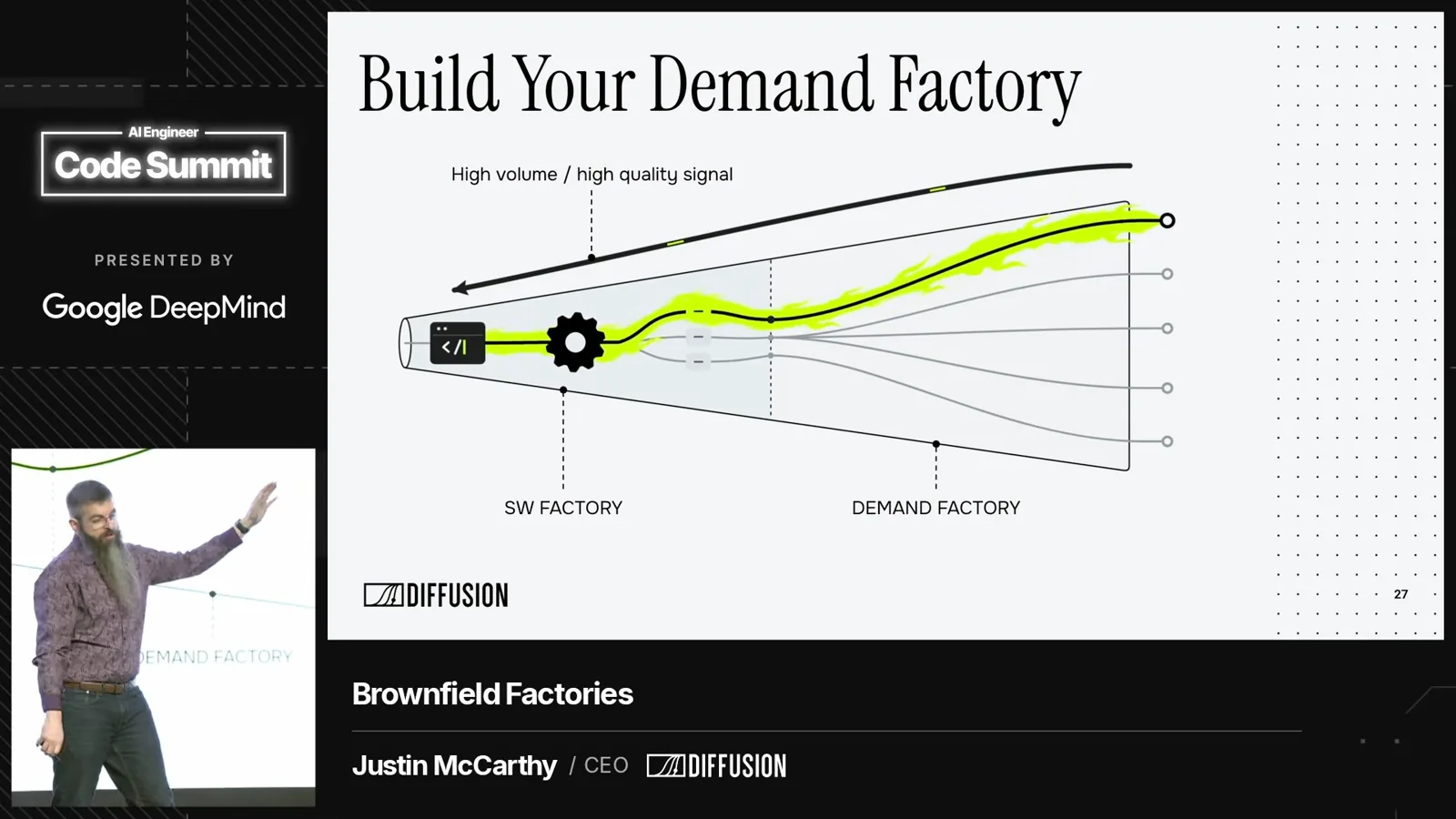
A demand factory would take in a high volume of useful signals from customers and the market. To absorb increased production without overwhelming customers, I suggest reaching more customers, serving more of their needs and organizing additional offerings into coherent product lines.
Once those opportunities are exhausted, a company might acquire a competitor, I suggest. Begin now on the existing-product factory and the demand factory; that also means rethinking product management and engaging the executive team.
Mehr aus diesem Kanal
 18:43EN
 AI Engineer· 25. Nov. 2026Lance Martin: 1,000 Agents Coordinate a Formal ProofLance Martin · AnthropicA lead agent built its own coordination system; separate memory experiments show how reflection can repair mistakes.
 18:01ENAI Engineer· 25. Nov. 2026Quinn Slack: How Amp Built a Company Around AgentsQuinn Slack · AmpA year without hiring pushed Amp to ship in small steps, put customer work in agent threads and give 21 people broad ownership.
 22:29ENAI Engineer· 24. Nov. 2026Jarred Sumner: Independent Tests Made Millions of Agent-Written Lines ShippableJarred Sumner · AnthropicBun’s creator explains why existing tests, three-way comparisons and repeated measurement mattered more than code volume.
 21:22ENAI Engineer· 24. Nov. 2026Steve Yegge's software factory hit a human bottleneckSteve Yegge · Gas TownHis game-building agents produced more changes than players could absorb, while cost, accumulated context and stalled tasks demanded active management.
 20:24ENAI Engineer· 23. Nov. 2026Dex Horthy: software factories still need people to review the workDex Horthy · FactoryFaster agent-written code needs checks, proportionate planning and human review, especially when a codebase must remain maintainable.
 19:56ENAI Engineer· 22. Nov. 2026Armin Ronacher: Build a Software Workshop Before a FactoryArmin Ronacher · EarendilAgents can start projects faster, but human attention still limits which ones become good and stay maintained.