In 30 Sekunden
Arize AI product manager Fuad Ali describes the evolution of Alyx, an agent inside Arize X that helps users analyze traces and create evaluations. His team moved planning and completion checks into custom harness code, stored large tool outputs outside the immediate context, and replaced several specialist agents with one agent that loads skills on demand. Ali also explains why a small per-user memory file worked for his team, how real sessions become regression tests, and where people still supply judgment. These are design choices and observations from Arize's own system, not universal performance guarantees.
- 1The harness owns the planThe team moved plan state into messages rendered by the harness and is testing a version without a separate to-do tool.
- 2An explicit finish gateA finish call can be rejected while plan items remain open, with safeguards for stalled runs and iteration limits.
- 3Treat large results as filesInstead of filling the context window, Alyx retains a reference and can use code to inspect the full result.
- 4One small memory fileThe team chose a per-user, per-space file capped at 8,000 characters and updated by a background job.
- 5From specialists to one agentAfter trying ten specialists, the team consolidated planning into one agent with skills loaded on demand.
- 6Production sessions become testsTraces and session datasets provide evolving regression cases, while human labels anchor evaluators.
Das Wichtigste
- A harness can maintain plan state and enforce a completion gate instead of relying on the model's implicit stopping behavior.
- Large tool results can stay outside the immediate context, with the agent retrieving the relevant parts when needed.
- Arize settled on a small, auditable per-user memory file after trying more elaborate retrieval and graph approaches.
- The team merged page-specific specialists into one agent that loads skills and tools on demand, while retaining subagents for scoped jobs.
- Production traces and human-labeled examples support regression tests and evaluator alignment.
- Model selection balances speed and quality for a specific task; the newest model is not automatically the best default.
Den bearbeiteten Text nach Kapiteln lesen
Agents building and debugging agents
Ali introduces Alyx and Arize's use of agents to inspect other agents. He describes its product role and early prototypes.
I'm Fuad Ali, an AI product manager at Arize. Today I want to share lessons from roughly two years of shipping our in-product production agent. The aim is to give other teams useful design questions as they build their own agents.
Our work gets a little recursive. Coding agents help build our products; Signal reads agent traces; Alyx is the in-product agent I am discussing; and we use Alyx to debug Alyx. We can use the same tools to evaluate our agent and examine design patterns that might transfer to other systems.
Alyx lives inside Arize X. It can read traces, turn findings into evaluations and datasets, run experiments, plan multistep work and generate synthetic data from traces. A staff engineer described the first late-2023 prototype, using models from the 3.5 era, as about half hallucination. That is an internal characterization of an early prototype, not a measured comparison across products.
The product moved from a simpler prompt-and-tools interface to a deeper workflow with planning and explanations of what it is doing. In one example, Alyx is asked to optimize its own system prompt and plans how to inspect resources in the application.
The architecture timeline
The team evolved from a routed skills loop to iterative tools, planning, on-demand skills and memory. Ali emphasizes custom harness code.
The prototype began in late 2023. The team moved mathematical work out of the model and into harness code, then launched a copilot organized as a router over skills. An August 2025 rewrite introduced iterative tool calling and a to-do tool; a February 2026 relaunch and a June consolidation followed. Long-term memory was added later.
We didn't train the frontier models behind these changes. The models improved on their own schedule, but our rebuilds were primarily harness code. We don't use an agent framework: we own the loop, plan, stopping rule and memory. That gives us control and a way to learn from the system.
Planning and completion
The harness gradually took responsibility for plan state. An explicit finish gate and limits address premature or stalled endings.
The first design question is who owns the plan. Think of giving a child a list of chores: you could ask them to maintain the list, or you could keep it yourself and provide the next task. Each approach makes different demands on the person doing the work.
Initially we gave the model a to-do list. It spent too many calls checking off items instead of doing useful work, and could lose focus after many tool calls. We then moved the plan into the harness incrementally, beginning with an in-progress state.
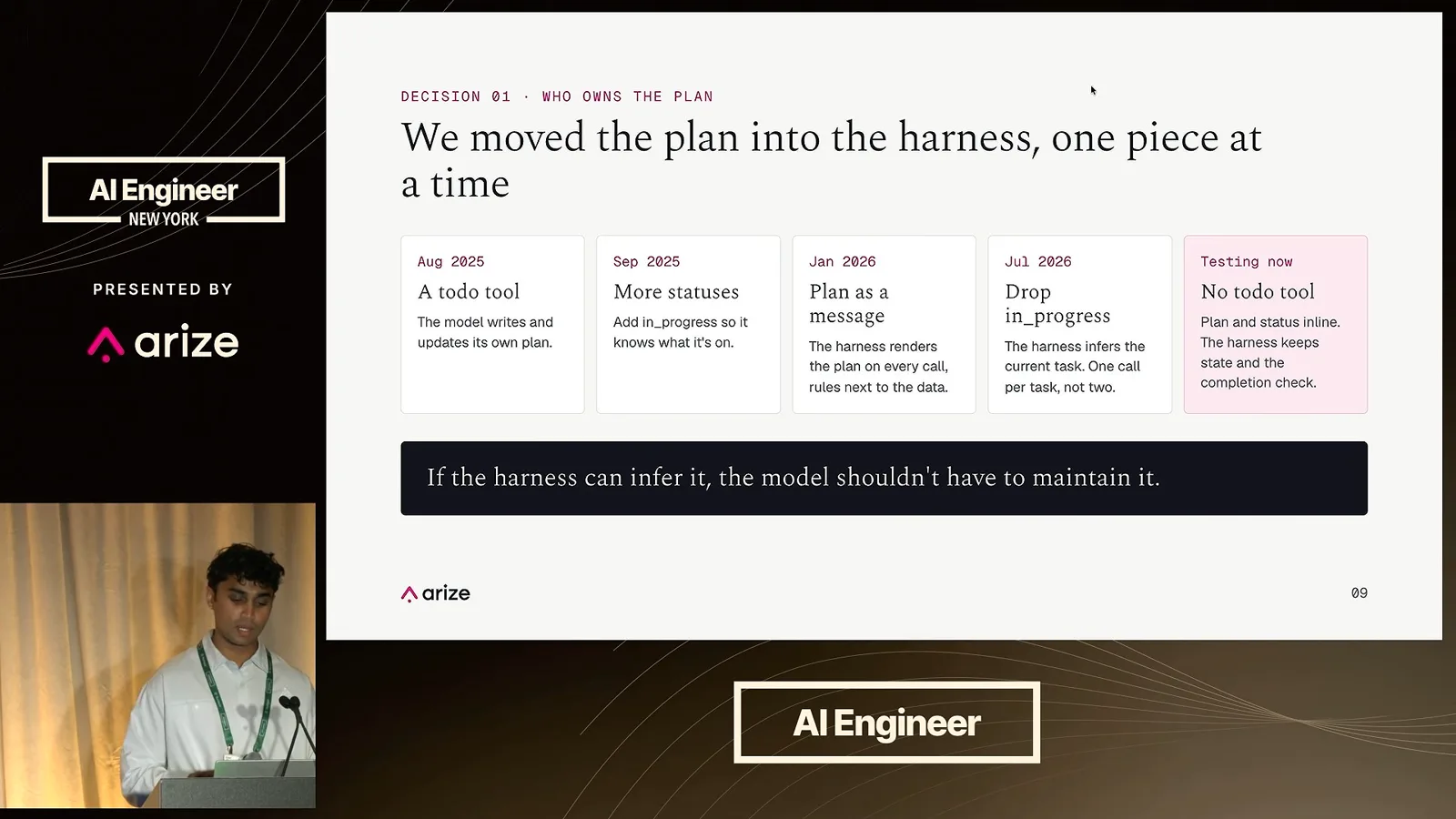
Next, the harness rendered the plan as a message on every model call, placing the rules next to the relevant data. We later removed the in-progress marker: if unfinished items are ordered, the next unfinished item already identifies the next task. We are now testing a version without a separate to-do tool, keeping state and completion checks in the harness.
The next question is what ends a turn. Our first rule treated text without tool calls as completion. That broke when a model announced a step in one turn and made the tool call in the next. Model changes can expose this kind of assumption, and customers can also choose their own providers.
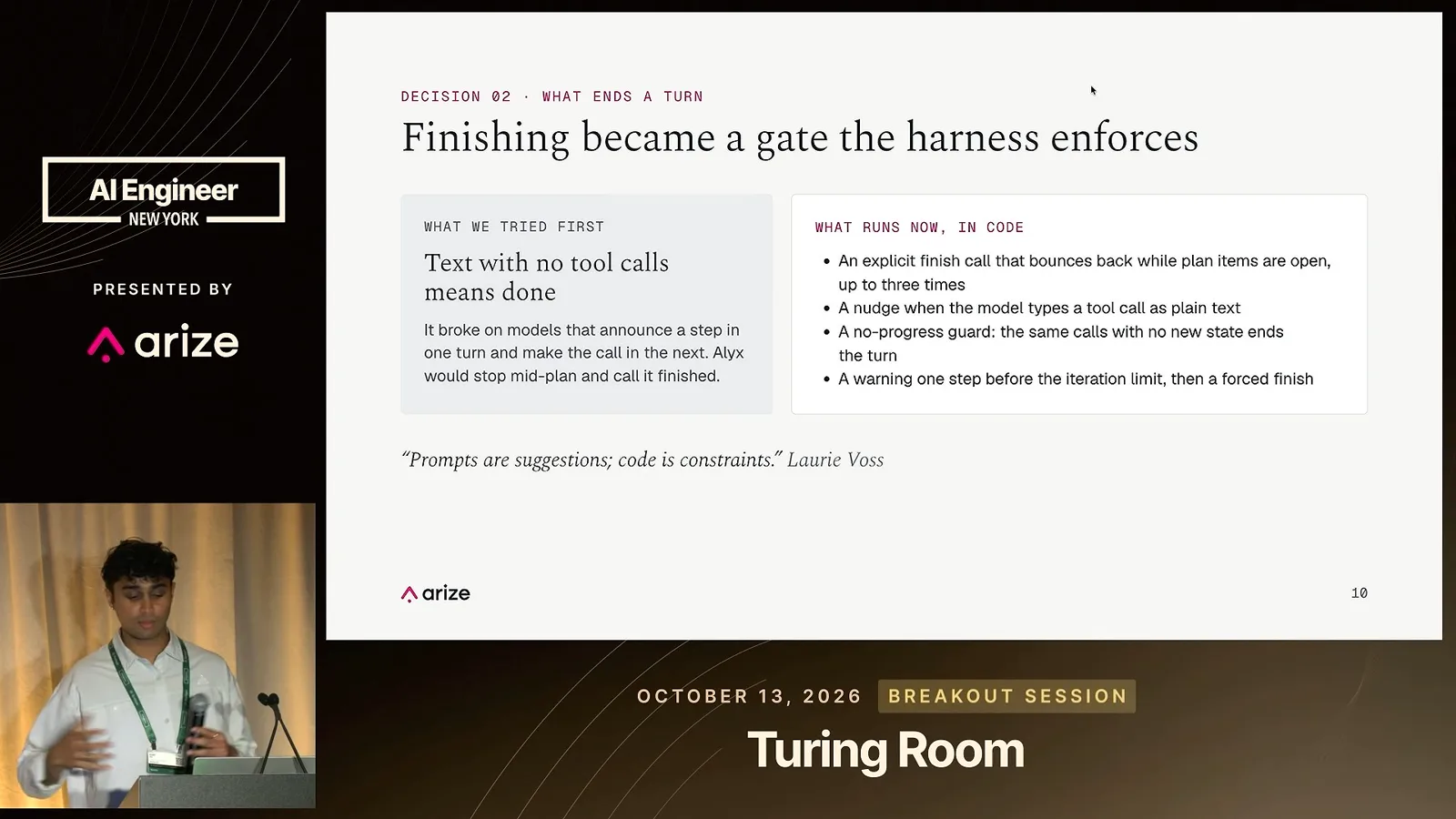
The current design uses an explicit finish call. If plan items remain open, the harness can send the model back up to three times. The slide also describes nudging plain-text tool calls, stopping repeated calls that make no progress, and warning before the iteration limit followed by a forced finish.
Context and long-term memory
Large results are referenced rather than dumped into context, and checkpoints compact history. A small user-specific file became the long-term memory design.
Memory creates several related problems. A large tool result is like a book that takes over your desk; several such books can fill the desk entirely. Rather than leave the whole result in context, we keep a reference and a high-level description so the agent can retrieve what it needs.
Trace analysis can return a large JSON object that would crowd out useful work in the context window. Alyx truncates the immediate result and can write code or use tools such as jq to inspect the full material. This makes use of models' ability to work with code rather than dumping everything into the prompt.
The agent's own history also grows. The harness asks the model to write a checkpoint and then drops the material the checkpoint replaces, subject to a fixed history token budget. Across sessions, a background job edits a small file for each user.
For long-term memory, we tried vector retrieval, episodic and semantic stores, and temporal knowledge graphs. We ultimately chose a Markdown file per user per space, capped at 8,000 characters and loaded in full on each request. A background job applies small edits after a turn, with a safety check on writes.
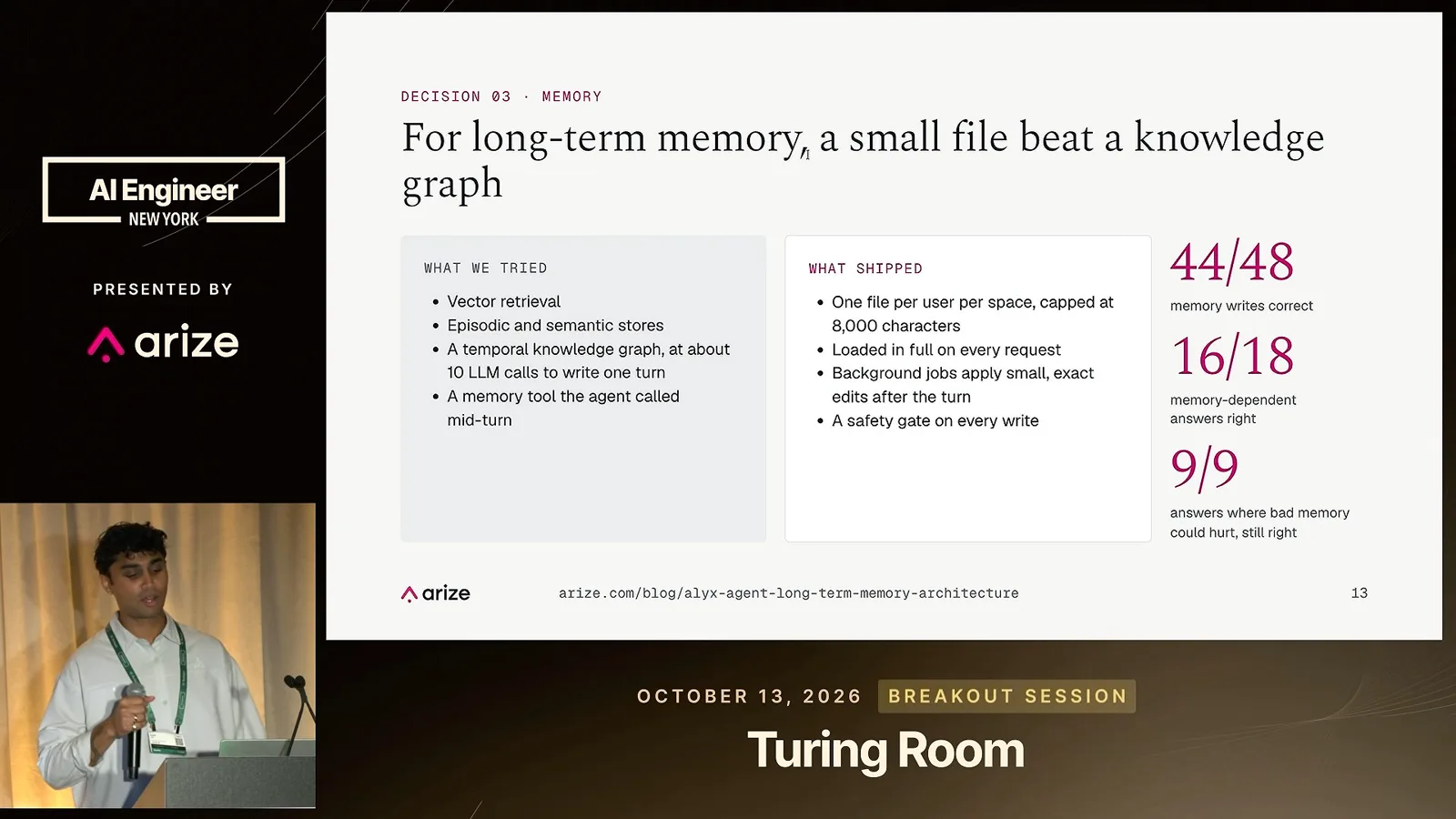
The small file is easy to load and audit without overwhelming context. A human labeler can inspect what was saved and adjust the background job's instructions. Ali presents this as a lesson from Arize's experience in avoiding unnecessary engineering complexity, not proof that files outperform other memory systems everywhere.
Specialists and model selection
The team moved from ten specialists toward one agent with on-demand skills. It selects models according to task quality and speed rather than novelty alone.
We began with one trace agent, then grew to ten page-specific specialists. A dataset page, for example, had its own agent for generating synthetic data and inspecting datasets. We later merged the main flow into one agent that loads skill instructions and tools as needed, letting it choose the tools to use.
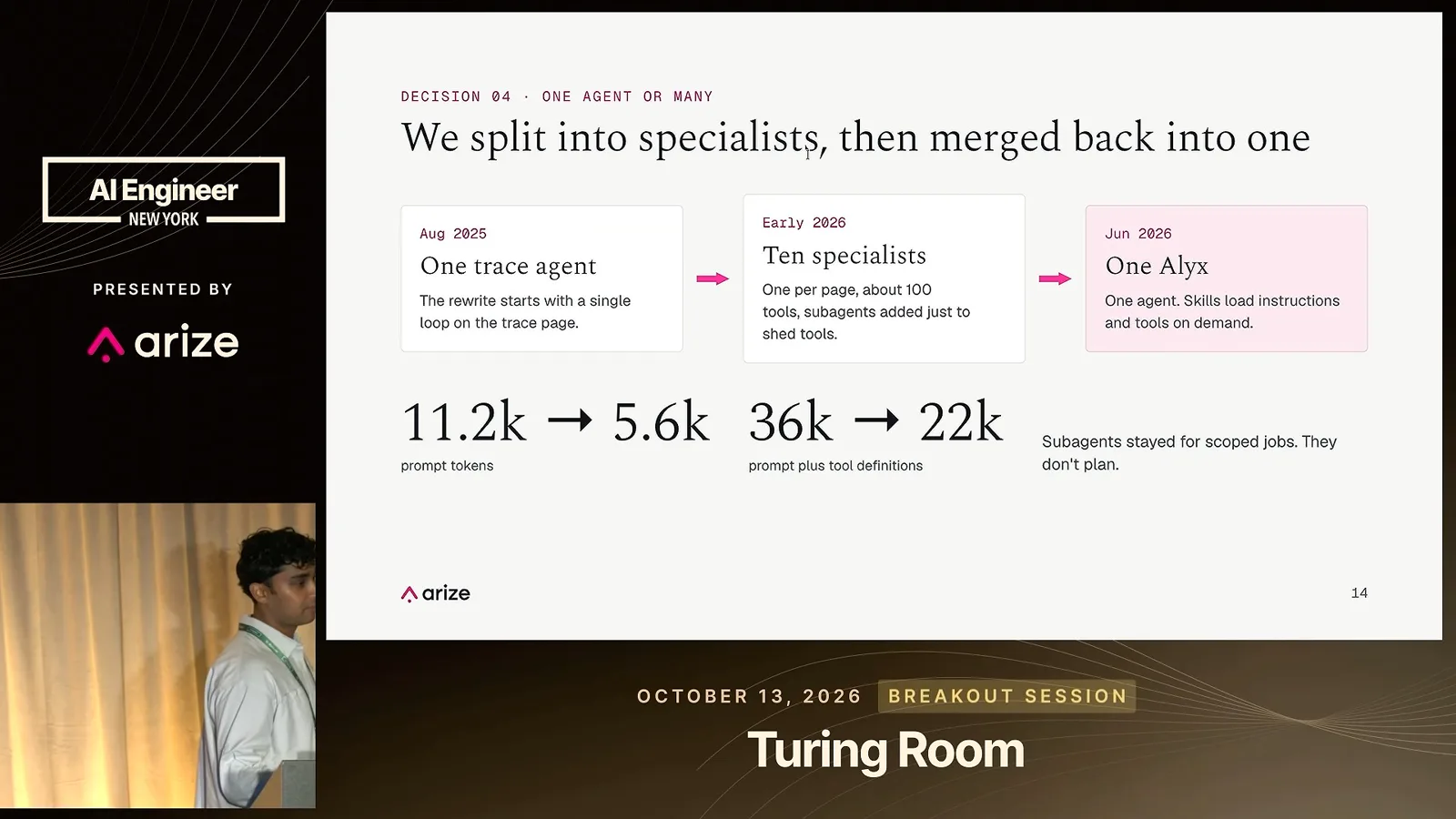
The slide shows that scoped subagents remain for bounded jobs rather than planning. It also reports reductions in prompt tokens and in prompt-plus-tool-definition size across the redesign. Those are figures from this system's architecture, not a general prediction for every consolidation.
The newest model isn't automatically the best default. A general frontier ranking differs from what works for a particular product. We usually choose a model that is fast and good enough, then spend time on the harness; the team is also exploring task-specific routing and small post-trained models.
Some tasks do not require an agent loop at all. Ali gives AI-assisted filter generation as an example where a single call to a small model may be sufficient. Adding a full loop in that case could be another form of overengineering.
Testing and human judgment
Production traces become regression examples and reveal qualitative failures. Human labels and judgment remain important to evaluation and quality tradeoffs.
Tracing production sessions helps us turn real user questions and failures into regression datasets. These fixtures change over time as new cases appear. Session datasets can also retain a full session and replay a particular turn, while experiments help compare harness changes.
Agent bugs do not always appear as explicit errors. A run can report success while making 43 identical tool calls in one turn. Latency also needs context: 227 seconds may clearly be too long, but an acceptable response time depends on the application. Signal helps the team surface patterns in traces.
A fix can introduce the next bug, so regression datasets matter. Evaluator judges need a human baseline: the team aligns automated judgments with engineers' assessments and uses human-created golden labels and datasets. Automation reduces some trace reading without eliminating expert judgment.
Choosing the tradeoff between speed and quality remains a human decision. Metrics can show the latency and quality changes from switching models, but they do not decide which tradeoff is appropriate across every part of the product.
What survived the rebuilds
Ali lists persistent engineering practices including tracing, calculations in code, golden datasets, recoverable errors, streaming and skills.
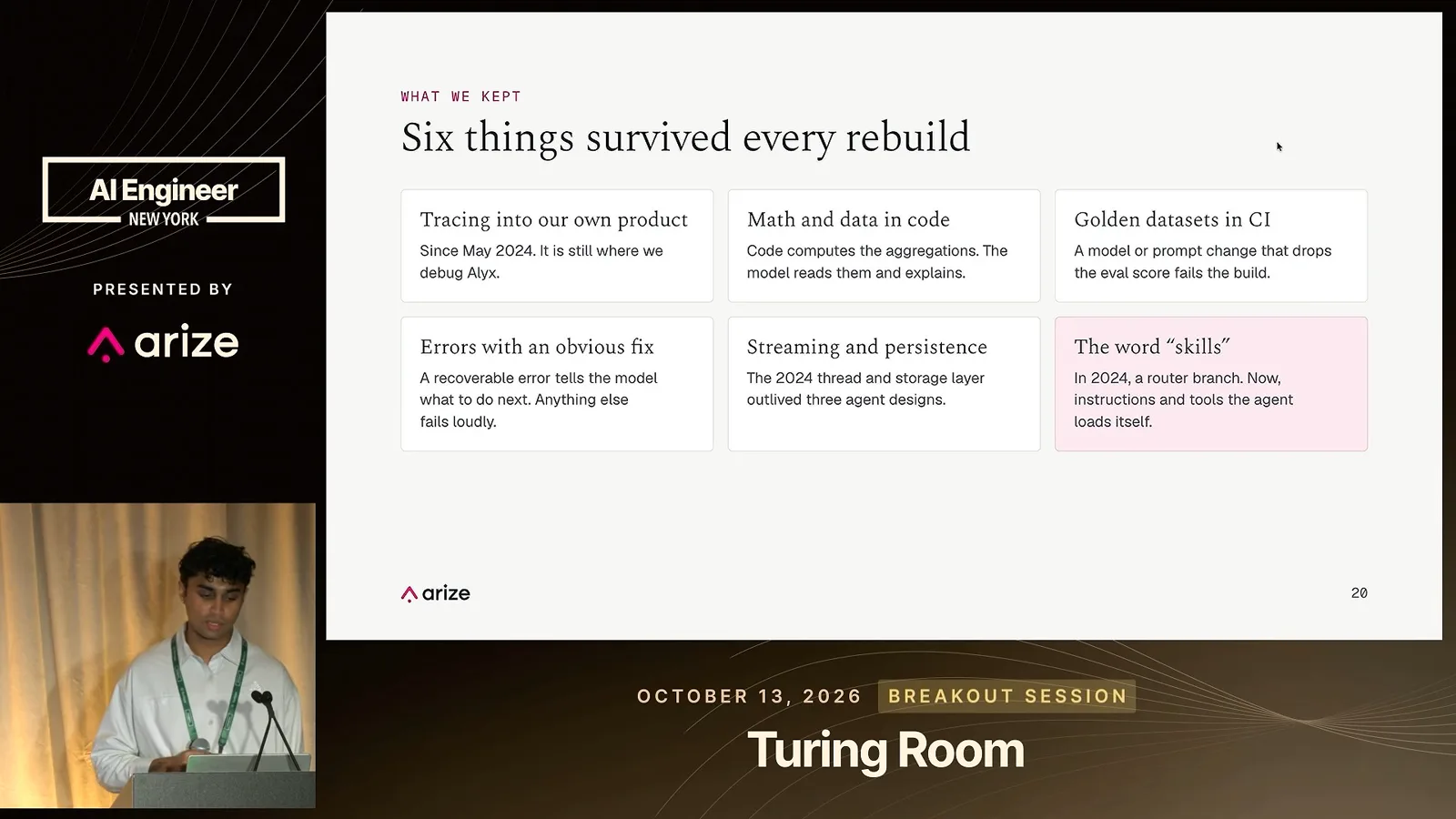
Six practices survived the rebuilds: tracing into Arize's own product; doing mathematical aggregations in code and having the model explain them; golden datasets in continuous integration; recoverable errors with an obvious next step; streaming and persistence; and skills. The meaning of skills changed from a router branch to instructions and tools the agent can load itself.
Ali closes with the questions he wants builders to ask: who owns the plan, what ends a turn, how to handle oversized tool output and long-term memory, whether to use one agent or several, which model is fast and capable enough, and who checks the agent's fixes. His team continues to use Alyx to build Alyx.
Mehr aus diesem Kanal
 21:32EN
 AI Engineer· 29. Okt. 2026Shy Ruparel on AI agent reliability and recovery after failuresShy Ruparel · TemporalTemporal’s survey finds a gap between frequent agent use and dependable deployment. Ruparel demonstrates a synthetic payout workflow that resumes after workers stop.
 14:50ENAI Engineer· 29. Okt. 2026Cole Gannaway on code review, cross-repository risk and AI software factoriesCole Gannaway · QodoA one-line rename can pass local checks while affecting distant clients. Qodo’s Cole Gannaway explains how review context, shared rules and independent agents can expose those risks.
 11:47ENAI Engineer· 29. Okt. 2026Revolut’s David Abitbol on self-hosting AI coding models at scaleDavid Abitbol · RevolutAbitbol shares engineering delivery trends, GPU-serving costs and latency tuning, then describes controls for operating the tools in a regulated bank.
 21:47ENAI Engineer· 28. Okt. 2026Patrick Smyth on Open-Source Supply Chain Security in the AI EraPatrick Smyth · ChainguardChainguard’s Patrick Smyth discusses faster exploitation, malware in dependencies, zero-days and the expanding attack surface around developer workflows.
 14:09ENAI Engineer· 28. Okt. 2026Taylor Luttrell-Williams on Finding Logic Vulnerabilities with SonarQube Hunter AgentTaylor Luttrell-Williams · SonarSonar’s Taylor Luttrell-Williams explains how a security agent maps a codebase, investigates logic flaws and presents validated findings alongside conventional scans.
 16:29ENAI Engineer· 28. Okt. 2026Chris Vela on Benchmarking vLLM Configurations with Runpod BenchPodChris Vela · RunpodRunpod’s Chris Vela demonstrates a dashboard for comparing LLM serving configurations and choosing performance settings with workload-specific data.