In 30 Sekunden
In this Real Numbers episode, Sawyer uses a driving-test scenario to distinguish two directions of conditional probability and derives Bayes' theorem from the multiplication rule. He then solves the previous episode's War card-game challenge by dividing it into three disjoint cases, and leaves the driving-test problem for viewers to solve.
- 1A driving-test puzzleOf applicants, 60% studied, 75% passed, and half of those who did not study passed. The question asks how likely a passing applicant was to have studied.
- 2Bayes reverses the conditionThe theorem relates P(A|B) to P(B|A), adjusting for the probabilities of A and B.
- 3A proof from intersectionsBecause A and B is the same event as B and A, the conditional probability multiplication rule gives both sides of Bayes' theorem.
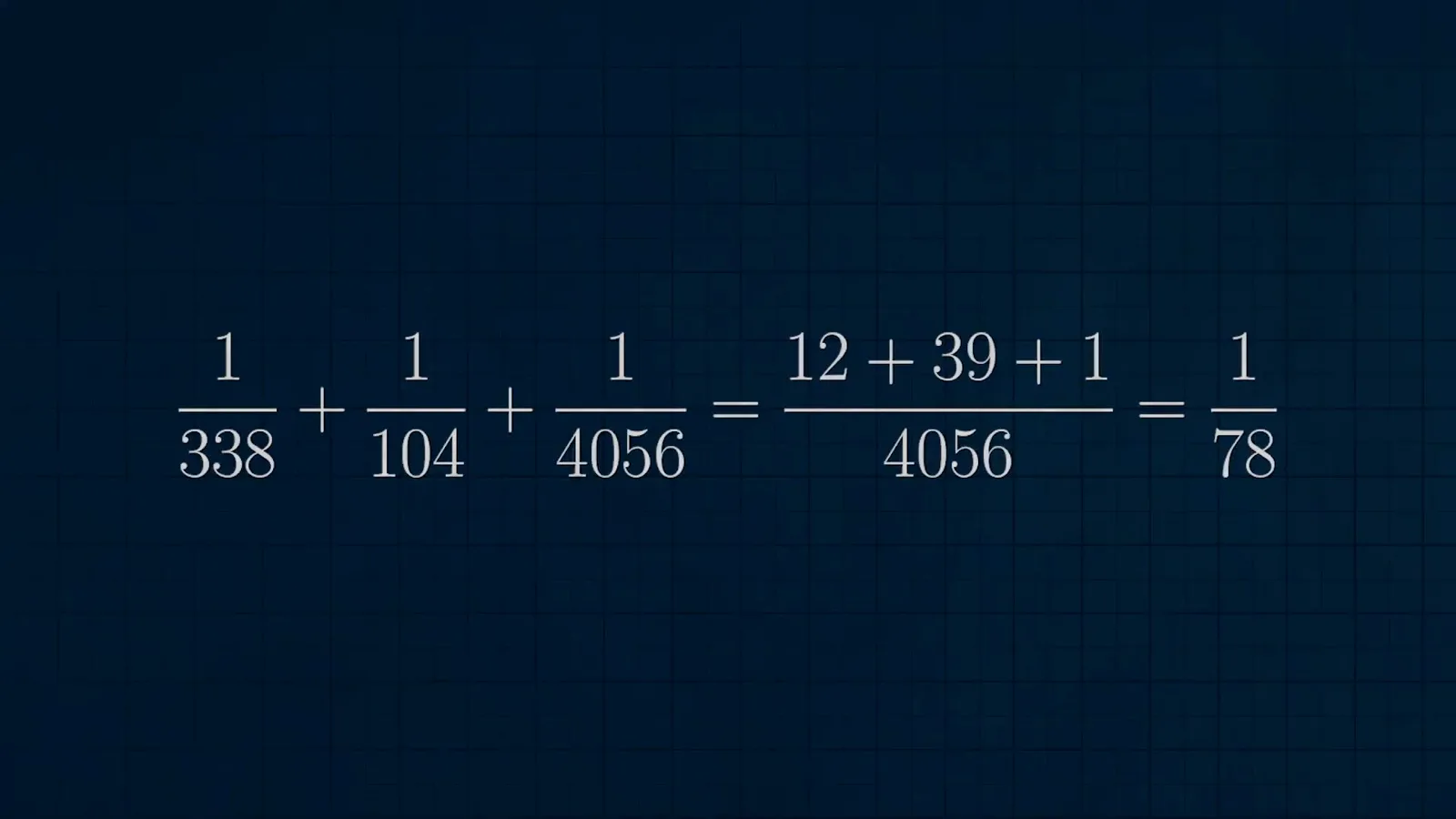
- 4Three ways to lose an aceThe prior War puzzle divides into three disjoint cases, yielding probabilities 1/338, 1/104 and 1/4056, which add to 1/78.
Das Wichtigste
- Conditional probabilities reverse the roles of the event of interest and the known condition, so they are not generally interchangeable.
- Bayes' theorem follows by expressing the same intersection in two orders and dividing by the probability of the condition.
- Disjoint cases can be calculated separately and added to obtain the probability of a combined event.
- In the stated War puzzle, the probability that Clara wins Damian's ace on the first move is 1/78.
Den bearbeiteten Text nach Kapiteln lesen
The driver's test question
Sawyer introduces the known study and pass rates and asks for the probability that a successful applicant studied. He distinguishes the given conditional probability from the one sought.
I'm Sawyer, and welcome to Real Numbers, where we solve real-world problems using mathematical techniques. Our sequence of probability puzzles leads into Bayes' theorem, a foundational result in probability theory.
Evelyn administers written tests at the local DMV and asks each applicant whether they studied. She finds that 60% studied, the overall pass rate is 75%, and only half of those who did not study pass. One applicant just passed, but Evelyn forgot to ask whether they studied. What is the probability that they did?
We know the conditional probability of passing given that an applicant did not study: the proportion passing within that subset. We want the probability of having studied given that the applicant passed. Notice that we have changed both the event of interest and the condition we know occurred.
Bayes' theorem and its proof
The theorem relates the two conditional probabilities. Sawyer derives it by writing the probability of an intersection in both orders.
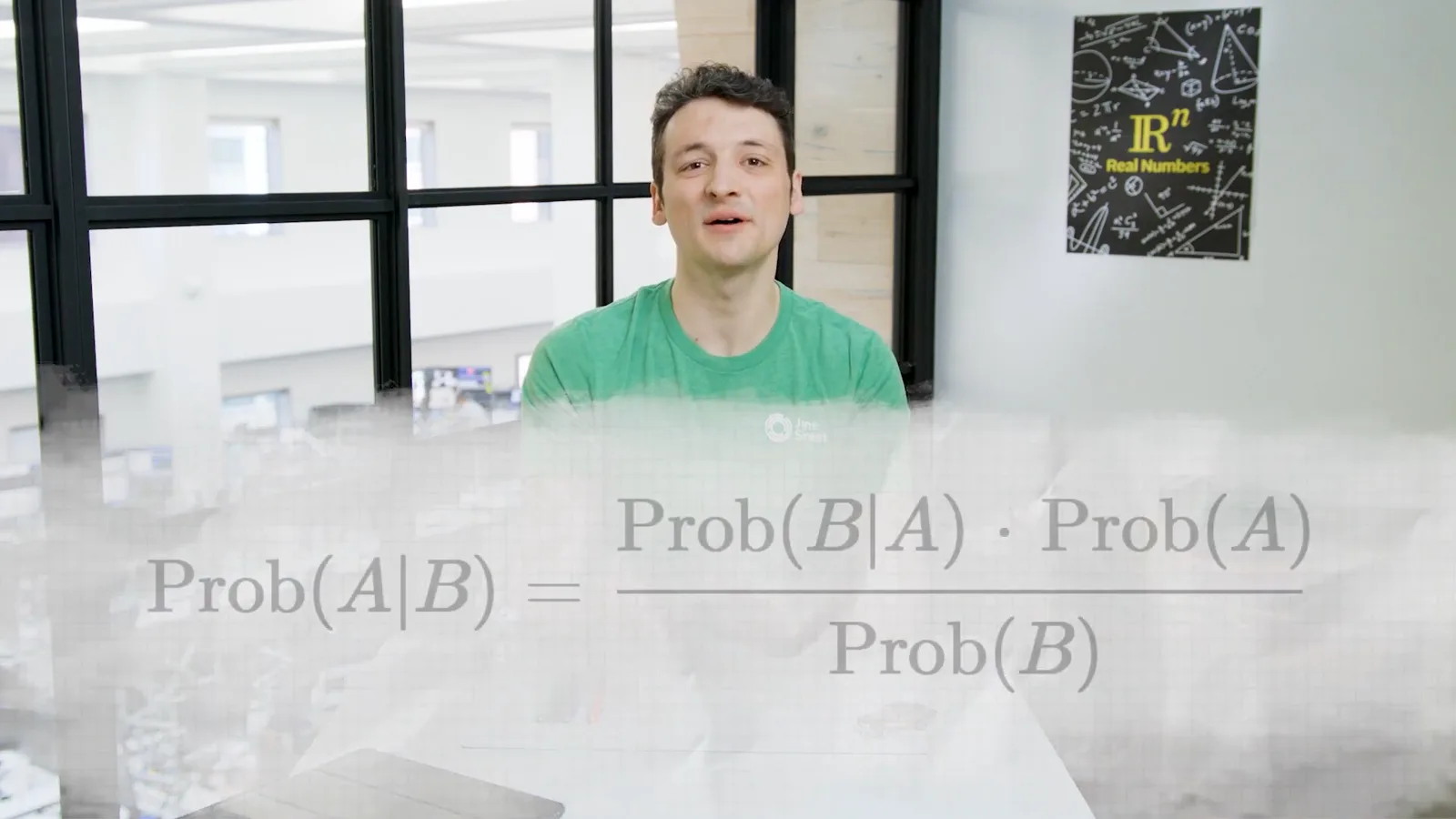
Bayes' theorem relates P(A|B) to P(B|A). At Jane Street, one application is Bayesian inference, which assesses the relative accuracy of models given empirical data. The theorem states P(A|B) = P(B|A) × P(A) / P(B), provided P(B) is nonzero.
The proof follows from the conditional probability multiplication rule: P(A and B) = P(A) × P(B|A). But A and B is the same event as B and A; ‘and’ is commutative. If a muffin is warm and delicious, it is also delicious and warm.
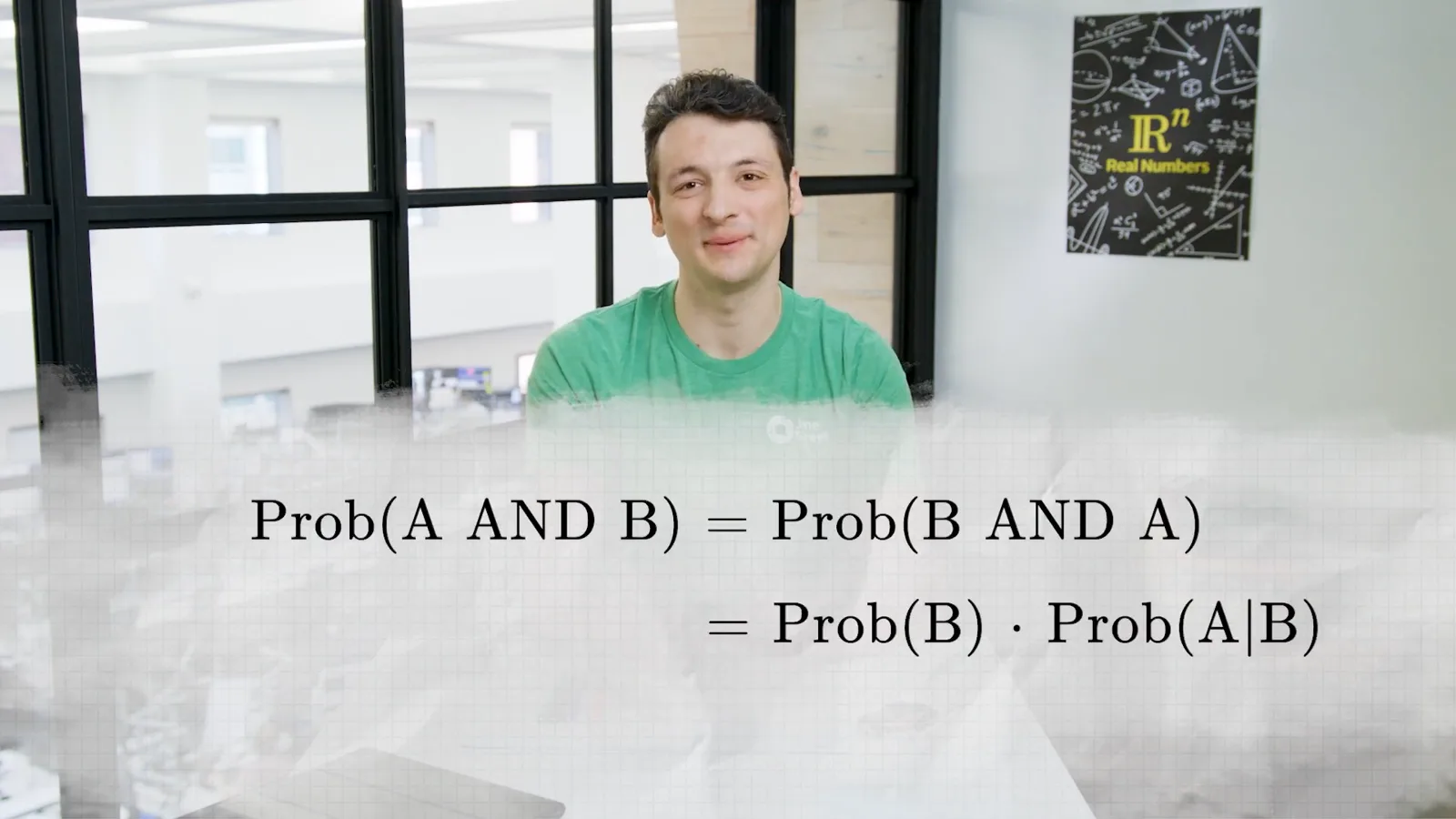
Writing the intersection in the other order gives P(B and A) = P(B) × P(A|B). Equating the two expressions and dividing by P(B) yields Bayes' theorem. Try using it to solve the driver's test problem.
Solving last week's War puzzle
Clara and Damian each have a shuffled suit, and the question is whether Damian loses his ace on the first move. Sawyer divides the possibilities into three disjoint cases and adds their probabilities.
Now let's solve last week's War challenge. Clara has the 13 clubs shuffled and Damian has the 13 diamonds shuffled. We want the probability that Damian loses his ace of diamonds after their first move is settled.
An ace wins any ordinary battle, so Damian can lose it only if there is a war: the first cards must have the same rank. Whatever Damian turns over, exactly one of Clara's 13 equally likely cards matches it, so the probability of a war is 1/13.
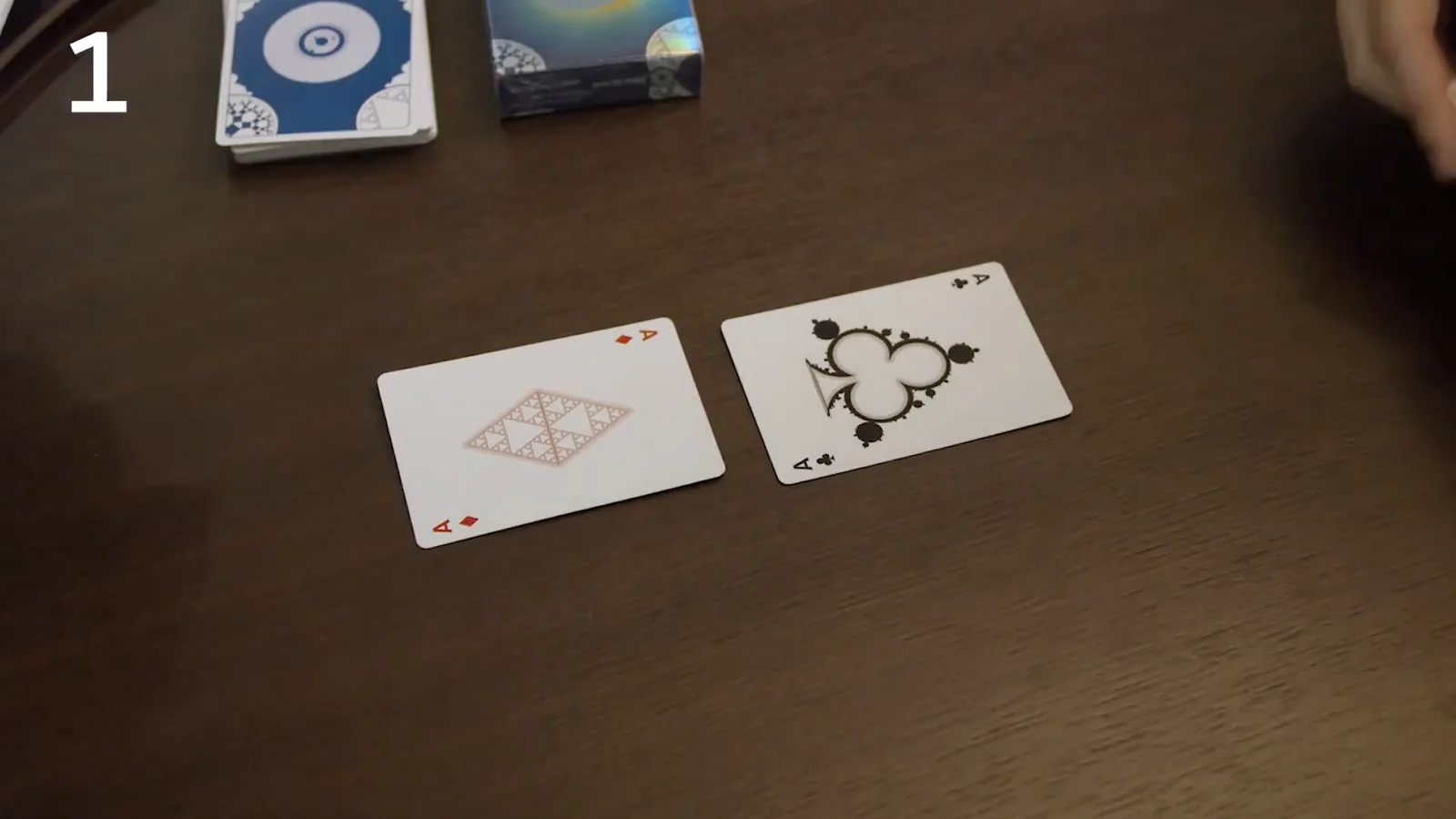
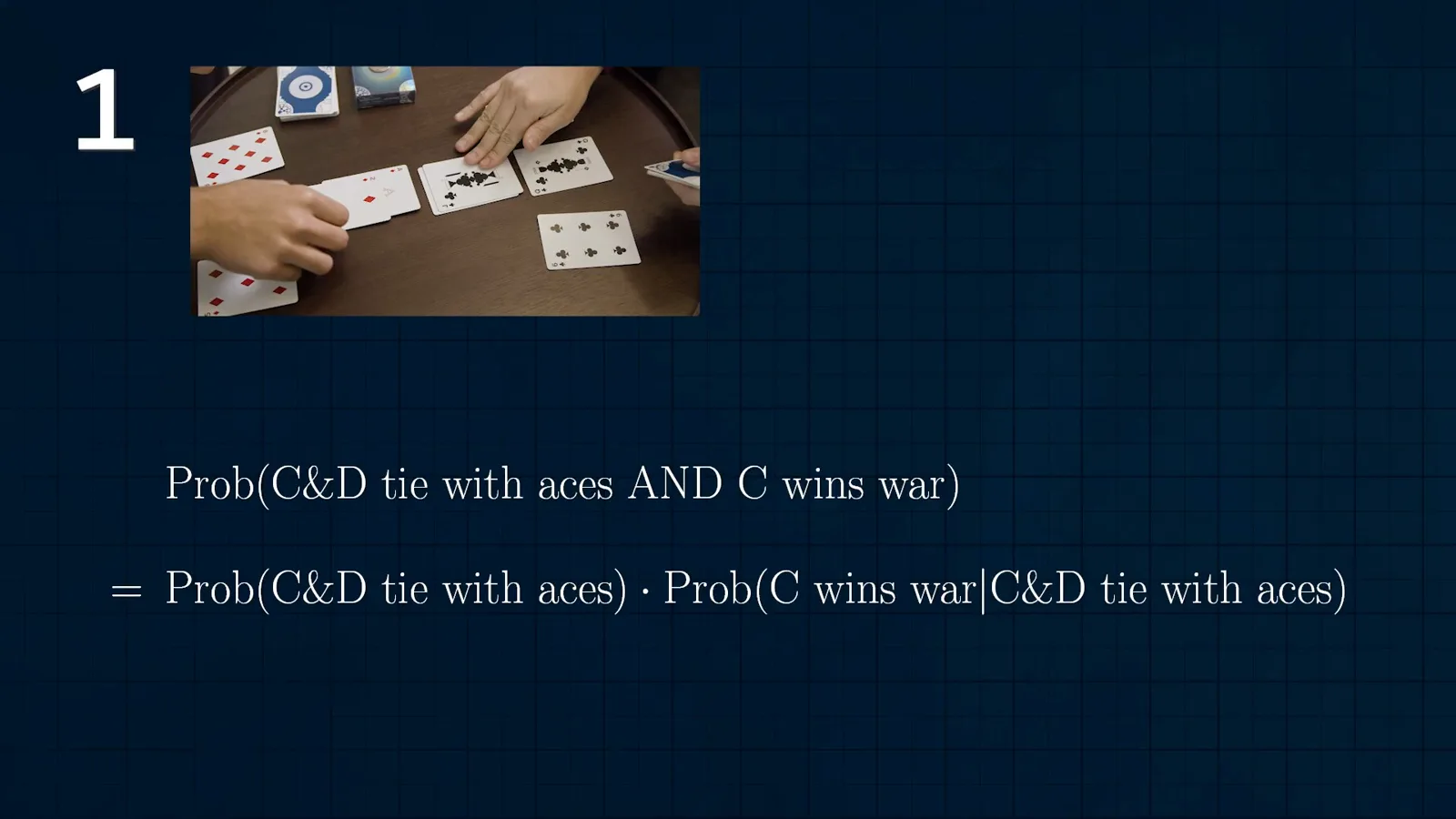
There are three disjoint ways Clara can win Damian's ace. They can tie initially with aces and Clara can win the ensuing war; they can tie with non-aces, Damian's ace can be among the next three cards, and Clara can win; or they can tie with non-aces, then tie with aces in the war, and Clara can win the coin flip. The cases are disjoint because Damian's single ace occurs in different places in his deck.
For the first case, multiply the chance that both players turn over their aces by Clara's chance of winning the subsequent war. Once the aces are set aside, their remaining decks are equal, so symmetry gives each player a 1/2 chance. The result is (1/13) × (1/13) × (1/2) = 1/338.
For the second case, the factors are 12/13 for Damian's first card being a non-ace, 1/13 for the initial match, 3/12 for his ace being among the next three cards, and Clara's conditional chance of winning the war. If Clara draws her ace she wins; otherwise her remaining deck is symmetric with Damian's and she wins with probability 1/2. The resulting probability is 1/104.
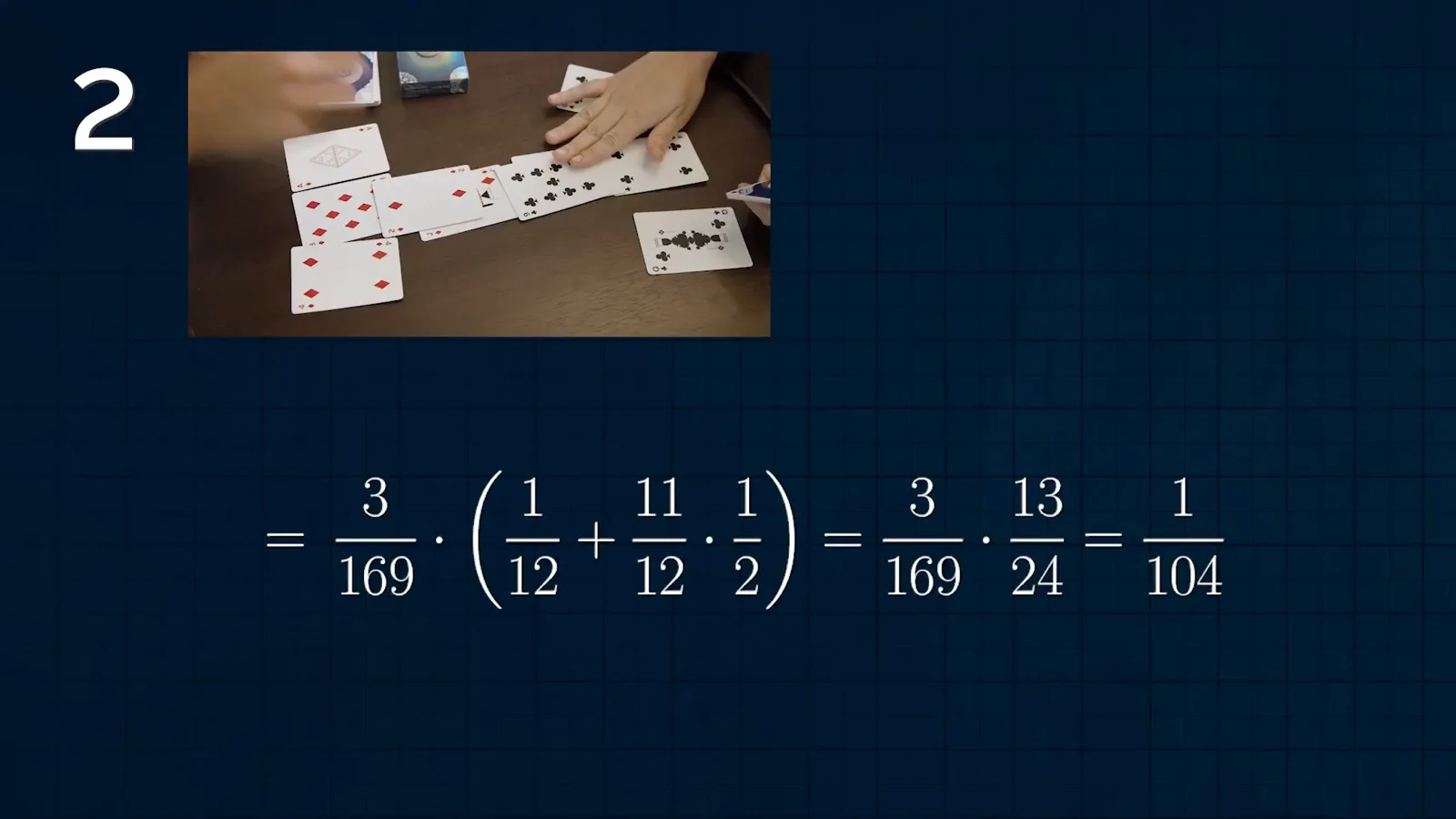
In the final case, the players initially tie with non-aces, then tie with aces in the war, and Clara wins the coin flip. Its probability is 1/4056. Adding the three disjoint cases gives 1/338 + 1/104 + 1/4056 = 1/78. The simple result suggests there might be a more direct solution; perhaps you can find one.
The new challenge
Sawyer recaps the driver's test information and invites viewers to solve it. The solution is reserved for the next episode.
Returning to this week's problem: 60% of applicants studied, 75% passed, and someone who did not study passes with probability 50%. Given that an applicant passed, what is the probability they studied? I invite you to work it out and share your reasoning; the solution comes next week.
Mehr aus diesem Kanal
 1:48:29EN
 1:36:37EN
 1:05:45EN
 1:25:00EN
 1:16:29EN
 27:39EN