In 30 Sekunden
In January 2025, Matthew Berman discusses DeepSeek-R1, its connection to Chinese quantitative investment firm High-Flyer, and the reaction to its release. He weighs claims about training costs, GPU access and inference economics, arguing that lower costs could expand demand. The frequently repeated $5 million figure refers to a narrower DeepSeek-V3 training-compute estimate, not the total cost of developing R1.
- 1R1’s releaseDeepSeek released an open-weight reasoning model and described its training approach, attracting intense attention in January 2025.
- 2What the cost figure meansThe $5.576 million calculation in the V3 report is an estimate for specified training GPU-hours, not a complete R1 budget.
- 3The High-Flyer connectionBerman discusses DeepSeek’s connection to a quantitative trading firm, while social-media descriptions of it as a mere side project are not a verified cost breakdown.
- 4Unverified claimsClaims of covert state direction or a particular hidden GPU inventory require evidence; the video presents them as disputed speculation.
- 5Demand and the rebound effectBerman argues efficiency could expand inference demand, but the size of that response and its effect on total spending are empirical questions.
- 6Open researchYann LeCun emphasizes the value of shared research and tools; R1’s available weights and report enable further experimentation.
Das Wichtigste
- DeepSeek released R1’s weights and a technical report, but a detailed recipe is not the same as releasing every dataset and component needed for exact reproduction.
- The widely cited $5.576 million estimate covers specified DeepSeek-V3 training stages at an assumed GPU rental rate and excludes prior research and experiments; it is not R1’s total development cost.
- Claims about secret GPU inventories, government direction and unusually cheap API usage discussed in the video were not established by the cited social posts.
- Lower unit costs can increase usage, but a rebound in total spending or compute demand is not guaranteed.
- Benchmark comparisons depend on the tasks and configurations tested, and more compute alone does not guarantee the best model.
Den bearbeiteten Text nach Kapiteln lesen
The release and its cost debate
Berman describes the reaction to R1 and contrasts it with large infrastructure commitments. The frequently cited training cost refers to V3 and excludes important expenses.
DeepSeek-R1 arrived in January 2025 and sparked a strong reaction across the AI industry. It is a reasoning model whose weights and technical report were released, enabling others to study and run it under the applicable terms. Comparisons with OpenAI’s o1 are based on particular evaluations and should not be generalized to every task.
I repeat a widely circulated claim that the model cost roughly $5 million to train. That needs a correction: the [DeepSeek-V3 technical report](https://arxiv.org/abs/2412.19437) estimates $5.576 million for 2.788 million H800 GPU-hours covering V3 pretraining, context extension and V3 post-training, assuming $2 per GPU-hour. It excludes prior research and ablation experiments; it is not a complete cost for R1, its separate post-training, hardware, staffing or serving.
The release came amid major US infrastructure plans. Stargate’s January 2025 announcement described an intended $500 billion investment over four years; that was a plan, not proof the whole amount had already been spent. Meta and other companies also discussed substantial AI capital expenditure, prompting questions about how efficiently future systems could be built.
DeepSeek published R1 on January 20, 2025. Its report describes a multi-stage reasoning-training approach, and selected benchmark results were competitive with contemporary models. Although weights and important details were made available, not every dataset and training component was released; reproducibility and the practical cost of running a large model remain separate questions.
The early excitement turned into a debate about whether major AI firms had overspent. I do not think the release alone establishes that their investments were unnecessary. Comparing costs requires consistent accounting for earlier research, training, infrastructure and inference, rather than treating the narrow V3 compute estimate as an all-in price.
A viral post describes DeepSeek as a side project connected to High-Flyer, a Chinese quantitative trading firm. That connection is part of the company’s background, but a social post is not an audited account of its staffing, equipment or purpose. Open weights can be run on independent hardware, yet the full model still demands substantial resources and hosted API use has its own costs.
A quant fund and contested claims
He recounts the High-Flyer connection and public speculation about hardware and motives. Social-media claims are not independent proof.
Online reactions ranged from jokes that a cheap model had defeated OpenAI to allegations that the release was state-directed economic warfare. I do not accept the exaggerated conclusion that OpenAI was defeated, and the claim of a covert state operation presented in the video is unverified. A model release or low API price alone cannot establish such intent.
Scale AI’s Alexandr Wang suggested DeepSeek might possess about 50,000 NVIDIA H100 GPUs and discussed US export controls. That is a claim, not an independently established inventory or proof of a violation. DeepSeek’s report disclosed the H800 hardware and GPU-hours used for the specified V3 training run; that figure does not establish the firm’s entire hardware holdings.
I mention that Hugging Face was working to reproduce aspects of the approach. Its later [Open-R1 project](https://huggingface.co/blog/open-r1) describes reconstructing data and the training pipeline, demonstrating both the value of the published report and the work still needed for a fully open reproduction. Emad Mostaque also offered cost estimates on social media; they are estimates rather than audits of DeepSeek’s total expenditure.
Social posts claimed large numbers of API calls at extremely low cost and contrasted service capacity with competitors. These anecdotes do not establish aggregate throughput, actual unit costs, profitability or the amount of hardware deployed. Pricing can reflect subsidies, promotion, output lengths and many other conditions.
Inference economics and demand
Berman distinguishes training from inference and presents a rebound-effect argument. Efficiency and spending outcomes remain uncertain.
Training a model and serving its responses are different costs. Reasoning systems can use additional inference-time compute, and greater computation may help on some tasks, but it is not guaranteed to improve every response. A low advertised API price by itself does not reveal the provider’s full cost or prove a unique technical advantage.
Wang argued that the US should innovate faster and tighten chip controls, while describing DeepSeek as a potential threat to equity markets. Those are policy and market views, not findings established by the model release. It is possible to debate export controls, competition and capital spending without treating an unverified hardware count as fact.
My first scenario is that efficient techniques are reproduced and the cost of inference falls. I invoke Jevons’ paradox: when a resource becomes cheaper, greater use can offset some or even all of the savings. Whether total energy, GPU demand or spending actually rises depends on how much demand responds; the rebound is possible, not an automatic economic law.
My second scenario is that the company has more computing resources than some assume. I argue that investment could still be useful in either case, because capable systems have substantial demand. My stronger claim that whoever owns the most compute will necessarily build the smartest model is a prediction: algorithms, data, engineering, access and deployment also matter.
Y Combinator’s Garry Tan similarly argues that cheaper training could accelerate demand for inference. That is a plausible market scenario, but neither the magnitude of demand nor its distribution across firms follows inevitably from one model’s release. Training economics, serving economics and the returns to data-center investment should be assessed separately.
Competing investment views and open research
He discusses differing interpretations of capital spending and credits open research. His predictions about compute and model leadership are opinions.
Investor Chamath Palihapitiya presents a different view, calling for scrutiny of possible prohibited chip access and distinguishing controls on training chips from the global market for inference. He also predicts volatility as investors reconsider companies’ capital expenditure. These are his policy and market arguments, not verified findings that any specific chip transfer occurred.
I disagree with the view that more efficient models necessarily make big infrastructure spending a mistake. I expect cheaper AI to reach more use cases and consume available compute, while Palihapitiya argues that companies may be rewarded if they can win without spending as much. Either outcome depends on future pricing, productivity, competition and demand.
Palihapitiya also argues that constraints can encourage more creative engineering. That is a useful possibility: limited resources may push teams to improve efficiency. It does not establish the complete history of DeepSeek’s resources or prove that large investment and innovation are mutually exclusive.
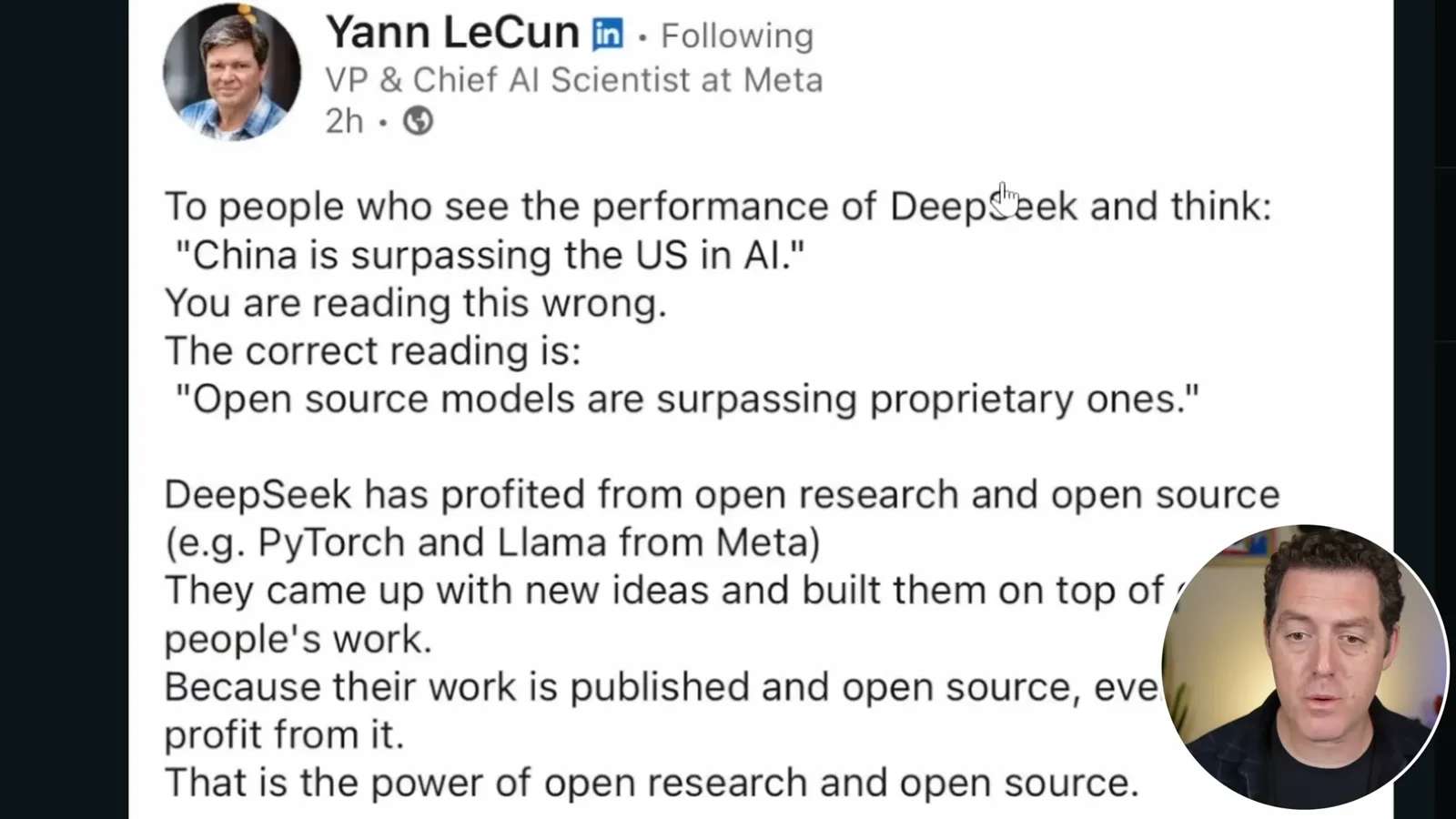
Yann LeCun argues that DeepSeek benefited from open research and tools, including PyTorch and Llama, and that publishing improvements lets others build on them. I agree that sharing research and weights can widen participation. The distinction still matters: available weights and a paper support experimentation without automatically providing all data and artifacts required for exact replication.
At the time of recording, many questions about DeepSeek’s hardware, costs and competitive impact remained open. Rather than selecting between a hidden-resource theory and a universally cheap side-project story, I see this as a developing debate about efficiency, open research and demand for AI. The evidence available for each claim differs.
Mehr aus diesem Kanal
 34:21EN
 Matthew Berman· 27. Okt. 2026Matthew Berman Examines Anthropic’s IPO Filing, AI Growth and GovernanceMatthew Berman, Sam Altman · Forward FutureThe presenter reviews the S-1’s financial metrics, compute strategy and voting structure while questioning the tension between rapid AI development and safety.
 0:26ENMatthew Berman· 25. Okt. 2026Sam Altman on Human Values and Problem-Solving in an AI WorldSam Altman · OpenAIIn a short interview excerpt, Altman considers the enjoyment of solving hard problems and the human role in interpreting results.
 0:36ENMatthew Berman· 25. Okt. 2026Kimi K3.1 and a Rubik’s Cube Solver DemonstrationMatthew Berman · Forward FutureMatthew Berman shows a scrambled virtual cube being solved and gives the Kimi K3.1 test a favorable assessment.
 0:21ENMatthew Berman· 24. Okt. 2026An AI-Generated Kimi Benchmark Chart Used Invented ScoresMatthew Berman · Forward FutureMatthew Berman asks for a graph of Kimi K3.1 Pro benchmarks, then discovers that the displayed figures are illustrative placeholders.
 25:50ENMatthew Berman· 24. Okt. 2026Kimi K3.1 Pro Tested: Strong 3D Demos, Uneven Results and Competitive PricingMatthew Berman · Forward FutureMatthew Berman tests the open-weight model on coding, 3D rendering and visual explanations, then compares benchmark results and prices.
 32:20ENMatthew Berman· 23. Okt. 2026Who Is Local AI For? The Costs, Trade-offs and a Hybrid FutureMatthew Berman · Forward FutureMatthew Berman weighs data control and independence against hardware cost, setup complexity and inference speed.