In 30 Sekunden
Dan Shipper argues that as AI models become widely available, their default answers become a shared baseline. The differentiator, he says, is a person’s responsibility and perspective: what they ask, notice and choose to act on. At Every, a single customer survey led Shipper and colleagues to find different opportunities and build different things with the same AI tools. He also describes an internal experiment in which generating possible answers was easier than ranking the answer he would actually choose.
- 1One person used agents across several roles in a weekShipper analyzed a survey, made a game and built a customer-management tool while carrying out his other work.
- 2The same survey led colleagues to different actionsShipper saw an opportunity in team sales; Yash focused on subscriber churn and Douglas noticed readers’ loneliness.
- 3Generating a possible answer was easier than ranking itIn an internal experiment, Shipper says his Slack answer appeared among 400 candidates more often than it ranked in the top tenth.
- 4Future workers will use future models tooShipper argues against comparing a more capable future model only with a human frozen at today’s abilities.
- 5Measure whether a model helps with the user’s own workHe proposes evaluating performance against an individual’s goals and perspective as well as shared benchmark tasks.
Das Wichtigste
- Ask how an AI output serves a specific responsibility, rather than stopping at a generic summary.
- Let people with different roles examine the same information; they may notice and act on different opportunities.
- Separate generating candidate answers from ranking and selecting the one worth pursuing.
- Shipper argues that comparisons should consider people using newer tools, not only people fixed at today’s capabilities.
- Evaluate models on the work and perspective of the person using them, alongside general benchmarks.
Den bearbeiteten Text nach Kapiteln lesen
An aggregate chart and a closer look at work
Shipper contrasts benchmark trends with observing a real case. He describes using agents to analyze a survey and build tools during a busy week.
Every’s conference asked what great human work looks like after automation. Introducing its closing talk, Natalia Quintero says Every co-founder Dan Shipper analyzed a customer survey, built a simple customer-management tool and a game, and contacted customers with the help of a Claude subscription.
Quintero says those activities previously might have required several specialists, yet the output from a generic question about the survey would likely look much like anyone else’s. She introduces Shipper’s argument that the perspective brought to a model makes work distinctive.
Shipper contrasts two ways of thinking about the future. An aggregate view collects many observations and extends a trend; an intimate view examines one situation closely, including its messy details, and reasons outward from it. He says the first is powerful, but neither view tells the whole story alone.
As an example of the aggregate, he points to the relationship between model capability and the data and computing used to train models. He also cites OpenAI’s GDPval benchmark, in which experts compare outputs from models and humans on real work tasks.
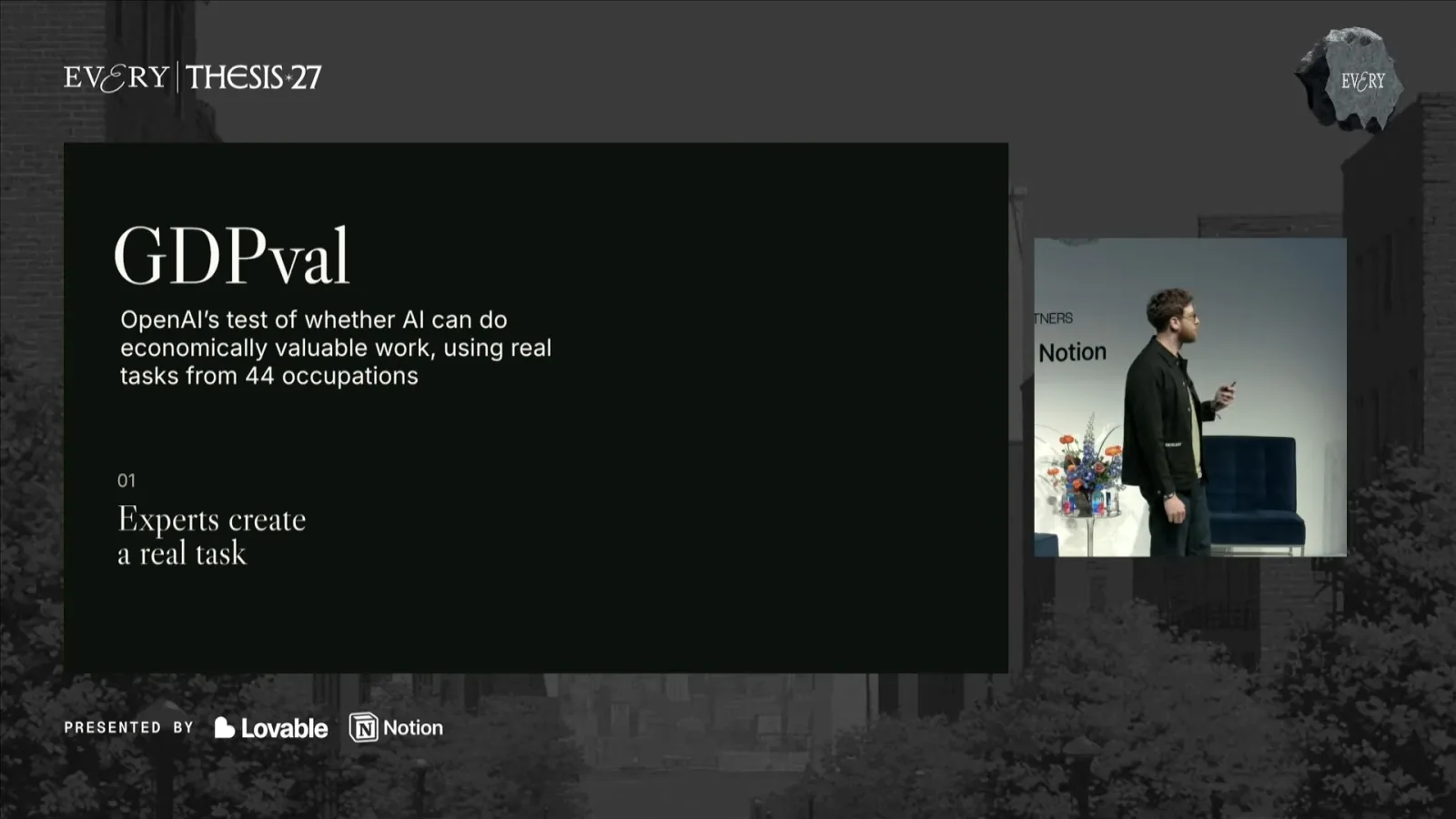
Shipper presents benchmark figures from 2024 through 2026 as evidence of rapid improvement. He says looking only at those results can make the future of human work look bleak. The measures compare model output with human work performed without AI.
In his own week, Shipper used agents to ask many questions of a quarterly customer survey, generate a game for an all-hands meeting and build a customer relationship management tool for outreach. He says that, in earlier terms, the work would have involved a data scientist, a game developer, a marketer, an engineer and a business development representative.
He describes seeing a model perform familiar work as an “agency rupture”: people often identify with what they do, and automation can unsettle that sense of self. For him, the way to examine what an aggregate chart misses is to look closely at how a real person uses the tools.
Shipper says this style of work, with a person directing agents between other responsibilities, is already familiar to many attendees. A few years earlier, some people saw language models as unlikely to improve much, while others predicted that jobs would disappear almost immediately.
Using GPT-3 in 2022, Shipper had predicted that improved AI might let an individual have an impact comparable to a much larger organization. He now sees his own work as an example and asks what that means for the value of a team.
What a team finds in the same survey
Several people use the same data and model but pursue different findings. Shipper argues that their roles and perspectives help determine what they select.
Every has about 30 people, he says, despite the work its agents can perform. To explain why, he returns to the same customer survey: every member of the team could inspect the data and analyze it using AI, but they did not all choose the same question or result.
Shipper noticed an opportunity to sell Every to teams and built his own tool for customer outreach. Yash, a go-to-market engineer focused on subscriber growth, found that some first-time subscribers left after one month because they received too much email.
Douglas, who led marketing and organized the conference, found a different pattern: some readers felt lonely using AI because people around them did not share their enthusiasm. Jack, a senior editor, made a clay-animation game show to communicate the survey results.
Each person had the same data and access to Claude, but emphasized something different. A default request to the model produced observations Shipper considers real, such as the value of the writing and bundle, yet no one on the team simply submitted that generic response.
The team did its analysis while preparing for the conference. Shipper says Yash not only identified a growth issue but also wrote a proposed code change, while helping build the event’s live-streaming experience. The tools let individuals explore and act on more ideas in the time available.
Generating candidates is easier than selecting them
An internal experiment examines whether a model can predict and rank Shipper’s Slack response. He uses it to explain the value he sees in human judgment.
Could a model have produced the ideas the team found? Shipper says it could produce many candidates, but selecting the useful one is harder. Every’s head of evaluations, Mike Taylor, tested whether Claude could predict what Shipper would say in Slack.
In the experiment, Shipper says the model could include his answer among 400 candidate answers about 93% of the time. When asked to rank the candidates, however, his answer appeared in the top tenth about 60% of the time. He uses the result to distinguish cheap generation from the harder problem of choosing.
A team member has responsibility for a particular part of the business and a perspective on what matters there. Those constraints narrow where the person looks and help them decide which output deserves attention, ownership and action. Different people can therefore explore different parts of the same set of possibilities.
Compare people and models as both change
Shipper expects models to improve, but says people will also gain experience and use those improved models. He sees default output becoming a shared baseline.
Shipper expects models to improve at ranking too. But he argues that comparing a future model with a human frozen at today’s abilities is misleading: in the future, the person will have more experience and will also have access to newer models.
He compares a future team member using a future model with a default request to that same model. Since both sides have access to the tool, he says the difference lies in the person’s responsibility and perspective: what they choose to investigate, how they direct the model and which result they act on.
As a model becomes widely available, Shipper expects its default capabilities to raise the baseline for everyone. An unusual insight may later become part of that baseline, but a person continuing to use improved models can also build on it. He sees value in the way people direct those shared capabilities.
Allocate intelligence toward work that matters
His allocation economy emphasizes directing resources and ensuring work is done well. He proposes evaluating models on individual work as well as general tasks.
This leads him to what he has called the “allocation economy.” In a 2024 essay, he proposed that people would increasingly be judged by how well they allocate intelligence and other resources to a task and ensure the work is done well, rather than only by what they know themselves.
Shipper suggests testing models on how well they perform an individual’s work from that individual’s perspective, alongside tests of agreed problems such as mathematics or programming. He argues that once a capability becomes widely available, a distinctive point of view can matter more to the output a person chooses to pursue.
His conclusion is that aggregate capability charts can compare models with people at a fixed point in time, while close observation lets people see how their own work may change as they use the tools. He closes by asking the conference audience to share what they learned from working with AI and with one another.
Mehr aus diesem Kanal
 16:57EN
 Every· 9. Nov. 2026PodcastFable 5.2 excels at ambitious builds, but its token costs add upEvery’s early tests found strong coding and creative work; a single documentary run used 1.4 billion tokens.
 46:14ENEvery· 4. Nov. 2026Podcast · 2 StimmenKevin Roose on Reporting AI History and Choosing What to DelegateGast: Kevin Roose · Moderation: Natalia QuinteroThe journalist discusses The AGI Chronicles, interviewing a secretive industry, AI-assisted research and his distinction between weightlifting and forklifting.
 50:51ENEvery· 29. Okt. 2026Podcast · 3 StimmenFred Graver on Using AI as a Writers’ Room, Not a GhostwriterGast: Fred Graver · Moderation: Dan Shipper, Natalia QuinteroThe writer and producer explains how he develops ideas and uses AI feedback.
 43:01ENEvery· 21. Okt. 2026Podcast · 8 StimmenHow Every’s Frontier Team Turns AI Experiments Into Useful WorkGast: Mike Taylor, Arielle Shipper, Jack Cheng, Katie Parrott, Jannik Jung, Kieran Klaassen · Moderation: Natalia Quintero, Dan ShipperEvery’s team explains how it tests models, organizes experiments and brings useful tools back to the rest of the company.
 51:02ENEvery· 14. Okt. 2026Podcast · 2 StimmenMatt Hartman on Hugging Face, Technical Founders and Product InsightGast: Matt Hartman · Moderation: Natalia QuinteroThe Factorial Capital investor discusses pivots, founder networks and what building his own AI app taught him about software.
 33:46ENEvery· 7. Okt. 2026Podcast · 2 StimmenHow Every Moved From Personal Bots to a Shared Company AgentGast: Willie Williams · Moderation: Dan ShipperDan Shipper and Willie Williams discuss agent experiments, management feeds and the boundary between work and personal tools.