In 30 Sekunden
In a September 2026 video sponsored by Greptile, Matthew Berman discusses OpenAI’s August 28 announcement that it intends to end its direct model agreement with SpaceX-owned Cursor, with November 12, 2026 as the proposed shutoff date. He reviews the history of Elon Musk and OpenAI, possible concerns about model distillation, statements from Cursor and Anthropic, and his prediction that coding platforms will become more vertically integrated. Motives, data practices and future outcomes that he infers are distinguished from the companies’ actual statements.
- 1A proposed contract wind-downOpenAI proposed November 12, 2026 as the direct agreement’s shutoff date and cited its concerns about compliance following the change of control.
- 2Distillation concernsBerman explains the idea of training a model on another model’s outputs and offers his interpretation of OpenAI’s concern.
- 3Cursor’s responseCEO Michael Truell said OpenAI models served roughly 5% of Cursor traffic; the statement did not specify revenue share.
- 4Precedents and contrastsBerman compares provider restrictions and notes Anthropic’s commitment to continue supporting Claude in Cursor.
- 5Platform dependenceHe predicts model providers will increasingly combine models and coding platforms, potentially narrowing multi-model choice.
Das Wichtigste
- OpenAI announced a proposed November 12, 2026 end to its direct Cursor model-supply agreement, not an immediate blanket ban.
- OpenAI cited its concerns about compliance and past dealings with Musk-controlled companies; this is its stated rationale.
- Cursor CEO Michael Truell said OpenAI models accounted for about 5% of user traffic, a measure that does not establish its share of revenue.
- Berman’s claim that all Cursor user data can be used to train future models is too broad; Cursor says Privacy Mode prevents training on code.
- Anthropic’s Tom Brown said Claude would continue to be supported in Cursor after the acquisition.
- Berman predicts more vertically integrated AI coding platforms, but that is an opinion about the future.
Den bearbeiteten Text nach Kapiteln lesen
OpenAI’s proposed Cursor cutoff
Berman introduces the August 2026 announcement and OpenAI’s stated reasons. The contract was proposed to end in November, not immediately.
OpenAI’s announcement about Cursor may look routine, but I think the dispute behind it raises larger questions about model access and competition. In this September 2026 video, I examine the company’s stated reasons, responses from Cursor and Anthropic, and what the decision could mean for developers.
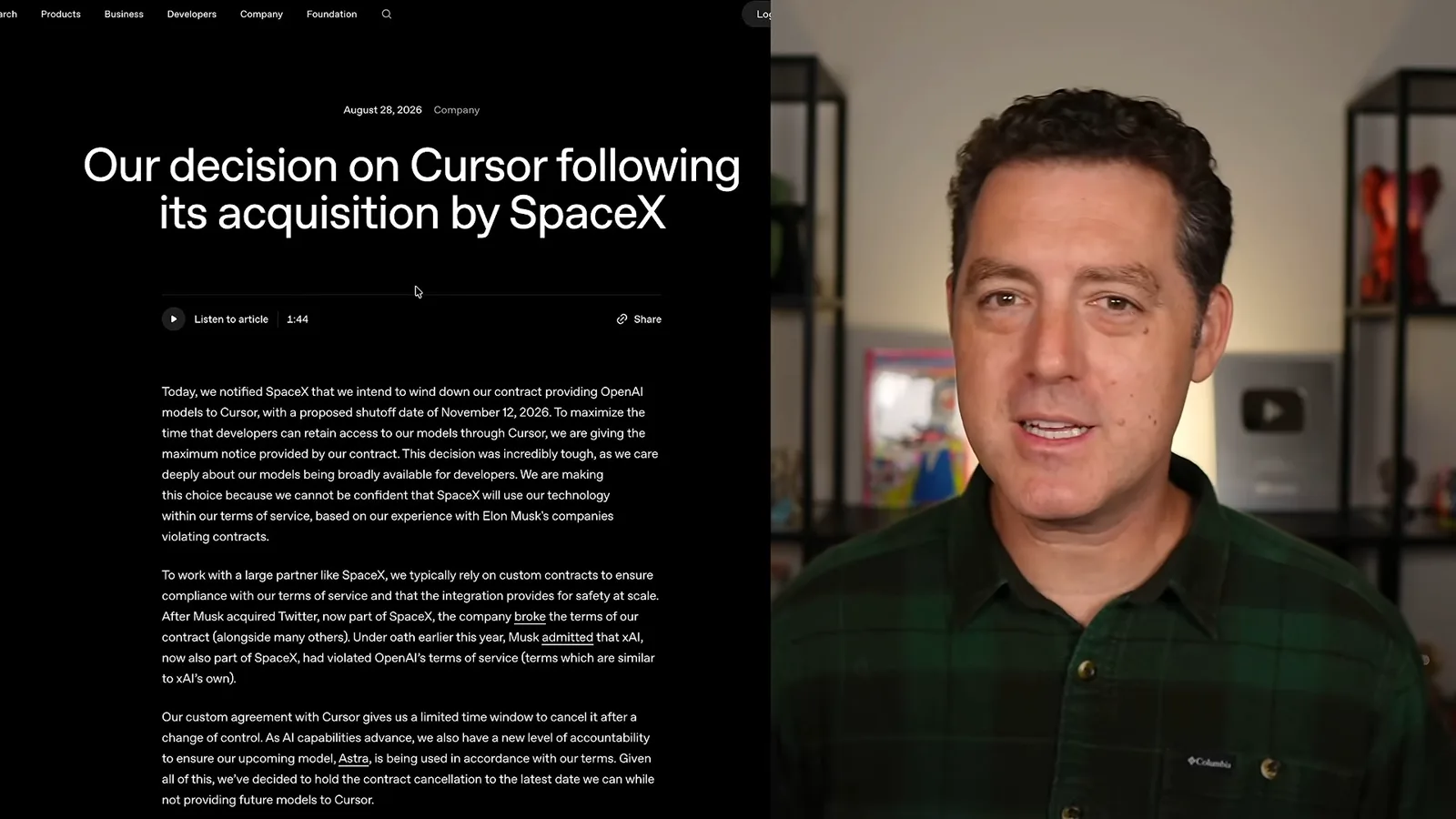
Berman interprets the Friday-evening announcement as an attempt to limit attention; that is his inference, not a stated company motive. On August 28, OpenAI said it intended to wind down its direct agreement supplying models to Cursor after SpaceX acquired it, proposing November 12, 2026 as the shutoff date. The announcement did not describe an immediate, universal ban.
OpenAI said it could not be confident that SpaceX would use its technology within its terms, citing its experience with Musk-controlled companies and past contractual issues. It also said the agreement gave it a limited cancellation window after a change of control and that future models would not be provided under that arrangement. These are OpenAI’s stated reasons, not proof that Cursor misused model outputs.
History, sponsorship and distillation
He recounts the Musk–OpenAI dispute and introduces the sponsor Greptile. He then explains why model-output distillation might matter to providers.
Berman recounts the history of Elon Musk and Sam Altman at OpenAI: the organization’s nonprofit founding, Musk’s departure, the later capped-profit structure and the emergence of xAI as a competitor. He describes their disagreement over the organization’s direction; the parties have offered competing accounts.
Musk sued OpenAI over its direction in 2024. In May 2026, a federal court dismissed claims in a California case after finding they were brought too late; the outcome should not be generalized to every dispute between the parties. Berman argues that access to multiple models can be valuable for developers and adversarial review.
The video is sponsored by Greptile, a code-review product. Berman describes an example in which its tool flagged a reported issue in an open-source project, and says he uses it on his own projects. This is a sponsor presentation and his endorsement, not an independent comparison of code-review tools.
Returning to OpenAI’s statement, Berman discusses its references to past dealings with Musk-controlled companies. OpenAI said Twitter had broken a contract and cited Musk’s testimony concerning xAI’s use of its models. Those statements concern the company’s stated experience; they do not establish that Cursor itself violated its agreement.
Berman explains distillation in broad terms: a developer can use examples or outputs from a larger model to train another model. He argues this can lower the work needed to create a capable model, while noting that providers may restrict such use in their terms.
He refers to Anthropic’s earlier allegations of large-scale extraction by other labs and draws a possible analogy with OpenAI’s concern. Whether a particular system was trained on prohibited outputs, and how capable the result is, requires evidence; the video’s examples do not prove that Cursor or SpaceX did so here.
Berman interprets OpenAI’s decision as concern that access to model outputs could help a competitor train models. This is his explanation of a possible incentive; OpenAI’s announcement states a broader concern about compliance and past dealings, rather than proving a Cursor distillation incident.
Cursor’s response and data
Berman reviews the CEO’s traffic estimate and discusses the SpaceX acquisition. His claims about user data require qualification.
Berman discloses existing business relationships with both Cursor and OpenAI and says he likes both companies. He shows Cursor CEO Michael Truell’s response: Truell said OpenAI models accounted for about 5% of Cursor user traffic and that the companies were speaking about a resolution.
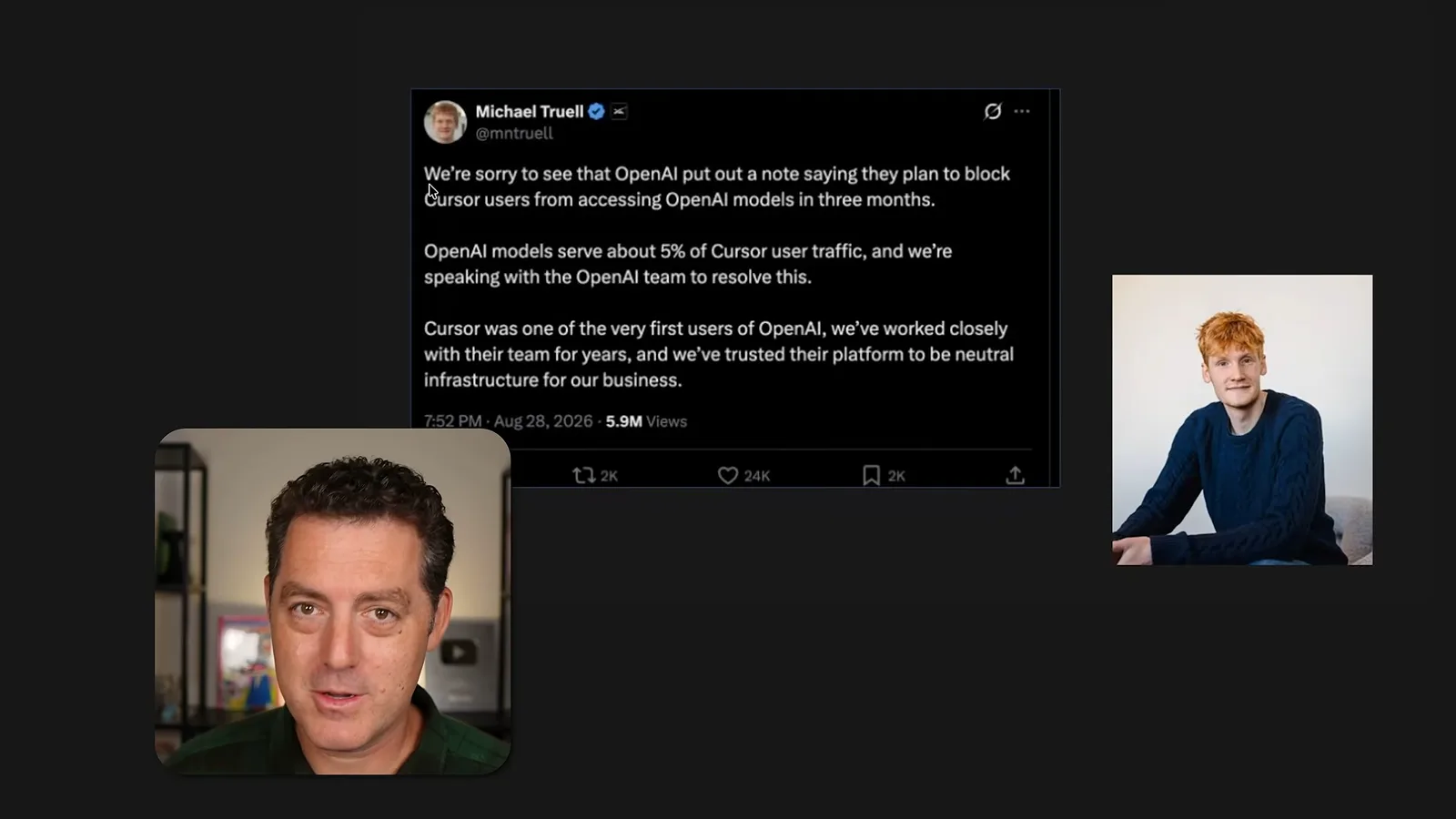
Berman says that 5% traffic does not necessarily mean 5% of revenue and wonders what the traffic measure counts. He discusses an OpenAI representative’s argument that token volume and value are different. Neither the exact denominator nor the economic impact is established by the cited statement.
Berman considers SpaceX’s acquisition of Cursor strategically valuable, arguing that Cursor offers distribution and coding experience while xAI has substantial compute. He speculates that model training and access to computing resources were important motivations and predicts that future Grok models will improve; those predictions are not demonstrated outcomes.
Berman claims Cursor has all users’ coding data available to train future models. That is too broad: Cursor’s published privacy documentation says code is not used for training by Cursor or other model providers when Privacy Mode is enabled. Data handling depends on settings, agreements and policy, and this video does not establish training on all user data.
Berman describes direct native access as the affected relationship and says users may have alternatives such as bringing their own API key or using an extension or compatible gateway. Availability and terms depend on the particular product and integration; OpenAI’s August statement sets out the proposed contract termination, not a guarantee that every workaround will remain available.
Other providers and future access
Berman compares previous provider restrictions with Anthropic’s support for Claude in Cursor. He considers alternate access and predicts more vertical integration.
Berman compares other restrictions on model access, including Anthropic’s earlier limits involving Windsurf and access by competing labs. His claim that Google bought Windsurf oversimplifies events: Google hired Windsurf’s leadership and licensed technology, while Cognition acquired Windsurf’s remaining business. The examples show providers making different access decisions under different circumstances.
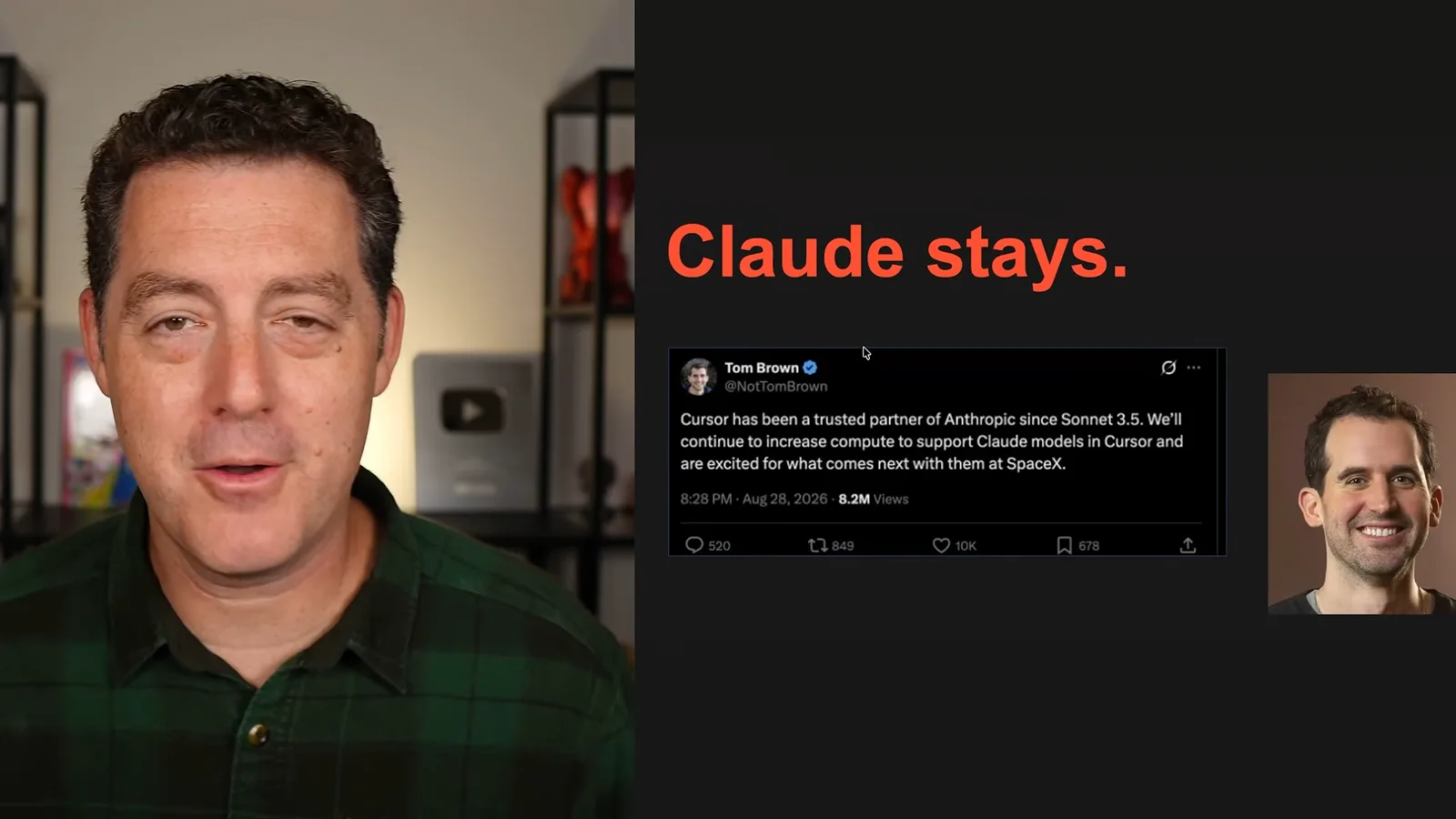
Berman contrasts those earlier restrictions with a statement from Anthropic co-founder Tom Brown that Claude models would continue to be supported in Cursor following the SpaceX acquisition. He sees a tension in the decisions, though they concern different relationships and circumstances.
He recalls a difficult public relationship between Musk and Anthropic and discusses their subsequent engagement and compute arrangements. His explanation of the companies’ motivations and the extent of available idle capacity is interpretation, not independently established evidence.
Berman argues that a coding platform dependent on an outside model supplier faces platform risk. He expects Cursor and other companies to invest more in their own models and predicts that leading AI labs will increasingly build their own models, developer tools and platforms.
In Berman’s view, that vertical integration could make it harder to use several providers’ models in one interface. This is a forecast, not a proven market outcome. He closes by mentioning Musk’s hostile public response and a separate interview with an OpenAI representative.
Mehr aus diesem Kanal
 34:21EN
 Matthew Berman· 27. Okt. 2026Matthew Berman Examines Anthropic’s IPO Filing, AI Growth and GovernanceMatthew Berman, Sam Altman · Forward FutureThe presenter reviews the S-1’s financial metrics, compute strategy and voting structure while questioning the tension between rapid AI development and safety.
 0:26ENMatthew Berman· 25. Okt. 2026Sam Altman on Human Values and Problem-Solving in an AI WorldSam Altman · OpenAIIn a short interview excerpt, Altman considers the enjoyment of solving hard problems and the human role in interpreting results.
 0:36ENMatthew Berman· 25. Okt. 2026Kimi K3.1 and a Rubik’s Cube Solver DemonstrationMatthew Berman · Forward FutureMatthew Berman shows a scrambled virtual cube being solved and gives the Kimi K3.1 test a favorable assessment.
 0:21ENMatthew Berman· 24. Okt. 2026An AI-Generated Kimi Benchmark Chart Used Invented ScoresMatthew Berman · Forward FutureMatthew Berman asks for a graph of Kimi K3.1 Pro benchmarks, then discovers that the displayed figures are illustrative placeholders.
 25:50ENMatthew Berman· 24. Okt. 2026Kimi K3.1 Pro Tested: Strong 3D Demos, Uneven Results and Competitive PricingMatthew Berman · Forward FutureMatthew Berman tests the open-weight model on coding, 3D rendering and visual explanations, then compares benchmark results and prices.
 32:20ENMatthew Berman· 23. Okt. 2026Who Is Local AI For? The Costs, Trade-offs and a Hybrid FutureMatthew Berman · Forward FutureMatthew Berman weighs data control and independence against hardware cost, setup complexity and inference speed.