In 30 Sekunden
Matthew Berman explores Z.ai’s GLM-4.5 through a Rubik’s Cube simulator, Tower of Hanoi, Lego builder and solar-system visualization, then reviews the model maker’s benchmark charts. Some demos need follow-up fixes, and the cube uses the recorded scramble sequence to reverse moves. He describes the model’s mixture-of-experts sizes and thinking modes and concludes that open models were becoming competitive with proprietary ones. The demonstrations are illustrative and the comparative scores come from Z.ai’s selected tests, not an independent universal ranking.
- 1Cube simulationThe interactive cube scrambles and animates a return to the solved state; its visible implementation reverses recorded scramble moves.
- 2Solar systemA follow-up prompt fixes an initial loading problem, allowing Berman to explore planets and adjust the visualization.
- 3Two model sizesZ.ai describes GLM-4.5 as 355B total and 32B active parameters and Air as 106B total and 12B active.
- 4Vendor benchmark chartZ.ai reports aggregate scores of 63.2 for GLM-4.5 and 59.8 for Air on its selected benchmark suite.
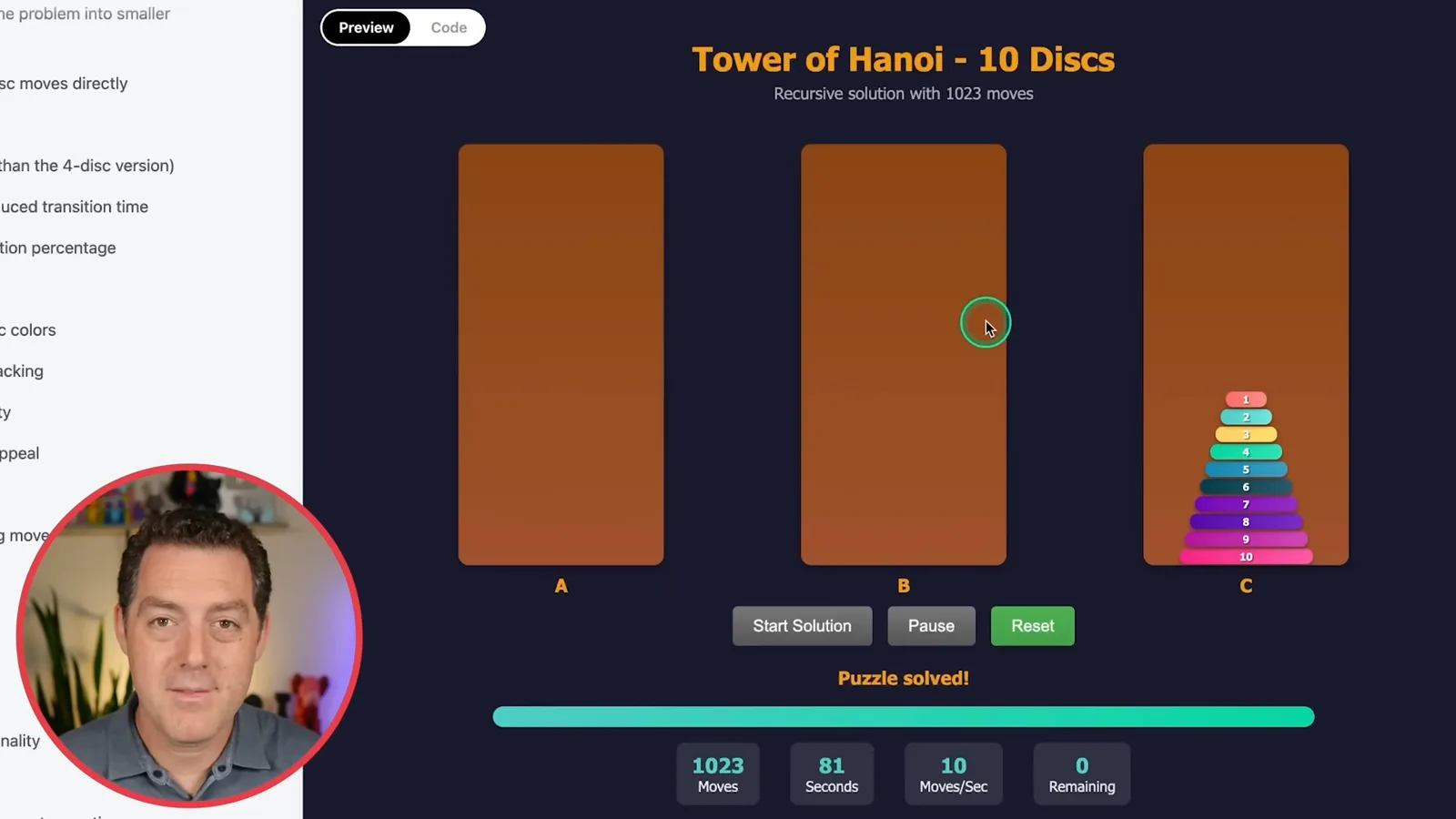
- 5Ten-disc HanoiThe generated program animates 1,023 moves using a recursive solution; the model’s displayed reasoning groups the steps.
Das Wichtigste
- GLM-4.5 and GLM-4.5-Air have 355 billion and 106 billion total parameters respectively, with smaller subsets active per token.
- Z.ai offers thinking and non-thinking modes, although Berman could not trigger non-thinking mode in his brief tests.
- The cube animation reverses recorded scramble moves, so it is not evidence of solving an arbitrary unknown cube state.
- The solar-system demo required a follow-up fix, and the Lego simulation showed alignment and placement errors.
- Z.ai’s benchmark charts indicate competitive performance on its selected evaluations but do not establish a universal ranking.
- The ten-disc Hanoi animation shows a recursive solution implemented in code, not a manually enumerated reasoning trace.
Den bearbeiteten Text nach Kapiteln lesen
A Rubik’s Cube simulator
Berman tests an interactive cube and requests a deeper scramble. Its displayed implementation reverses recorded scramble moves.
In July 2025, Matthew Berman examines GLM-4.5, an open-weight model from Z.ai, through coding demos and the company’s own benchmark charts. He argues that several Chinese open models are approaching leading proprietary systems, but the examples and reported scores are snapshots of particular tasks rather than proof of universal superiority.
The first demo is a 3D Rubik’s Cube simulator. Berman says he needed a couple of follow-up exchanges to fix a minor problem; the resulting interface rotates layers, scrambles the cube and displays move history. A standard cube appears to return to its solved state, followed by a 5×5 cube.
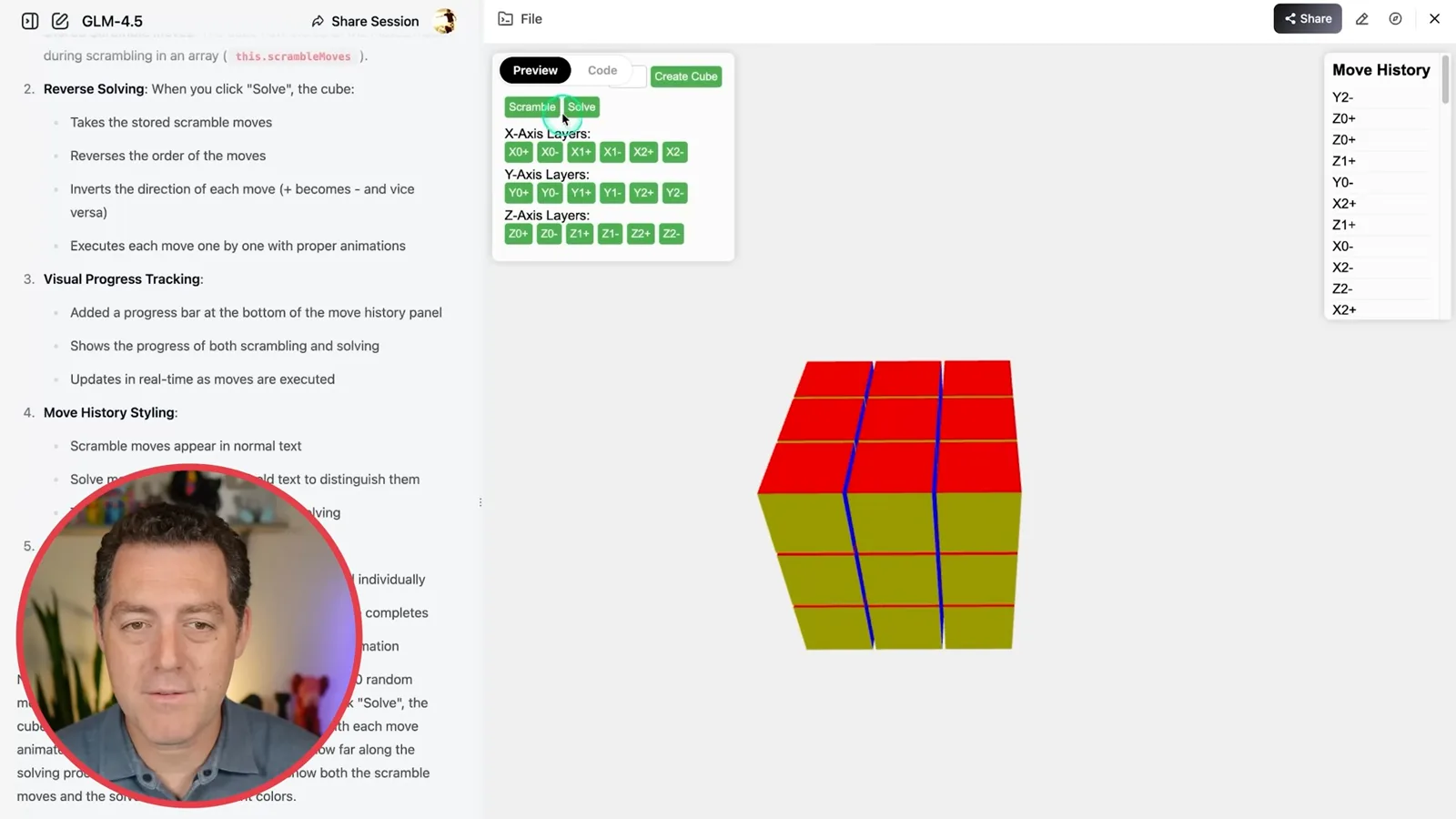
He also tries a 10×10 cube, but notices that its initial scramble is fairly limited. He asks the model to add a control for the number of scramble moves. The on-screen explanation describes solving by reversing the stored scramble sequence and inverting each move, so this shows an undo-based simulator rather than a solver independently finding a solution to an arbitrary cube state.
Hanoi, Lego and the solar system
The model creates puzzle visualizations, a brick builder and an adjustable solar system. Some examples require follow-up fixes or show placement errors.
Next is a four-disc Tower of Hanoi. Berman asks the model to work through the recursive puzzle in its reasoning before creating a visualization, and says its displayed reasoning lists 15 moves. The generated visualization then animates a solution. This single small example does not resolve broader questions about models’ performance across puzzle sizes or conditions.
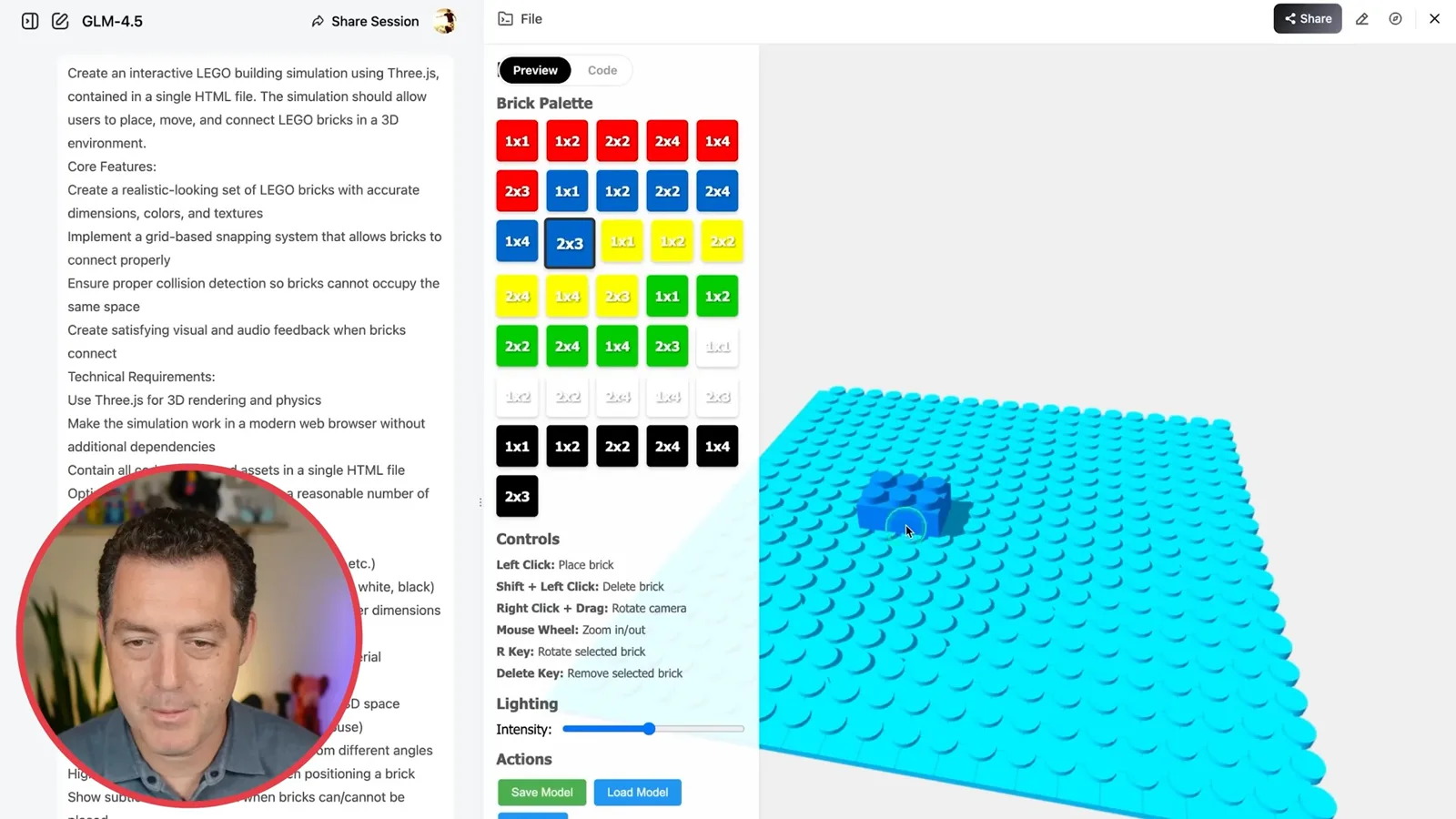
Berman asks for a ten-disc version at higher animation speed and moves on to an interactive Lego builder made with Three.js in a single HTML file. He can select colored bricks and stack them, but the first brick does not align perfectly with the base and another placement produces an error. He regards the result as promising rather than flawless.
His favorite demo is a 3D solar system with planet information and adjustable settings. The first attempt becomes stuck loading; after he tells the model about the problem, it revises the code and the visualization works. Berman performs this in the Z.ai chat interface’s canvas mode, not a local development environment.
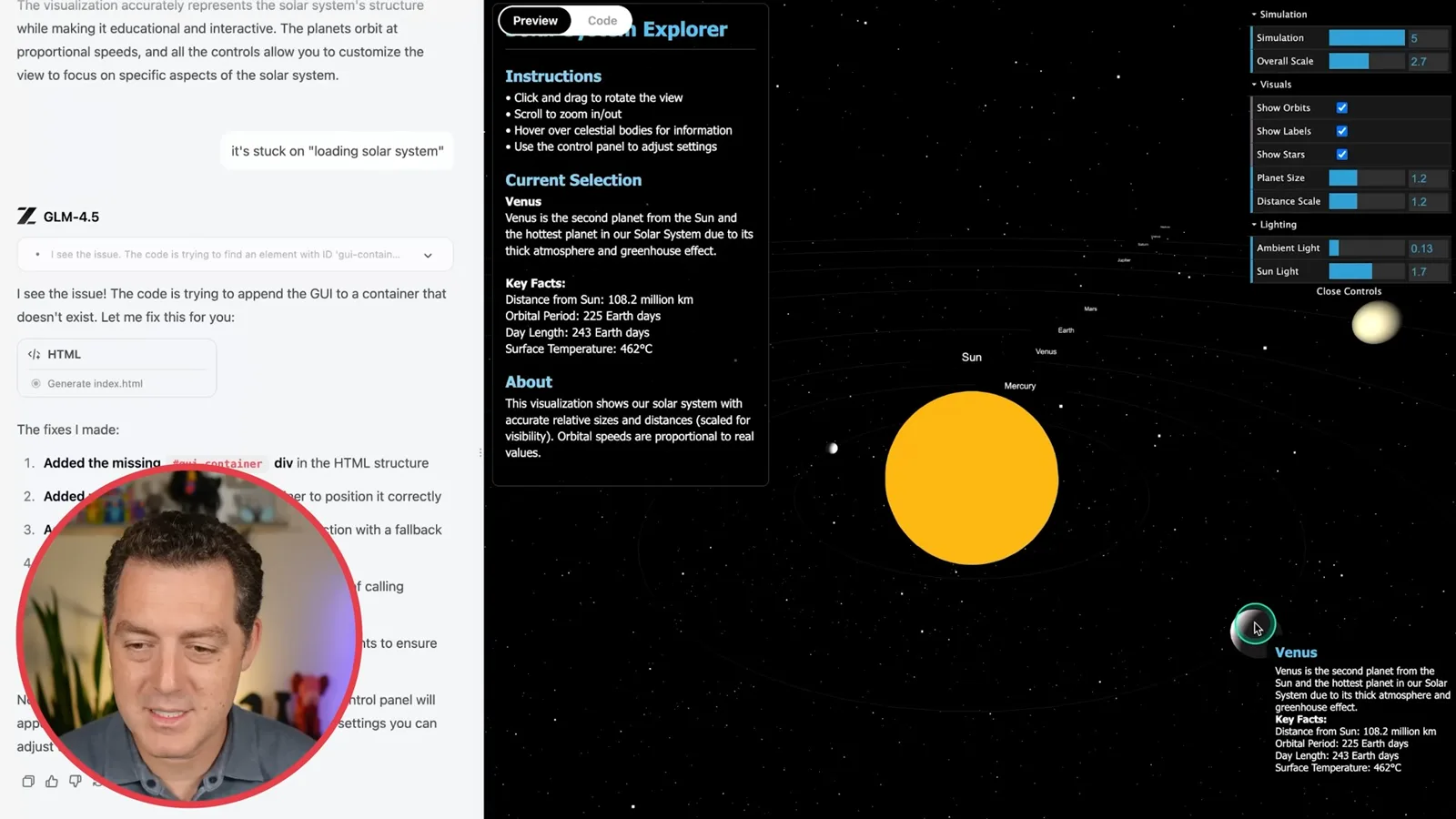
Hovering over Venus reveals details such as its distance from the Sun and orbital period. Berman adjusts the simulation speed, orbits, labels, stars, planet size, distance scale and lighting. The demo shows interactive features, although the video does not independently verify every astronomical value.
Architecture and reported benchmarks
Berman reviews model sizes, thinking modes and Z.ai’s benchmark comparisons. The results are company-reported and tied to selected evaluations.
Berman turns to the model release. GLM-4.5 has 355 billion total parameters, 32 billion active per token; the smaller GLM-4.5-Air has 106 billion total and 12 billion active. Both use a mixture-of-experts design and are released with weights under an MIT license, according to Z.ai’s model card.
Z.ai describes both as hybrid models with a thinking mode for complex reasoning and tool use and a non-thinking mode for immediate responses. In Berman’s quick tests, even asking California’s capital or requesting a simple story triggers visible thinking; he says he did not manage to activate the non-thinking behavior.
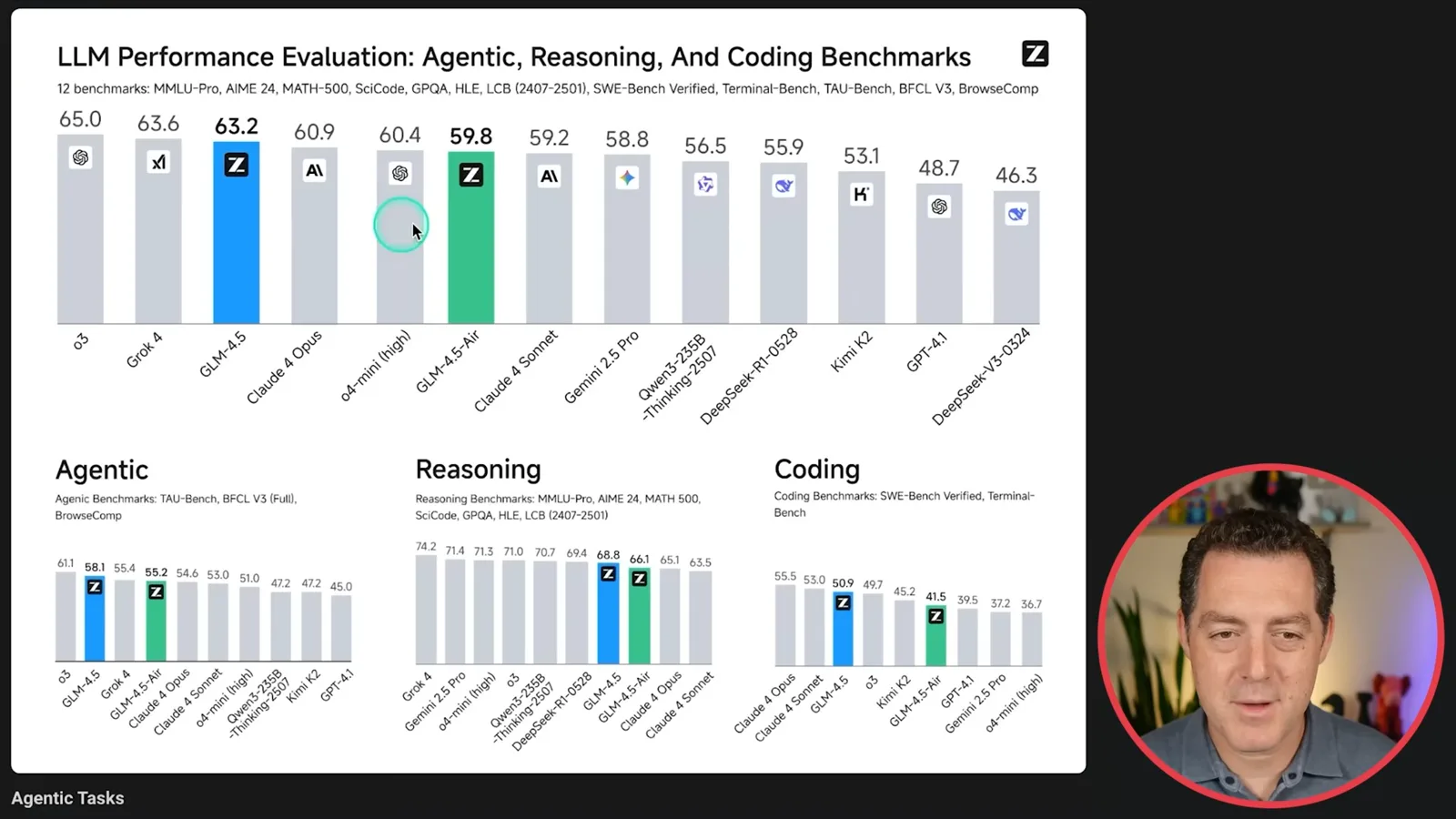
Berman shows Z.ai’s aggregate chart covering 12 benchmarks. The company reports 63.2 for GLM-4.5 and 59.8 for Air, compared with 65.0 for OpenAI o3 and 63.6 for Grok 4 in that chart. These are vendor-reported comparisons under its selected evaluation conditions, not a current or universal ranking.
The chart also groups agentic tasks, reasoning and coding. Berman notes GLM-4.5’s strong agentic results, a lower position in reasoning than several competing models, and a coding result behind the two Claude 4 models shown. Individual benchmark choices, test settings and scaffolding matter when interpreting these comparisons.
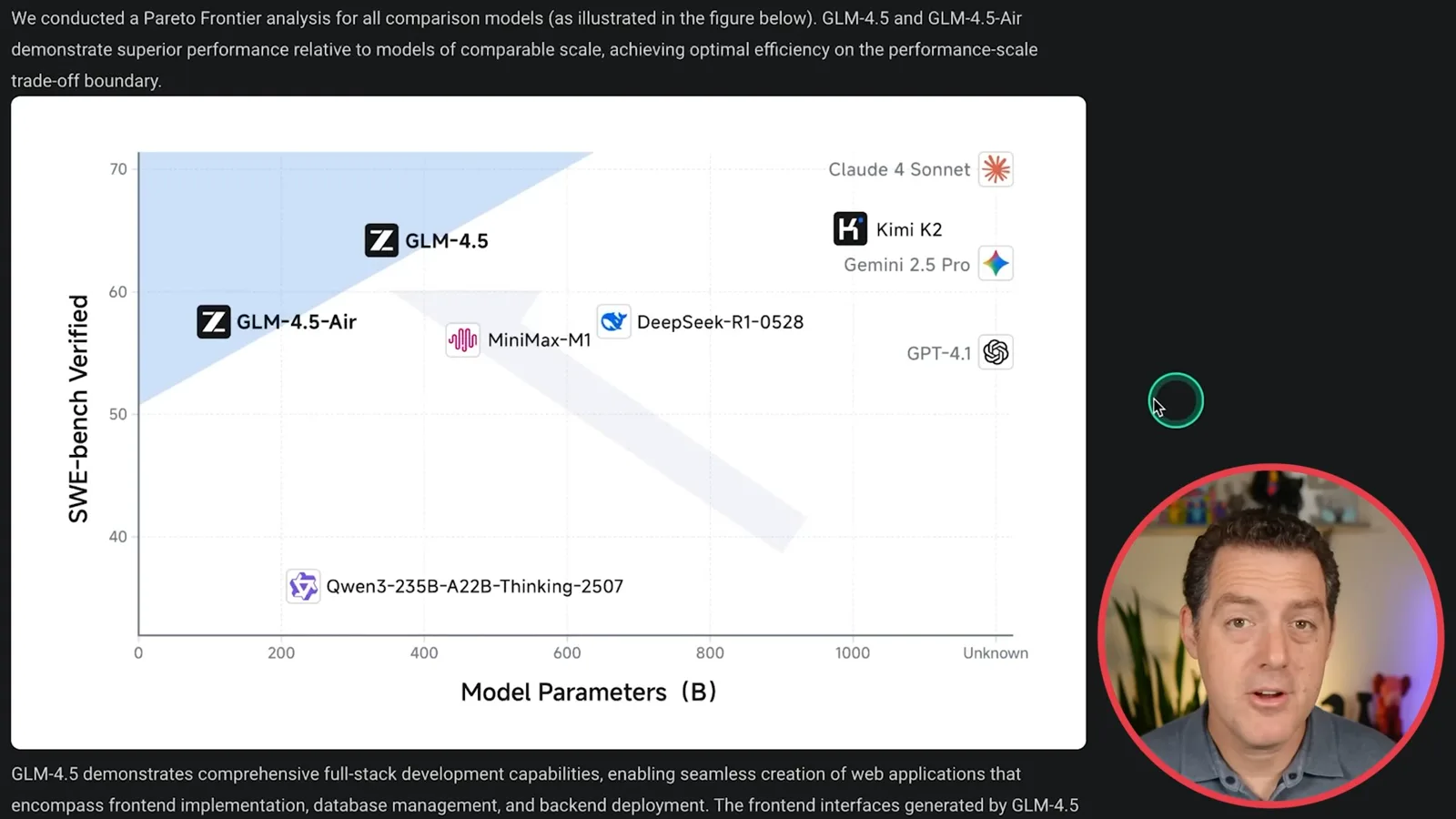
A second vendor chart plots SWE-bench Verified performance against total parameter count. Berman highlights GLM-4.5 near Kimi K2’s plotted score at a smaller total size, while Claude 4 Sonnet appears higher with its parameter count unknown. He notes that Z.ai used reinforcement-learning post-training for agentic capabilities.
More demos and a ten-disc puzzle
Berman revisits the cube, tours vendor examples and displays a ten-disc Hanoi solution. He closes with his assessment of the 2025 model landscape.
Returning to the cube, Berman uses the newly added control to request 50 scramble moves on a 10×10 cube and then runs the solve animation. He does not count the moves independently. The visible description of the implementation indicates that it reverses recorded scramble moves, limiting what this result demonstrates.
He then tours examples provided by the model maker: a Flappy Bird-style game controlled with the space bar, a 3D maze, a movable to-do board, an SVG history of large language models, nested spinning hexagons and a Pokédex interface. These are selected demonstrations, not systematic tests of reliability.
Finally, the ten-disc Hanoi example presents a recursive algorithm and groups of steps rather than listing every move in the displayed reasoning. The animation finishes with 1,023 moves shown; the interface also displays 81 seconds and a speed setting of 10 moves per second. Berman praises the result, though an animation generated by code does not establish that the model manually reasoned through all 1,023 moves.
Berman concludes that open models have effectively caught up with closed models in the examples and benchmarks he has reviewed, while speculating that the then-unreleased GPT-5 might change the comparison. His judgment reflects the landscape and evidence available in July 2025.
Mehr aus diesem Kanal
 34:21EN
 Matthew Berman· 27. Okt. 2026Matthew Berman Examines Anthropic’s IPO Filing, AI Growth and GovernanceMatthew Berman, Sam Altman · Forward FutureThe presenter reviews the S-1’s financial metrics, compute strategy and voting structure while questioning the tension between rapid AI development and safety.
 0:26ENMatthew Berman· 25. Okt. 2026Sam Altman on Human Values and Problem-Solving in an AI WorldSam Altman · OpenAIIn a short interview excerpt, Altman considers the enjoyment of solving hard problems and the human role in interpreting results.
 0:36ENMatthew Berman· 25. Okt. 2026Kimi K3.1 and a Rubik’s Cube Solver DemonstrationMatthew Berman · Forward FutureMatthew Berman shows a scrambled virtual cube being solved and gives the Kimi K3.1 test a favorable assessment.
 0:21ENMatthew Berman· 24. Okt. 2026An AI-Generated Kimi Benchmark Chart Used Invented ScoresMatthew Berman · Forward FutureMatthew Berman asks for a graph of Kimi K3.1 Pro benchmarks, then discovers that the displayed figures are illustrative placeholders.
 25:50ENMatthew Berman· 24. Okt. 2026Kimi K3.1 Pro Tested: Strong 3D Demos, Uneven Results and Competitive PricingMatthew Berman · Forward FutureMatthew Berman tests the open-weight model on coding, 3D rendering and visual explanations, then compares benchmark results and prices.
 32:20ENMatthew Berman· 23. Okt. 2026Who Is Local AI For? The Costs, Trade-offs and a Hybrid FutureMatthew Berman · Forward FutureMatthew Berman weighs data control and independence against hardware cost, setup complexity and inference speed.