In 30 Sekunden
In May 2023, Matthew Berman demonstrates early ChatGPT plugins, web browsing and the alpha version of Code Interpreter. He explores travel planning with Expedia, creates an Instacart grocery list, summarizes a research paper, and analyzes a LEGO dataset and a Python file. The video captures product names, access conditions, prices and interface limits as they appeared in 2023. A regression slope and a correct answer in this demo should not be generalized beyond the particular data and test shown.
- 1Plugins connect external servicesBerman explores a historical plugin store, selecting services for travel and grocery planning.
- 2Travel results and retriesExpedia supplies hotel options and a booking link; flight requests produce errors before a result appears.
- 3Browsing a research paperA browsing-enabled model summarizes a paper and answers a follow-up despite repeated read failures.
- 4Analyzing an uploaded datasetCode Interpreter loads LEGO data, plots parts per set and fits a linear trend.
- 5Inspecting codeAn uploaded Python module is described and the tool extracts method names.
Das Wichtigste
- In the 2023 interface, plugins connected ChatGPT conversations to services such as Expedia and Instacart, with a three-plugin selection limit.
- The Expedia demo showed a hotel booking link and flight suggestions, but also produced errors and retries.
- Browsing produced the correct answer of 25 agents for the cited paper despite visible content-reading failures.
- Code Interpreter used Python to explore an uploaded LEGO dataset and create graphs; its reported 2.86 parts per year was a fitted slope for that dataset.
- Historical availability, pricing and feature names in the video are not a current product guide.
Den bearbeiteten Text nach Kapiteln lesen
Early ChatGPT plugins
Berman introduces three early capabilities and the 2023 plugin store. The travel demo uses Expedia and encounters errors.
In May 2023, Matthew Berman describes early access to ChatGPT plugins, browsing-enabled GPT-3.5 and GPT-4, and the alpha version of Code Interpreter. He wants to see how the tools connect a conversation to external services, web content and file analysis. The names, prices, availability and interface shown here are historical rather than current instructions.
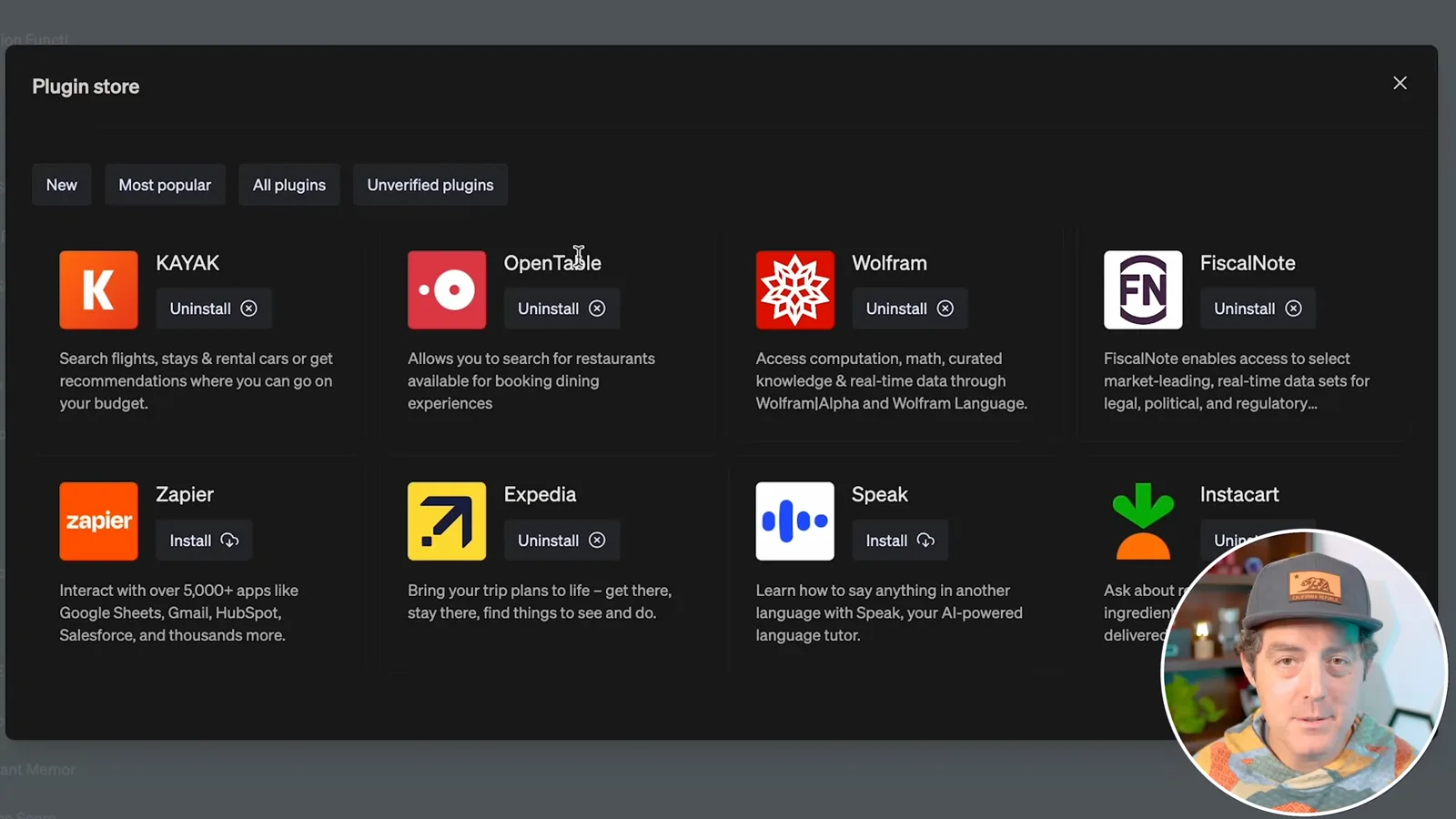
Berman compares the plugin store to an app store and shows integrations including Kayak, OpenTable, Wolfram, Instacart, Expedia and Zapier. In the interface he demonstrates, up to three plugins can be enabled at a time. He selects OpenTable, Expedia and Instacart for the session, though the examples shown focus on Expedia and Instacart.
For a travel example, Berman starts by asking where he might go in Europe in July. ChatGPT suggests several destinations, and he chooses Amsterdam. Once he provides a three-day stay, the interface shows calls to Expedia and returns lodging options with ratings and nightly prices. The conversation narrows the search to luxury hotels.
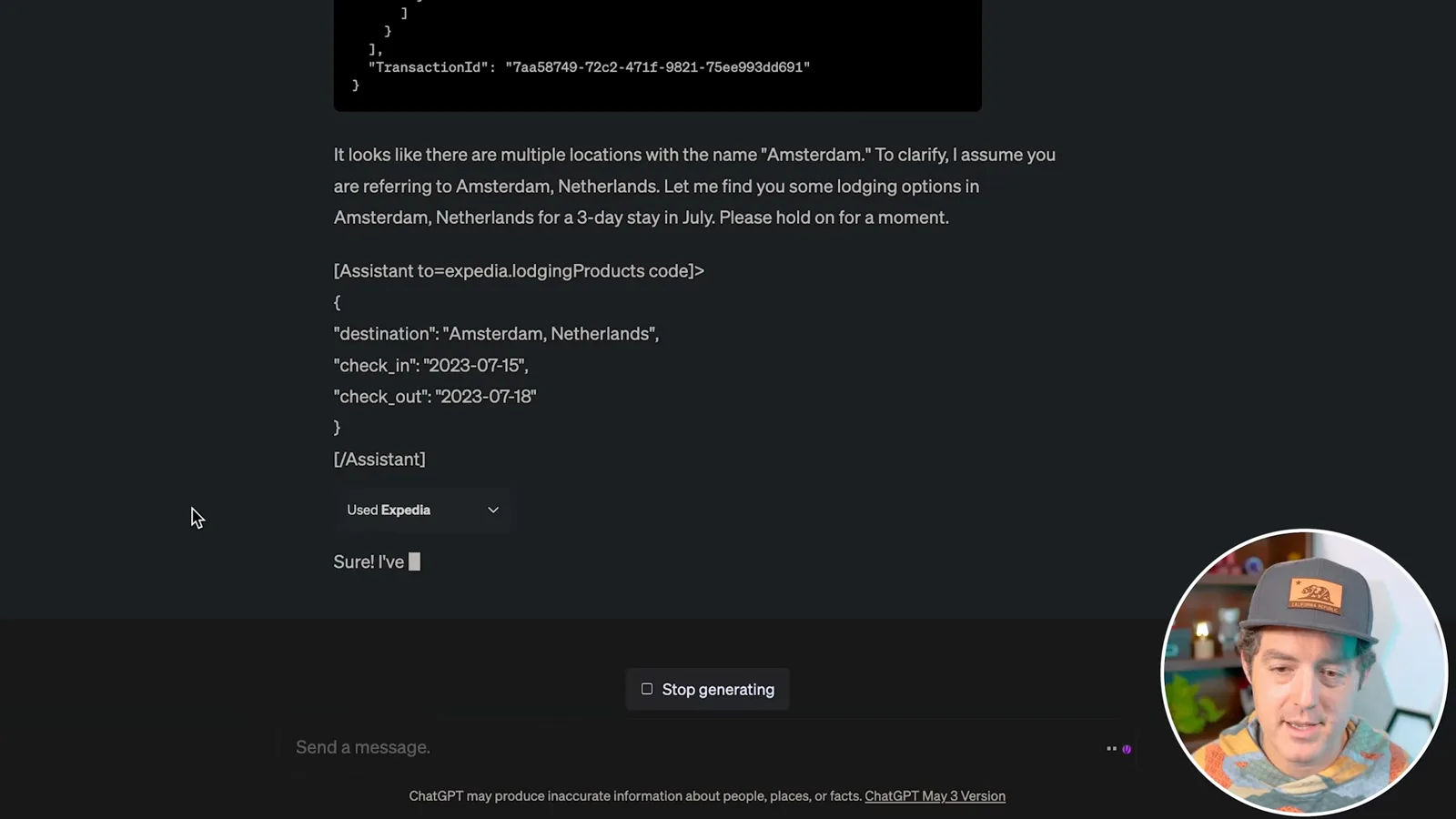
Berman selects one suggested hotel and follows a link to its Expedia page, where a user could choose a room. The video shows a booking page, not a completed reservation. When he asks for a first-class nonstop flight from San Francisco, the plugin encounters errors; he retries and eventually sees flight suggestions, including an approximately $1,300 ticket. That historical output is not a verified current fare.
Groceries and web browsing
An Instacart integration creates a shopping list. Berman then tests browsing against a paper on generative agents.
Next, he asks for a two-day healthy meal plan and grocery list. The assistant proposes meals such as yogurt, chicken and salmon, then asks whether to create an Instacart list. After Berman agrees, the plugin constructs a request containing the ingredients and returns a link to a shopping page. The demonstration reaches a list; it does not show a completed purchase.
Berman switches to browsing-enabled GPT-4. He explains that a model’s built-in knowledge has a cutoff and tests whether giving it a web URL can bring in newer context. Browsing can retrieve accessible material, but it does not give a model complete or guaranteed access to all information on the internet.
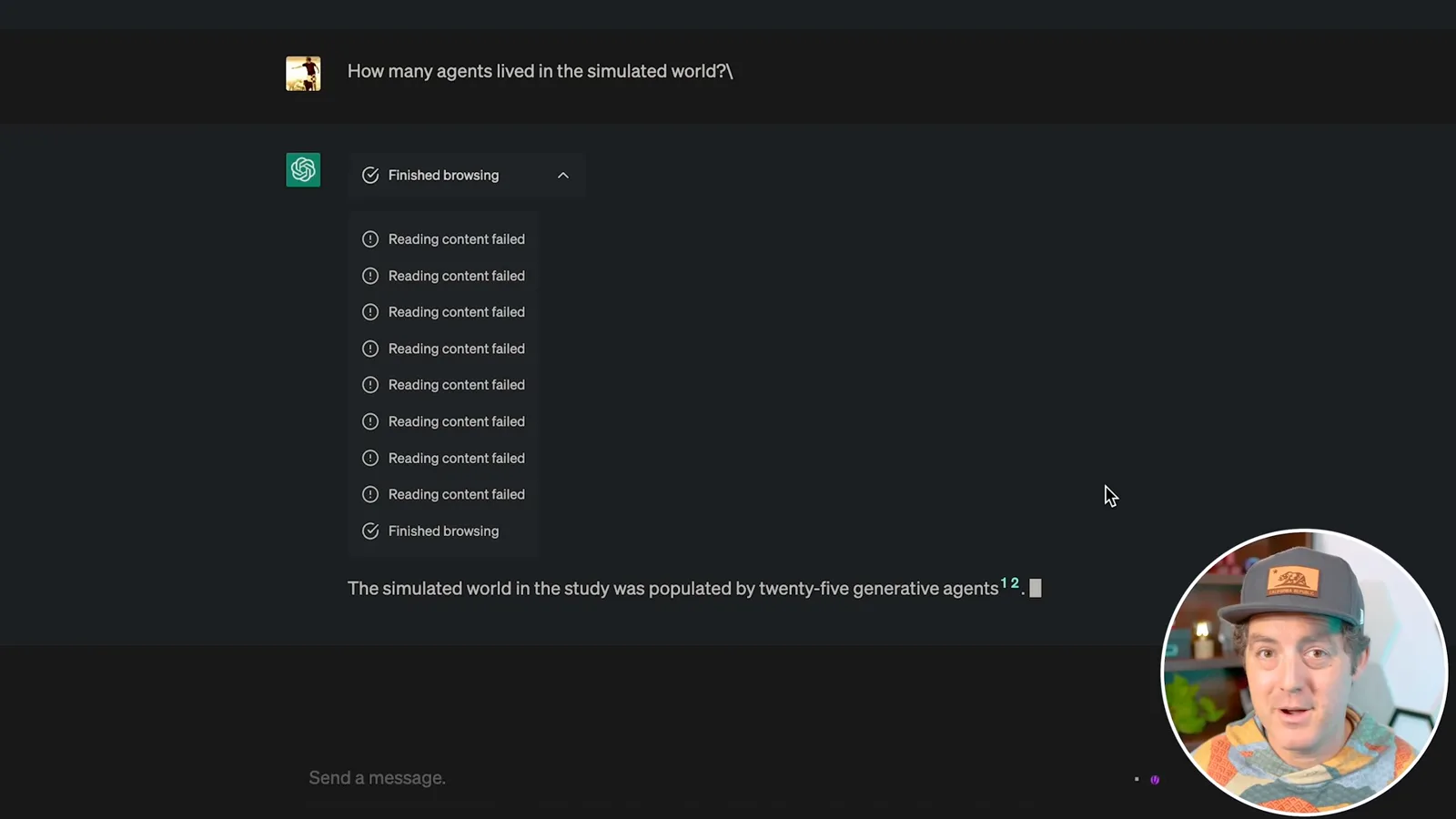
He supplies the URL for the paper [Generative Agents: Interactive Simulacra of Human Behavior](https://arxiv.org/abs/2304.03442) and asks for a summary. The interface displays steps such as reading, scrolling and following links, as well as several content-reading failures. It eventually produces a summary with references; the visible status messages alone do not establish that it read every part of the paper.
Berman asks how many agents inhabit the simulation. Further read failures appear, but the answer is 25, consistent with the paper’s abstract. He considers the result promising for summarizing, translating and retrieving information from web pages, while the test itself is one question rather than a broad reliability benchmark.
Code Interpreter and a LEGO dataset
An uploaded CSV is explored using Python, a scatter plot and a linear regression. The resulting figures describe that particular dataset and model.
For Code Interpreter, Berman explains that a user can upload a file and ask the assistant to write and run Python for analysis, charts or other tasks. His example is a LEGO sets CSV downloaded from Kaggle. The assistant loads it with pandas and identifies fields for set number, name, year, theme ID and number of parts.
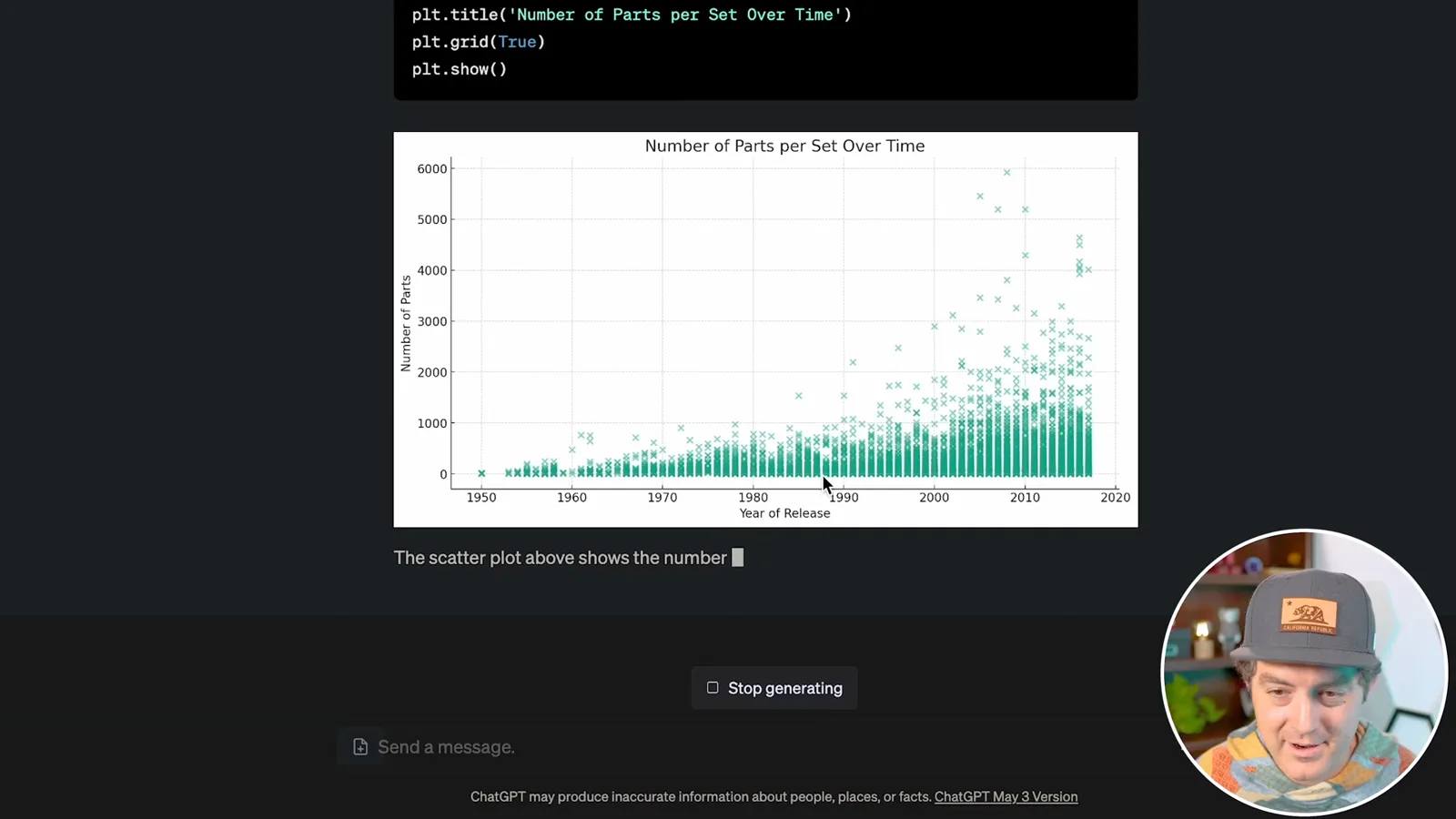
He asks for a plot of parts per set over time. Code Interpreter writes Python and returns a scatter plot with release year on the horizontal axis and parts on the vertical axis. Berman observes that larger sets appear more common later in the displayed data, though the plot also contains substantial variation.
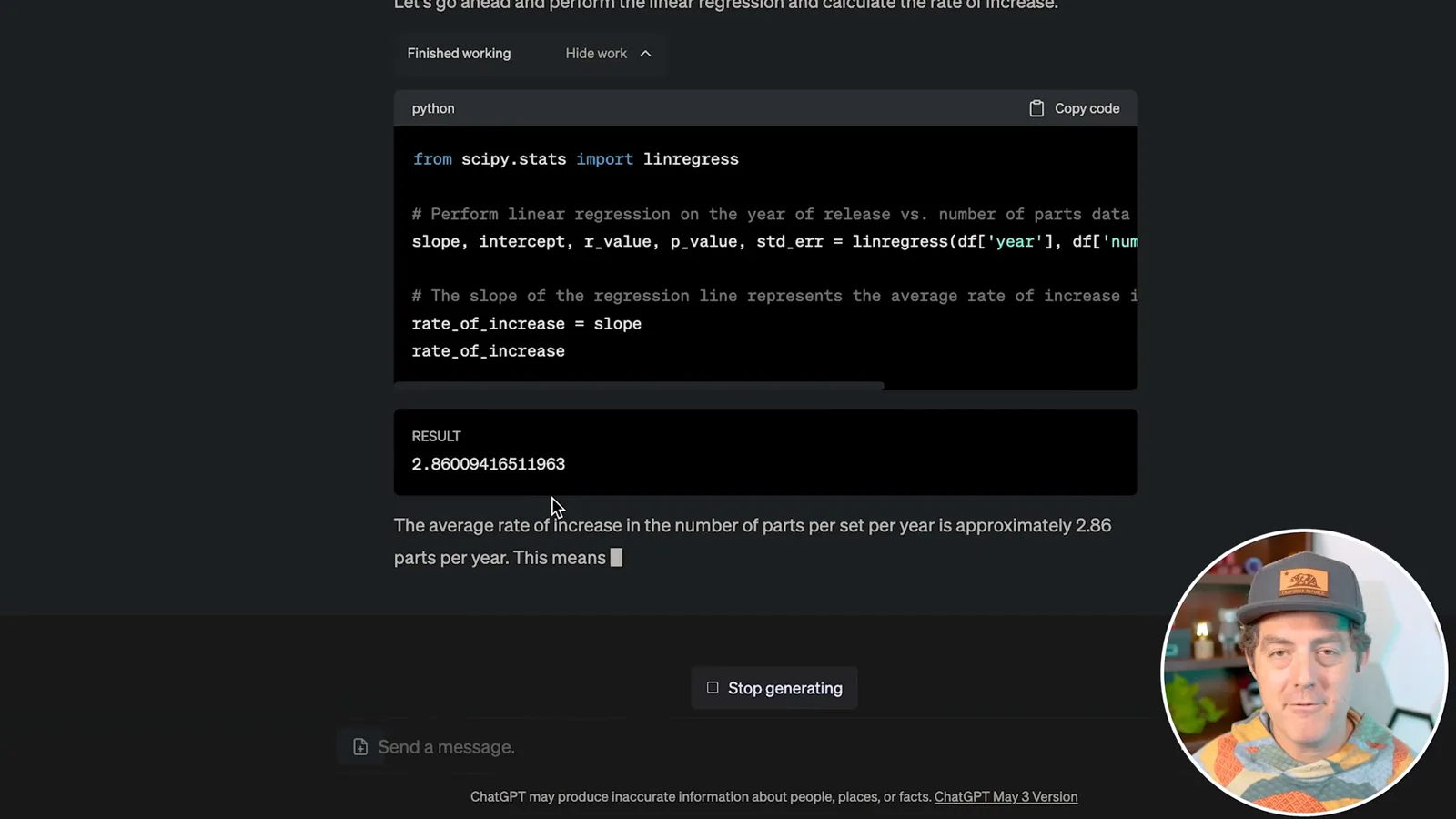
Asked for the rate of increase, the assistant fits a linear regression and reports a slope of approximately 2.86 parts per set per year. This is a fitted average trend for the uploaded dataset under that model, not proof that every set gained exactly 2.86 parts each year or that the relationship remains linear outside the sampled period.
Berman next requests a line chart of the number of sets released per year. The generated graph shows an upward pattern in the data presented, covering years from around 1950 to just before 2020. He sees the ability to produce charts through conversation as potentially useful to data scientists and others, while results still depend on the data and generated analysis.
Analyzing a Python file
Berman uploads a module and asks for method names. He closes with an assessment of the 2023 alpha.
Finally, Berman uploads a Python file called memory.py from a larger project. The assistant describes code involving memory management and score normalization and notes that the file lacks the rest of the project context. When asked for method names, it writes Python to extract them. Berman closes by praising the alpha and mentions a $20 monthly subscription as his understanding at the time; this is historical pricing and not a claim about current access.
Mehr aus diesem Kanal
 34:21EN
 Matthew Berman· 27. Okt. 2026Matthew Berman Examines Anthropic’s IPO Filing, AI Growth and GovernanceMatthew Berman, Sam Altman · Forward FutureThe presenter reviews the S-1’s financial metrics, compute strategy and voting structure while questioning the tension between rapid AI development and safety.
 0:36ENMatthew Berman· 25. Okt. 2026Kimi K3.1 and a Rubik’s Cube Solver DemonstrationMatthew Berman · Forward FutureMatthew Berman shows a scrambled virtual cube being solved and gives the Kimi K3.1 test a favorable assessment.
 25:50ENMatthew Berman· 24. Okt. 2026Kimi K3.1 Pro Tested: Strong 3D Demos, Uneven Results and Competitive PricingMatthew Berman · Forward FutureMatthew Berman tests the open-weight model on coding, 3D rendering and visual explanations, then compares benchmark results and prices.
 32:20ENMatthew Berman· 23. Okt. 2026Who Is Local AI For? The Costs, Trade-offs and a Hybrid FutureMatthew Berman · Forward FutureMatthew Berman weighs data control and independence against hardware cost, setup complexity and inference speed.
 1:03:37ENMatthew Berman· 23. Okt. 2026Matthew Berman’s Team Tests Kimi K3.1 on Animation, Games, and ChartsMatthew Berman, Alex, Brian · Forward FutureA live team AMA turns into an informal test of Kimi K3.1, from personal-agent workflows to motion graphics, a browser game, and a benchmark chart.
 0:53ENMatthew Berman· 22. Okt. 2026Sam Altman on AI and the Discovery of New KnowledgeSam Altman · OpenAIAltman expects progress in mathematical discovery to extend to biology, materials and energy.