In 30 Sekunden
Matthew Berman introduces Open Interpreter’s 01 Lite and plays the team’s promotional launch video, which demonstrates voice commands, a taught Slack workflow and an invoice-monitoring scenario. The company’s claims and plans reflect the March 2024 announcement. Berman could not get the 01 OS working after hours of trying, so he tests the separate Open Interpreter command-line software instead. It lists folders and opens browser tabs, but his email test produces an error and the assistant declines to read his Twitter timeline.
- 1Voice control for a computerBerman introduces 01 Lite as an open hardware companion to Open Interpreter and plays the team’s launch film.
- 2The company’s voice demoThe presenter uses a connected computer to check a calendar, arrange a concert outing and send a desktop PDF by email.
- 3Teaching a workflowThe launch film shows a Slack skill being taught step by step, followed by a claimed invoice-monitoring workflow.
- 4A historical developer previewThe team announced a $99 preorder, developer-preview software and hardware plans, plus a future offline device. These were announcements in 2024.
- 5Berman’s own testUnable to get 01 OS running, Berman tests Open Interpreter instead; simple desktop and browser actions work, while more complicated requests fall short.
Das Wichtigste
- The 01 Lite was presented as an open hardware voice interface that could operate a connected computer through Open Interpreter.
- The launch film demonstrates a taught Slack workflow and invoice monitoring, but those are company demonstrations rather than independent tests.
- The $99 preorder, developer preview and proposed offline device were announcements at the time of the 2024 video.
- Berman’s Open Interpreter tests worked for listing folders and opening Chrome, but did not complete the Gmail or Twitter reading requests.
- Generated commands require careful review because a computer-use assistant can act with access to the user’s applications and files.
Den bearbeiteten Text nach Kapiteln lesen
Introducing the 01 Lite
Berman describes Open Interpreter’s natural-language computer control and introduces the launch film. He sees voice interaction as a possible future for computing.
The team behind Open Interpreter, an open-source project for controlling a computer with natural language, has introduced a hardware device called the 01 Lite. Matthew Berman sees it as an open-source alternative in the emerging category of devices such as Rabbit and the AI Pin. He first plays the project’s launch film, then demonstrates the underlying software himself.
The launch film: computer tasks by voice
The project presenter introduces the 01 Lite and demonstrates a calendar, concert search, messaging and a document email. These scenes are part of the project’s promotional demonstration.
In the promotional film, a project presenter argues that computers should be as easy to interact with as people. She describes an open, flexible foundation for the next generation of computing, with a language model at the center of the operating system. This is the team’s vision for its product, rather than an independent evaluation of it.
The presenter describes the 01 Lite as a device that listens when a user presses a button and operates a computer to carry out requests. She says the language model can run on a home computer or on the project’s cloud server, with Wi-Fi or a hotspot making the device portable. Local and hosted operation are presented as options, not as proof that every deployment works offline.
In the film’s demonstration, she asks for the next sunny day and then whether she has anything scheduled. The assistant checks the calendar on the connected computer. She asks about concerts in Seattle, chooses a Bad Bunny show, and asks it to add the event with a ticket link and text the link to Page; the assistant reports that both actions are done.
The assistant then mentions an email from Mike about an article. The presenter says the PDF is on her desktop, and the assistant finds it and asks whether to send it. She notes that she could also ask the device to read or edit the document, but instead confirms the email; the assistant reports that it has sent the file.
Teaching Slack and monitoring invoices
The presenter teaches the system a Slack workflow and demonstrates asking it to watch an inbox for invoices. The film then announces a preorder and developer-preview releases.
Back at the laptop that the device has been controlling, the presenter says it cannot do everything out of the box. To teach a new workflow, she guides it through opening Slack, using Command-K, selecting a recipient, clicking the message box and sending a sample message. At each step the assistant asks whether it performed the action correctly, and she confirms before it saves the skill.
The presenter suggests that similar instruction could teach other workflows across applications and websites. She then asks the assistant to monitor her email for invoices, inspect their attachments and send relevant details to Mike on Slack. The launch film shows a test invoice being sent and the assistant reporting that it messaged Mike. This is a staged product demonstration, so it does not establish reliability for arbitrary workflows or unattended monitoring.
At the 2024 launch, the team advertised a $99 preorder and said the version customers received would work as a standalone device using its hosted service. It announced developer previews of the 01 Lite, 01 server and 01 OS, along with software, CAD files and wiring diagrams for builders. Prices, availability and capabilities here are historical statements from the announcement.
The presenter imagines a wider ecosystem of open AI devices, including toys and robots, and says the team intends to release a computer-control language model, phone app and fully offline handheld device in the following weeks. Those are plans stated in the launch film, not a verification that the products shipped on that schedule or worked as envisioned.
Installing Open Interpreter
Berman reports that he could not get 01 OS working and walks through an Open Interpreter command-line installation. The commands and service options reflect the 2024 recording.
Berman distinguishes Open Interpreter, the underlying project for natural-language computer control, from the 01 project’s voice interface. He says he spent several hours trying to get 01 OS working but could not, possibly because of his computer. His following demonstration is therefore of Open Interpreter itself, not a successful hands-on test of the 01 Lite or 01 OS.
For his 2024 setup, Berman uses Conda to create a Python 3.9 environment named oi, activates it, installs the package with pip install open-interpreter and starts it with interpreter. He says the program requests a GPT-4 API key and that other language models can also be used. Installation steps, model support and service requirements may have changed since the recording.
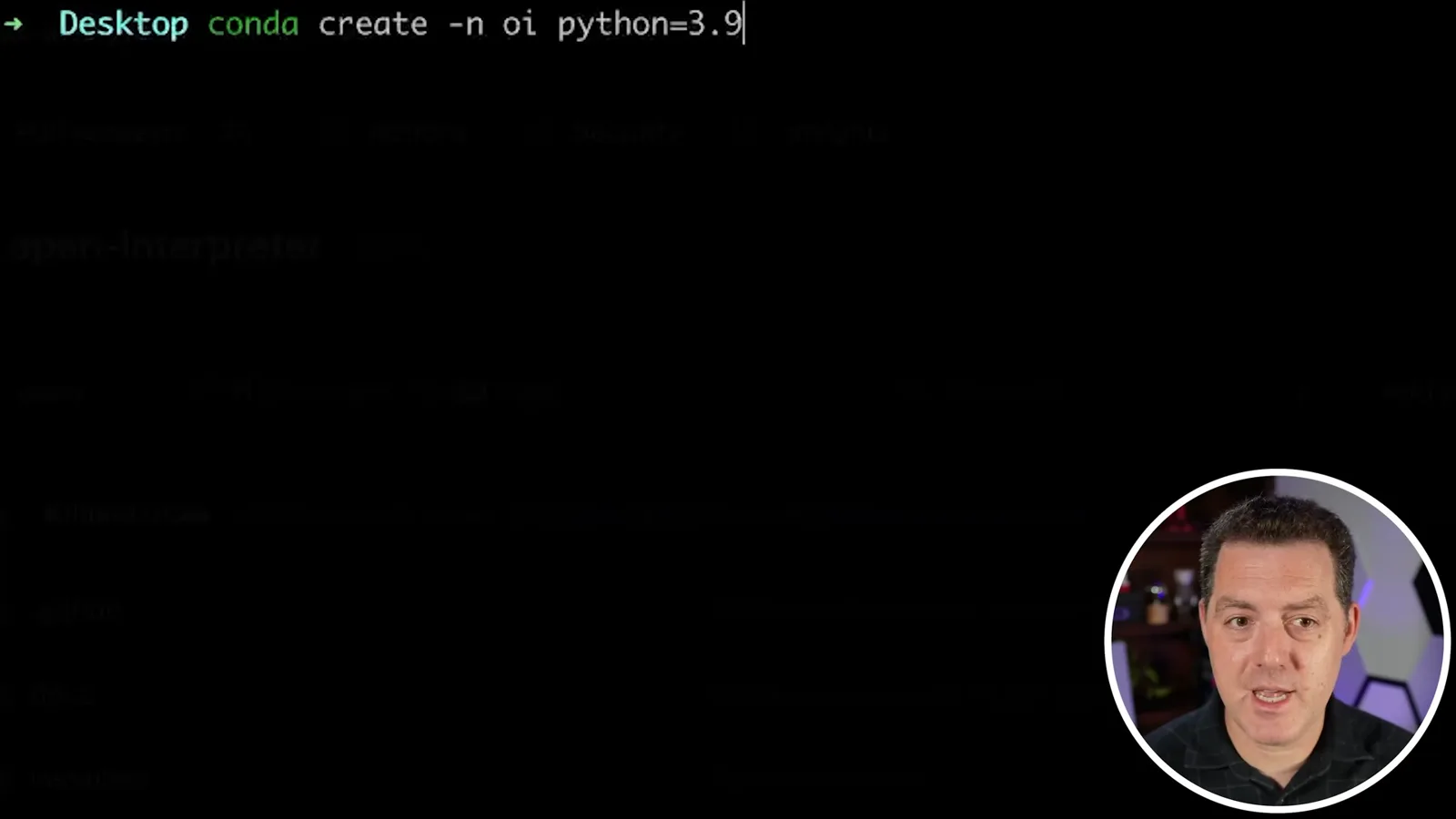
Testing browser and desktop actions
He approves generated commands to list folders and open Chrome. A Gmail script errors and a Twitter request stops after the site opens.
Berman first asks which folders are on his desktop. Open Interpreter shows the command before running it, and he approves it; the terminal then lists the folders. He next asks it to open a new Chrome tab, reviews and approves the generated action, and shows the tab opening. The approval step is meaningful because generated code acts with the user’s computer permissions.
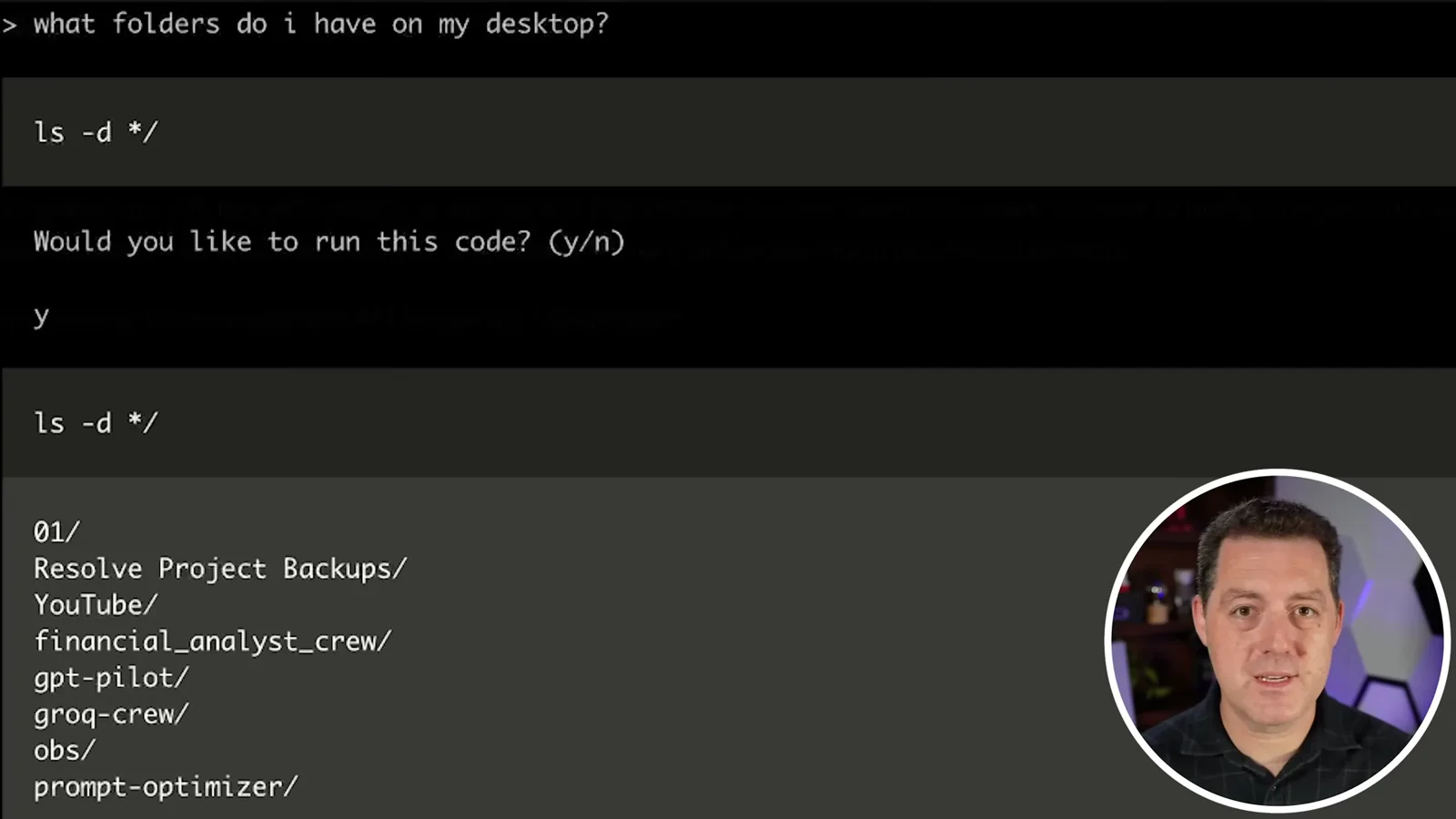
A more ambitious request asks it to open Gmail and find new email from the preceding 30 minutes. It opens Gmail and generates a script, but the script encounters an error after Berman approves it. He then asks for the latest post in his Twitter timeline: the software opens Twitter, but says it cannot directly access the timeline content because of privacy concerns. Neither request is shown completing as asked.
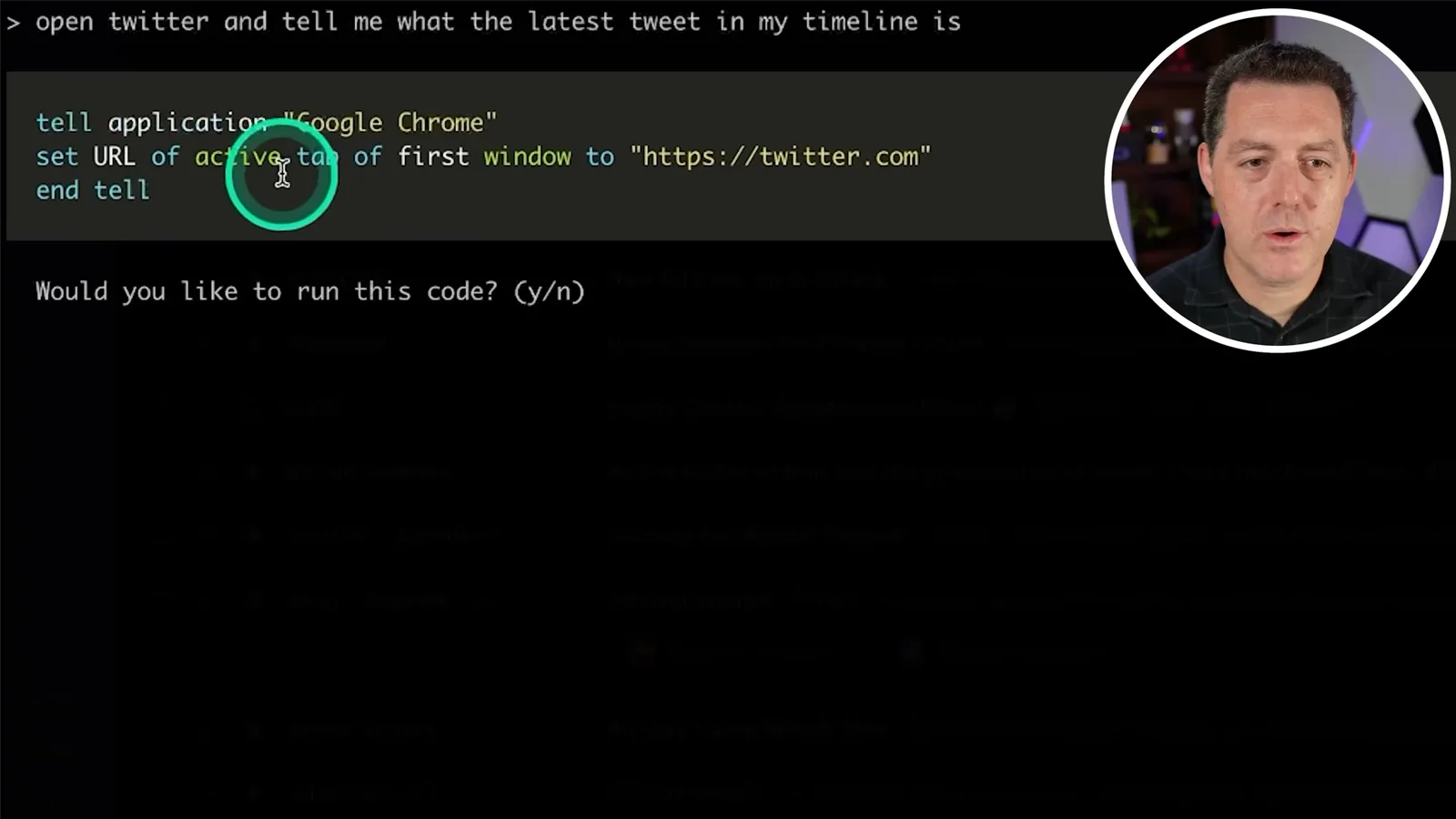
Berman concludes that there is still a lot of debugging to do, though he finds the software impressive. He suggests trying Open Interpreter with a local model, says he will keep working on the voice setup, and promises another tutorial if he gets it running. He also describes the device as an early developer preview and quotes $109 including shipping at the time.
An early preview of a possible future
Berman describes the preview as early, cites the device price including shipping, and shares his hopes for natural-language computing.
Looking ahead, Berman imagines people speaking directly to devices that control an operating system locally or elsewhere, and eventually using natural language and a language model for direct execution. That is his prediction, not a demonstrated capability. He says he wants to try the 01 device and compare the emerging category with his Rabbit R1.
Mehr aus diesem Kanal
 34:21EN
 Matthew Berman· 27. Okt. 2026Matthew Berman Examines Anthropic’s IPO Filing, AI Growth and GovernanceMatthew Berman, Sam Altman · Forward FutureThe presenter reviews the S-1’s financial metrics, compute strategy and voting structure while questioning the tension between rapid AI development and safety.
 0:26ENMatthew Berman· 25. Okt. 2026Sam Altman on Human Values and Problem-Solving in an AI WorldSam Altman · OpenAIIn a short interview excerpt, Altman considers the enjoyment of solving hard problems and the human role in interpreting results.
 0:36ENMatthew Berman· 25. Okt. 2026Kimi K3.1 and a Rubik’s Cube Solver DemonstrationMatthew Berman · Forward FutureMatthew Berman shows a scrambled virtual cube being solved and gives the Kimi K3.1 test a favorable assessment.
 0:21ENMatthew Berman· 24. Okt. 2026An AI-Generated Kimi Benchmark Chart Used Invented ScoresMatthew Berman · Forward FutureMatthew Berman asks for a graph of Kimi K3.1 Pro benchmarks, then discovers that the displayed figures are illustrative placeholders.
 25:50ENMatthew Berman· 24. Okt. 2026Kimi K3.1 Pro Tested: Strong 3D Demos, Uneven Results and Competitive PricingMatthew Berman · Forward FutureMatthew Berman tests the open-weight model on coding, 3D rendering and visual explanations, then compares benchmark results and prices.
 32:20ENMatthew Berman· 23. Okt. 2026Who Is Local AI For? The Costs, Trade-offs and a Hybrid FutureMatthew Berman · Forward FutureMatthew Berman weighs data control and independence against hardware cost, setup complexity and inference speed.