In 30 Sekunden
Brex CEO Pedro Franceschi explains how his team uses customer signals, prototypes and product review, then demonstrates a recruiting agent with a specific role. He discusses CrabTrap network controls, Magpie token-spend analytics and an OpenClaw-based personal system. The video says the displayed data is Brex demo data; claims about security, future products and employment are presented as his views. The episode is sponsored by Riverside, with Linear also listed.
- 1Shorten the customer-to-product loopFranceschi emphasizes customer evidence, prototyping and human judgment across product, design and engineering.
- 2Scope agents around specific rolesBrex’s recruiting example combines role criteria, connected systems, persistent state and recruiter review.
- 3Apply controls at the network boundaryCrabTrap combines static rules, model-based decisions and audit logs; Franceschi presents it as part of a security approach, not a guarantee.
- 4Measure usage by work performedMagpie breaks down AI costs across use cases and models so teams can investigate spending.
- 5Organize signals around people and projectsFranceschi’s personal system collects messages and notes into editable Markdown records and action items.
Das Wichtigste
- Use customer evidence and prototypes to decide which problem matters before scaling a solution.
- A specialized agent needs role criteria, access to relevant systems, state and a feedback process.
- Recruiting scores require human scrutiny and should not be treated as proof of candidate quality.
- A network proxy can apply policies and log requests, but model-based checks are not a security guarantee.
- Token spending is more useful when analyzed by use case and outcomes rather than volume alone.
- Franceschi’s personal system turns messages and meeting notes into project records and action items.
Den bearbeiteten Text nach Kapiteln lesen
Product management in an AI-enabled team
Franceschi discusses judgment, prioritization and direct review.
Brex co-founder and CEO Pedro Franceschi talks with Peter Yang about product management, narrowly scoped “virtual employees,” agent security and AI spending. The video description says the data Pedro shares is Brex demo data. Riverside sponsors the episode; Linear is also listed as a sponsor.
Franceschi judges a product organization by how quickly it turns customer signals into a useful shipped solution. He says AI is blurring traditional product, engineering and design roles, but argues that the judgment of all three remains important.
As building becomes easier, he says prioritization matters more: teams should identify the actual bottleneck and solve a smaller number of problems deeply. Franceschi says he spends about half his time reviewing work to set a quality bar.
Brex distinguishes problem alignment from solution alignment. Product teams use customer calls and other unstructured signals to formulate hypotheses, then validate them with prototypes. A shared repository of review skills encodes recurring product principles and questions, leaving reviewers to focus on the specifics.
A recruiting agent in practice
Jim connects skills, candidate data and recruiter workflows.
Franceschi describes an internal agent-building approach centered on bounded roles rather than a single open-ended assistant. His example is Jim, a recruiting agent built on OpenClaw with skills, persistent state, connections and additional infrastructure.
According to Franceschi, Jim synchronizes with the applicant-tracking system, gathers candidate information, evaluates it against role-specific criteria and surfaces people for recruiters to review. The interface presents a score and supporting context, and the team compares the agent’s judgments with human decisions. Those scores are model outputs, not proof of a candidate’s merit or a substitute for fair human review.
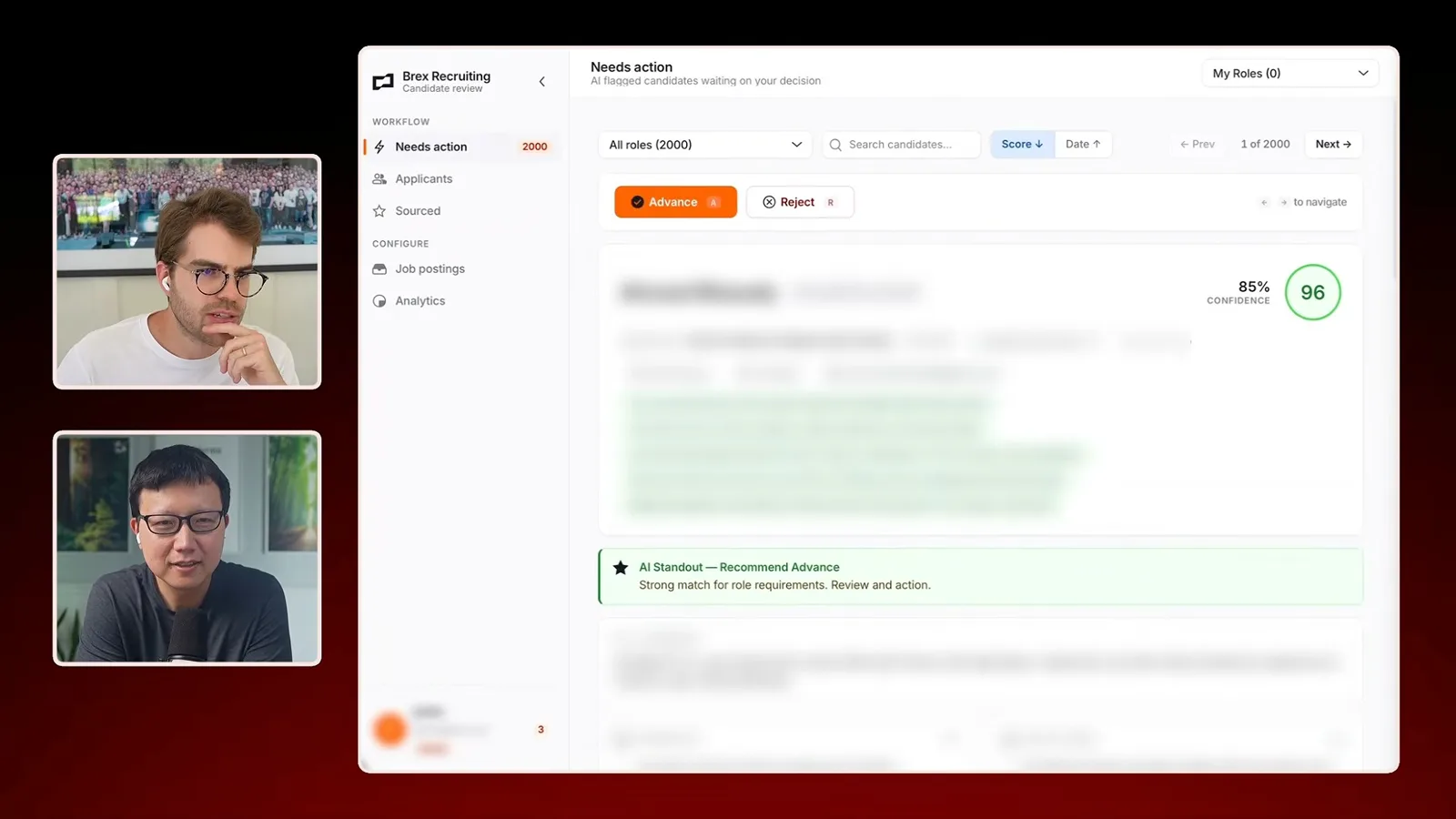
The recruiting system also provides analytics and can report to staff through Slack. Franceschi says the team improves its behavior from feedback. He adds that open-source contributions can be a positive signal in hiring, but their absence is not automatically a negative one; Brex’s engineering interviews include a building exercise using AI tools.
Security and network policy
CrabTrap applies rules and model checks to agent traffic.
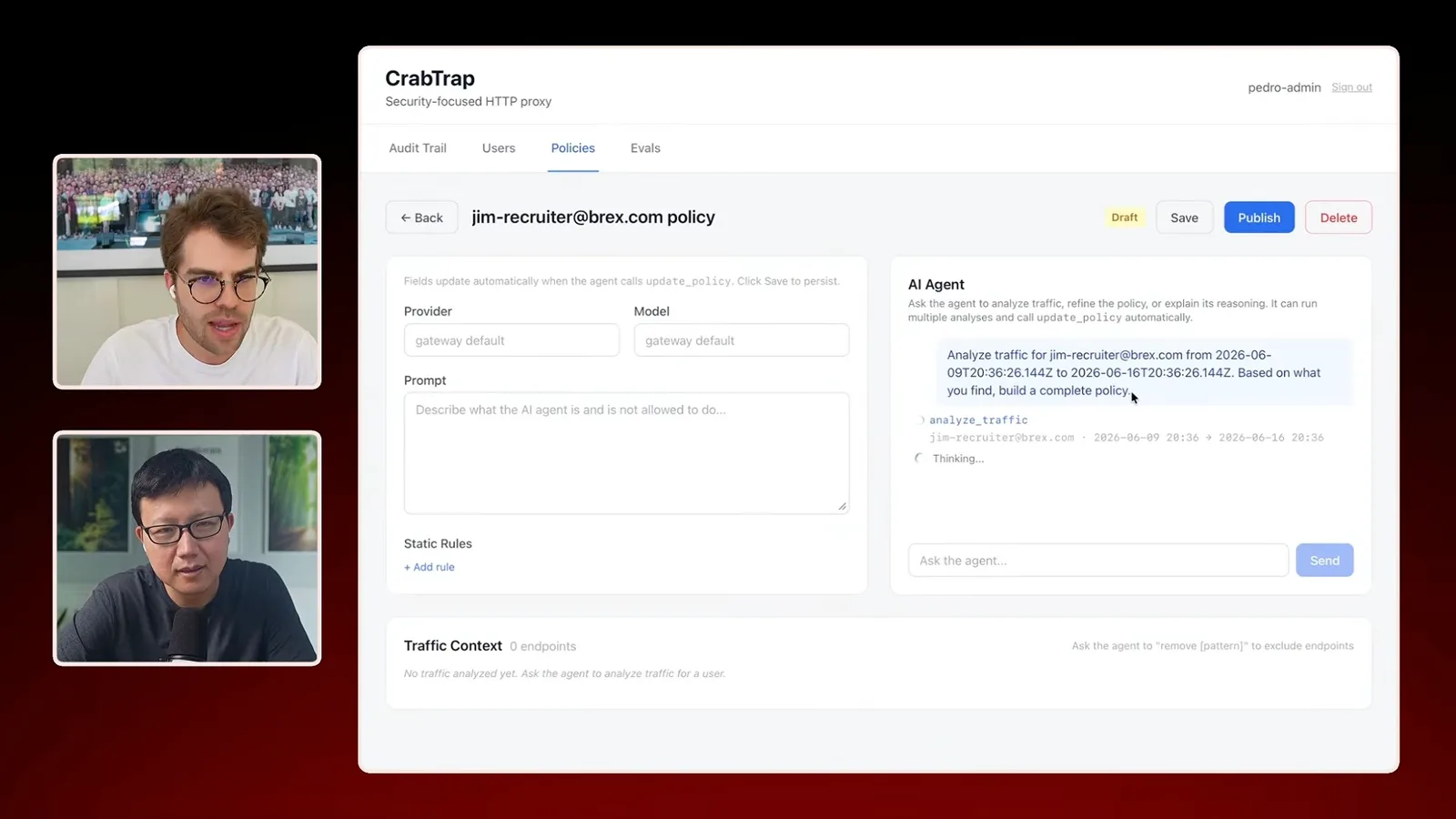
For network controls, Franceschi demonstrates CrabTrap, an open-source HTTP proxy. He describes static rules for known requests and an LLM-based judge for other traffic, plus an audit trail. A suggested policy can be generated from observed traffic and reviewed; network policy and model judgments have limits and require testing rather than guaranteeing security.
Understanding token costs
Magpie illustrates usage analysis and optimization.
The next tool, Magpie, tracks AI consumption and costs across corporate, operational and product use. Franceschi shows how a team might break spending down by use case or model and investigate changes. He describes plans to connect usage with actual company spend; future availability is his stated intention, not a promise.
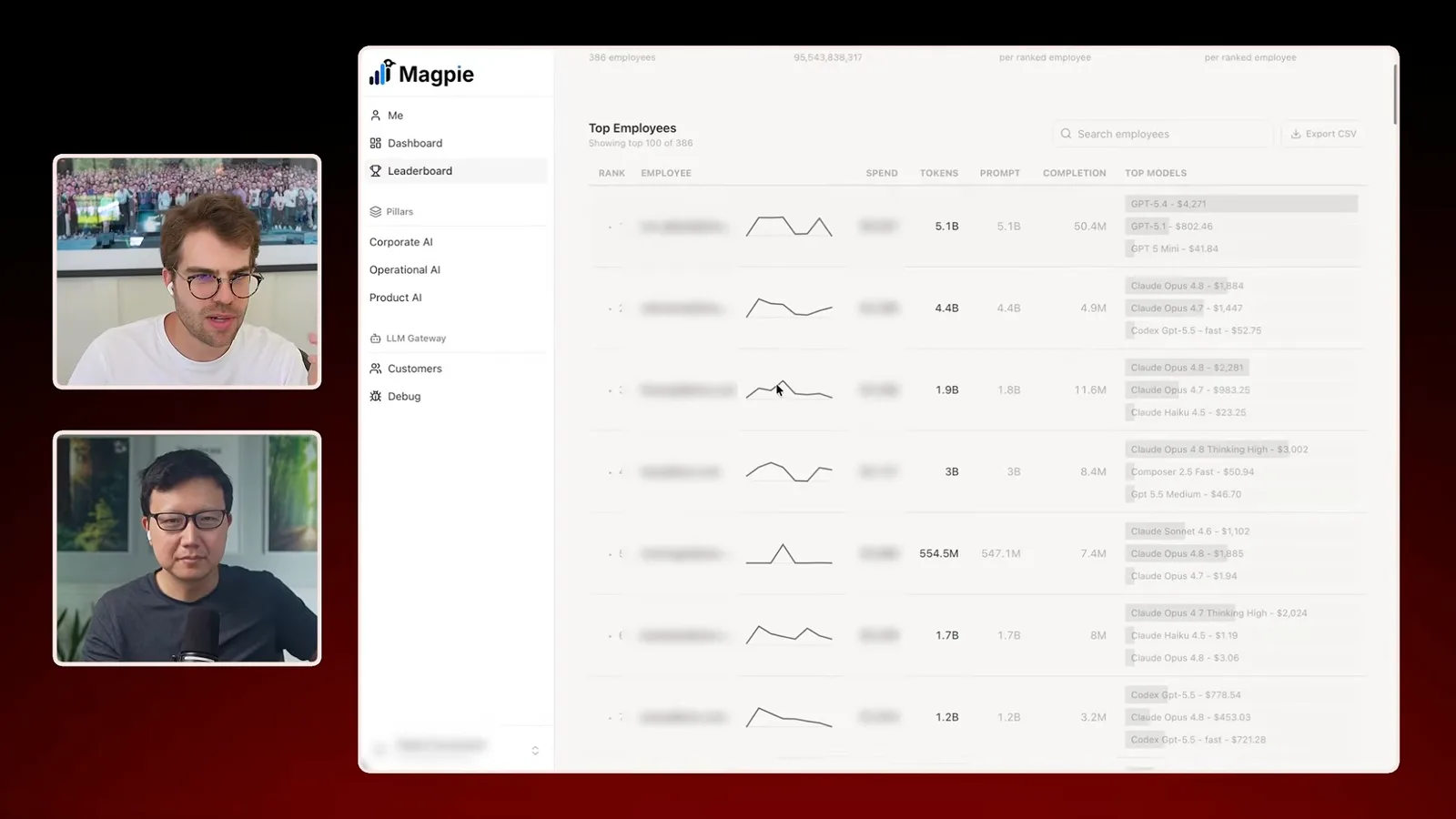
Asked about token budgets, he says Brex initially allowed extensive experimentation, with some caps, before optimizing usage. Examples of later optimization include caching and choosing a less expensive model where appropriate. High token use by itself does not demonstrate productivity or return on investment.
Work, personal systems and software businesses
Franceschi shares predictions and demonstrates his personal Autopilot.
Franceschi predicts changing jobs and more people building with AI, while acknowledging uncertainty about employment. His estimates of productivity and future adoption are opinions, not established outcomes. He expects companies to need people to help implement these changes.
He shows a personal OpenClaw system called Autopilot that collects signals from Slack, email and meeting notes. It organizes them around people and projects, produces action items and retains links to source interactions. The underlying project files are Markdown stored in a repository, with scripts providing a searchable interface.
On software businesses, Franceschi argues that AI changes how providers deliver value: a product can sell completed work as well as a tool. He describes agents, tools and feedback loops as a common pattern. This is his strategic view of the market, rather than a guarantee that any particular model will succeed.
Mehr aus diesem Kanal
 46:40EN
 Peter Yang· 8. Nov. 2026Podcast · 2 StimmenAshley Alexander: How AI Helps Me Care for My Parents With CancerGast: Ashley Alexander · Moderation: Peter YangA caregiver uses AI to prepare for appointments, organize records and ask better questions—while keeping doctors at the center of treatment.
 17:50ENPeter Yang· 4. Nov. 2026PodcastPeter Yang’s Five Steps for Using AI to Help Care for His MotherYang uses a shared care brief and organized records to navigate appointments, while making time for family.
 15:03ENPeter Yang· 3. Nov. 2026PodcastHow Peter Yang Used an AI Phone Agent to Negotiate His Internet BillAn AI call negotiated a lower price and faster service, but Yang still had to approve the change himself.
 33:09ENPeter Yang· 1. Nov. 2026Podcast · 2 StimmenJaclyn Konzelmann: When AI Can Build More, Choose What Deserves to ExistGast: Jaclyn Konzelmann · Moderation: Peter YangGoogle Labs pairs short strategy documents with prototypes, user co-creation and lessons from experiments that end.
 13:05ENPeter Yang· 28. Okt. 2026PodcastPeter Yang Tests Genie 4: Convincing Worlds, Unfinished GameplayFive live demonstrations show scenes that respond to prompts and sound, alongside inconsistent actions and limited game mechanics.
 1:06ENPeter Yang· 26. Okt. 2026PodcastPeter Yang on Setting Up Payroll for a One-Person BusinessIn a paid partnership, Yang describes the paperwork he encountered and a payroll product integrated with a business account.