In 30 Sekunden
At a Citadel Securities event on October 20, 2026, Bloomberg’s Lisa Abramowicz interviews former Italian prime minister and ECB president Mario Draghi about Europe’s economic and geopolitical challenges. Draghi offers his own assessment of monetary policy and argues for deeper integration, investment and AI adoption; his statements about market conditions and future events are views at the time of the interview.
- 1Blocked expectationsDraghi connects youth frustration with weak growth and intergenerational opportunity.
- 2French spreads and the ECBSpeaking personally, he describes a high intervention bar and the importance of transmission and contagion.
- 3Inflation and interest ratesHe says policymakers should examine persistence, second-round effects and why financing conditions tighten.
- 4A single market for servicesDraghi argues for deeper services and capital markets alongside bottom-up private-sector integration.
- 5Europe’s AI choicesHe proposes work on electricity, strategic compute and adoption rather than assuming an easy path to scale.
- 6Energy infrastructureHe says renewable targets require grids, permits and investment to support the transition.
- 7Europe and the United StatesHe sees common democratic ties but a more transactional relationship, with Ukraine central to its future.
Das Wichtigste
- Draghi links youth frustration partly to weak growth and blocked expectations while condemning violence.
- He says the bar for ECB intervention in French spreads was high at the time, while noting he no longer speaks for the central bank.
- He argues that inflation, its persistence and the causes of higher rates require close assessment.
- He calls for deeper European services and capital markets, and less fragmented regulation.
- His proposed AI priorities include electricity, strategic compute and adoption in existing industries.
- He argues that renewable energy objectives must be matched with grids, permits and investment.
- He expects European unity to endure while warning about tensions in transatlantic relations and Russian interference.
Den bearbeiteten Text nach Kapiteln lesen
Growth, protests and France’s fiscal challenge
Abramowicz asks Draghi about unrest and public finances. He discusses youth expectations, slow growth and political constraints.
Bloomberg Television’s Lisa Abramowicz introduces Mario Draghi, former president of the European Central Bank and former prime minister of Italy. At a Citadel Securities event on October 20, 2026, she asks about European unrest, fiscal pressures and the political appetite for reform.
Draghi says protests in different countries have distinct causes, but he sees blocked expectations as a common element. Many young people, he argues, feel unheard and unequipped for rapid technological change. Weak growth makes intergenerational fairness and social mobility harder to sustain.
He says political actors and crowd dynamics can amplify unrest, and condemns violence. Abramowicz asks how countries can address debt in a weak-growth environment, particularly France, and whether political leaders can persuade investors that they will act.
Draghi describes Europe as wealthy but aging and insufficiently dynamic, despite some upward revisions to growth forecasts. He argues that when growth is weak, incumbents retain influence and younger people can feel excluded. These are his interpretations of the situation at the event.
On France, he points to years of deficits and rising debt relative to GDP, with higher interest rates making the budget harder to manage. Before discussing the ECB, he cautions that he has not been a central banker for nearly seven years and is describing what he would do, not the institution’s policy.
The ECB, spreads and inflation
Draghi offers a personal assessment of ECB intervention and the transmission of monetary policy. He then discusses inflation and the causes of higher interest rates.
Asked whether the ECB should intervene to narrow spreads, Draghi says the spreads then appeared to reprice fiscal and political risk. In his view the threshold for intervention was high, particularly with inflation elevated and price stability central to the ECB’s mandate.
He says intervention tools require attention to contagion and impairment of monetary-policy transmission into credit markets. At the time, he does not see substantial contagion of the kind observed in an earlier crisis or clear damage to lending transmission, and notes that bank lending had increased.
Draghi adds that an excessive-deficit procedure does not automatically prohibit use of the Transmission Protection Instrument, but in his view raises the practical threshold. He expects the ECB to monitor the speed and extent of spread movements while staying on the sidelines for the moment.
He identifies factors that, in his assessment, give France some time: little remaining issuance that year, relatively long debt duration and a limited external deficit. He also says a budget proposal under discussion would meet a minimum requirement if approved. He stresses that the fiscal adjustment is political and will take time.
Draghi says a broader consensus on the need for budget correction has emerged, but parties disagree over how to distribute the burden. Parliamentary discussion and candidate debates ahead of elections will shape the outcome. His comments describe the political process as he saw it in October 2026.
Abramowicz turns to the oil-price shock and asks whether the ECB should slow rate increases. Draghi again emphasizes that he is speaking personally. He says the first priority is assessing inflation: whether the shock is temporary, whether second-round effects emerge and how expectations and core inflation evolve.
He says nominal wage growth had not yet clearly accelerated, but notes increases in unprocessed food prices and uncertainty about how long energy-market disruption would last. The longer and more severe the disruption, he argues, the greater the risk of second-round effects.
Some observers argue that tighter financing conditions can do the central bank’s work. Draghi says policymakers must distinguish the causes of higher rates. Higher rates associated with stronger growth are different from increases driven by other forces, and an estimate he cites attributes about half of Europe’s long-term rate increase to external factors, largely the US Treasury market.
He therefore rejects relying on a broad description of tighter financing conditions alone. Whether short-term policy rates should follow depends on the underlying cause and the inflation assessment. This is his policy judgment at the time, not a statement by the ECB.
Asked what has happened since his 2024 competitiveness report, Draghi says some regulatory simplification and competition measures have occurred. He considers the biggest change a shift in perception: complacency has given way to wider recognition that Europe needs to act.
Competitiveness and European integration
The conversation turns to the Draghi report, private-sector integration and fragmented regulation. Draghi argues for stronger services and capital markets.
He sees more movement at company level than at government or EU level, citing partnerships, mergers and joint ventures. In innovative sectors, he argues, a national market may be too small; private companies are joining forces in what he calls bottom-up integration.
Draghi identifies a deeper single market in services and a capital markets union as major priorities. He says Europe has a single market in goods but still lacks an equivalent market in services, including AI, even though services now account for more than 70% of EU GDP by his account.
He says strong governments are needed to make these changes. Abramowicz asks whether regulatory changes and banking consolidation, including the debate around UniCredit and Commerzbank, show that barriers are falling.
Draghi argues that European regulation can be excessive or outdated, especially for fast-changing services. He considers fragmentation the greater problem: national layers can differ even when European rules exist. He uses differing social-media age requirements as an example of variation that can complicate development.
He sees some signs of national fragmentation easing in banking, but says this is not enough to make Europe competitive with the United States and China in AI. Regulation alone is not the field on which he would choose to compete.
AI, electricity and investment
Draghi assesses Europe’s position in computing and AI adoption. He connects energy security, renewable investment, grids and capital markets.
Draghi argues that building large-scale compute is difficult without customers whose demand makes the investment financeable. Existing hyperscalers already aggregate much of that demand, while European frontier-model companies are, in his assessment, earlier in their development than their US or Chinese counterparts.
His first AI priority is electricity. Second, he suggests building strategically scaled compute for areas such as defense, security, cybersecurity and healthcare, potentially including a segregated cloud. He says national scale alone may be insufficient, and points to the potential value of European public health data.
Third, Draghi argues that Europe can compete through adoption: spreading AI quickly through companies in areas of comparative strength, such as industrial automation, pharmaceuticals and finance. He notes uncertainty about an older estimate of Europe’s industrial automation share and says companies can choose between open and closed models.
He adds that Europe still depends on chips made elsewhere, complicating competition on compute. Abramowicz asks how Europe can improve energy security after dependence on different fossil-fuel suppliers and amid pressure on gas prices.
Draghi says decarbonization and electrification remain Europe’s long-term direction. He sees geopolitical risk in imported fossil fuels, rising electricity demand from AI, buildings and transport, and falling costs in clean technology as reasons to continue expanding renewable energy.
He argues that earlier climate objectives were not always matched with the tools required to reach them. Renewables need grids, and electric vehicles need charging infrastructure. Long permitting delays can slow grid expansion; he cites an older estimate of 25,000 kilometers of grids awaiting permits.
Draghi also cites an estimate that 10% of renewable electricity is wasted each year because of insufficient grids. He says the targets should remain, but instruments and investment must align with them. These infrastructure figures are presented as his estimates at the event.
Investment need not be entirely public, he says. Draghi argues that fragmented capital markets prevent European companies from reaching scale and help explain why savings flow abroad. He cites annual outflows of roughly half a trillion euros, including about 300 billion to the United States.
In his view private capital should provide much of the investment, while public funds can catalyze or reduce risks for long-gestation projects. He also acknowledges a transition problem: industries may face high energy costs before the anticipated benefits of cheaper clean electricity arrive.
Draghi suggests changes to electricity-market arrangements that could reduce the impact of volatile gas prices, while acknowledging there are reasons for the existing marginal pricing system. Abramowicz asks whether Europe can still regard the United States as an ally.
Alliances and the future of Europe
Draghi discusses the transatlantic relationship, Ukraine and European political cohesion. He closes with a qualified optimism about European unity and reform.
He distinguishes enduring democratic affinities from recent damage to the relationship. Draghi says international trade rules and traditional alliances have changed, creating uncertainty, and sees European assumption of more responsibility for its own defense as overdue.
He expects decisions across the Atlantic to become more transactional and says the future of relations will be shaped by what happens in Ukraine. He states that Russia invaded Ukraine and argues that the way a peace is agreed, including whether Europeans participate, will matter for the relationship.
Abramowicz asks whether the euro area faces a threat comparable to the crisis during Draghi’s ECB tenure. He notes strong recent capital inflows into Europe and says elections may bring more disagreement, but in his judgment coalition politics and shared interests make disintegration unlikely.
Draghi says he remains optimistic about European unity while warning of Russian interference in political processes. Asked specifically whether there is evidence connecting Russia to the recent protests and rioting, he says there is no evidence so far. He ends by saying he is optimistic some of his report’s public-sector recommendations will be adopted.
Mehr aus diesem Kanal
 1:01:02EN
 Citadel Securities· 27. Okt. 2026Podcast · 3 StimmenSequoia's Alfred Lin and Konstantine Buhler on AI, Investment and the Agent EconomyGast: Alfred Lin, Konstantine Buhler · Moderation: Nohshad ShahAt Citadel Securities' 2026 conference, the partners discuss their investment process, model competition, computing constraints and future opportunities.
 18:55ENCitadel Securities· 26. Okt. 2026Podcast · 4 StimmenJeff Maurone on Citadel Securities’ Market Analytics and TechnologyThe technology COO describes tools for market positioning, credit spreads and client questions, and the research infrastructure behind them.
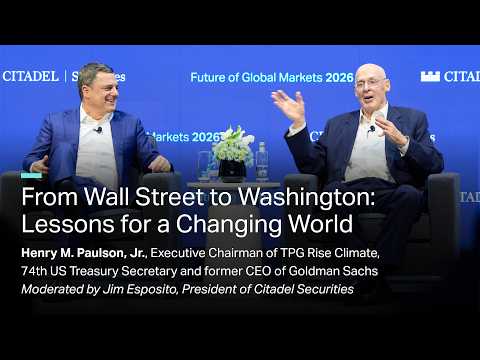 45:34ENCitadel Securities· 26. Okt. 2026Podcast · 2 StimmenHenry Paulson on AI Risk, U.S.–China Relations and Crisis LeadershipGast: Henry M. Paulson, Jr. · Moderation: Jim EspositoThe former Treasury secretary discusses today’s economic risks and lessons from the 2008 financial crisis.
 1:01:23ENCitadel SecuritiesPodcastJensen Huang on AI Factories, Digital Workers and Why the Build-Out Has Barely BegunNvidia's CEO tells a room of institutional investors how accelerated computing led to AI factories, and where agentic AI, robotics and sovereign AI go next.