In 30 Sekunden
In a May 2026 video, Matthew Berman reviews Anthropic’s announcement of a SpaceX compute agreement and higher Claude Code and Opus API rate limits. He compares other infrastructure partnerships, discusses statements from Elon Musk and Anthropic, and considers possible effects on Cursor. The video mixes company announcements with Berman’s interpretations of motives, capacity utilization and market dynamics. Anthropic said Colossus 1 capacity would become available within the month; its immediate rate-limit changes did not establish that every GPU was online on announcement day.
- 1Compute agreementAnthropic linked higher usage limits to the SpaceX partnership and other recent compute deals.
- 2Five-hour limits doubledThe May announcement covered Claude Code Pro, Max, Team and seat-based Enterprise, with separate Opus API changes.
- 3Capacity within the monthAnthropic said the agreement would give it access to more than 300 MW and 220,000 GPUs within the month.
- 4Interest in orbital computeThe companies expressed interest in a potential future project, without announcing an operational system.
- 5A separate Cursor optionSpaceX’s April partnership included the right to acquire Cursor later in 2026; the transaction was not complete when this video was made.
Das Wichtigste
- Anthropic announced immediate increases to selected Claude Code five-hour limits and Claude Opus API rate limits on May 6, 2026.
- Anthropic said the SpaceX deal would provide over 300 MW and more than 220,000 GPUs within the month, rather than confirming full availability on day one.
- Anthropic and SpaceX expressed interest in orbital compute; they did not announce an operating orbital data center.
- Berman’s explanations for the deal, idle capacity and Musk’s motivations are interpretations rather than established facts.
- SpaceX’s April Cursor agreement included an acquisition option; Cursor announced the completed acquisition in August 2026.
- Subscription allowances and API rate limits are different measures, and both may change over time.
Den bearbeiteten Text nach Kapiteln lesen
Anthropic’s compute constraints
Berman discusses AI demand and his frustrations with Claude quotas. Anthropic announces a SpaceX partnership and higher usage limits.
Matthew Berman reacts to Anthropic's May 6, 2026 compute partnership with SpaceX, a surprising arrangement given Elon Musk's prior criticism of Anthropic and his involvement in rival xAI. He considers why Anthropic wants more capacity, how its customer limits are changing, and what the deal might mean for SpaceX's separate partnership with Cursor.
Berman contrasts what he describes as Anthropic CEO Dario Amodei's more conservative approach to capital spending with OpenAI's aggressive infrastructure commitments. He argues that unexpectedly strong demand left Anthropic short of compute. This is Berman's assessment of the companies' strategies and their consequences, not an independently established account of every investment decision.
He criticizes Anthropic's communication about subscription quotas, peak-hour restrictions and access for third-party tools such as OpenClaw. He says the limits made it difficult for him to use what he paid for. These are his experience and judgments, not a finding that every user was affected in the same way.
Anthropic announced that its SpaceX agreement and other recent compute deals enabled higher usage limits for Claude Code and the Claude API. Berman compares this with the company's separate Amazon agreement for up to five gigawatts, noting that large infrastructure commitments can take time to come online.
Effective May 6, Anthropic said it was doubling Claude Code's five-hour rate limits for Pro, Max, Team and seat-based Enterprise plans, removing peak-hour reductions for Pro and Max, and raising Claude Opus API rate limits. Berman welcomes the changes but says the underlying subscription allowance remains difficult for him to understand. These are historical limits, not a promise about current plans.
Colossus 1 and rate limits
Berman reads the capacity announcement and details of Claude Code and API changes. The additional compute was expected within the month.
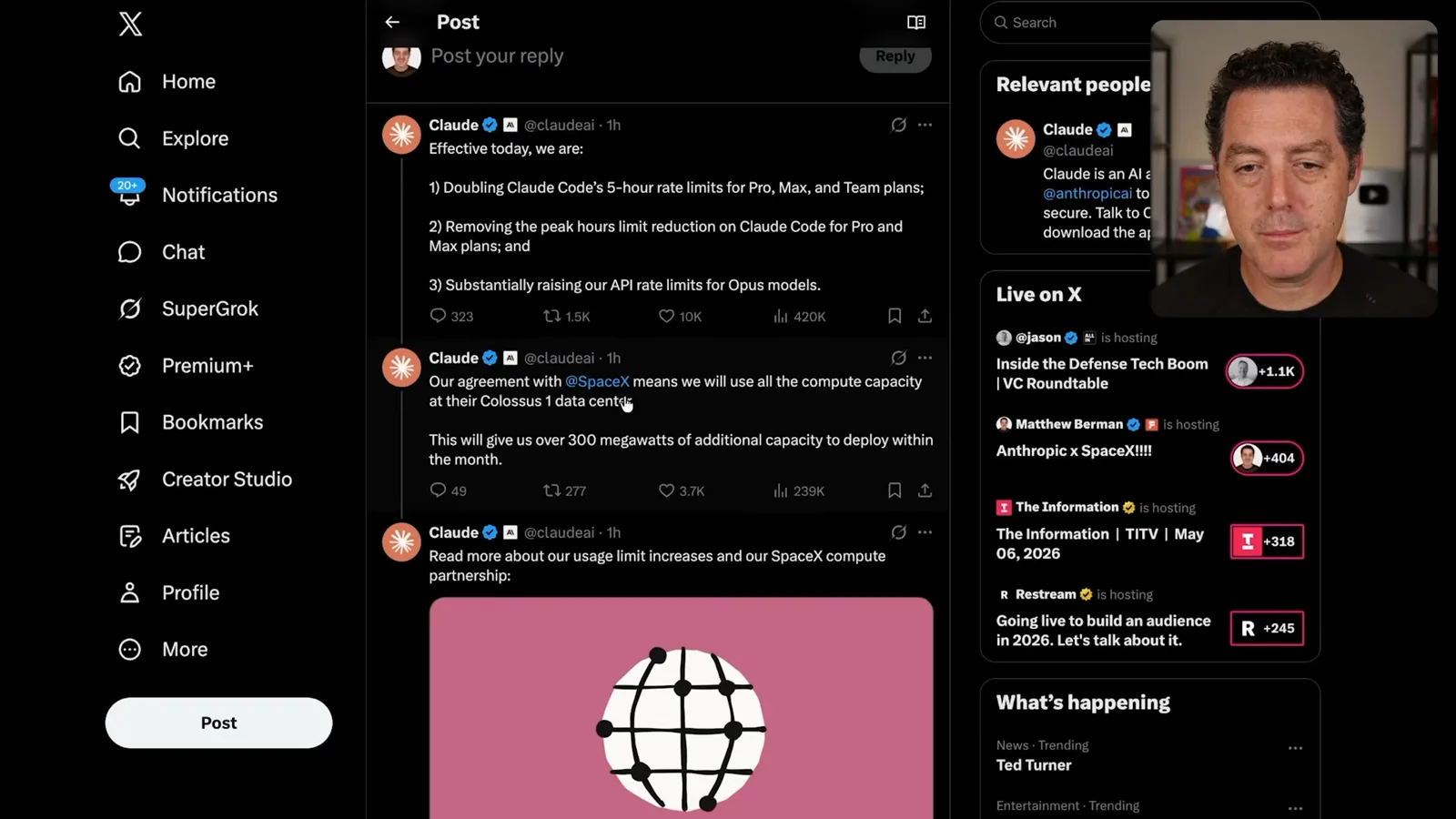
Anthropic said its agreement covered all compute capacity at Colossus 1 and would provide more than 300 megawatts of capacity, including over 220,000 NVIDIA GPUs, within the month. Berman infers the entire capacity was immediately online and previously idle. The announcement specifies a rollout within the month, while the prior utilization and exact allocation are not established by that announcement.
Returning to Anthropic's post, Berman says higher subscription limits were overdue and expresses frustration about restrictions affecting third-party harnesses. The five-hour Claude Code rate change and separately billed API rate limits are distinct from an unlimited or universally expanded subscription quota.
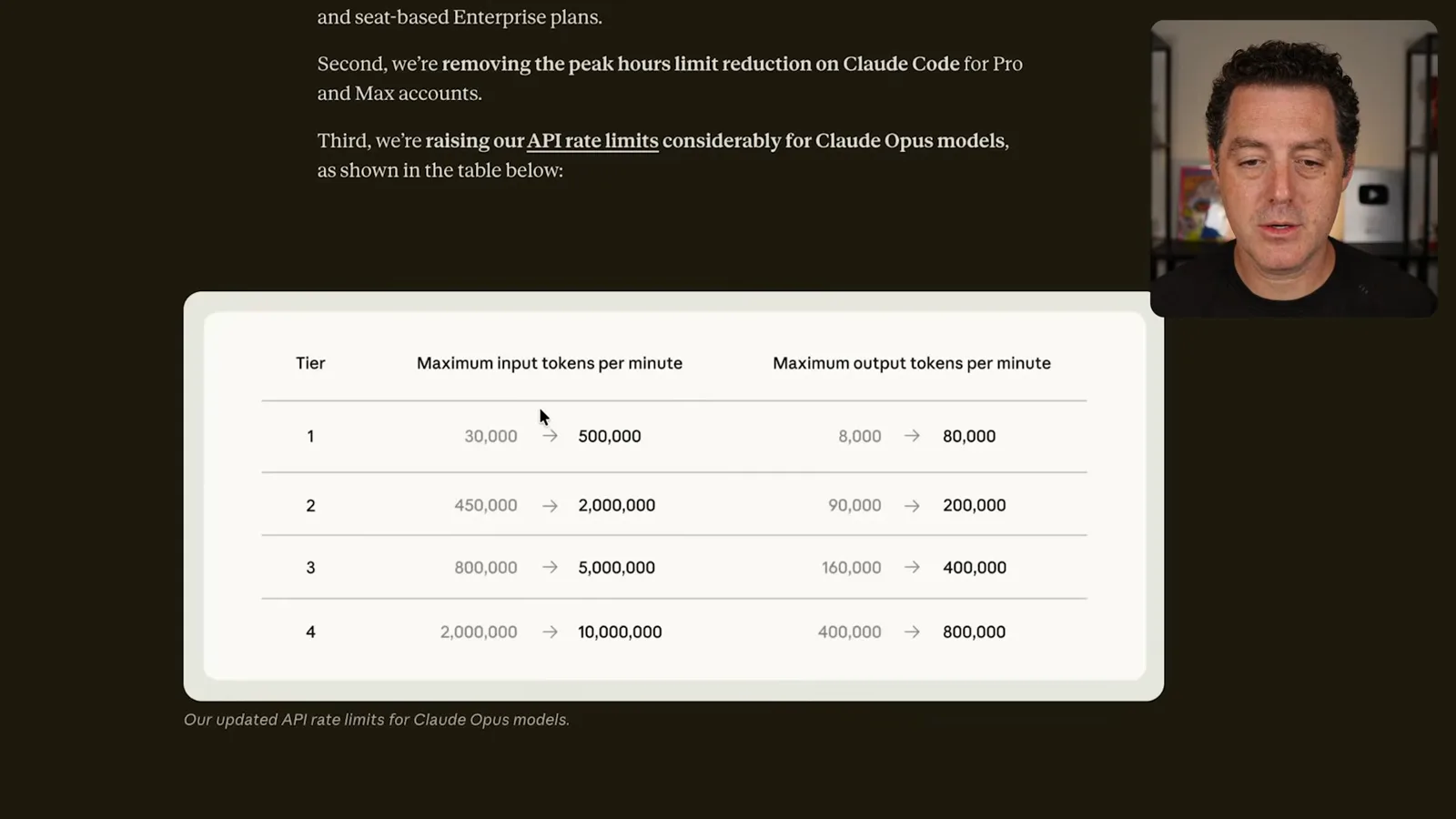
He reads the announced Opus API input-token rates: tier 1 rose from 30,000 to 500,000 per minute; tier 2 from 450,000 to 2 million; tier 3 from 800,000 to 5 million; and tier 4 from 2 million to 10 million. These are rate limits in the May 2026 announcement, rather than the number of tokens included in a subscription.
Berman predicts AI demand will outstrip supply for at least another decade and identifies NVIDIA as a beneficiary of demand for accelerators. His estimate is a forecast. Anthropic's stated access to over 220,000 GPUs within the month should not be confused with Berman's earlier estimate of nearly a million GPUs at the site.
Other infrastructure deals
He reviews Anthropic’s other agreements and an interview excerpt from Google Cloud CEO Thomas Kurian. He considers whether chips may become more interchangeable.
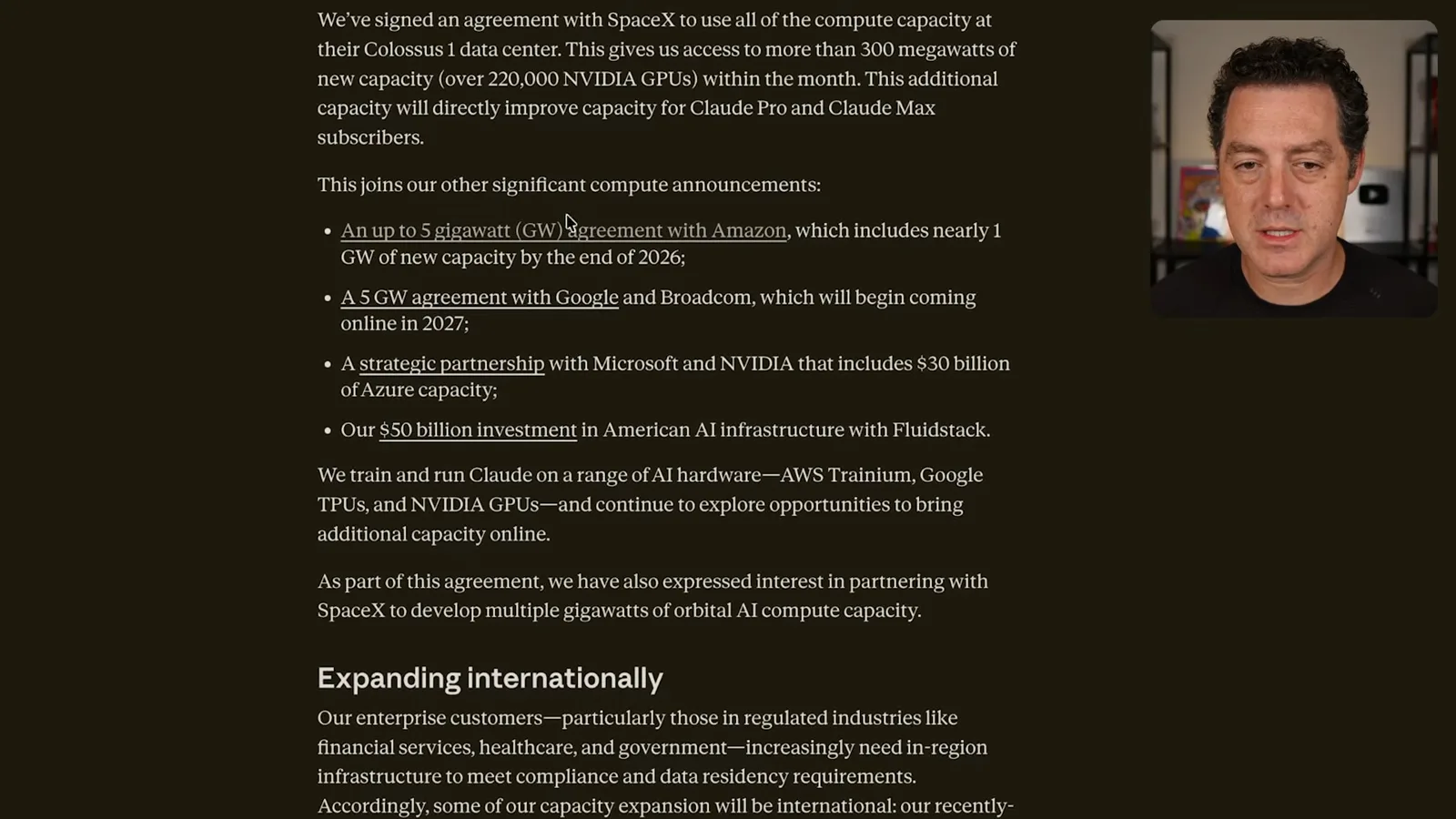
He surveys other capacity arrangements listed by Anthropic: up to 5 GW with Amazon, including nearly 1 GW by the end of 2026; 5 GW with Google and Broadcom starting in 2027; $30 billion in Azure capacity under a Microsoft and NVIDIA partnership; and a $50 billion infrastructure investment with Fluidstack. These figures describe announced agreements and plans, not capacity already operating in May.
Berman compares comments from Google Cloud CEO Thomas Kurian with remarks he attributes to Google CEO Sundar Pichai about compute constraints. In an interview excerpt, Kurian says capacity allocated to others must be balanced against Google's own needs and capital requirements, and argues that venture capital cannot indefinitely support a widening gap between AI costs and revenue.
Anthropic says it trains and runs Claude across AWS Trainium, Google TPUs and NVIDIA GPUs. Berman recalls a conversation with OpenAI's Greg Brockman and considers whether using different chip architectures might eventually make chips more interchangeable. He also acknowledges current manufacturing and supply constraints; chip commoditization is his hypothesis, not a conclusion demonstrated by this announcement.
SpaceX and Anthropic’s public statements
Berman reads the companies’ posts, including a possible orbital-compute collaboration, and compares Musk’s new remarks with earlier criticism.
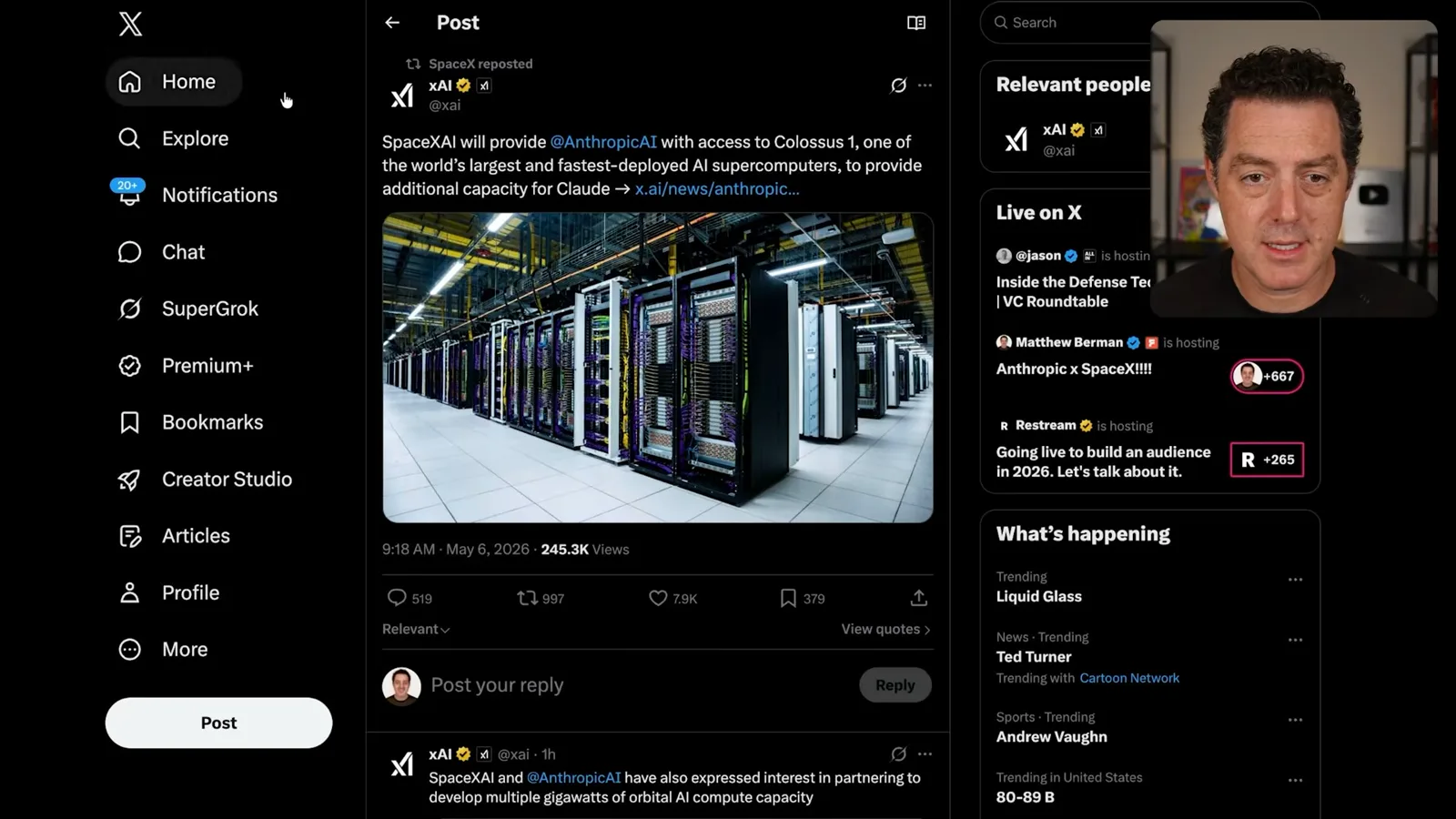
SpaceX's AI unit said it would provide Anthropic access to Colossus 1 for Claude. The companies also expressed interest in developing multiple gigawatts of orbital AI computing capacity. That is an expression of interest in a possible future project, not an operational orbital data center or a committed delivery schedule.
Berman reads a post from Anthropic co-founder Tom Brown saying Claude inference would ramp up on Colossus in the following days. Musk replied that he had met senior Anthropic staff, was impressed by their competence and concern for doing the right thing, and was comfortable leasing Colossus 1 after SpaceXAI moved its own training to Colossus 2.
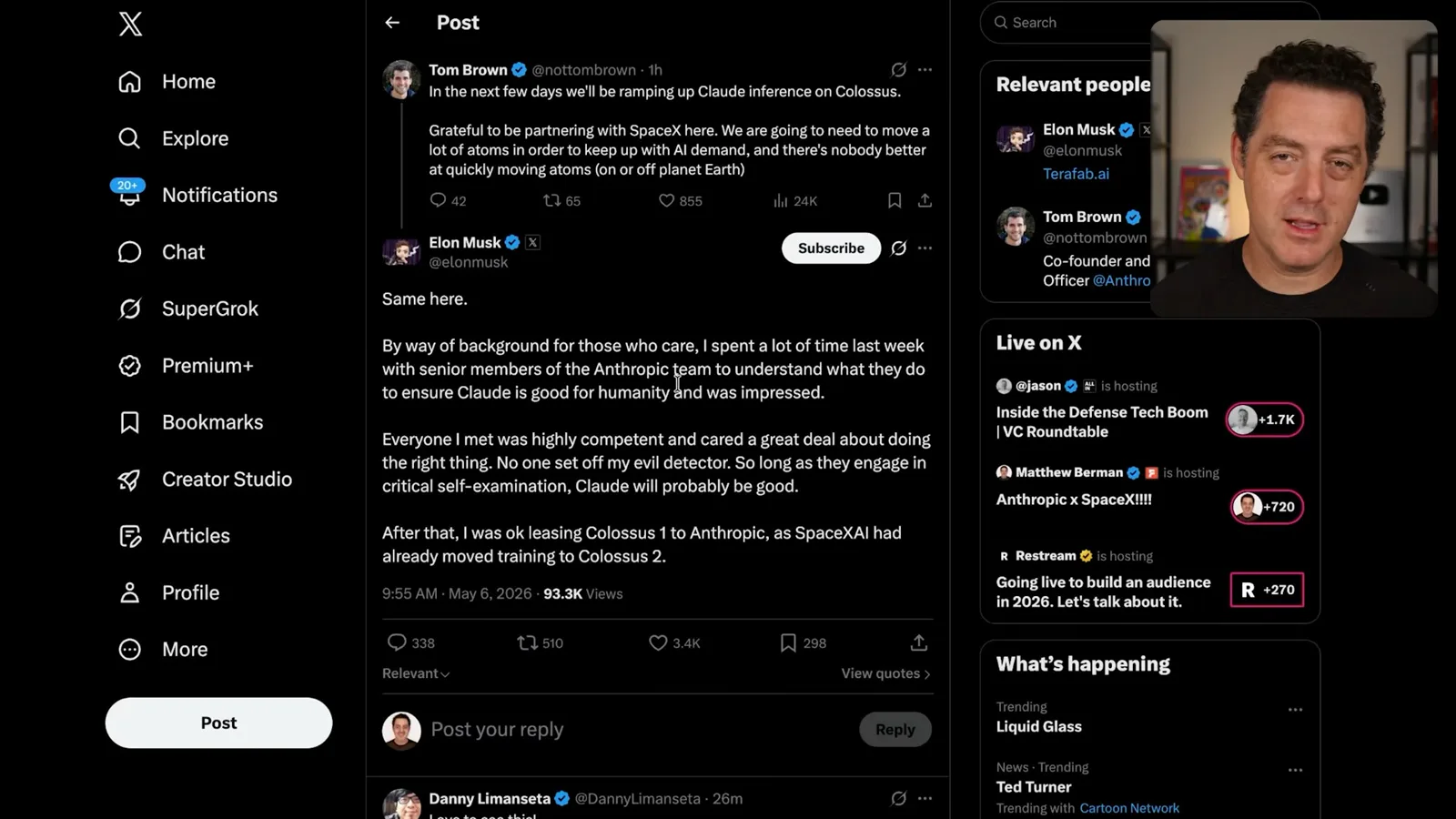
Berman finds Musk's positive comments striking alongside his prior criticism of Anthropic and his litigation involving OpenAI. Berman argues that financial incentives are important and disputes Anthropic's approach to openness and AI governance. His claims about Musk's motives, including his interpretation of the tone of the post, remain his own speculation.
He reads Musk's statement that continued self-examination could make Claude beneficial, and Musk's explanation that the company's own training had moved to Colossus 2. Berman interprets this as a way to emphasize that SpaceX retained another cluster for its work. The post itself does not establish the full allocation or utilization of either facility.
To illustrate the contrast, Berman reviews Musk's earlier critical social-media posts about Anthropic, including a March 2026 post calling the company hypocritical amid controversy over military uses of AI. The claims and accusations appearing in those posts are the speakers' views; the video does not establish the truth of every allegation in the material displayed.
Berman also refers to Anthropic's allegation that several Chinese AI labs used accounts to extract outputs at scale for model distillation, and to Musk's criticism of Anthropic's own training data practices. These are contested claims and arguments, not a determination that every practice or allegation is legally equivalent.
Motives, xAI and market speculation
He offers his interpretations of capacity utilization and xAI’s rebuilding, then considers AI models, chips and electricity as potential business bottlenecks.
Berman returns to Musk's praise and speculates that the partnership was driven by a need to monetize capacity. He characterizes xAI's compute as excess and Anthropic's demand as constrained. Neither the amount of idle capacity nor Musk's private decision-making is proven by the posts shown.
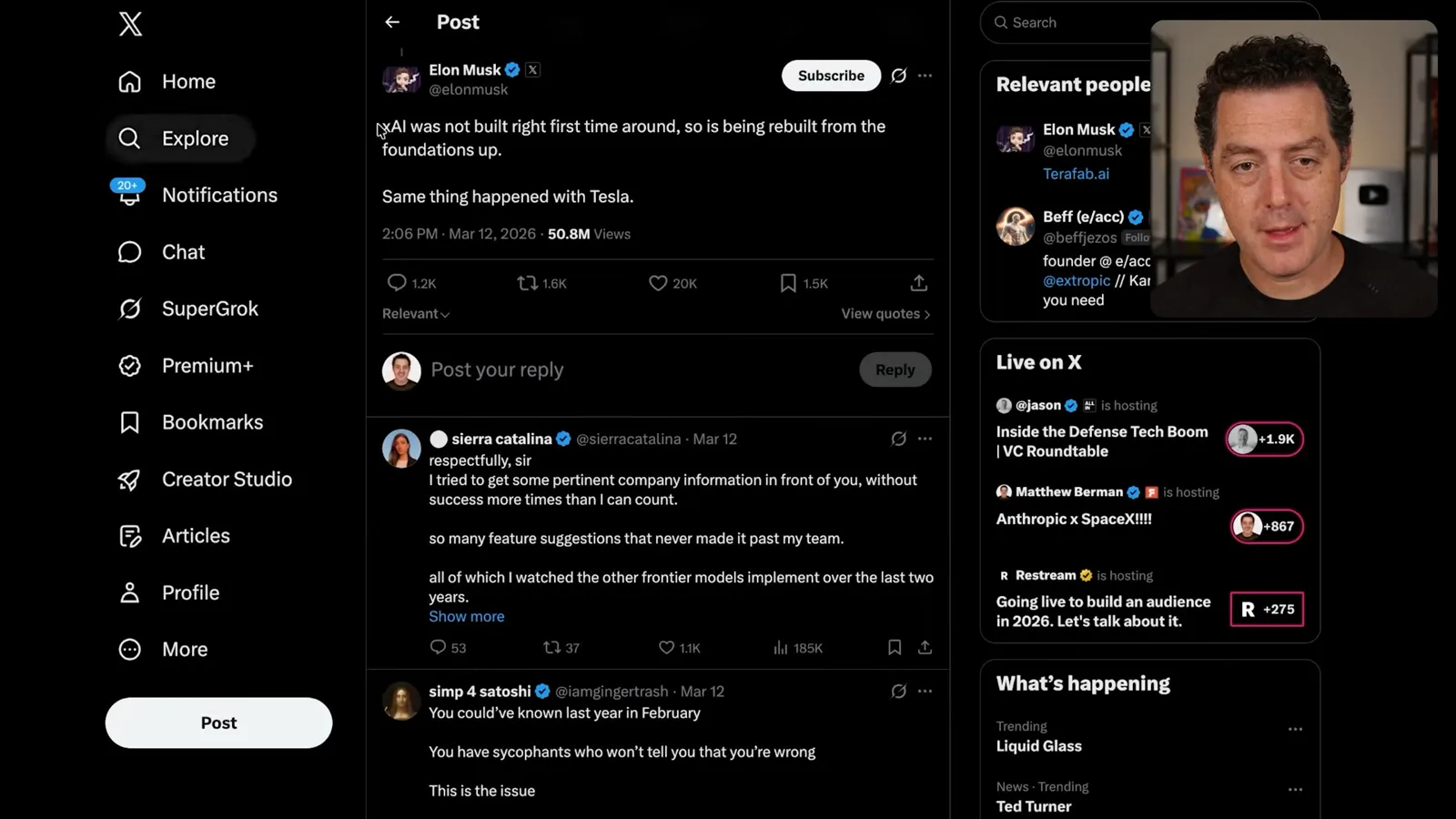
He reads Musk's earlier statement that xAI was being rebuilt from the foundations up and compares it with Tesla's shift toward neural-network-based driving systems. Berman believes the analogy explains why xAI might sell capacity while rebuilding its models; this is his inference rather than an announced reason for the Anthropic deal.
Berman recounts a Tesla drive in which the vehicle traveled for about an hour without a disengagement and says he favors end-to-end neural networks. That anecdote is his personal experience; it does not establish the safety or general performance of autonomous driving systems.
In his view, the partnership could benefit both parties: SpaceX earns revenue from compute while Anthropic gains capacity to serve demand. He hopes Anthropic will use the opportunity to improve customer experience. The scale of actual savings, revenue and future capacity utilization remains outside the evidence presented in the video.
Berman wonders whether xAI needs a leading model if models become commodities, and then asks whether chips might also become interchangeable across providers. He proposes electricity as a possible limiting layer of the AI stack. These are open-ended market hypotheses, not evidence that models or hardware are already commodities.
He speculates that Musk may also favor Anthropic because of his dispute with OpenAI. Berman explicitly presents this as a guess about private motivations. The public compute announcements do not establish that rivalry or spite caused the agreement.
Cursor and the acquisition option
Berman discusses the April SpaceX–Cursor partnership and possible consequences of the Anthropic deal. His conclusions about allocation and deal outcomes remain speculative in the May video.
Turning to Cursor, Berman notes its April 21 partnership with SpaceX to use Colossus infrastructure for model training. SpaceX had an option to acquire Cursor for $60 billion later in 2026 or pay $10 billion for their work together. In May, this was an option and partnership, not a completed acquisition; Berman questions what the Anthropic agreement could mean for it.
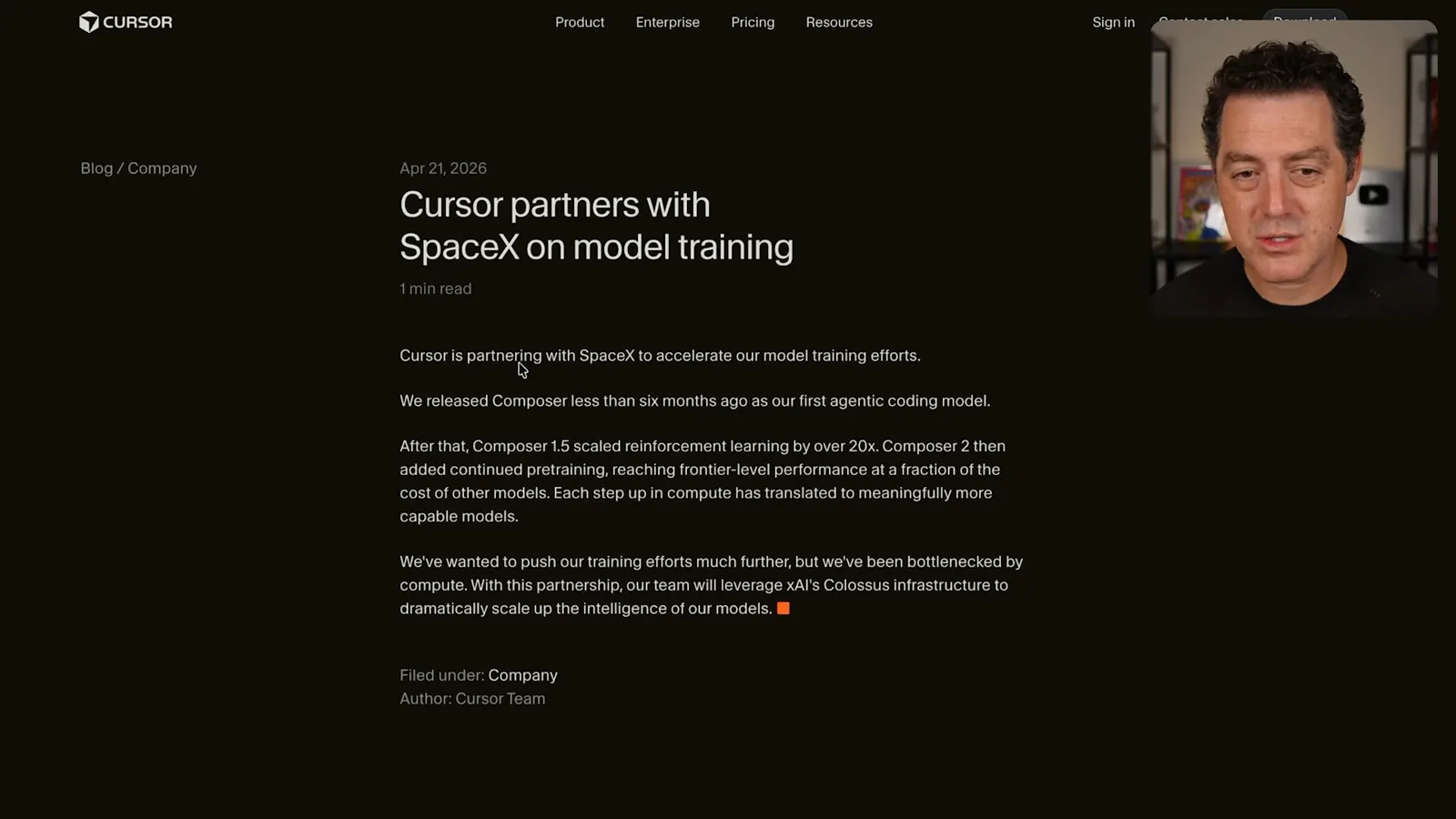
Cursor said it had been constrained by compute and expected Colossus access to help scale its coding-model training. It highlighted its Composer series and claimed that increasing training compute had improved its models. These are Cursor's descriptions of its products and expectations, not a direct measurement of the outcome of the new partnership.
Berman pieces together the announcements: Anthropic said it would use Colossus 1, while Musk said SpaceXAI's training had moved to Colossus 2. He guesses that xAI and Cursor would use the latter facility and wonders whether the acquisition option will be exercised. Those allocations and his characterization of the $10 billion alternative as a breakup fee are his interpretation, not fully established terms.
His final assessment is that the arrangement leaves SpaceX options while giving Cursor access to compute and offering Anthropic more capacity. He sees value in Cursor's engineering and model work but remains critical of Anthropic's recent customer experience. The video's analysis is a May 2026 snapshot: Cursor announced that SpaceX completed its acquisition in August 2026, after the video was published.
Mehr aus diesem Kanal
 34:21EN
 Matthew Berman· 27. Okt. 2026Matthew Berman Examines Anthropic’s IPO Filing, AI Growth and GovernanceMatthew Berman, Sam Altman · Forward FutureThe presenter reviews the S-1’s financial metrics, compute strategy and voting structure while questioning the tension between rapid AI development and safety.
 0:36ENMatthew Berman· 25. Okt. 2026Kimi K3.1 and a Rubik’s Cube Solver DemonstrationMatthew Berman · Forward FutureMatthew Berman shows a scrambled virtual cube being solved and gives the Kimi K3.1 test a favorable assessment.
 0:21ENMatthew Berman· 24. Okt. 2026An AI-Generated Kimi Benchmark Chart Used Invented ScoresMatthew Berman · Forward FutureMatthew Berman asks for a graph of Kimi K3.1 Pro benchmarks, then discovers that the displayed figures are illustrative placeholders.
 25:50ENMatthew Berman· 24. Okt. 2026Kimi K3.1 Pro Tested: Strong 3D Demos, Uneven Results and Competitive PricingMatthew Berman · Forward FutureMatthew Berman tests the open-weight model on coding, 3D rendering and visual explanations, then compares benchmark results and prices.
 32:20ENMatthew Berman· 23. Okt. 2026Who Is Local AI For? The Costs, Trade-offs and a Hybrid FutureMatthew Berman · Forward FutureMatthew Berman weighs data control and independence against hardware cost, setup complexity and inference speed.
 1:03:37ENMatthew Berman· 23. Okt. 2026Matthew Berman’s Team Tests Kimi K3.1 on Animation, Games, and ChartsMatthew Berman, Alex, Brian · Forward FutureA live team AMA turns into an informal test of Kimi K3.1, from personal-agent workflows to motion graphics, a browser game, and a benchmark chart.