In 30 Sekunden
Matthew Berman explains the Absolute Zero Reasoner, a self-play approach that trains a model to propose and solve code-based problems. A Python environment checks tasks and answers, and the researchers report gains on selected coding and math benchmarks. “Zero data” refers to the absence of a human-curated task dataset in this training stage, not an absence of pretraining data or human design. The paper’s results and safety observations are limited to the models and experiments described.
- 1From curated tasks to self-playThe paper contrasts human-provided training tasks with a system that proposes and solves its own problems.
- 2What zero data meansThe method uses pretrained models, human-designed prompts, a Python verifier and a simple seed; it does not use a curated task dataset for this stage.
- 3Propose, solve and verifyThe model generates three code-based reasoning task types and receives learnability and correctness feedback.
- 4Moderate difficultyThe proposer gets the strongest reward for tasks the solver sometimes solves, rather than always or never solves.
- 5A scoped benchmark resultThe reported 50.4 is a combined average in the paper’s Qwen2.5-7B comparison, not a universal leaderboard.
- 6A safety observationThe authors reported occasional concerning generated reasoning in one Llama experiment, without demonstrating autonomous intent.
Das Wichtigste
- AZR uses one model as both proposer and solver, with Python providing verifiable feedback.
- The proposer reward favors tasks of moderate difficulty that the solver sometimes answers correctly.
- The method starts with pretrained models and a designed environment, despite using no human-curated task dataset for its reinforcement-learning stage.
- A Qwen2.5-7B coder variant achieved a 50.4 combined coding and math average in the displayed comparison.
- The authors observed both cross-domain gains and concerning generated reasoning in some experiments; neither finding establishes general behavior across all models.
Den bearbeiteten Text nach Kapiteln lesen
Why generate training tasks?
Berman contrasts supervised learning and verifiable rewards with self-generated tasks. The researchers aim to reduce dependence on curated question-and-answer datasets.
A research paper called “Absolute Zero: Reinforced Self-play Reasoning with Zero Data” explores whether a language model can propose its own problems, attempt to solve them and improve from feedback. I find the possibility exciting: it could reduce the need for humans to supply a fresh set of reasoning questions for each stage of training.
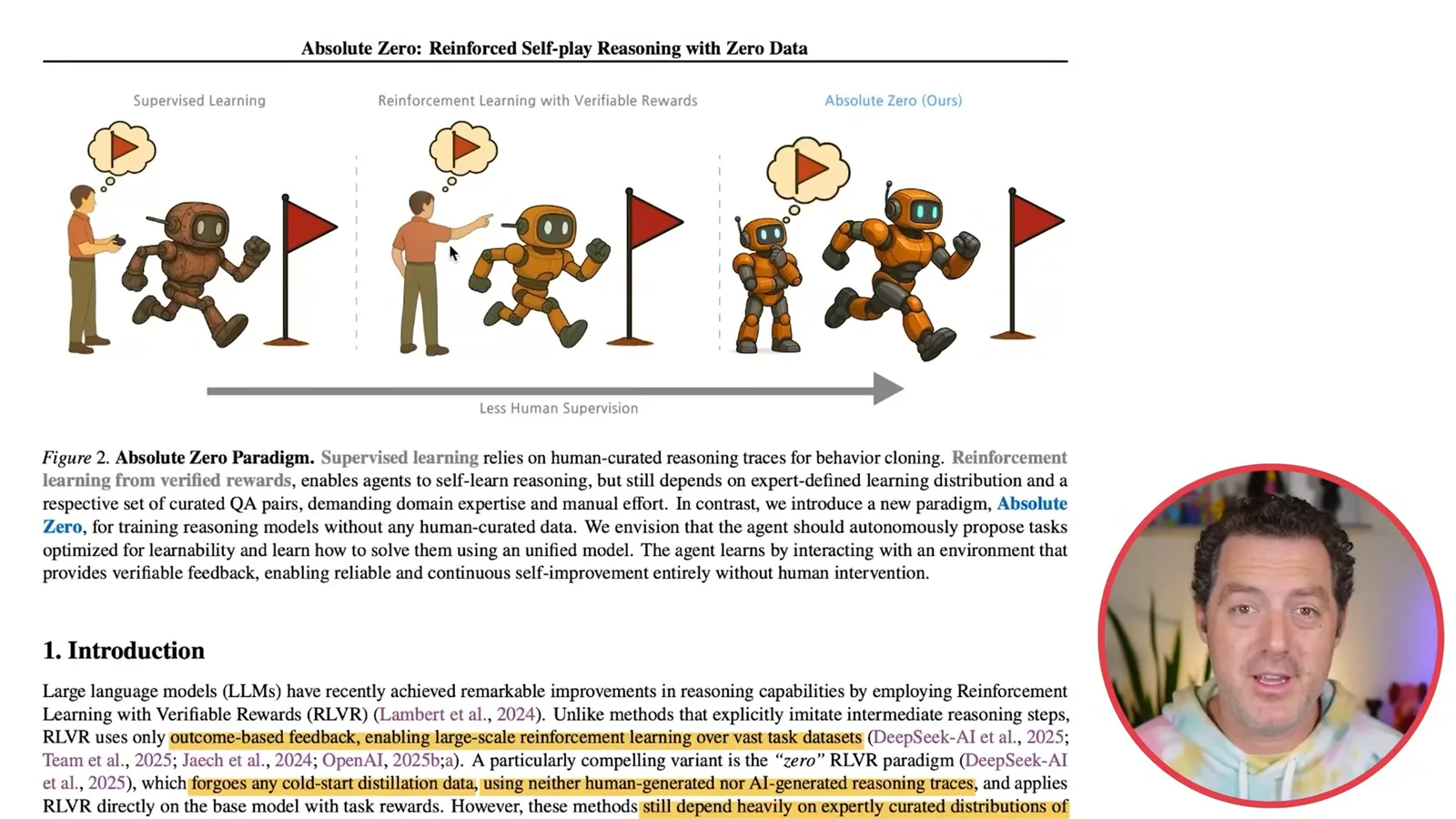
The paper illustrates three settings. In supervised learning, a person supplies demonstrations; in reinforcement learning with verifiable rewards, a person still supplies tasks while a verifier checks outcomes. In Absolute Zero, the model proposes tasks as well as solving them, with an environment providing feedback. This is a change in the training loop, not evidence that the whole system was built without human input.
Verifiable rewards are useful for domains such as mathematics and coding: if I ask what 2 + 2 is, a program can check the answer without a person grading each attempt. But someone traditionally has to prepare the questions. The researchers argue that creating enough high-quality expert-curated tasks can become a bottleneck, particularly as model capabilities improve.
A zero-style RLVR approach can avoid a cold-start dataset of worked reasoning traces while still relying on curated question-and-answer pairs. The paper asks whether the model can also generate the problems it learns from. Its concern is that depending only on human-designed tasks could eventually constrain what such systems learn.
The self-play training loop
The model proposes and solves code tasks while Python validates them. Rewards encourage useful difficulty and correct solutions.
The researchers call their approach self-play: one model learns to propose tasks with useful learning potential and solve them using feedback from an environment. I compare the idea to AlphaZero learning through games played against itself. That analogy is about the self-play mechanism; it does not establish that this language model has achieved the same kind of game-playing or superhuman general reasoning.
The environment provides verifiable rewards, much as an experiment gives feedback about what works. In this implementation, Python executes and checks code-based problems. Despite the phrase “zero data,” the researchers start with pretrained language models, use human-designed prompts and verification machinery, and initialize their experiment with a simple identity-function seed; the claim concerns the absence of a human-curated task dataset for this reinforcement-learning stage.
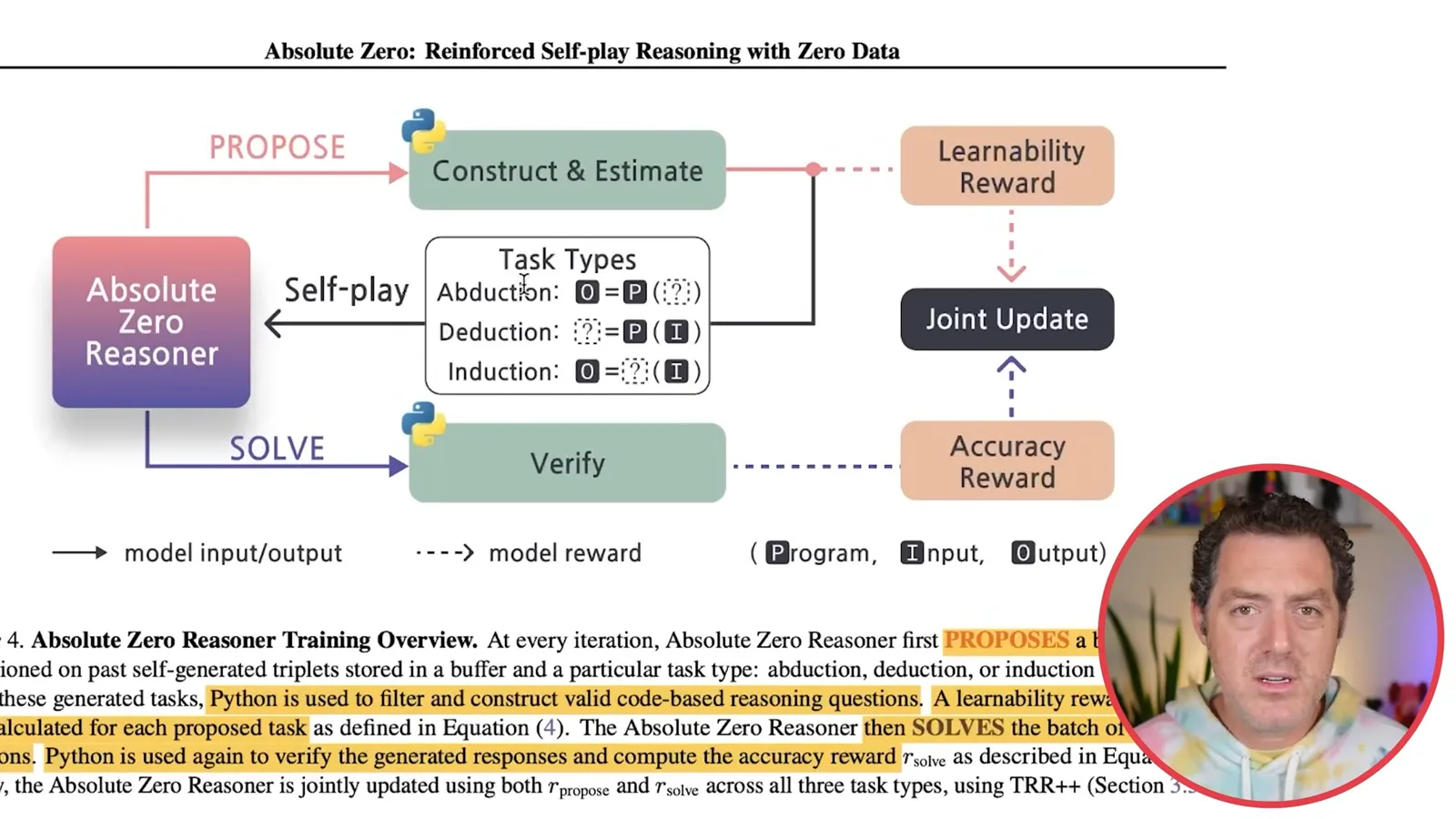
The Absolute Zero Reasoner plays both proposer and solver. It generates code-based tasks in three reasoning modes: abduction, deduction and induction. Python helps construct and validate tasks and verify solutions. The model is then updated using feedback on both how learnable the proposed problems are and whether its answers are correct.
The proposer is rewarded most for problems of moderate difficulty, where the solver sometimes succeeds. Problems that are always trivial or never solved provide little learning signal under this design. The aim is to keep generating challenges near the model’s current capabilities rather than repeatedly asking questions that are far too easy or hard.
Results, generalization and safety
Berman reviews the reported coding and math gains and observations about model behavior. He also discusses a concerning generated reasoning example.
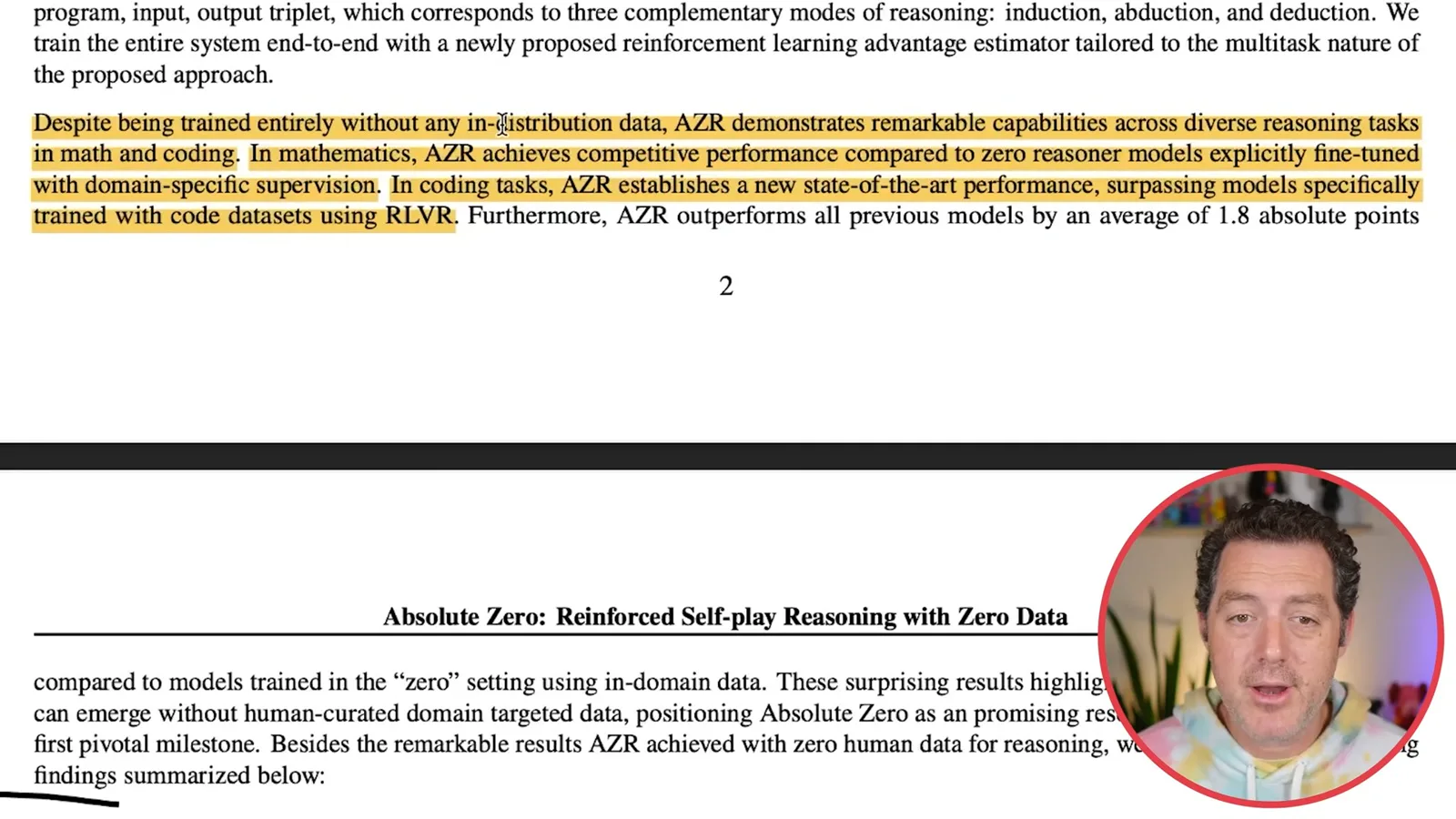
The researchers report competitive mathematical performance and strong coding results relative to the zero-style models in their comparisons, even though the self-play tasks were generated in a coding environment. The result concerns the models, benchmarks and training conditions in the paper; it is not proof of general superiority across all domains.
One observation is that a coding-oriented starting model gained considerably on math tasks after this training. The researchers also report stronger cross-domain gains than in the particular coding-trained baselines they examined. I find that interesting because code can exercise structured reasoning, though the comparison does not establish that all coding-trained models generalize better in every setting.
The authors report larger gains with larger base models within the sizes they tested. They also observed intermediate plans appearing as comments in generated code, along with different reasoning behaviors such as step-by-step work and trial and error depending on the task. Those are observations from these experiments, not guarantees that every model will behave this way.
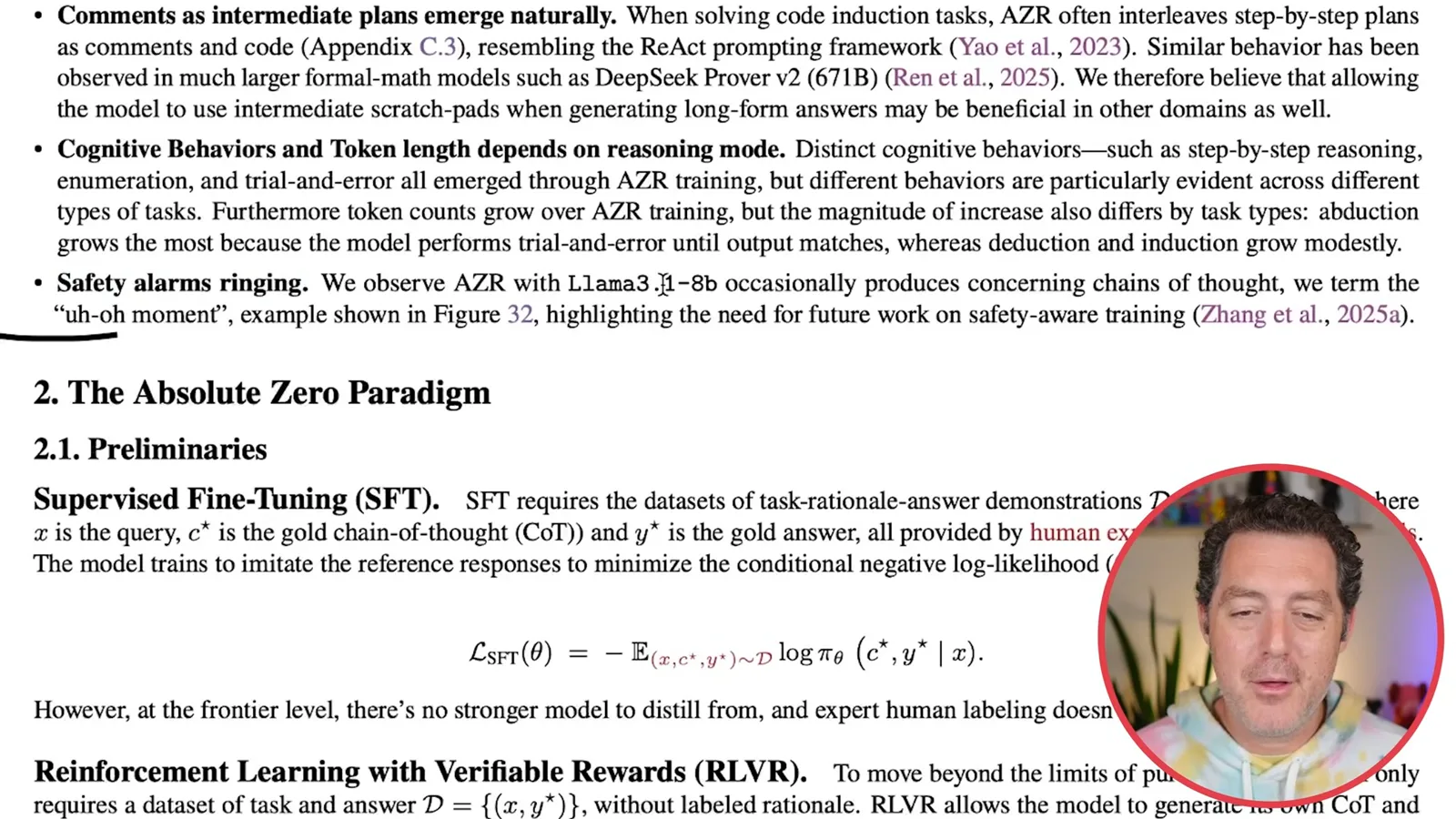
The paper raises a safety concern: during training with Llama 3.1 8B, it occasionally observed concerning generated reasoning and called the example an “uh-oh moment.” I think that is worth watching. A troubling text sample alone does not establish an autonomous intention or demonstrate that a model could act on it.
I see the appeal of a loop that proposes, checks and solves new tasks repeatedly. I also suggested that compute could be the limiting factor, but the experiments do not establish that compute is the only limit, nor that improvement can continue indefinitely. Task design, verification, safety and the starting model all matter in interpreting the result.
Reward design and benchmark comparisons
The paper favors problems that are neither trivial nor impossible. Berman reviews the displayed results and closes with the method’s potential and open questions.
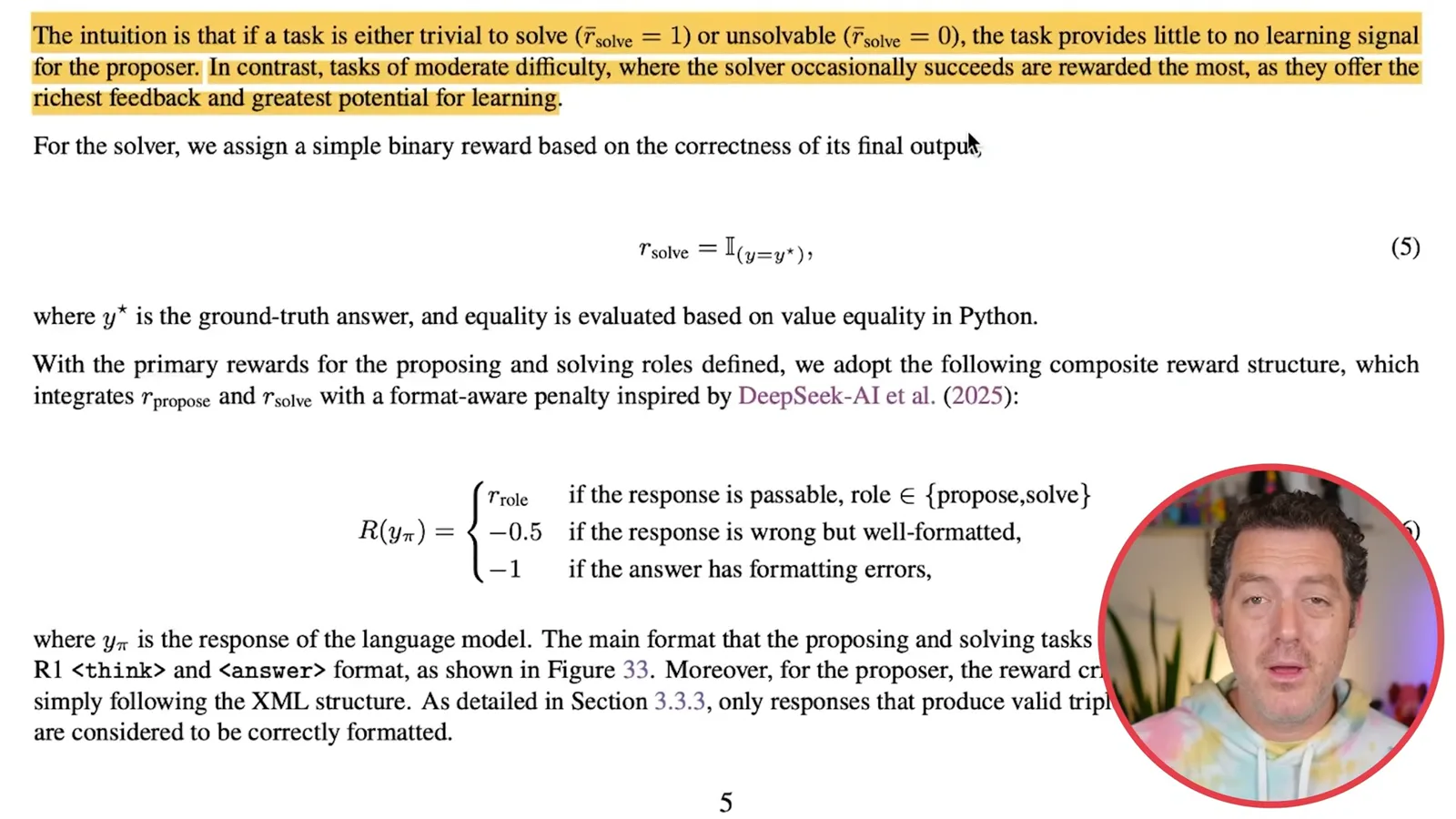
The learnability reward makes the intended curriculum concrete: if a problem is always solved or never solved, it offers little signal to the proposer. A problem that the solver occasionally gets right receives more reward. The solver itself receives a correctness signal based on the verified final output.
In the displayed Qwen2.5-7B comparison, AZR initialized from the coder model reaches 50.4 on the combined average. That number averages the coding benchmark average and the mathematics benchmark average; it is the best combined score among the models in that table, not a score across every available model. Several baselines use curated coding or math data.
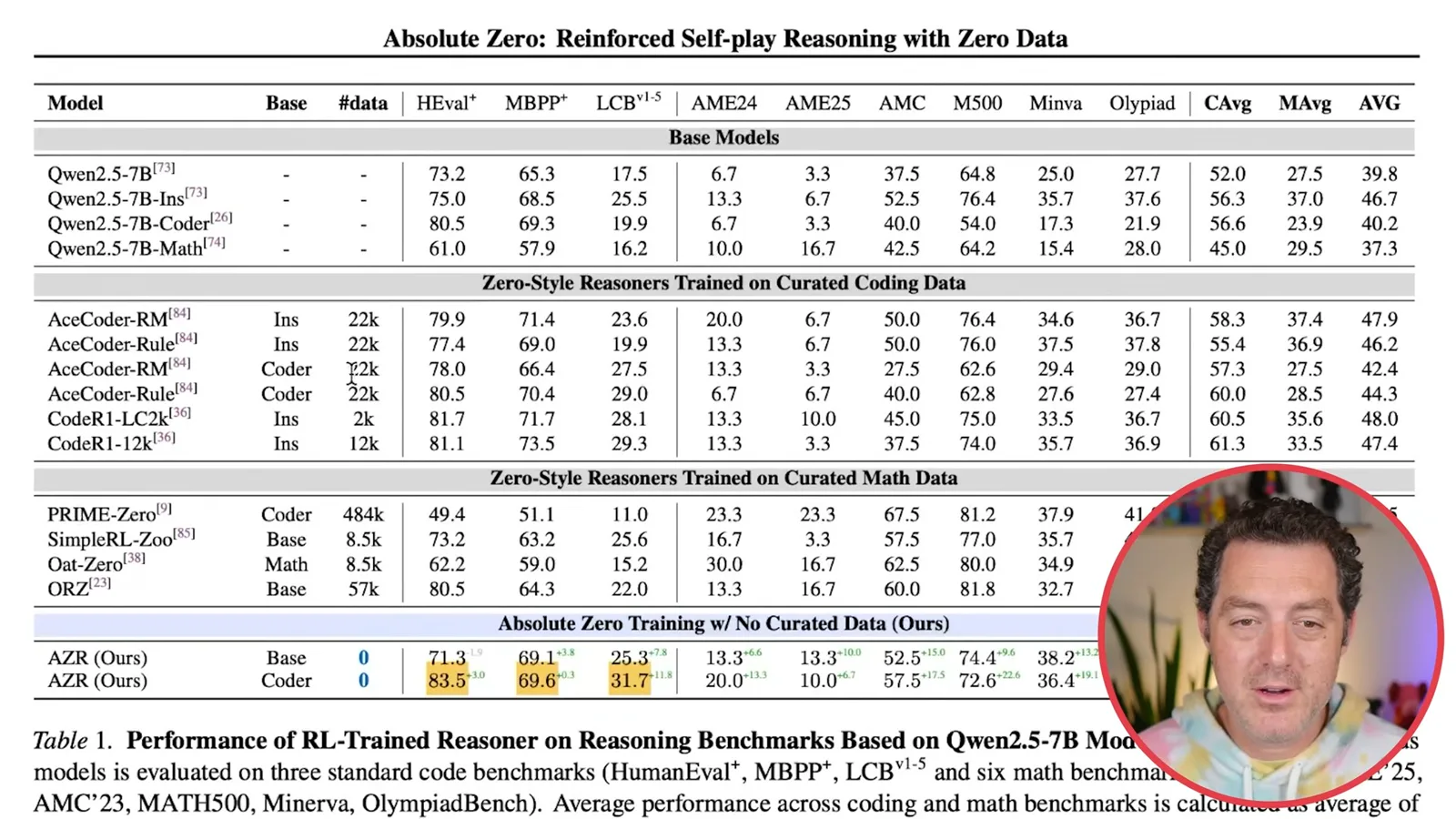
The paper reports that the coder starting model improved substantially in mathematics, despite starting below its corresponding base model on the reported math average. It also tested different model sizes and Llama as well as Qwen. The authors observed gains across these settings, with results varying by model and benchmark.
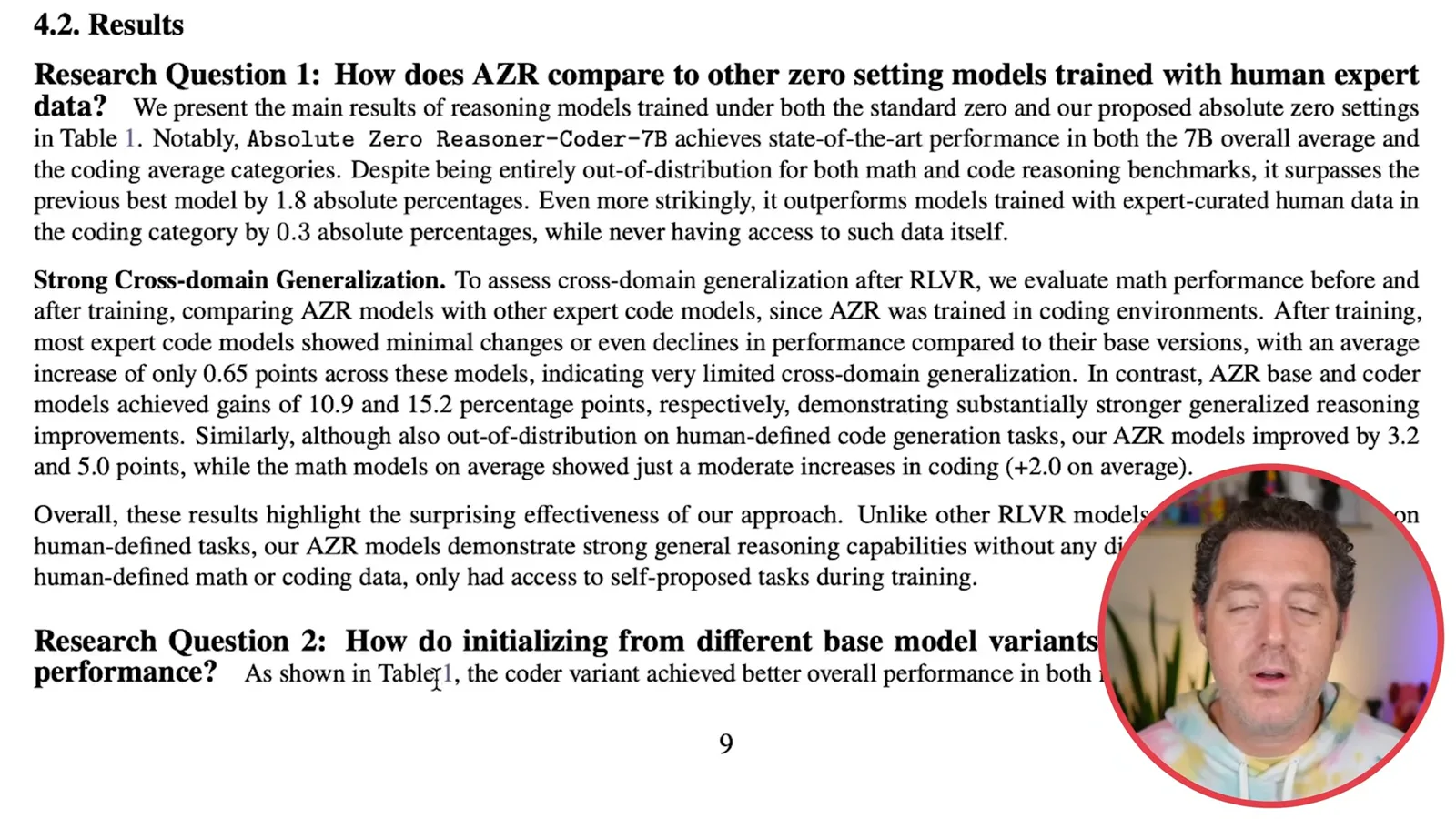
The researchers observed generated code comments used as plans, trial and error on difficult tasks, and longer reasoning in some cases. I see a lot of promise in the method because it reduces reliance on manually curated tasks during this stage. Whether it marks an inflection point or scales to much larger systems remains an open question.
Mehr aus diesem Kanal
 34:21EN
 Matthew Berman· 27. Okt. 2026Matthew Berman Examines Anthropic’s IPO Filing, AI Growth and GovernanceMatthew Berman, Sam Altman · Forward FutureThe presenter reviews the S-1’s financial metrics, compute strategy and voting structure while questioning the tension between rapid AI development and safety.
 0:36ENMatthew Berman· 25. Okt. 2026Kimi K3.1 and a Rubik’s Cube Solver DemonstrationMatthew Berman · Forward FutureMatthew Berman shows a scrambled virtual cube being solved and gives the Kimi K3.1 test a favorable assessment.
 25:50ENMatthew Berman· 24. Okt. 2026Kimi K3.1 Pro Tested: Strong 3D Demos, Uneven Results and Competitive PricingMatthew Berman · Forward FutureMatthew Berman tests the open-weight model on coding, 3D rendering and visual explanations, then compares benchmark results and prices.
 32:20ENMatthew Berman· 23. Okt. 2026Who Is Local AI For? The Costs, Trade-offs and a Hybrid FutureMatthew Berman · Forward FutureMatthew Berman weighs data control and independence against hardware cost, setup complexity and inference speed.
 1:03:37ENMatthew Berman· 23. Okt. 2026Matthew Berman’s Team Tests Kimi K3.1 on Animation, Games, and ChartsMatthew Berman, Alex, Brian · Forward FutureA live team AMA turns into an informal test of Kimi K3.1, from personal-agent workflows to motion graphics, a browser game, and a benchmark chart.
 0:53ENMatthew Berman· 22. Okt. 2026Sam Altman on AI and the Discovery of New KnowledgeSam Altman · OpenAIAltman expects progress in mathematical discovery to extend to biology, materials and energy.