In 30 Sekunden
In February 2024, Matthew Berman reviews OpenAI’s early Sora video-generation demonstrations, including a Minecraft-like scene. He explores ideas from Jim Fan and Nando de Freitas about whether video models can learn useful representations of physical behavior, and imagines dynamically generated games with synthetic audio. These are research interpretations and future possibilities. The videos do not establish a reliable physics engine, real-time playable worlds, a perfect simulation of reality, or proof of the simulation hypothesis.
- 1Video models as world simulatorsOpenAI’s research described scaled video generation as a promising path toward simulators. Berman sees broader implications, while a video example alone does not establish a faithful world model.
- 2The simulation hypothesisBerman explains the philosophical idea that experienced reality might be simulated. Neither Sora nor the demonstrations prove that hypothesis.
- 3A Minecraft-like videoSora generates imagery resembling a game and its interface. Berman’s proposal for a playable, dynamically generated game extends beyond the demo.
- 4Fan’s physics analogyJim Fan calls Sora a data-driven physics engine and speculates about synthetic training data. These are interpretations and hypotheses, not verified claims about Sora’s full capabilities or training set.
- 5Audio for generated scenesFan discusses how a future video-to-audio model might infer materials and interactions. The ElevenLabs example discussed is described as text prompted.
- 6A speculative universe estimateFan uses assumed model parameters for a thought experiment about simulation code size. The number does not measure the size or establish the existence of a simulated universe.
Das Wichtigste
- Sora’s early examples generated video resembling familiar scenes, including a Minecraft-like environment, but did not demonstrate a complete playable game.
- OpenAI described scaled video generation as a promising direction toward general-purpose physical-world simulators, not proof that it had built a perfect one.
- Jim Fan’s description of a data-driven physics engine is an interpretation of learned visual behavior; the clip does not demonstrate consistently correct physics.
- The use of Unreal Engine synthetic training data was Fan’s speculation, not a confirmed detail in the video.
- Combining generated visuals, language-model logic, and audio into interactive games is Berman’s future-oriented proposal.
- A hypothetical file-size estimate and generated imagery do not prove that reality is simulated.
Den bearbeiteten Text nach Kapiteln lesen
Sora and simulated worlds
Berman introduces Sora through a Minecraft-like video and outlines its early results. He contrasts generated video with conventional rendering and discusses OpenAI’s world-simulator framing.
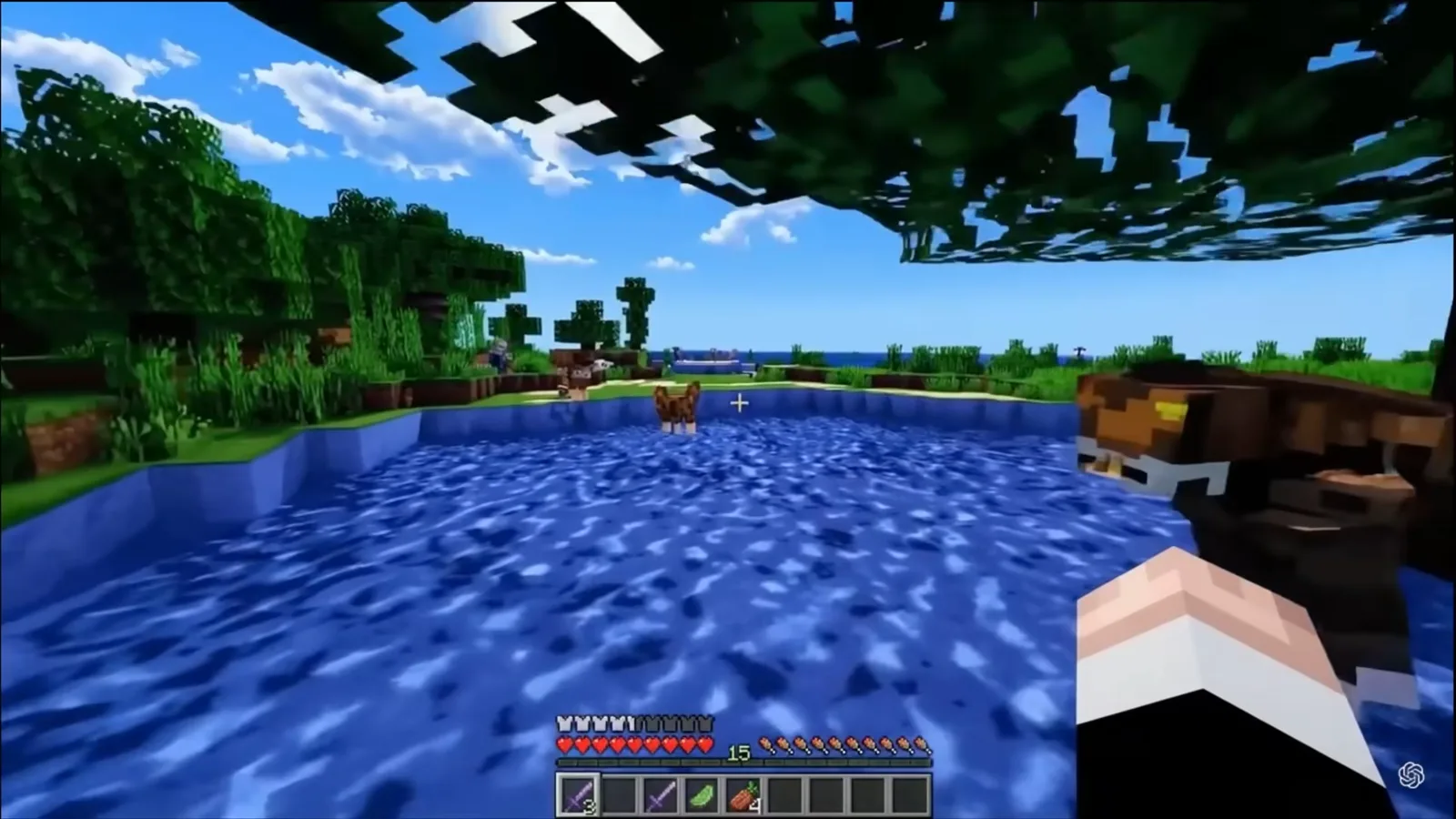
The Minecraft-like scene on screen is presented as a video generated by OpenAI’s Sora, not a recording of a playable Minecraft session. I find it remarkable that a video model can produce this kind of scene, and I want to explore what that might mean for games and world simulation. The further idea that our own reality is simulated is a philosophical hypothesis, not something this video proves.
OpenAI had just introduced Sora and shared early examples when I recorded this in February 2024. The visual consistency is striking to me, and I think the technology could eventually change games. My suggestion that OpenAI may already have more advanced undisclosed systems is speculation; the public examples do not establish what those systems can do.
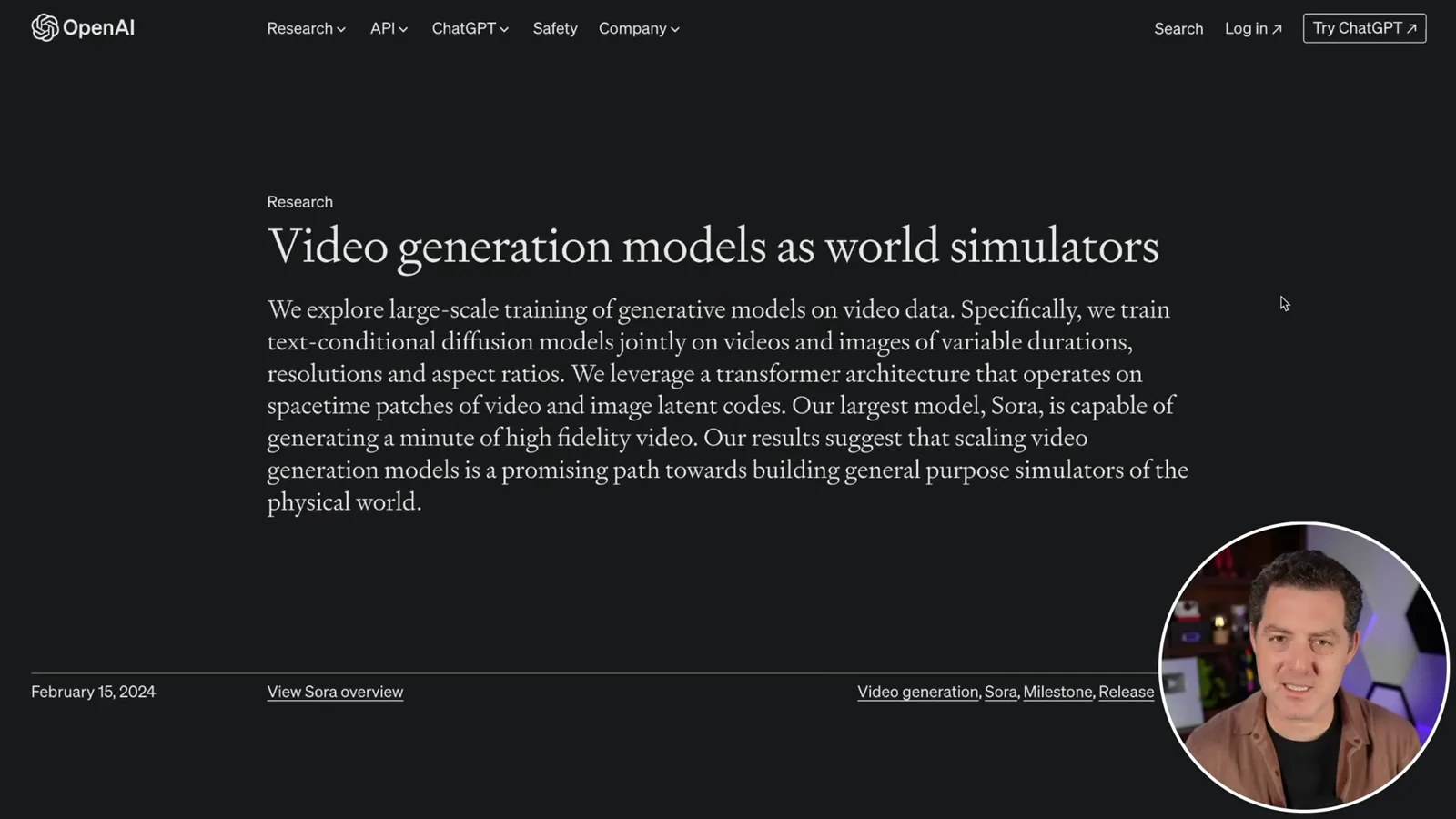
OpenAI titled its research discussion “Video generation models as world simulators” and described scaled video generation as a promising path toward general-purpose physical-world simulators. I contrast this with conventional game engines, which render scenes using modeled objects, lighting, and other calculations. That framing is a research direction, not a demonstration that the generated scene obeys all physical laws.
I suggest that Sora’s learned approach may generate an entire scene differently from a conventional graphics pipeline and may eventually be less costly. The video supplies no cost or latency comparison, so that economic claim is unverified. Similarly, a convincing instance of an object disappearing behind another does not establish perfect object permanence or universally correct motion.
The simulation hypothesis and games
He explains simulation theory and imagines games generated and changed dynamically in real time. The examples shown are videos and do not demonstrate that future workflow.
The simulation hypothesis proposes that the world we experience might itself be a simulated reality, with humans as part of that simulation. I enjoy thinking about whether a sufficiently detailed simulated world would be distinguishable from reality, and I mention the series Devs as a related piece of fiction. Better video generation does not show that such a complete simulation is possible, much less that we live in one.
Today’s game graphics can approximate environments but still differ from reality. I imagine a different approach using diffusion and transformer-based video generation instead of explicitly specifying every visual detail. Sora produces generated video; the presentation does not establish that it calculates an entire physically accurate world at once.
The Minecraft-like example includes the appearance of a game interface as well as scenery. I imagine pairing a visual generator with a language model that knows game rules, so someone could describe a game and play it without writing every rule by hand. The clip is generated footage, however, and does not demonstrate real-time control, persistent state, or a playable Minecraft implementation.
I find the early visual results impressive, even though the model was still at an early stage. A generated-looking world is a different way to think about building games, but it should not be assumed to implement accurate game physics or reliably maintain all objects. How the model arrives at each apparent detail is not directly established by looking at its output.
A video of a vehicle traveling through mountains suggests another game concept to me. Rather than using a fixed pre-rendered environment, a future system might generate scenery as the player moves. It might even change mountains to a swamp or switch the rules of gravity in response to a request. These are imagined capabilities, not features demonstrated by the Sora clip.
I also recall an experiment with 25 AI agents in a simulated environment, where agents formed routines and relationships. Combining an approach like that with generated visuals could produce more responsive non-player characters. My description of them as effectively alive expresses a possibility I am excited about, not evidence that such agents are living or conscious.
Jim Fan’s interpretation of Sora
Berman reads Fan’s account of a learned physics engine and analyzes a pirate-ship video. Fan’s suggestion about synthetic Unreal Engine data remains speculation.
NVIDIA researcher Jim Fan describes Sora as a “data-driven physics engine”: in his interpretation, training a video model may let it learn visual rendering, intuitive physical regularities, and semantic context. This is a useful way to think about the examples, but a realistic video does not prove that the model consistently reasons over or simulates physics correctly.
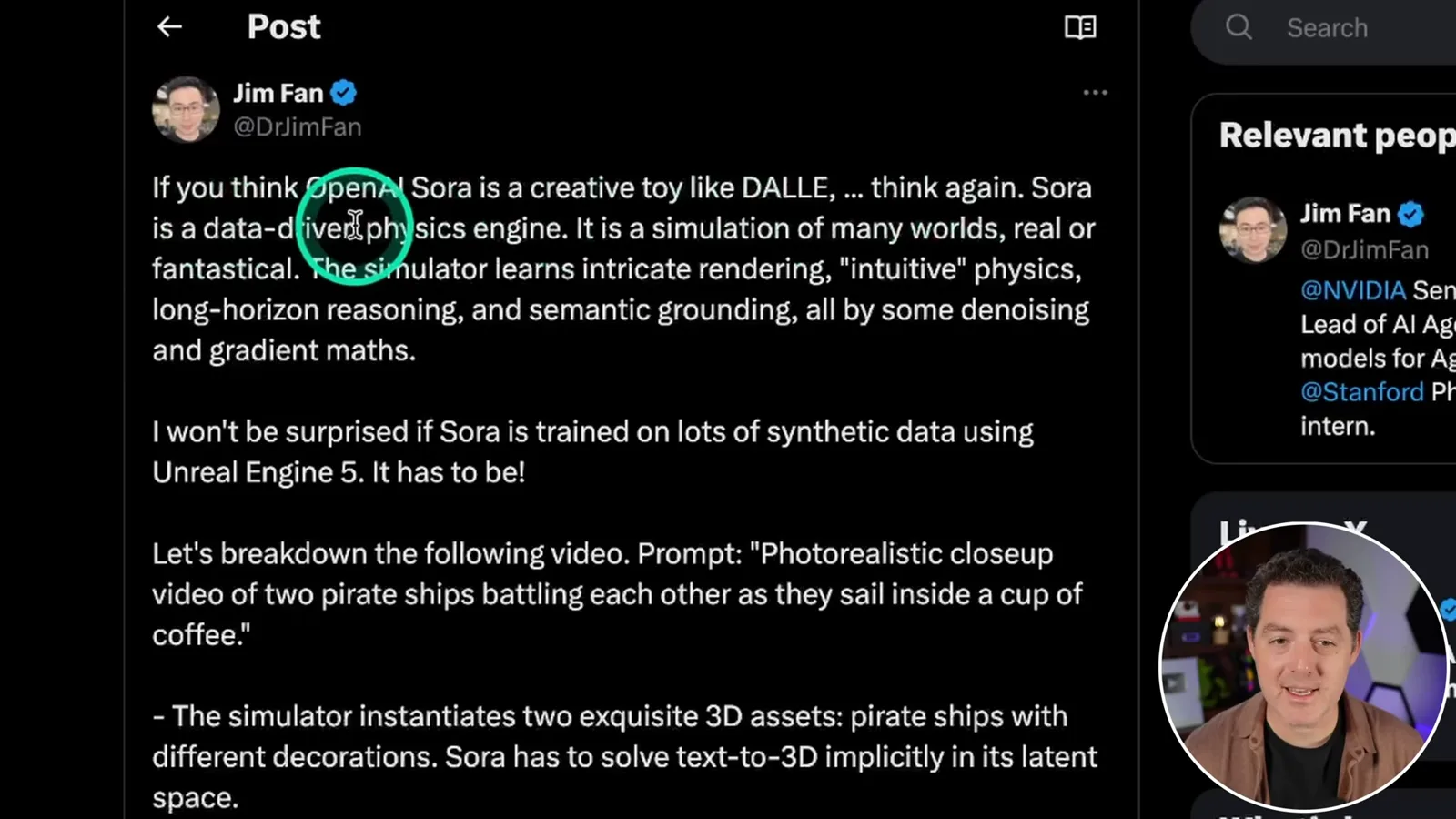
Fan speculates that synthetic videos produced with Unreal Engine 5 might have been included in Sora’s training data. That possibility is not confirmation that they were used. I wonder whether learned video generation could someday replace parts of traditional game production, though the video does not establish that it is cheaper or more efficient.

Fan analyzes a generated scene of two pirate ships sailing inside a cup of coffee. He points to the ships’ distinct appearances, their motion, the coffee and foam, and a miniature photographic look. These features support a discussion of plausible visual behavior; they do not establish explicit 3D assets or a validated fluid simulation inside the model.
In a follow-up, Fan explains that he means an end-to-end diffusion transformer conditioned on text or images that generates video, with regularities learned in the model’s parameters. He says Unreal Engine need not run during generation and suggests its synthetic data might have been used for training. That remains a hypothesis about the training set.
Synthetic audio and learned physical cues
ElevenLabs audio is paired with Sora examples. Fan considers what a more fully video-conditioned audio model might need to infer.
ElevenLabs later paired synthetic audio with Sora examples, including sound effects and a narrated scene. I can imagine a future system combining generated visuals, game logic, and audio. The examples demonstrate a combination of media, not a complete interactive world simulation.
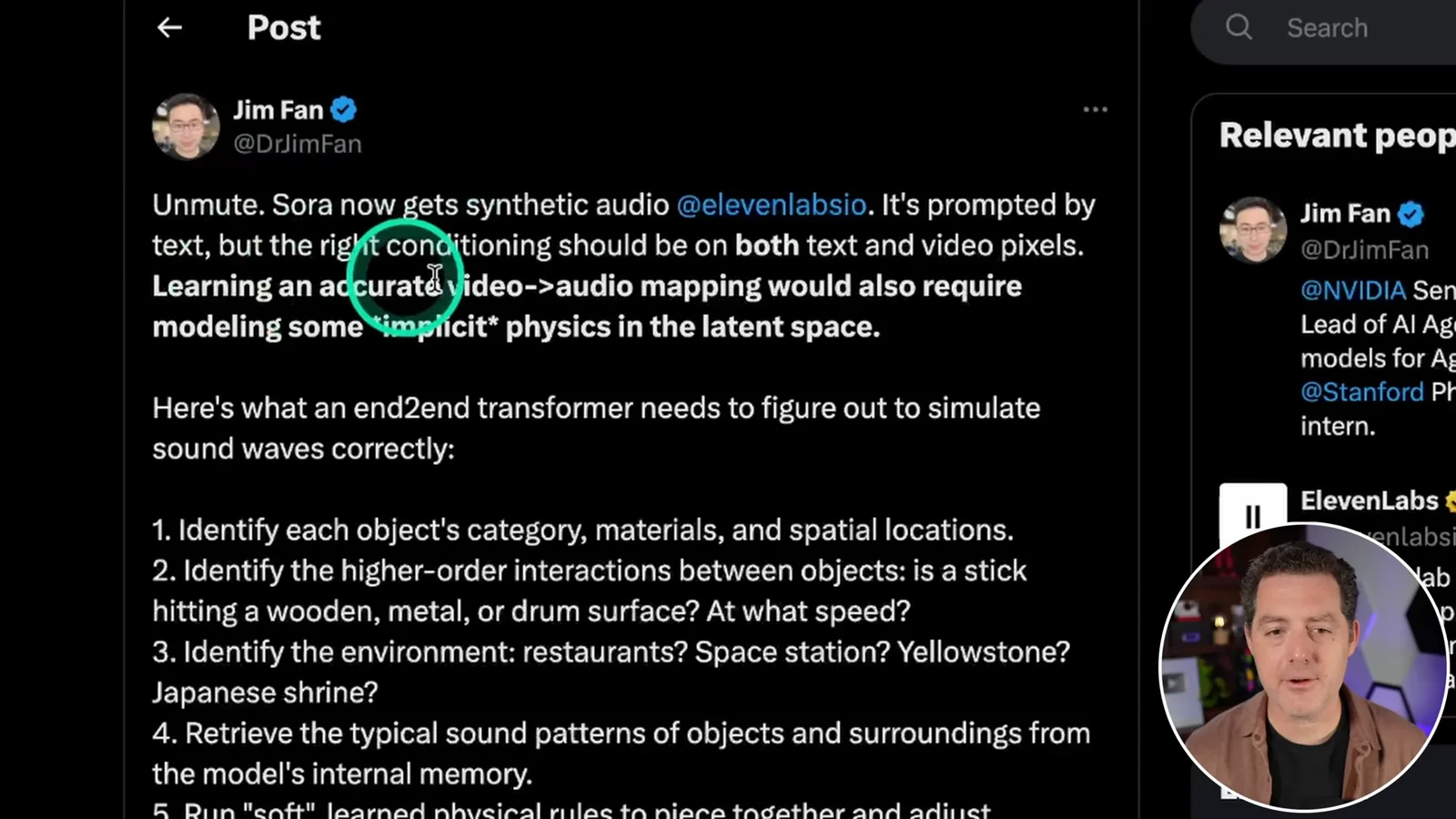
Fan notes that the audio example is text-prompted and proposes that an accurate video-to-audio system should also be conditioned on visual information. In his account, it might need to infer object categories, materials, positions, interactions, and the surrounding environment: a stick striking wood, metal, or a drum should sound different.
He imagines the model combining learned sound patterns, adjusting them for the scene, or synthesizing new ones, and layering sounds in a busy environment. He presents these as capabilities an end-to-end model might learn, not as a list of independently verified modules in the ElevenLabs demonstration.
A speculative simulation and its size
Berman discusses Fan’s hypothetical size calculation and Kolmogorov complexity. He closes with Nando de Freitas’s views and his own hopes for dynamic games.
Fan then offers a thought experiment about a hypothetical simulation of reality. Starting with Meta’s 6-billion-parameter Emu Video, he assumes a model ten times larger and 16-bit weights, arriving at a rough figure of 111 GB for the hypothetical binary. The assumed model size is not an established Sora specification, and the calculation is not a measurement of the information or compute needed to simulate the universe.
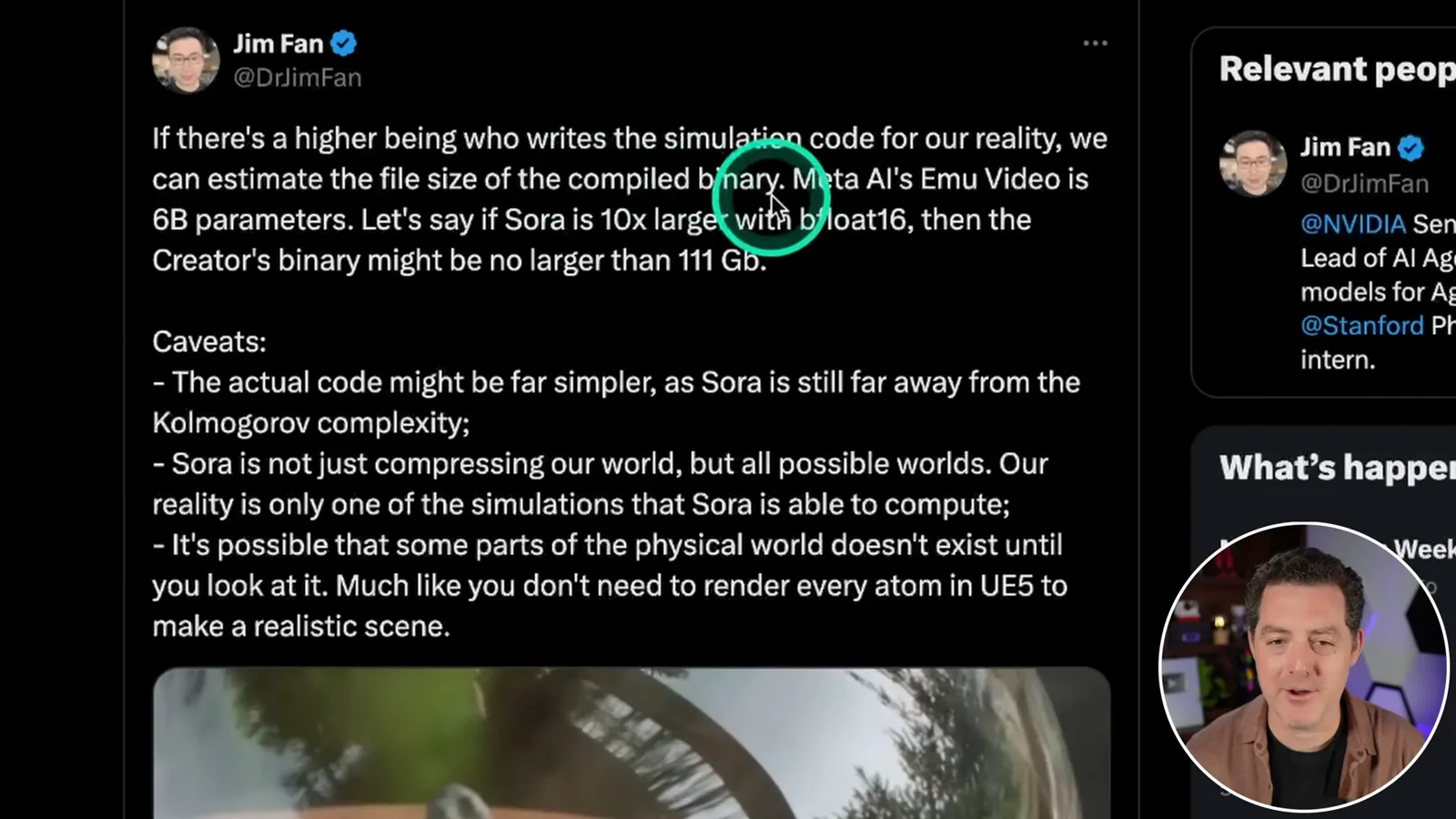
Fan adds caveats, including the idea that a shortest description might be simpler, and invokes Kolmogorov complexity: the length of a shortest program that produces a given object under a chosen framework. He also speculates that unobserved parts of a world might not need to be rendered. These are analogies and conjectures; the video does not establish that physical reality is generated this way.
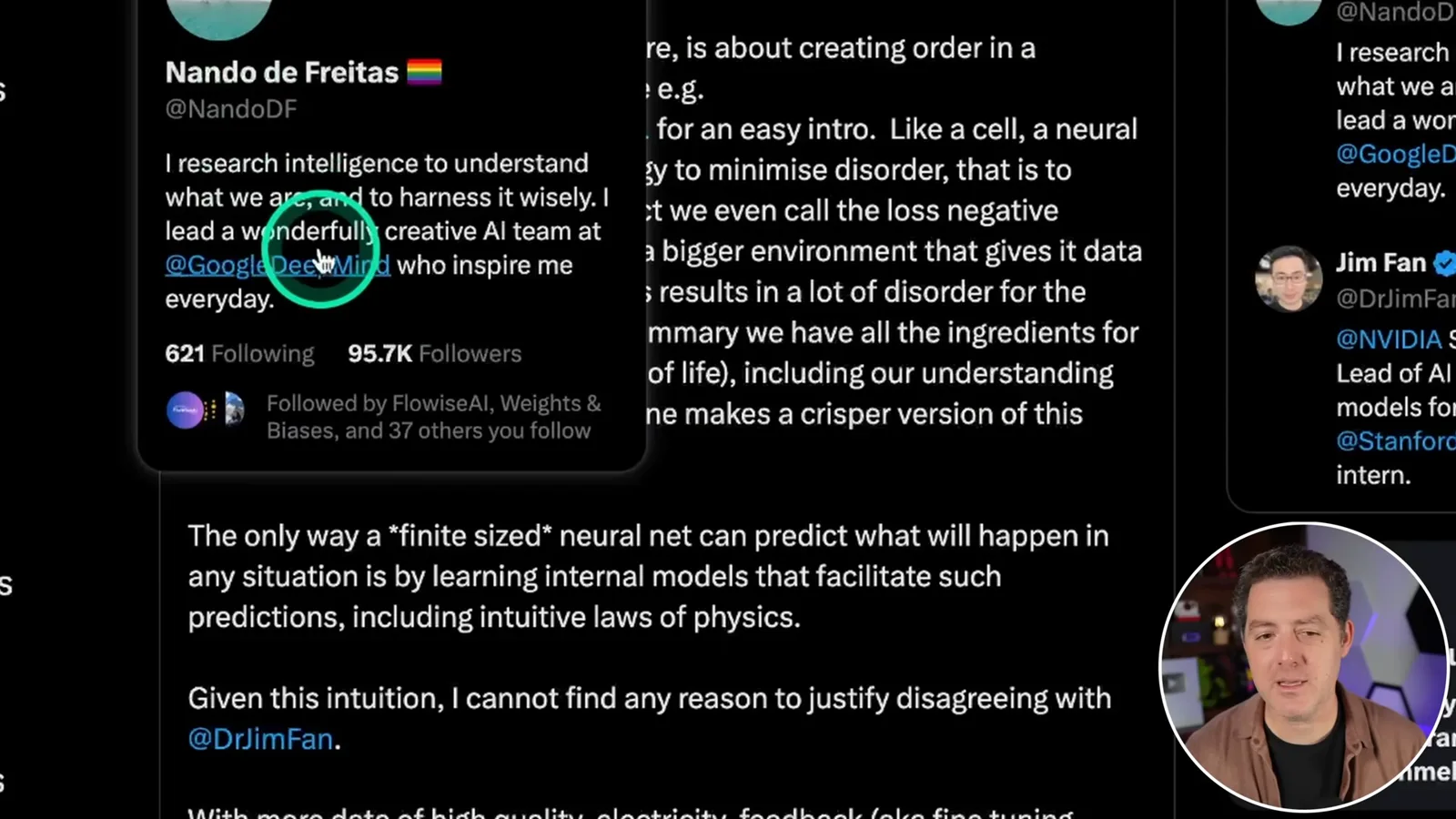
Nando de Freitas argues that a finite neural network predicting events must learn internal models that aid prediction, including intuitive physical rules, and says he agrees with Fan’s broad intuition. He anticipates that better data, feedback, and training may lead to stronger physical reasoning. I am excited about the prospect of games that adapt to what a player describes, while recognizing that the demonstrations shown do not yet prove that future.
Mehr aus diesem Kanal
 34:21EN
 Matthew Berman· 27. Okt. 2026Matthew Berman Examines Anthropic’s IPO Filing, AI Growth and GovernanceMatthew Berman, Sam Altman · Forward FutureThe presenter reviews the S-1’s financial metrics, compute strategy and voting structure while questioning the tension between rapid AI development and safety.
 25:50ENMatthew Berman· 24. Okt. 2026Kimi K3.1 Pro Tested: Strong 3D Demos, Uneven Results and Competitive PricingMatthew Berman · Forward FutureMatthew Berman tests the open-weight model on coding, 3D rendering and visual explanations, then compares benchmark results and prices.
 32:20ENMatthew Berman· 23. Okt. 2026Who Is Local AI For? The Costs, Trade-offs and a Hybrid FutureMatthew Berman · Forward FutureMatthew Berman weighs data control and independence against hardware cost, setup complexity and inference speed.
 1:03:37ENMatthew Berman· 23. Okt. 2026Matthew Berman’s Team Tests Kimi K3.1 on Animation, Games, and ChartsMatthew Berman, Alex, Brian · Forward FutureA live team AMA turns into an informal test of Kimi K3.1, from personal-agent workflows to motion graphics, a browser game, and a benchmark chart.
 0:53ENMatthew Berman· 22. Okt. 2026Sam Altman on AI and the Discovery of New KnowledgeSam Altman · OpenAIAltman expects progress in mathematical discovery to extend to biology, materials and energy.
 0:22ENMatthew Berman· 21. Okt. 2026A Robot Bodyguard Video Shows Dramatic Rescue ScenariosMatthew Berman · Forward FutureMatthew Berman reacts to a short robot demonstration depicting fighting and vehicle-rescue scenarios.