In 30 Sekunden
In February 2025, Matthew Berman discusses a llama.cpp contribution whose author credited DeepSeek R1 with most of its code, and R1-V, a low-cost visual counting experiment. He sees them as signs of rapid AI progress and speculates about an intelligence explosion, while the demonstrated results concern specific tasks rather than autonomous, general self-improvement.
- 1A targeted speedupA llama.cpp pull request reports faster WebAssembly SIMD dot products, with most code attributed to DeepSeek R1.
- 2Human-guided iterationThe developer wrote prompts and tests, supplied failed attempts and iterated with the model.
- 3A possible takeoffBerman speculates that automated research could lead to rapid improvement, while noting a competing gradualist view.
- 4R1-V countingLiang Chen describes reinforcement learning with verifiable rewards for a vision-language counting task.
- 5A narrow comparisonThe displayed evaluation reports 99% for a trained 2B model versus 94% for a 72B model on the specified counting evaluation.
Das Wichtigste
- A developer reported using DeepSeek R1 to write most of a llama.cpp optimization while providing prompts and tests.
- The reported twofold speedup concerns particular WebAssembly SIMD operations, not all DeepSeek inference.
- Berman sees recursive improvement and a possible intelligence explosion as imminent; these are his interpretations and predictions.
- R1-V researchers reported improving a 2B vision-language model on a specific counting evaluation with 100 reinforcement-learning steps costing under $3.
- Verifiable rewards can provide an automatic signal for tasks with checkable answers, but the counting result does not establish general model superiority.
Den bearbeiteten Text nach Kapiteln lesen
Self-improvement and the speed claim
Berman introduces his interpretation of AI progress and two examples. The first is a reported optimization of particular inference code.
I see a recent DeepSeek R1 coding example as a sign of self-improving AI. In my view, systems able to contribute to AI research could eventually drive recursive improvement and an intelligence explosion. That is a prediction about the future; the example I show involved a developer directing and testing a specific code change.
I think models such as o1, o3 and DeepSeek R1 are approaching a level where they can contribute to new knowledge. I also want to show a separate team’s experiment that elicited a reasoning-like “aha moment” on a narrow task for less than $3, following a separate $30 example I discussed earlier.
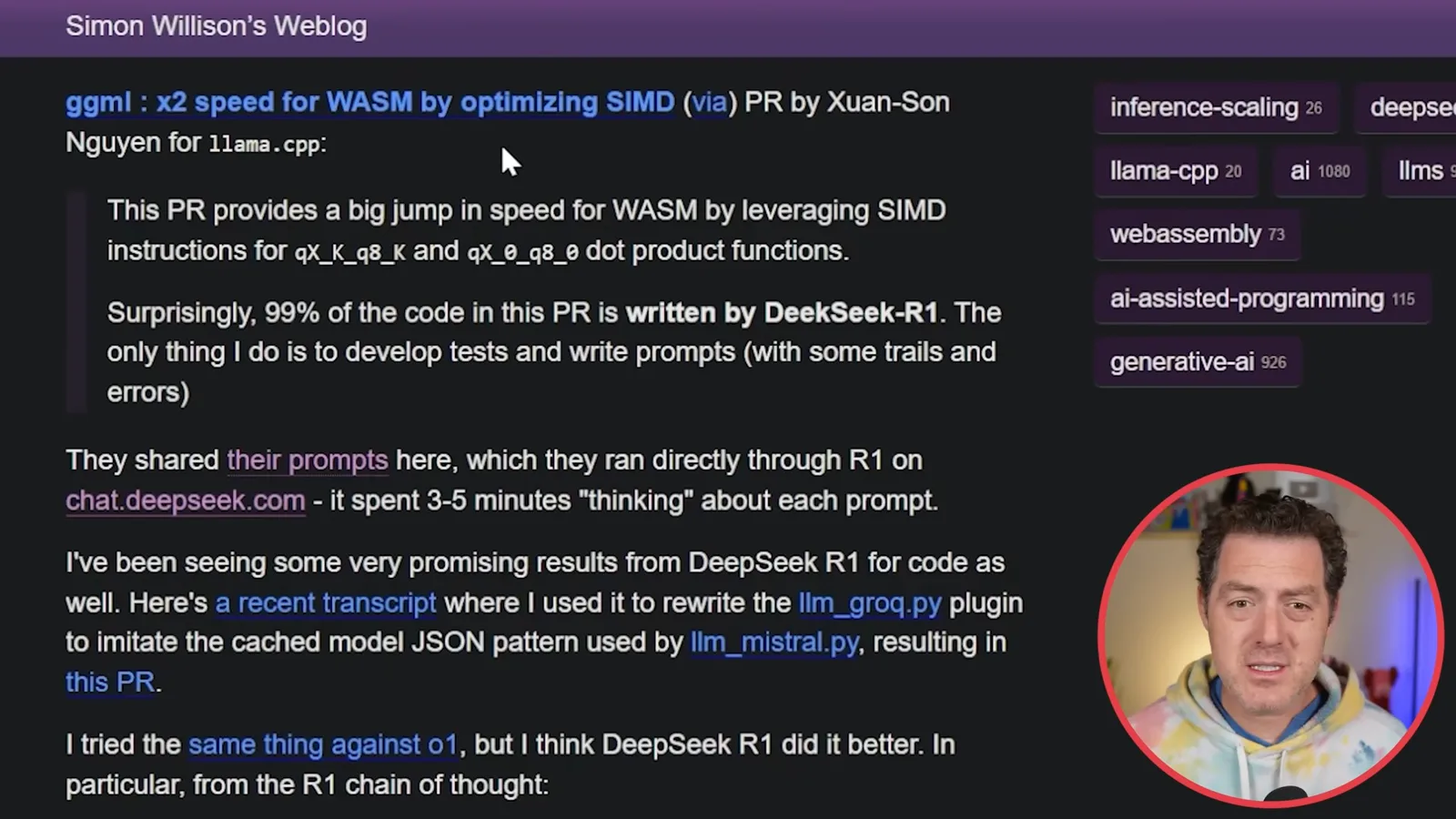
Simon Willison’s blog highlights a llama.cpp pull request by Xuan-Son Nguyen reporting a roughly twofold speed improvement for particular WebAssembly dot-product functions using SIMD. Nguyen said DeepSeek R1 wrote 99% of the code, while he developed tests and wrote prompts through trial and error. This is a change to inference software, not a demonstration that the model autonomously changed its own weights.
Willison also describes using R1 to rewrite an llm_groq.py plugin to follow a cached-model JSON pattern in llm_mistral.py. He says he tried the same task with o1 and thought R1 did better. It is an individual programming experience rather than a broad benchmark comparison.
The developer used the free chat.deepseek.com interface, with responses reportedly taking around three to five minutes. The iterative prompt described the problem and included the last failed attempt, asking the model to improve it. One example asks for a conversion from C++ ARM NEON SIMD to WebAssembly SIMD, with existing code supplied as context.
Prompts, tests and speculation
He shows the human-guided coding workflow and another programming example. He then discusses different expectations for an AI takeoff.
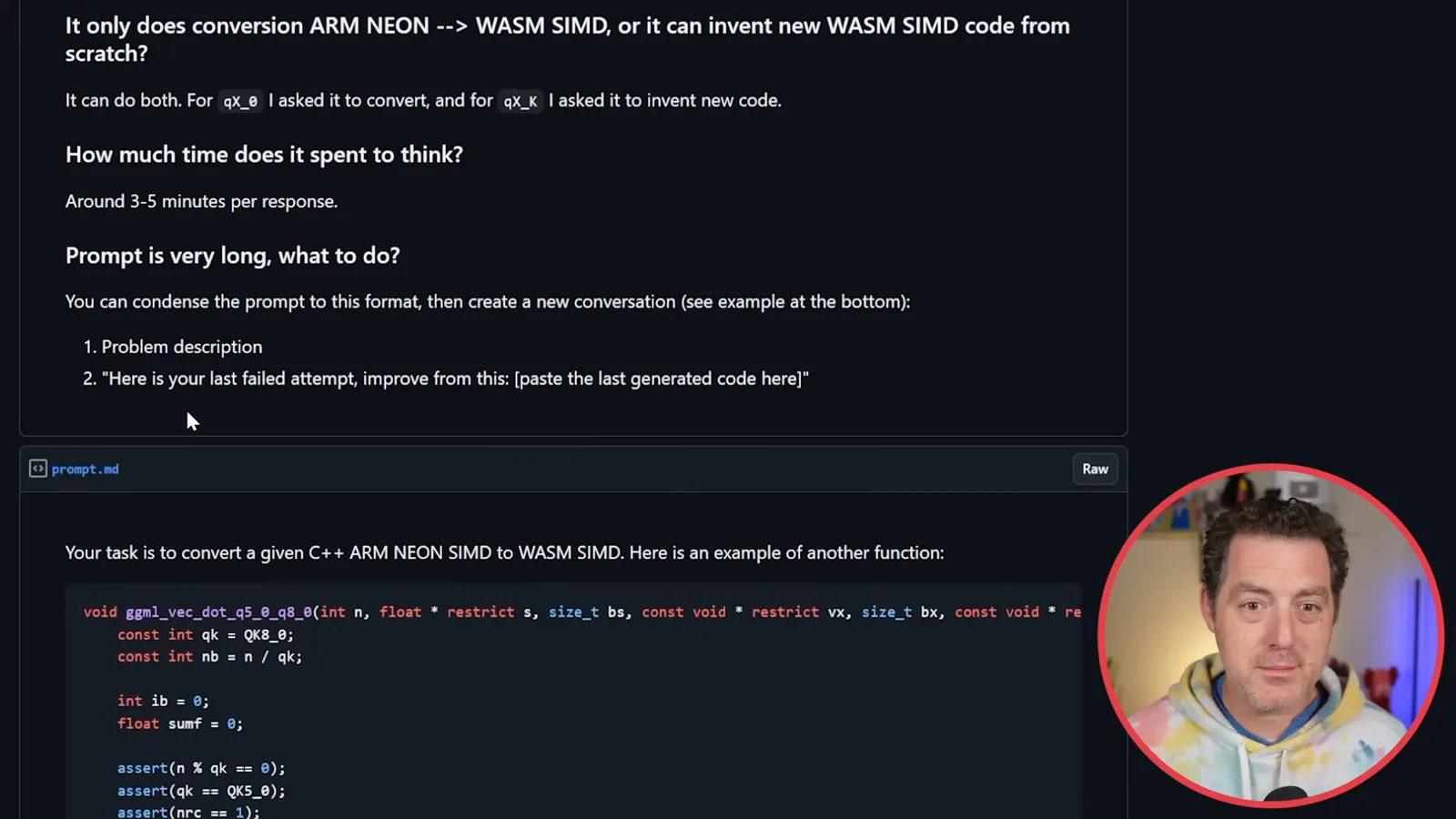
The prompts let the model look for code optimizations, and another example shows it working through how to apply a pattern from the Mistral plugin to Groq. I find this striking and imagine many agents continually searching for improvements. That imagined autonomous process goes beyond the human-guided examples shown here.
I return to an intelligence-explosion chart and argue that automated AI research could put us close to superintelligence. I am conflicted about whether progress would be a sudden takeoff or more gradual. Yann LeCun, for example, argues that AGI will emerge progressively and be reproduced by others relatively quickly once it appears.
I think open-source releases can accelerate the spread of advances, and I regard DeepSeek R1 as an important example. I also cite Sam Altman saying in a Reddit AMA that R1 is a very good model and that OpenAI would produce better models but maintain a smaller lead than in previous years.
Low-cost visual reinforcement learning
Berman introduces R1-V and explains rewards that can be verified against an answer. He discusses the reported counting result and possible future uses.
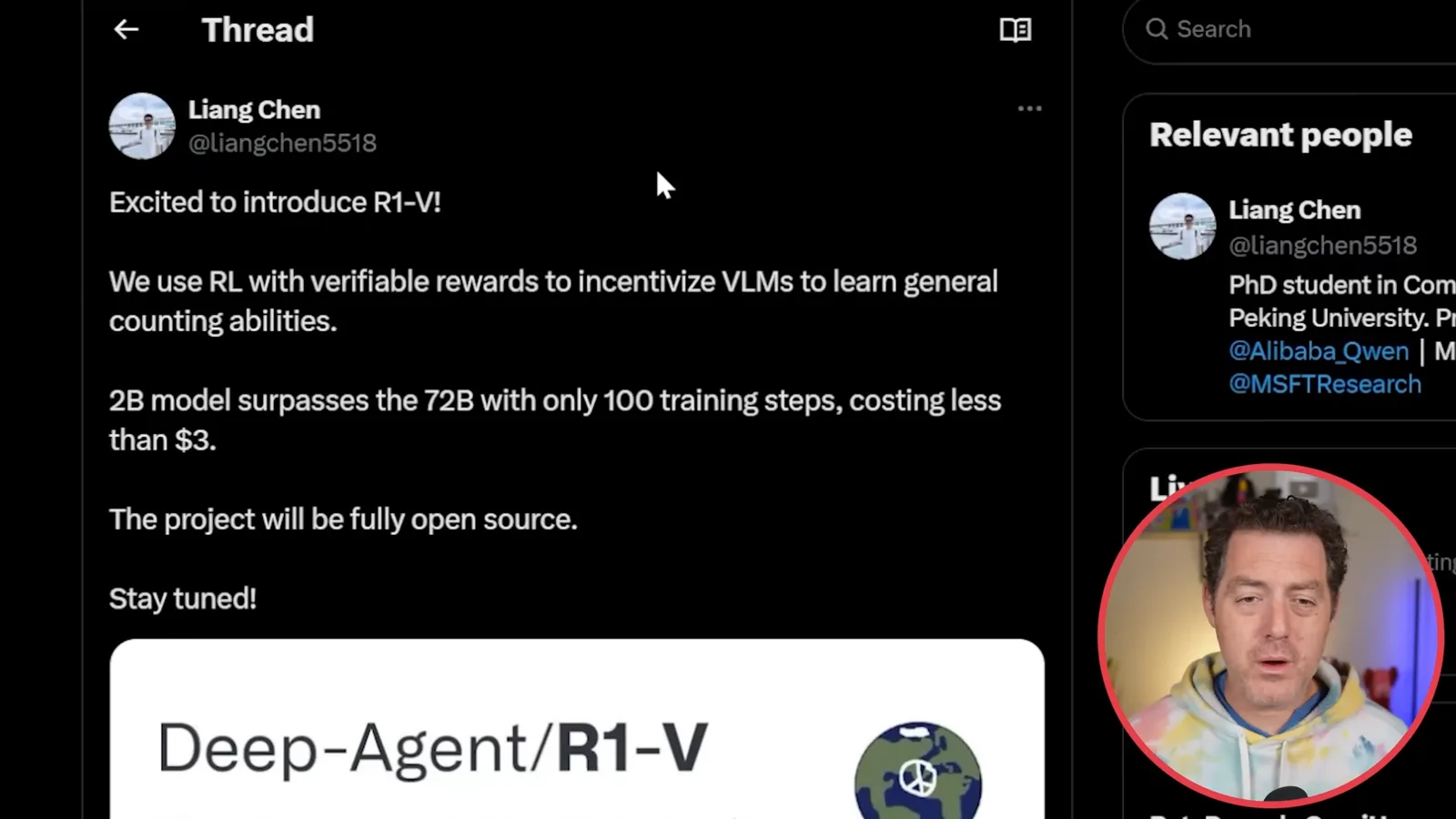
The second example is R1-V, introduced by Liang Chen. The team uses reinforcement learning with verifiable rewards to encourage vision-language models to learn counting. I compare it with the earlier $30 narrow experiment and DeepSeek R1’s approach, while the specific task and setup here are different.
A verifiable reward gives training a way to check an answer: arithmetic has a definite answer, whereas a favorite color is a matter of opinion. I argue this makes the technique especially appealing for well-defined problems in science, technology, engineering and mathematics. The example is about tasks with checkable rewards, not a claim that reinforcement learning cannot be used elsewhere.
Chen reports that a 2-billion-parameter model surpassed a 72-billion-parameter model on the counting task after 100 training steps costing less than $3. This is a narrow comparison, not evidence that the smaller model is generally better. I speculate that many small, specialized models could someday be selected by a router in response to a user’s request.
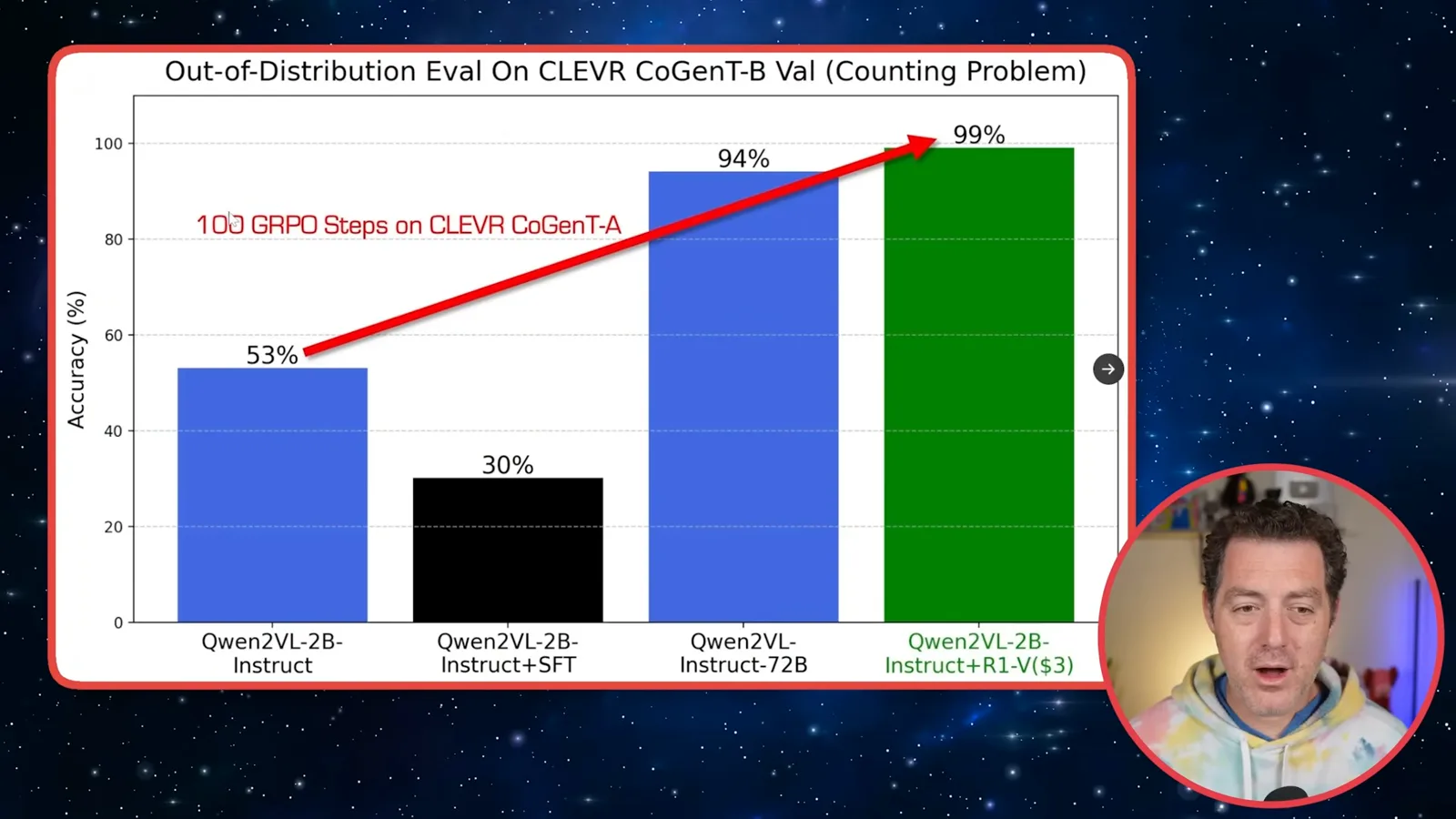
The displayed out-of-distribution evaluation on CLEVR CoGenT-B counting reports 53% for the original Qwen2-VL 2B model and 99% after R1-V training, compared with 94% for Qwen2-VL 72B. The chart also shows 30% for a supervised fine-tuning variant. These figures describe the shown evaluation and its particular training setup.
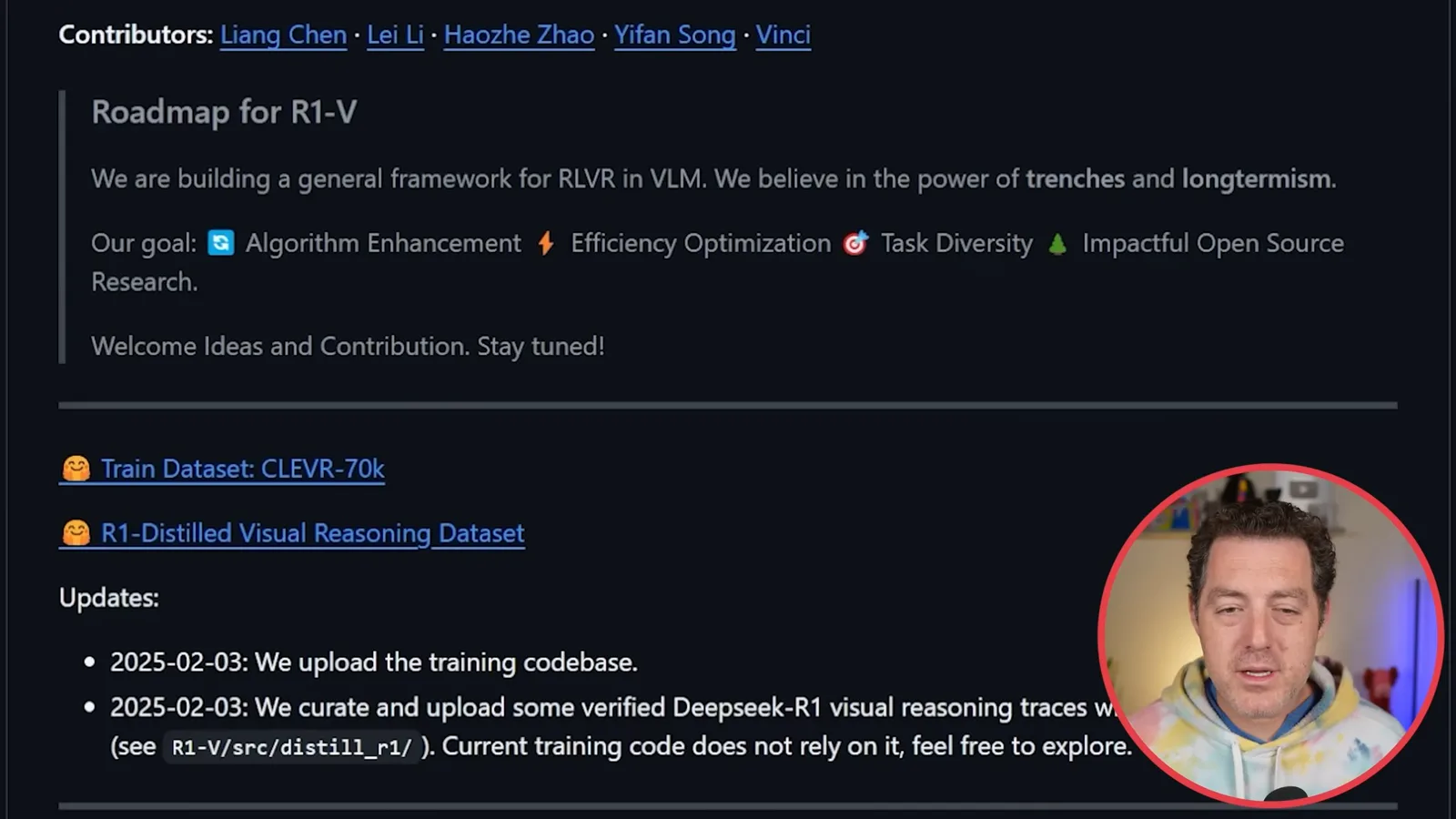
The R1-V team describes a goal of building a general framework for reinforcement learning with verifiable rewards in vision-language models. I imagine applying such tools to other tasks where rewards can be checked, and see the community’s ability to reproduce and extend ideas as a strength of open source.
Mehr aus diesem Kanal
 34:21EN
 Matthew Berman· 27. Okt. 2026Matthew Berman Examines Anthropic’s IPO Filing, AI Growth and GovernanceMatthew Berman, Sam Altman · Forward FutureThe presenter reviews the S-1’s financial metrics, compute strategy and voting structure while questioning the tension between rapid AI development and safety.
 0:26ENMatthew Berman· 25. Okt. 2026Sam Altman on Human Values and Problem-Solving in an AI WorldSam Altman · OpenAIIn a short interview excerpt, Altman considers the enjoyment of solving hard problems and the human role in interpreting results.
 0:36ENMatthew Berman· 25. Okt. 2026Kimi K3.1 and a Rubik’s Cube Solver DemonstrationMatthew Berman · Forward FutureMatthew Berman shows a scrambled virtual cube being solved and gives the Kimi K3.1 test a favorable assessment.
 0:21ENMatthew Berman· 24. Okt. 2026An AI-Generated Kimi Benchmark Chart Used Invented ScoresMatthew Berman · Forward FutureMatthew Berman asks for a graph of Kimi K3.1 Pro benchmarks, then discovers that the displayed figures are illustrative placeholders.
 25:50ENMatthew Berman· 24. Okt. 2026Kimi K3.1 Pro Tested: Strong 3D Demos, Uneven Results and Competitive PricingMatthew Berman · Forward FutureMatthew Berman tests the open-weight model on coding, 3D rendering and visual explanations, then compares benchmark results and prices.
 32:20ENMatthew Berman· 23. Okt. 2026Who Is Local AI For? The Costs, Trade-offs and a Hybrid FutureMatthew Berman · Forward FutureMatthew Berman weighs data control and independence against hardware cost, setup complexity and inference speed.