In 30 Sekunden
Faster code generation can move the bottleneck to requirements, review, release or compliance rather than accelerate delivery end to end. McKinsey’s Martin Harrysson and colleagues say some clients are reorganizing into smaller pods, shortening agent-assisted cycles and documenting business context. They also warn that quality can suffer as output rises and that many organizations still struggle to measure real impact. Harrysson reports that the strongest 20–25% in a client survey were beginning to see roughly twofold end-to-end gains.
- 1Some clients report much larger gains than the enterprise averageHarrysson says the top 20–25% in a survey of several hundred clients and enterprises were beginning to see around 2x end-to-end improvements.
- 2Short agent-assisted loops require explicit review boundariesDixit describes one- or two-day workflows and decisions about where a person validates the output.
- 3Smaller pods can mean more teams, not necessarily fewer peopleSome clients are moving toward two- to four-person teams with broader responsibilities.
- 4More generated code can coincide with deteriorating qualityThe speakers cite increases in bugs and incidents and recommend emphasizing review and curated examples.
- 5Faster build and test can move the bottleneck elsewhereRequirements, release, risk and compliance may become the limiting steps.
- 6Many organizations still lack confidence in impact measurementHarrysson says clients are combining established engineering measures with experiments to assess the value of work.
Das Wichtigste
- Map the full delivery workflow: faster building can expose bottlenecks in requirements, release and parallel governance.
- Define human review points and adjust them as confidence in a workflow grows.
- Document domain knowledge and curate strong examples and policies for agents.
- Invest in reviewing generated code and measure quality as well as speed.
- Treat reported productivity gains as context for investigation; choose outcome measures suited to the organization.
Den bearbeiteten Text nach Kapiteln lesen
Why enterprise AI coding results differ
Harrysson describes a gap between expectations and results, and reports stronger outcomes among some surveyed clients.
Martin Harrysson, Prakhar Dixit and their colleague Shilpa describe patterns they say they have observed while advising large organizations on AI in software development. Their focus is the way people and operating models change.
Harrysson says expectations initially outpaced results: many large companies reported modest improvements despite widespread AI use. In a later survey of several hundred clients and large enterprises, he says the top 20–25% were beginning to see much larger end-to-end gains, around twofold.
The speakers organize their observations around four areas: redesigning the development workflow, changing team structure and roles, building a suitable technology and context layer, and managing organizational change.
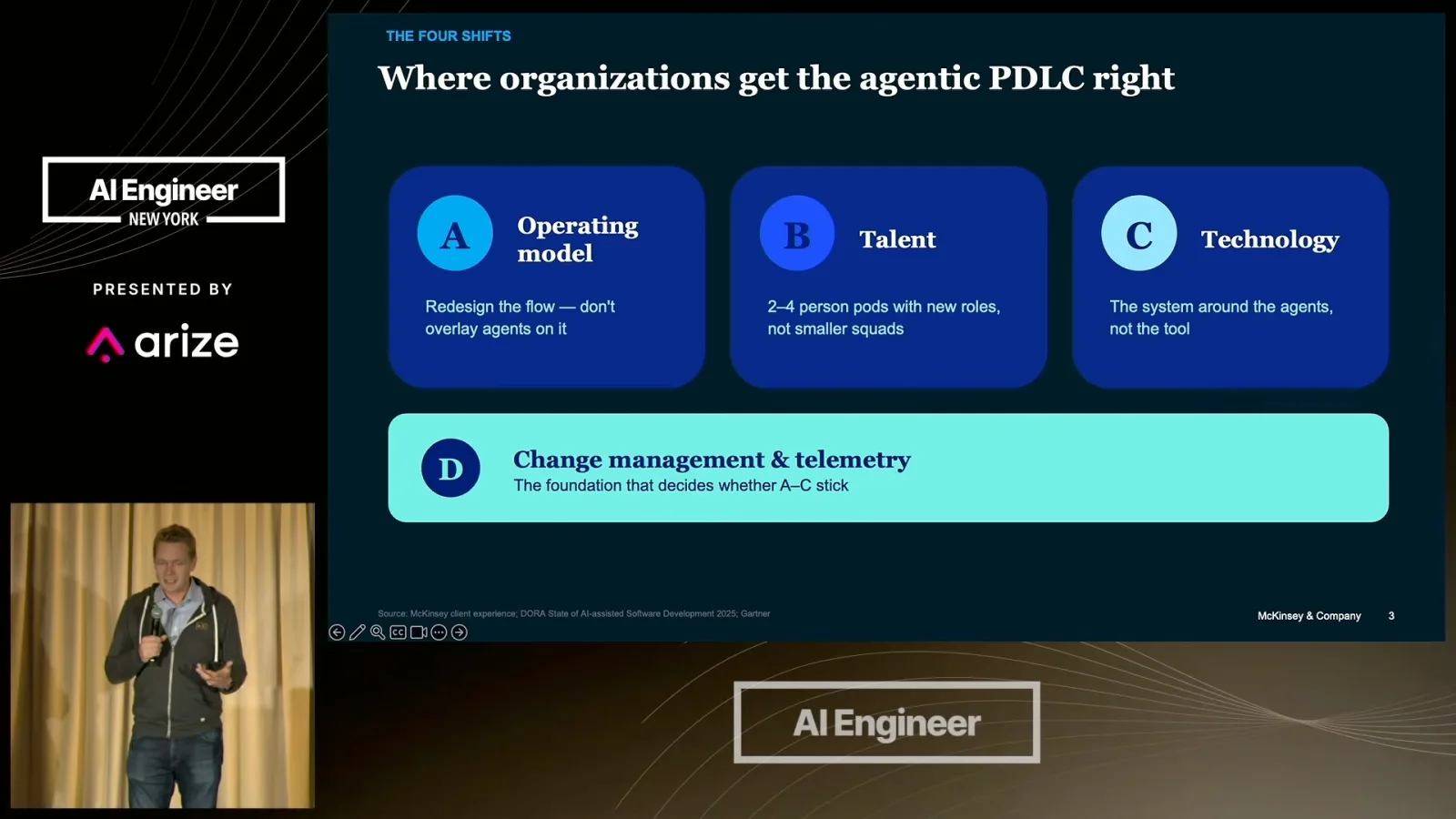
Shorter loops, smaller teams and shared context
Dixit describes changes to workflow, roles, knowledge and governance. Shilpa discusses curating skills.
Dixit describes some clients moving from two-week sprints toward one- or two-day workflows: agents work through tasks, people validate results and the loop repeats. Teams decide where human review belongs and adjust that boundary as confidence grows.
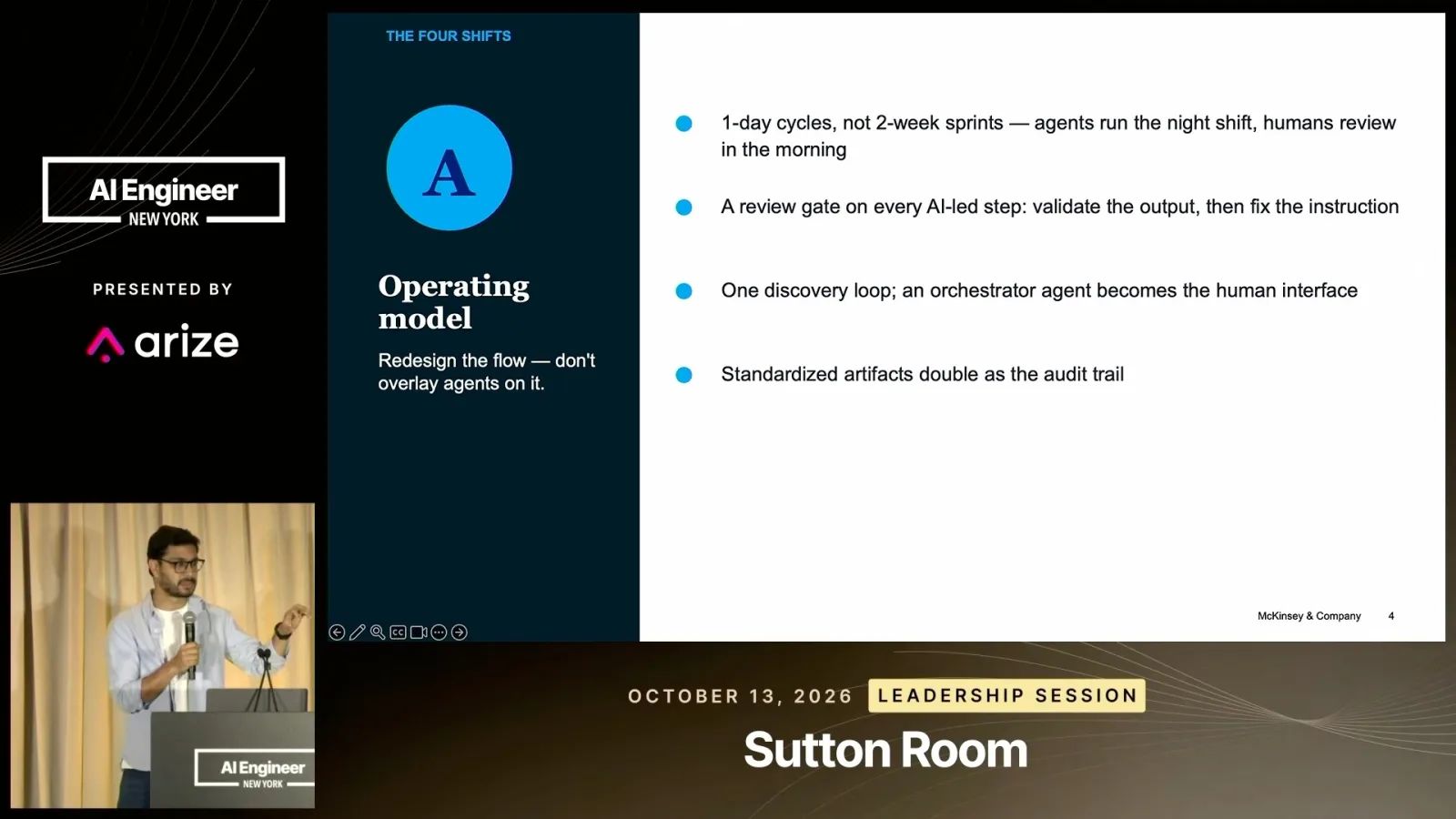
The workflow can extend beyond building and testing into product work and release. Dixit says standardized artifacts, such as requirements and specifications, help agents work consistently when large organizations store context in many different ways.
On staffing, Dixit reports a shift among some clients toward pods of two to four people. He says smaller teams do not necessarily mean reduced headcount; organizations may create more teams while broadening individual responsibilities.
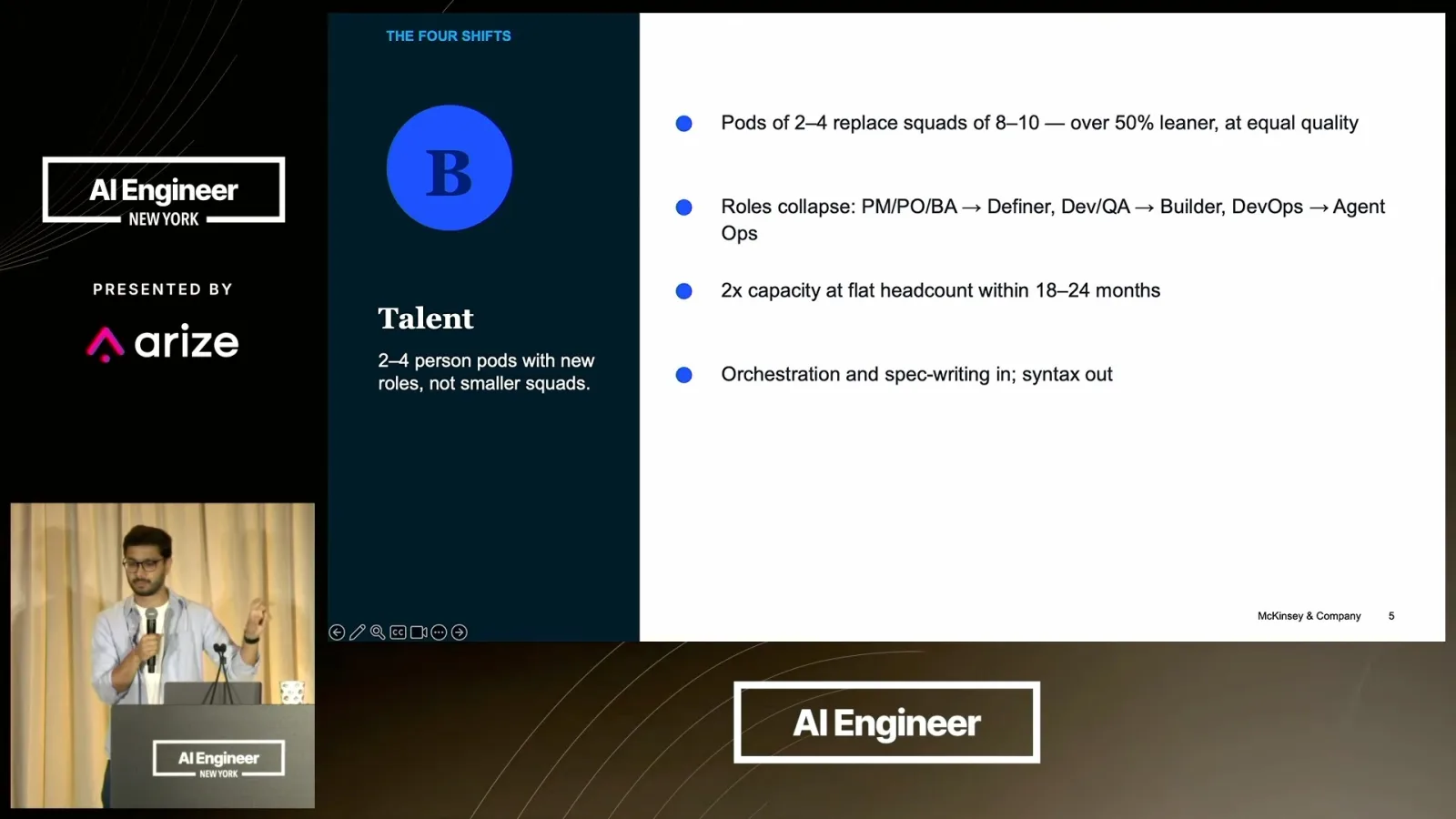
He describes product-oriented roles converging toward a “definer” and development and quality roles toward a “builder.” He says there is not yet an agreed industry vocabulary for these roles.
Dixit argues the challenge is assembling tools around an organization’s own context. Knowledge held by long-serving subject-matter experts must be documented so agents can use it without repeatedly depending on the same people.
He also emphasizes trust: governance, security and stability must accompany agent adoption. Scaling beyond a successful pilot requires preparation across the operating model, staffing, technology and costs, including AI financial operations.
A colleague identified in the talk as Shilpa says the difficulty is increasingly selecting and curating useful skills from a large supply. The relevant set depends on the organization’s work and context.
Protect quality as bottlenecks move
The speakers recommend stronger review and explicit examples, while mapping constraints in requirements, release and parallel teams.
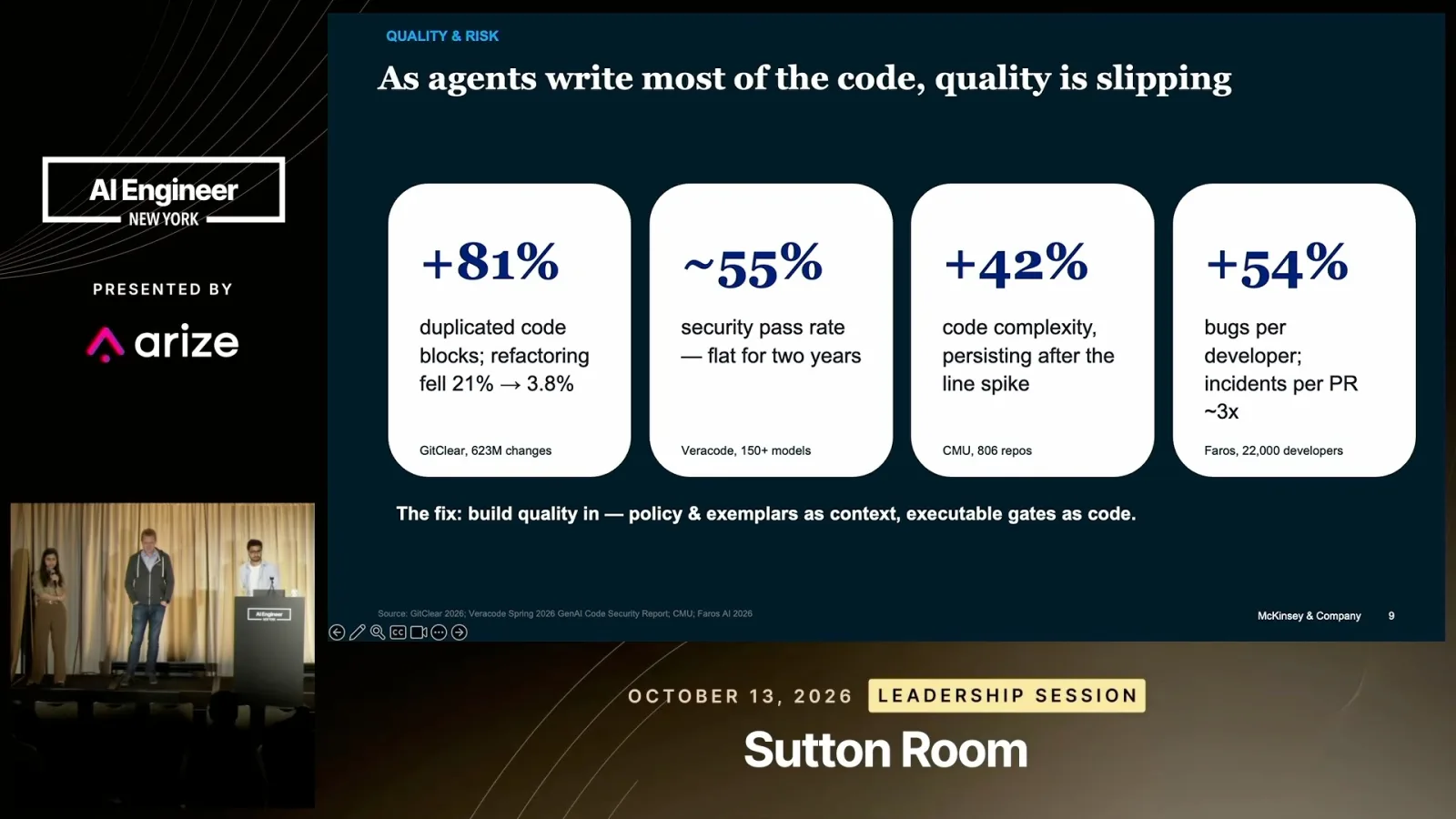
She warns that faster code generation may coincide with worse quality. She says the reports they reviewed show increases in bugs and incidents even when measured per developer or per pull request, and calls for equal attention to review skills.
The team recommends curating strong examples of desired work rather than giving agents only average examples from the existing codebase. Policies, standards and quality checks should be available throughout the development process.
Examples of checks include whether code is maintainable, appropriately simple and compatible with other branches. Applying expectations earlier can catch issues before a final quality gate.
As build and test become faster, bottlenecks can move upstream to requirements and design, downstream to release, and sideways to risk, legal, compliance and design teams.
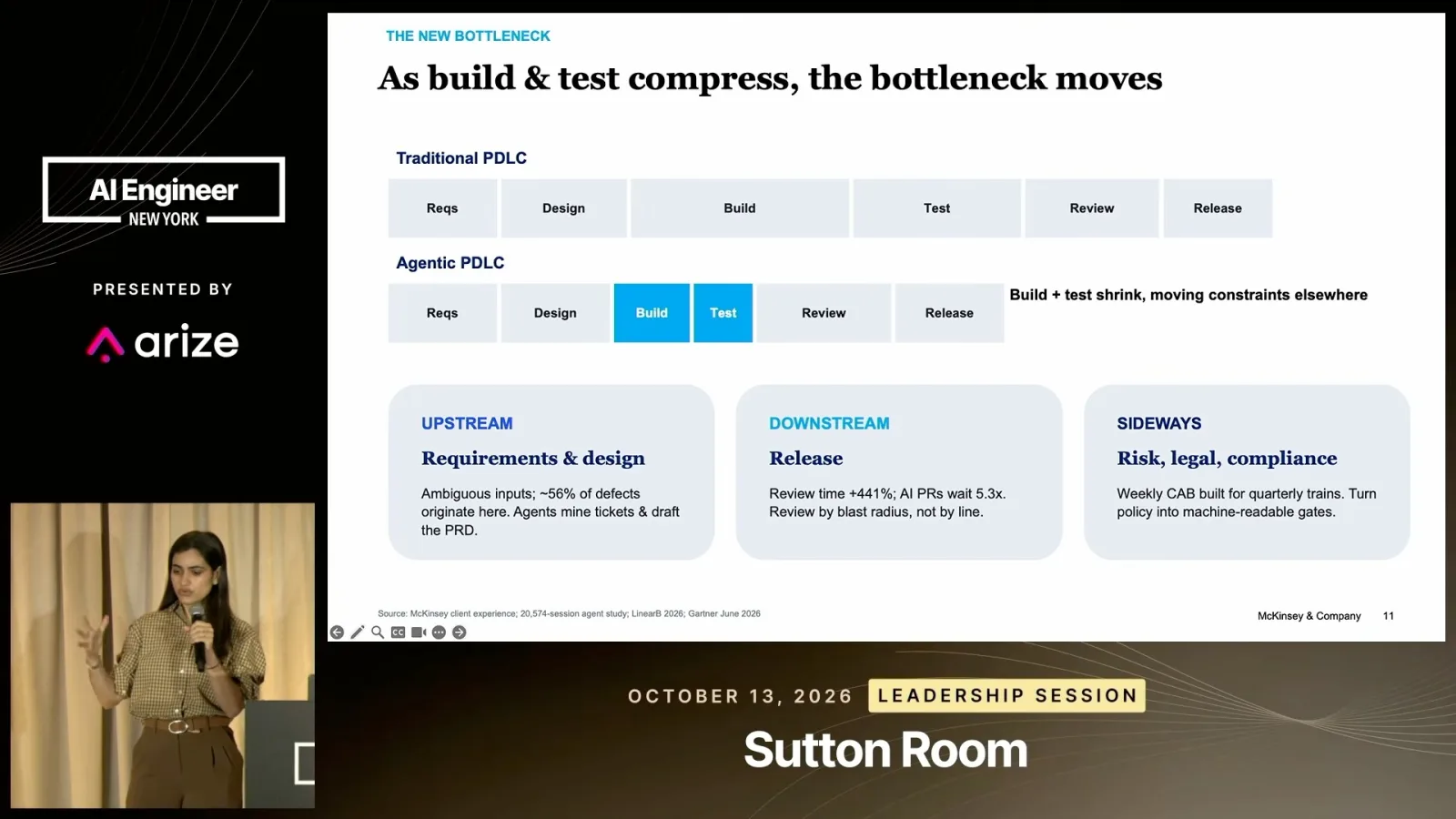
For the upstream stage, the speakers suggest connecting agents to relevant enterprise context, including customer information and logs, while linking that context to what needs to be built. Release requirements also need to be mapped in advance.
Shilpa describes a bank application where color and accessibility rules required coordination with another team. Such parallel requirements can become bottlenecks unless they are identified and made available to the workflow.
Measure outcomes and coordinate the changes
Harrysson discusses the difficulty of measuring value and describes smaller teams as one near-term organizational experiment.
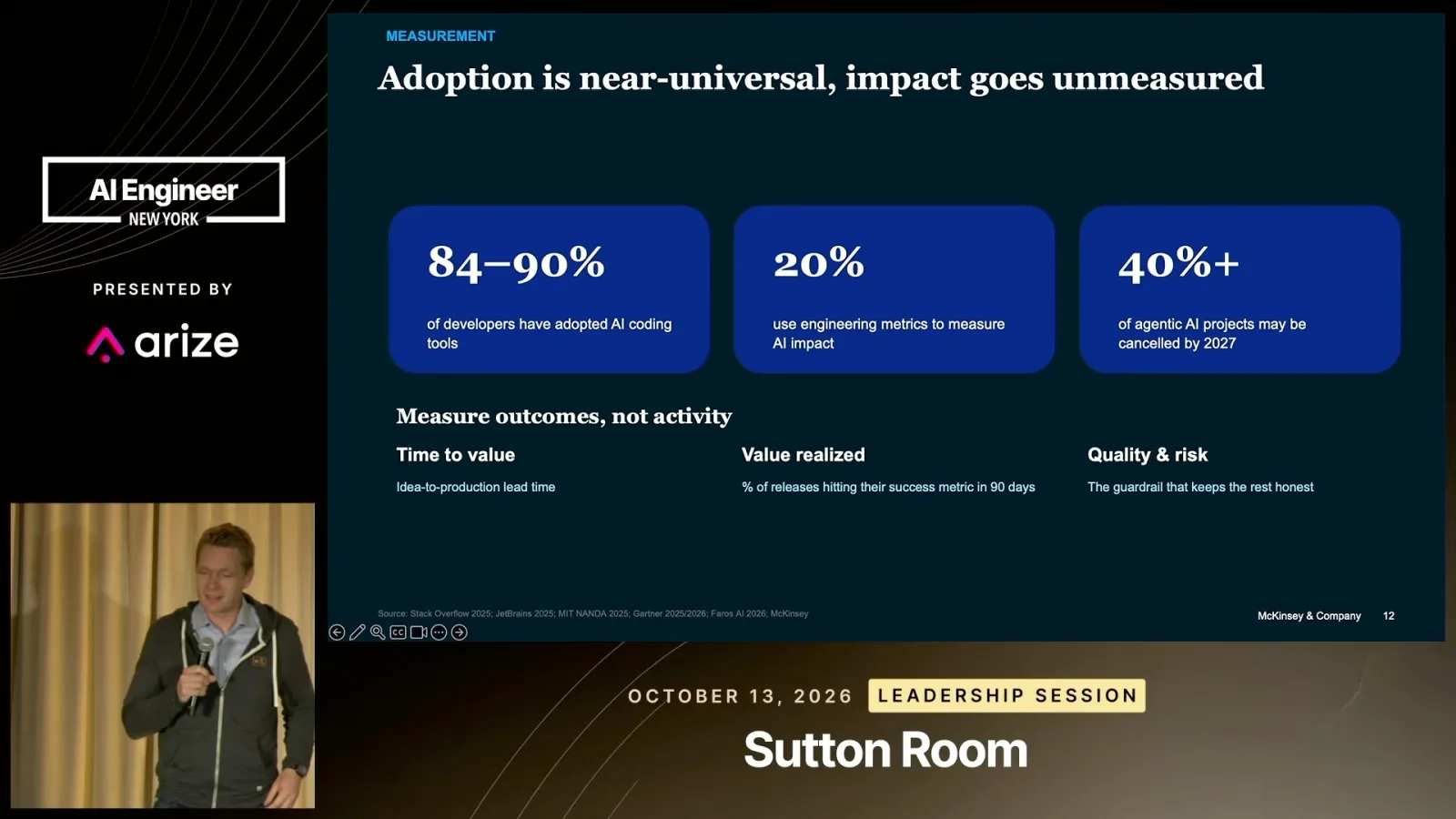
Harrysson says measuring impact remains unfinished work. Organizations spend on tools, tokens and training but often lack confidence that they are measuring the right outcomes.
Some clients are exploring AI-assisted ways to assess the value of work and allocate resources, he says. He considers the idea promising but difficult; existing engineering measures still have a role.
He describes a near-term management heuristic: splitting an existing group into smaller pods and more teams can increase parallel capacity. He says leaders will need more sophisticated measurement over time.
The speakers close by arguing that results depend on many coordinated changes rather than introducing a single tool. Harrysson reports seeing substantial improvements in some clients and remains optimistic about the direction.
Mehr aus diesem Kanal
 19:41EN
 AI Engineer· 9. Nov. 2026A high-reliability automation starts by routing the hard cases awayMatthew Jewkes · Standard CyberneticsMatthew Jewkes describes separating critical errors, ambiguous decisions and unusual exceptions in a biopharma indexing workflow.
 22:01ENAI Engineer· 9. Nov. 2026Zach Lloyd: make the software factory measurable and editableZach Lloyd · WarpWarp’s CEO proposes recording agent runs, scoring failures and testing changes to the workflow on real tasks.
 27:35ENAI Engineer· 9. Nov. 2026Uber traded an always-green trunk for faster AI-scale mergesPreetam Dwivedi, Manjari Akella · UberIts merge queue now relaxes some conflicts and validates the combined state after landing, with a verified-good fallback.
 15:25ENAI Engineer· 9. Nov. 2026Hassan and Omar El Mghari: When an AI financial forecast is right for the wrong reasonsHassan El Mghari, Omar El Mghari · Together AIA Costco membership-fee model passed basic checks and landed close to reported results, but an audit uncovered offsetting assumptions.
 14:38ENAI Engineer· 9. Nov. 2026Jemima Abu: Give coding agents accessibility rules from the startJemima Abu · CAISA product engineer shows how semantic HTML, reusable components and explicit agent skills can help teams build more usable interfaces.
 21:12ENAI Engineer· 9. Nov. 2026Tom Moor: Give coding agents the product context that code cannot showTom Moor · LinearLinear’s workflow carries customer requests, past decisions, review history and human feedback from intake through implementation and review.