In 30 Sekunden
Jared Zoneraich explains his approach to agent scaffolding and early evaluations, then demonstrates a cloud coding workflow that tests a page and launches parallel redesigns. He discusses cost, larger migrations and future interfaces from his perspective as a Cognition team member.
- 1Design for changing modelsZoneraich recommends avoiding dependence on elaborate prompting workarounds as the sole product advantage.
- 2Tests for an assistantHe describes sanity checks for recall, tool use and response length that an agent can use to iterate.
- 3Testing a real pageThe demo runs a cloud browser to inspect a small project.
- 4Parallel redesignsA coordinator launches separate sessions and asks them to return screenshots.
Das Wichtigste
- Build with model progress in mind and revisit prompting scaffolding as capabilities change.
- Start with a useful workflow and improve it through targeted tests and human review.
- Break large tasks into focused, verifiable pieces when parallel work is appropriate.
- Evaluate agent spend against the quality and value of the work produced.
- Treat the guest's product comparisons and future predictions as his perspective.
Den bearbeiteten Text nach Kapiteln lesen
Agent design and product development
Zoneraich discusses model progress, customers and initial evaluation.
Cognition builder-in-residence Jared Zoneraich talks with Peter Yang about agent design, evaluations and cloud coding workflows. He demonstrates Devin, a product built by his employer. The episode is sponsored by Riverside.
Zoneraich distinguishes agents built for customers from internal agents that help a team work. He argues that teams should account for model improvements and not assume today's elaborate prompting workarounds will remain their main advantage. He presents this as a heuristic and says choices are case-specific.
On differentiation, he points to product quality, execution and customer support, including engineers working directly with customers. He says showing an agent solve a real customer problem can be more persuasive than explaining the technology in isolation.
The guests discuss how to ship an initial agent without spending indefinitely on a perfect architecture. Zoneraich says a first version can be simple, but also acknowledges that reaching a reliable final result takes longer. His advice does not mean skipping appropriate evaluation before production.
Verification and cloud work
He explains sanity checks, asynchronous tasks and cost tradeoffs.
For a personal assistant project, he asks Devin to create sanity checks for data recall, tool use and response length. The agent compares old and new outputs and iterates. The example illustrates a feedback loop; its usefulness depends on whether the tests represent the desired behavior.
Zoneraich describes Cognition's focus on software engineering and verification, and contrasts synchronous work with asynchronous cloud tasks. His statements about Devin's strengths and customer adoption come from a person working at the company, rather than an independent comparison.
He argues that spending on agents should be judged against useful engineering outcomes, not token volume alone. He identifies migrations, test coverage and work in existing codebases as important customer use cases, while Yang notes that generated output still needs to be good.
Testing and parallel sessions
A Devin demonstration tests a page and explores multiple redesigns.
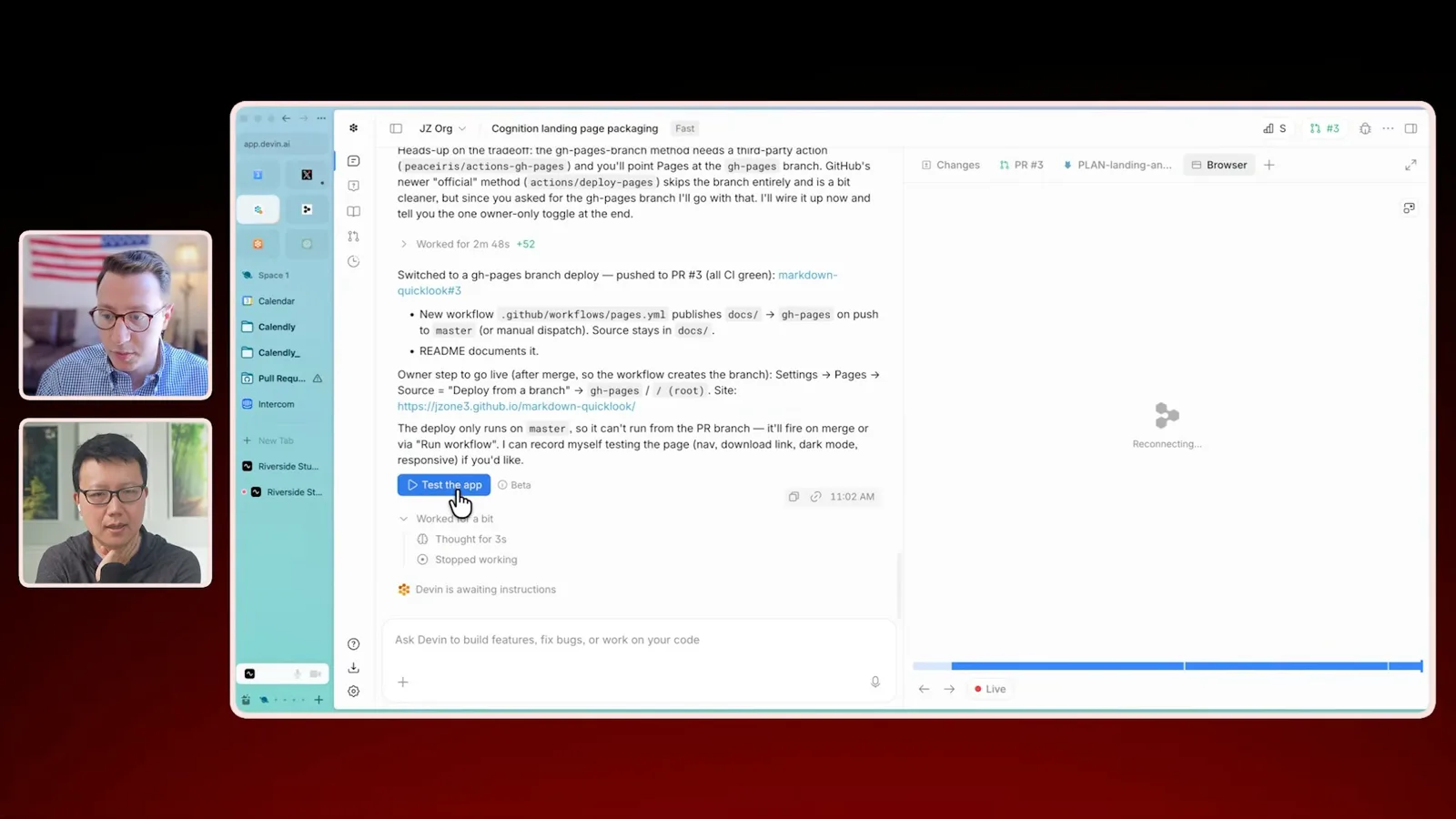
In a demo, he shows a small Markdown preview project and starts an application test. The agent runs in a cloud environment with a browser and attempts to check the page. The demonstration shows an activity and interface, not proof that every defect was found.
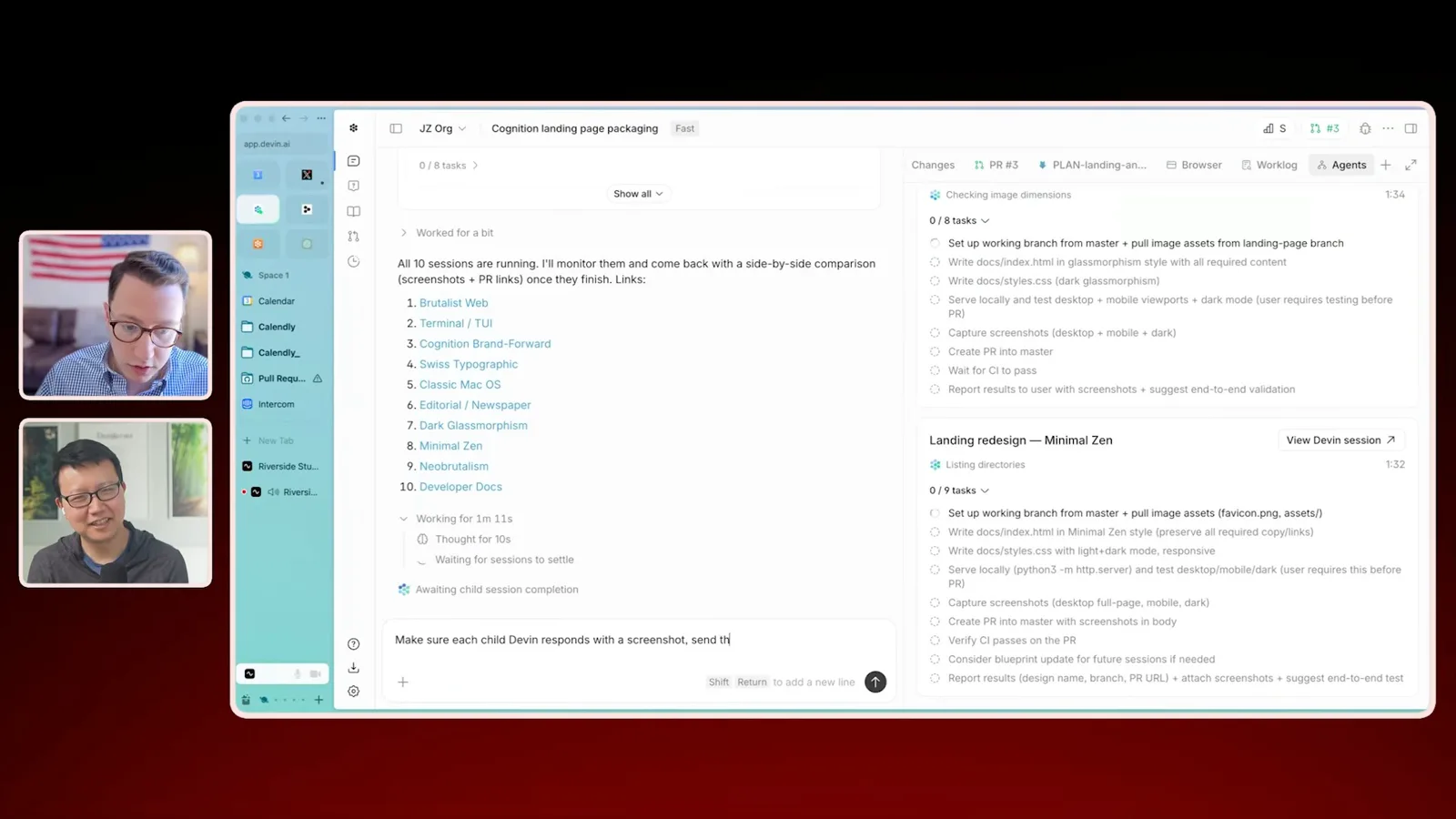
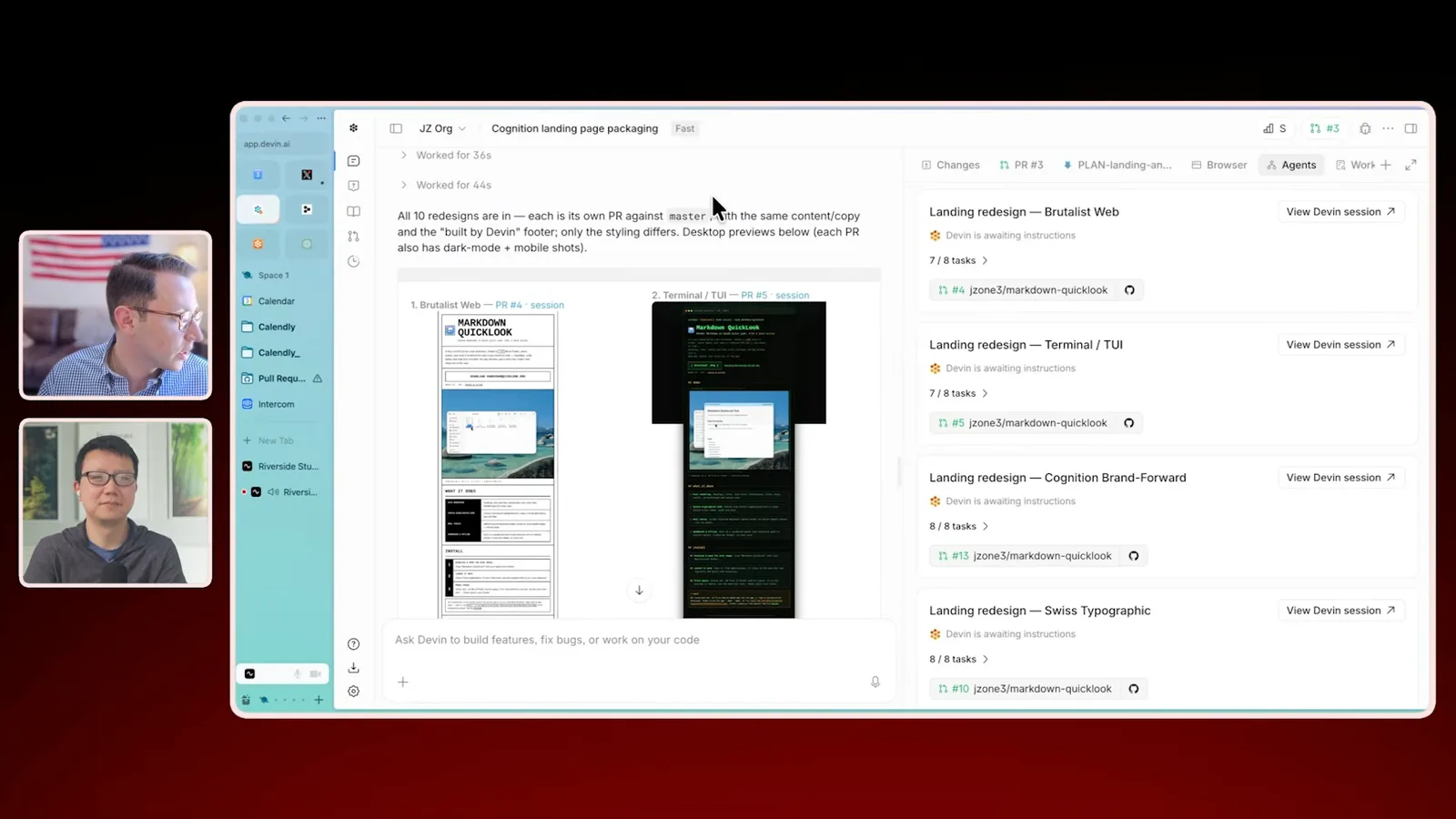
He then asks a coordinating Devin to launch ten independent redesign sessions for the landing page. Each runs in its own virtual machine and branch. The coordinator can send follow-up instructions, such as asking each session for screenshots, and compare the results.
Zoneraich proposes large migrations as a more substantial use for this fan-out pattern: split a large task into focused pieces that can run and be tested separately. He also describes model routing and cost tradeoffs as product work in progress; parallel work adds coordination and compute costs.
Shared knowledge and the future
The conversation turns to team context and speculative interfaces.
He mentions shared knowledge, skills and saved environment setup, along with repository documentation, as ways to make subsequent work easier. These are product capabilities he describes at the time of the interview.
The conversation closes with predictions about coding agents, short-lived software and voice interfaces. Zoneraich imagines a much simpler desk, but acknowledges the unresolved question of how people will see and assess results. These are views about a possible future, not demonstrated replacements for current tools.
Mehr aus diesem Kanal
 46:40EN
 Peter Yang· 8. Nov. 2026Podcast · 2 StimmenAshley Alexander: How AI Helps Me Care for My Parents With CancerGast: Ashley Alexander · Moderation: Peter YangA caregiver uses AI to prepare for appointments, organize records and ask better questions—while keeping doctors at the center of treatment.
 17:50ENPeter Yang· 4. Nov. 2026PodcastPeter Yang’s Five Steps for Using AI to Help Care for His MotherYang uses a shared care brief and organized records to navigate appointments, while making time for family.
 15:03ENPeter Yang· 3. Nov. 2026PodcastHow Peter Yang Used an AI Phone Agent to Negotiate His Internet BillAn AI call negotiated a lower price and faster service, but Yang still had to approve the change himself.
 33:09ENPeter Yang· 1. Nov. 2026Podcast · 2 StimmenJaclyn Konzelmann: When AI Can Build More, Choose What Deserves to ExistGast: Jaclyn Konzelmann · Moderation: Peter YangGoogle Labs pairs short strategy documents with prototypes, user co-creation and lessons from experiments that end.
 13:05ENPeter Yang· 28. Okt. 2026PodcastPeter Yang Tests Genie 4: Convincing Worlds, Unfinished GameplayFive live demonstrations show scenes that respond to prompts and sound, alongside inconsistent actions and limited game mechanics.
 1:06ENPeter Yang· 26. Okt. 2026PodcastPeter Yang on Setting Up Payroll for a One-Person BusinessIn a paid partnership, Yang describes the paperwork he encountered and a payroll product integrated with a business account.