30초 요약
Lu Wilson’s music-making tool Arroost helped people share unfinished work, but their own gatekeeping eventually drove contributors away. In the Pastagang community, a different approach emerged: anyone could edit shared music or change the Nudel tool itself, producing new features, performances and even a collaboratively written paper. The freedom also made the growing project difficult to follow and sometimes exclusionary. Wilson describes how evolving mantras, discussion inside the code and a willingness to delete work helped members make room for others—and why they ultimately ceremonially deleted Nudel.
- 1A community made sharing safer than a feature aloneWilson once credited Arroost’s success to their own design. Looking back, they say the community that normalized sharing rough experiments reduced their fear of sharing.
- 2Gatekeeping drove contributors awayWilson recalls rejecting suggestions and nitpicking changes while defending their ownership of the tool. Eventually fewer people participated.
- 3Nudel treated code changes like improvised musicAnyone could become a maintainer or administrator and push changes. Others could react to an idea through further changes, allowing features to emerge quickly.
- 4Radical openness can leave people unable to keep upA growing network of tools, performances and writing created possibilities no individual could track. Wilson says even participants can feel excluded when everything is happening at once.
- 5Disputes can be discussed where the change happensCode disabling pasting included an appeal explaining the decision. Wilson says changing a feature in a shared space requires communicating with and persuading the people who use it.
- 6The group deleted Nudel to make space for what came nextAt the end of a Linz performance, Pastagang ceremonially removed the tool and left a tombstone. Wilson connects that decision to accepting that code and projects can end.
핵심 정리
- Make it safe to share rough work; seeing others share can matter as much as a tool’s features.
- Allow contributors to try ideas and respond through working changes, not only proposals.
- Put context and reasons near the code where collaborators will encounter a contested decision.
- Use shared values and lightweight retrospectives to coordinate a group whose activity cannot be centrally controlled.
- Recognize the cost of radical openness: fast-moving activity can overwhelm or exclude participants.
- Letting a temporary experiment or crowded piece of code end can make space for something new.
챕터별로 다듬은 전문 읽기
The limits of one head
Wilson introduces their creative coding and the challenge of relying on one perspective. A music-making project reveals how much sharing depends on community.
Lu Wilson starts with a limitation: one person has only one head. No matter how hard they try, they can see from only one perspective and keep only so much in mind. The talk asks what programming might look like when many people can act together instead.
Wilson, known online as TodePond, is part of the Tentpole collective and helps organize Algorave London. They describe their work creating experimental prototypes for Wikipedia editors and playful computer projects that explore ideas.
In one example, drawings made inside one colored screen appear in every other screen of that color. Placing a screen inside itself creates a recursive image; moving and rotating it produces a changing fractal-like result.
Wilson says such experiments are not merely jokes: each tests an idea, sometimes leading to a research paper as well as a video. Their increasingly surreal presentations can leave viewers unsure what is happening, a reaction they recognize in the audience.
Five years earlier, Wilson set out to make a music tool that lowered the emotional barrier to recording and sharing. The initial plan included a sequencer, a new visual language, an audio engine, a paper and a video, all supposedly finished in three months.
The project instead took roughly two years, and the plan changed substantially. The resulting tool, Arroost, displayed a reminder to “normalize sharing scrappy fiddles”: make it ordinary to share small, unfinished or rough experiments.
Wilson demonstrates recording sounds and moving the resulting objects around to change their pitch. Users can connect sounds, adjust their timing and build looping patterns, then delete elements as they experiment.
From defending Arroost to welcoming other contributors
Wilson reconsiders an early explanation for Arroost’s success. Their own gatekeeping discouraged contributors despite the value of shared experimentation.
Others adopted Arroost and made work with their own recognizable character, from a noisy office soundscape to music made from a recording of a vacuum cleaner. Wilson says seeing others share helped reduce their own anxiety about sharing.
When presenting the associated paper, Wilson initially credited the result to their design decisions and vision. They now question that explanation: a time-travel feature they emphasized in the paper was rarely used, while the community’s willingness to share mattered much more.
The “scrappy fiddles” mantra spread beyond Wilson’s original intention. Looking back, they see a group of contributors—not a single author—as the reason sharing became more comfortable.
Despite that lesson, Wilson says they resisted community suggestions, defended the tool’s existing look and sometimes nitpicked changes to assert control. People eventually stopped contributing, leaving the project dependent on its original creator again.
Live coding becomes a shared jam
Wilson demonstrates Strudel and invites the audience to edit music together. An open room evolves into the Pastagang community.
Wilson introduces Strudel, a live-coding tool for making music. Typing code selects a sound, and adding sounds puts them into a repeating cycle; changing the tempo alters the pace.
In the demonstration, brackets group or repeat sounds and switch patterns across cycles. Wilson adds notes from a scale, then changes effects and timbre while the music plays.
The demonstration continues with a faster tempo, percussion, chords and effects. Wilson adds and removes pieces as the performance develops, stressing that a sound can be deleted once it has had its turn.
After trying Strudel with others at a conference, Wilson wanted to collaborate over the internet. A suggestion led them to Flok, which let several people work together in a shared live-coding room.
Wilson invites the audience into a Nudel room on their phones and laptops. Dozens of cursors appear as participants add panes, edit code and contribute sounds; Wilson estimates that about 30 to 40 joined the same space.
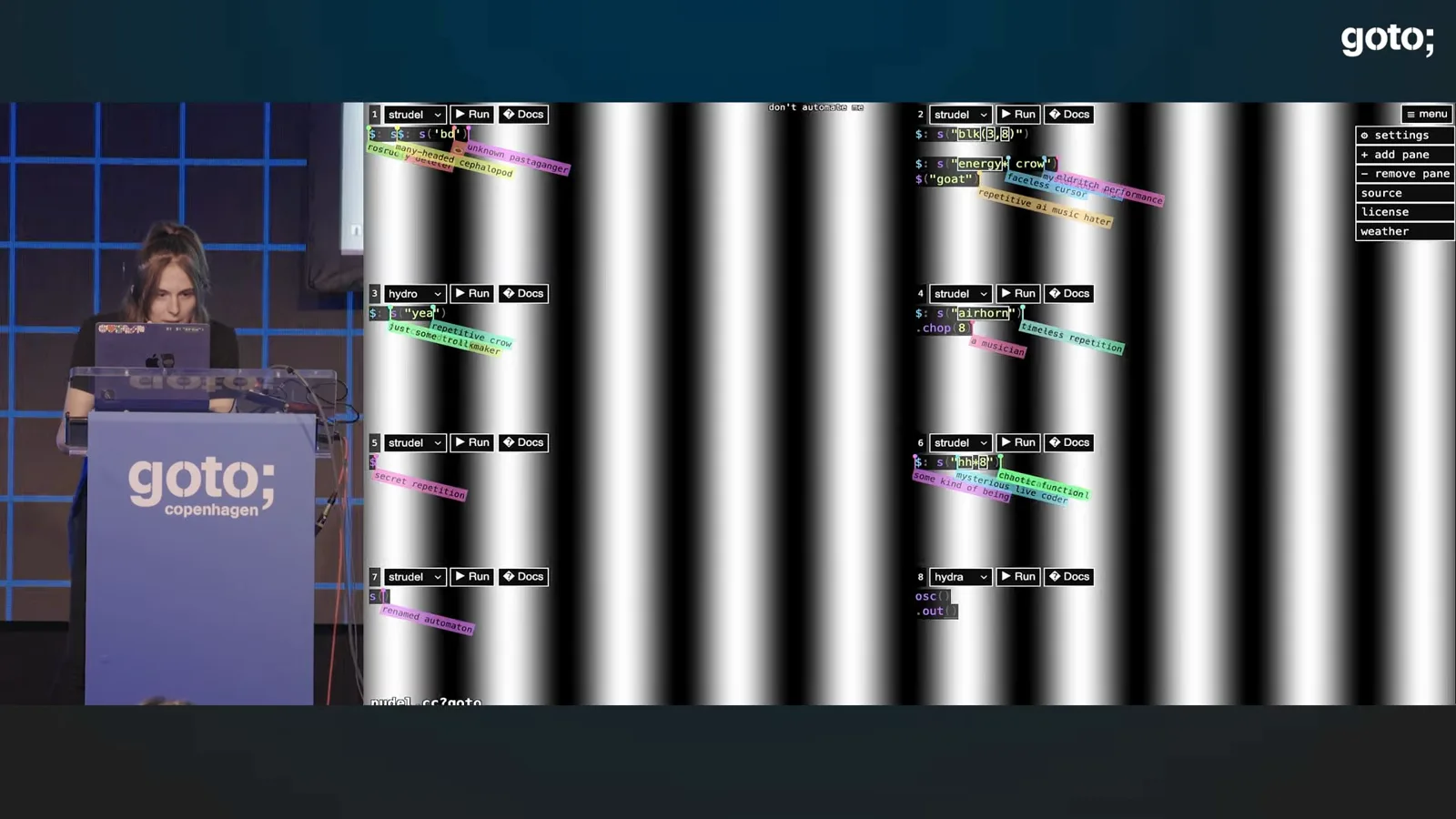
Instead of practicing Strudel alone, Wilson began learning in a shared room that anyone could enter. Sometimes it was empty except for traces of an earlier jam; at other times people arrived and edited or deleted one another’s code as they made music.
The experience challenged Wilson’s habit of being the “mini dictator” of their own code. The community that formed around the shared space became known as Pastagang.
Nudel lets everyone change the tool
After moving away from a tool not intended for mass collaboration, the community builds Nudel. Its radically open contributor policy allows features and mistakes to emerge quickly.
Wilson later realized that Flok had not been intended for this use: allowing other people to run code carried abuse risks even in a browser. They moved the experiment to a sandboxed version and a separate domain before the community built its own tool, Nudel, for larger-scale collaboration.
Nudel’s contributor policy gave anyone a route to become a maintainer or administrator. Rather than appointing a small group with a final say, contributors could submit changes or push directly to the main branch.
Wilson calls the approach jam-oriented programming. As in an improvised music session, a participant can change a part without asking first; others hear what happened and respond. Merging without checking became a running joke, and people could request organization-owner access.
The lack of gates made development extremely fast: Wilson recalls an entire tool appearing overnight. It also produced unexpected features. At one point pasting was disabled, while a special pasting mode disabled typing.
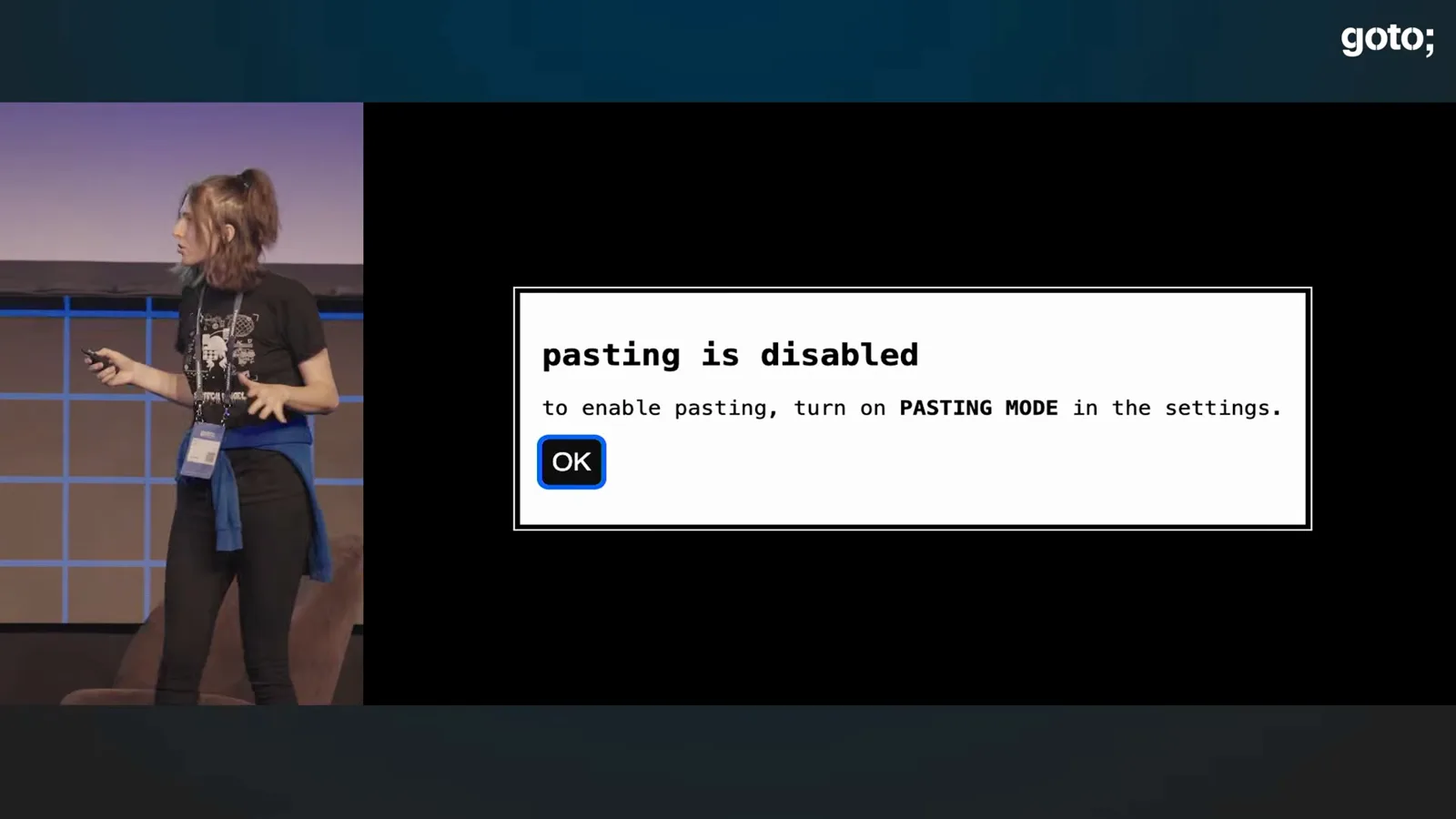
During performances, a participant might announce that Nudel had been updated and ask everyone to refresh. One person trying to restore pasting on a dance floor accidentally added an odd message; because people found it funny, the change remained for a while.
A “weather” system changed the interface every 25 hours, the length of a fictional Nudel day. One variation was “no Nudel day,” when community members would restore the restriction if someone tried to disable it.
A scrolling ticker displayed community mantras. The one Wilson highlights is “let code die”: participants accept that code can be deleted, lost or broken because preserving every contribution is not the point of a jam.
From an online room to a wider movement
Pastagang performs in clubs and creates music, papers and new tools. Growth brings creative possibilities but can also make the group hard to follow.
Pastagang began performing in a South London nightclub by connecting a laptop to a public room. People around the world could play remotely, while clubgoers could join from the dance floor or approach a table with a laptop.
At one event a person who had never coded typed something that crashed the music, laughed and continued for another hour. Wilson presents the moment as an example of an audience member becoming a participant rather than being shut out by a mistake.
Further invitations followed. At an arts festival, people in the crowd contributed from their phones; the group donated money from its first paid gig to open-source tools it used. Wilson says members also released albums that anyone with the shared password could add to.
Performances spread to multiple cities and settings, sometimes with little advance notice. Alongside laptop-based code, participants began bringing instruments, live vocals and improvised rap, expanding the jam beyond its original form.
The activity grew beyond music: anyone could contribute to a Pastagang podcast or blog, and a collectively written academic paper was accepted and presented by members other than Wilson. New tools for phones, samples and creative coding appeared faster than one person could track.
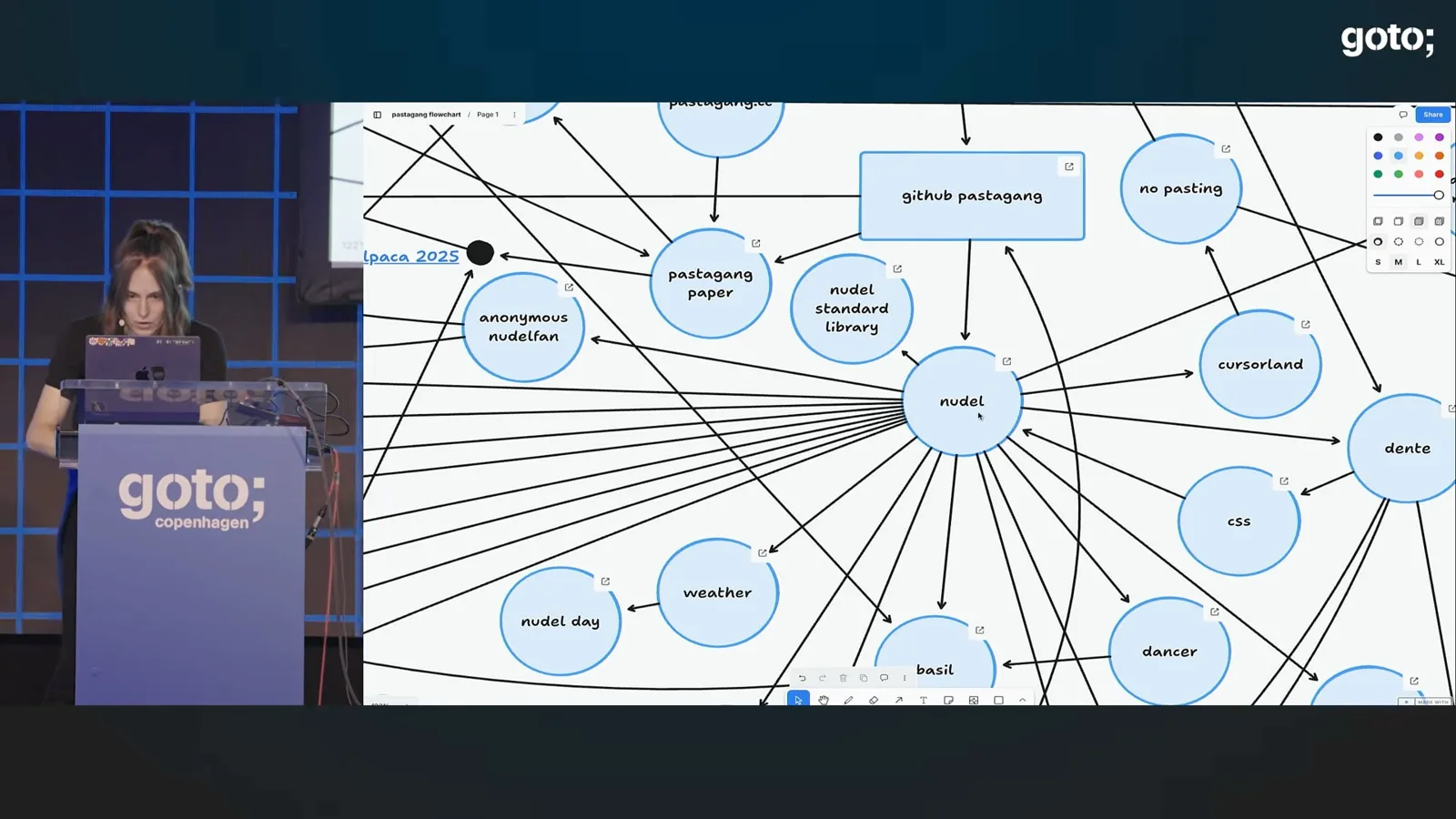
Wilson shows a growing map linking Nudel to the paper, weather system and many other projects. They say openness can also become overwhelming: when anyone can join and activity happens everywhere, even a participant can feel excluded or unable to keep up.
Values, conversation and letting code die
Members negotiate changes through evolving mantras and communication in code. Wilson closes with lessons about making space, accepting challenges and letting a project end.
One response Wilson observes is the use of shared values rather than an attempt to impose fixed rules on everyone. The mantras are themselves contested and continually edited, so they evolve as the community encounters new situations.
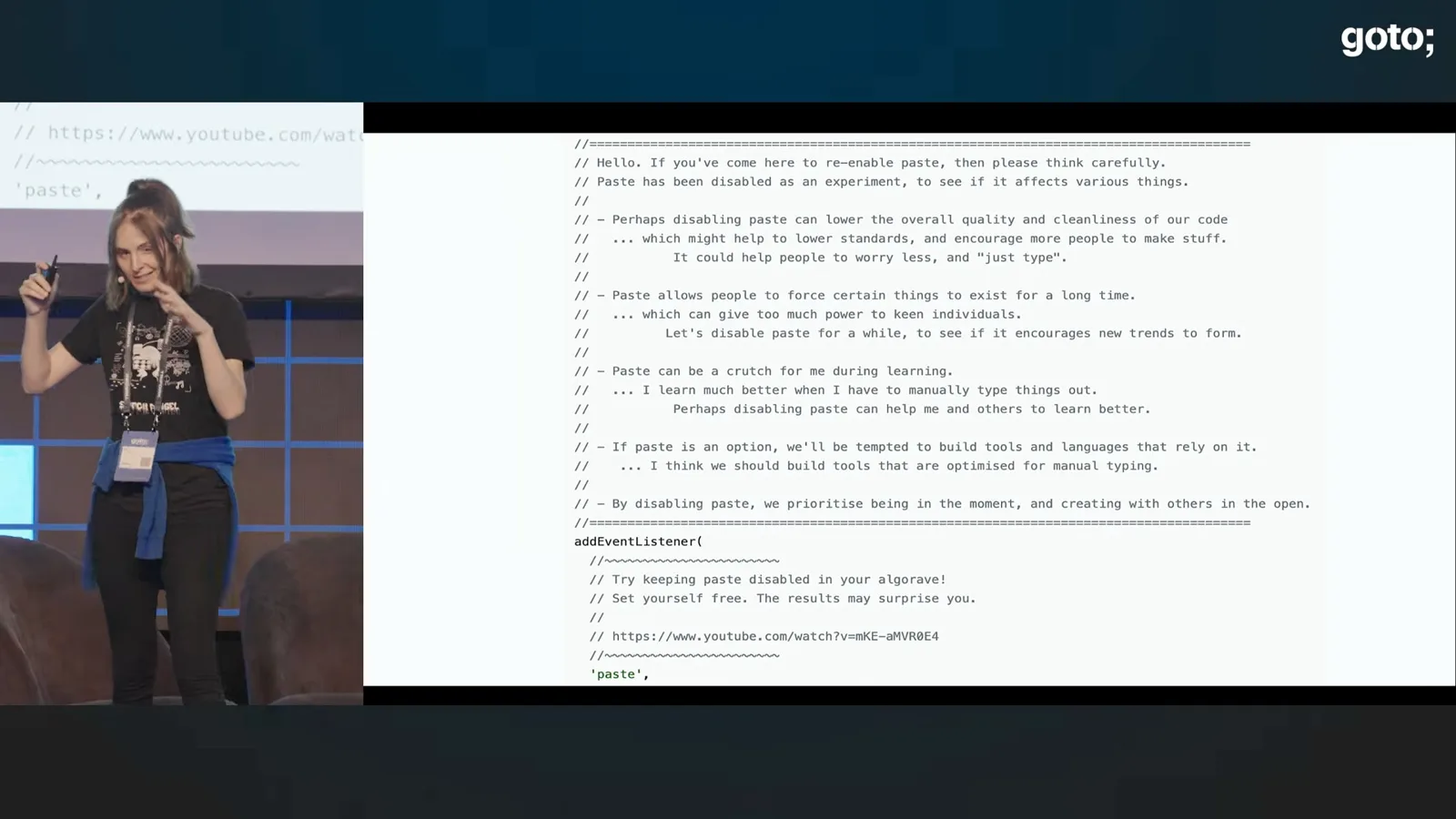
Communication can happen at the point of collaboration. Wilson shows code that disables pasting, accompanied by an appeal explaining why someone wants it kept that way; someone who wants to change the behavior must also persuade the people affected.
Members also share “unstructured thoughts” after events, listing positives and negatives of any size. Wilson compares this emergent practice to an asynchronous retrospective: it spreads knowledge that might otherwise remain with a few people.
Wilson compares jam coding with vibe coding: both can produce large amounts of messy or broken code quickly. But in their experience, one creates a dependency on other community members, while the other can create dependence on a company.
A participant can leave a request in the code, such as a prompt for a new feature or a saxophone solo, and another person may take it up. The response may be different from what was requested, which Wilson treats as part of the fun.
Wilson contrasts an AI assistant’s tendency to try to be helpful with people’s willingness to disagree or decline. That resistance, they say, can be useful because collaborators sometimes challenge the premise rather than merely carrying out the request.
Sometimes doing is a form of communication: show an idea in code and let another person respond by changing it. Wilson says working this way helped them get to know collaborators better, but required letting others act.
Making space may require removing work. The weather system offers a way to isolate an extreme idea so it appears only occasionally rather than disrupting every session; deletion can also clear a crowded creative space.
Wilson says they used to protect code from other people and are still learning to let go. At a closing performance in Linz, Pastagang ceremonially deleted Nudel and replaced it with a tombstone after deciding the tool had reached its limits.
Wilson does not use jam-oriented programming for every project. The broader change is a greater willingness to hear ideas they initially dislike and let colleagues try them, including committing changes that might break something.
They end with a joke that every bug can be fixed by deleting all the code and starting again. The serious lesson, Wilson says, is that collaboration can overcome the limits of a single perspective.
같은 채널의 다른 글
 45:41EN
 GOTO Conferences· 2026년 11월 23일AI made code cheaper, but good products are still hard to buildEvan Ratliff, Tim BerglundTim Berglund and Evan Ratliff weigh cheaper coding, unreliable AI forecasts and why conversational machines can feel like people.
 34:27ENGOTO Conferences· 2026년 11월 19일Wilco Burggraaf: Measure running software to find wasted energyWilco BurggraafAn AI-assisted PyTorch experiment found an unnecessary copying loop; its proposed fix cut both runtime and energy in one benchmark.
 32:58ENGOTO Conferences· 2026년 11월 18일Dave Thomas: Let Agents Handle Rituals, Keep Human JudgmentDave ThomasThe Pragmatic Programmer co-author separates repeatable process from tactics and values to explain where developers contribute alongside coding agents.
 43:06ENGOTO Conferences· 2026년 11월 17일Jennifer Petoff: Train Engineers to Run What They BuildJennifer PetoffGoogle’s former SRE education lead explains how hands-on training and reliability practices build production confidence at scale.
 38:10ENGOTO Conferences· 2026년 11월 16일Andrea Magnorsky: Make Architecture Decisions Visible and AccountableAndrea MagnorskyClarify who decides, seek advice from affected people and use small collaborative exercises to surface missing knowledge.
 45:33ENGOTO Conferences· 2026년 11월 12일A playground that makes computers something children can climbLinda LiukasLinda Liukas turns abstract computing into stories, physical games and public space—and asks what engineers can learn from play.