30초 요약
At Tesla’s June 2024 annual meeting, shareholders voted to move the company’s incorporation to Texas and ratify Elon Musk’s 2018 stock-option award. They also supported advisory proposals on annual director elections and simple-majority voting. Musk then argued that autonomy and Optimus could drive future value, while discussing vehicle costs, charging and energy storage. His robotaxi revenue and robot valuation figures were projections; Tesla says FSD (Supervised) requires an attentive driver.
- 1Shareholders backed Texas incorporation and the 2018 awardThe preliminary meeting results were later certified in Tesla’s SEC filing; two shareholder governance proposals also received support.
- 2Musk proposed a network of company and owner robotaxisHe imagined owners adding cars when not needed and predicted income could exceed monthly payments. This depended on future capabilities and approvals.
- 3Optimus valuation depended on hypothetical scaleMusk used projected robot production, costs and margins to describe a potential market, not existing profits.
- 4Testing driving models becomes harder as interventions grow rareMusk describes simulation, shadow-mode comparisons and difficult intersections as ways to evaluate successive models.
- 5Making cars cheaper requires savings across many partsMusk says supplier cell prices had fallen and Tesla’s own 4680 cells still cost more at the time.
핵심 정리
- Shareholders approved Texas incorporation and ratification of Musk’s 2018 award, according to Tesla’s certified vote filing.
- Annual director elections and simple-majority voting proposals won support as advisory measures.
- Musk described a possible robotaxi network and large Optimus market; the revenue and valuation figures were forecasts.
- Tesla says FSD (Supervised) requires active driver supervision and does not make a vehicle autonomous.
- Musk described affordability as a component-by-component manufacturing challenge, including for 4680 cells.
챕터별로 다듬은 전문 읽기
Opening remarks and the company’s 2023 review
Ehrhart opens the meeting and Denholm reviews Tesla’s vehicle, energy and sustainability claims.
Tesla general counsel and corporate secretary Brandon Ehrhart opens the meeting, explaining that shareholders will vote on 12 proposals before CEO Elon Musk presents. He notes that forward-looking statements are subject to risks and uncertainty.
Board chair Robyn Denholm welcomes shareholders and reviews the Model Y’s 2023 sales, Cybertruck deliveries and record energy-storage deployments. She describes the company’s goal as accelerating sustainable energy through vehicles, storage and AI.
Denholm discusses supervised driving, product manufacturing and battery recycling. She cites Tesla’s own estimates of avoided emissions and recovered battery material; these figures reflect the company’s calculations.
She compares Tesla driver-assistance crash rates with the broader U.S. fleet and thanks employees and shareholders. Raw comparisons of crashes per mile do not by themselves control for differences in road type, conditions or driver behavior.
Shareholder proposals and vote results
Proponents present governance, workplace, labor, health, sustainability and deep-sea-mining proposals. Tesla announces preliminary voting results.
Ehrhart opens voting, confirms a quorum and names the company proposals: electing James Murdoch and Kimbal Musk, advisory executive pay, moving incorporation from Delaware to Texas, ratifying Musk’s 2018 option award and appointing the auditor.
A shareholder proponent argues for annual director elections, saying a declassified board would improve accountability and independence. Tesla’s board recommends voting against the proposal and refers shareholders to its proxy response.
John Chevedden presents a proposal to replace supermajority voting requirements with a simple majority. He argues that it would improve shareholder rights and criticizes the board’s approach to the CEO’s compensation.
Kristin Hull presents a request for an independent report on Tesla’s efforts to prevent harassment and discrimination. She cites allegations and litigation and argues that workplace treatment creates operational and investment risks; these are allegations rather than findings established at the meeting.
A representative of SOC Investment Group asks Tesla to adopt and disclose a noninterference and collective-bargaining policy. She cites labor disputes and argues that international labor standards should guide the company’s approach.
A shareholder representative requests reporting on electromagnetic fields and wireless technologies in Tesla products, expressing concern about possible health risks. The [WHO](https://www.who.int/news-room/questions-and-answers/item/radiation-5g-mobile-networks-and-health) says no adverse health effect has been causally linked to exposure to wireless technologies; the meeting does not establish product-specific harm.
Another proponent asks the board to integrate sustainability measures, including leadership diversity, into executive compensation and reporting. The proponent argues this could align pay with long-term risks and performance.
A representative of As You Sow requests a moratorium on sourcing minerals from deep-sea mining, citing ecological uncertainty and reputational risks. The board recommends against the proposal and points to its written response.
Ehrhart announces preliminary results: shareholders supported the board on five of the seven shareholder proposals, while backing the proposals on annual director elections and simple-majority voting. He says the company’s director elections, advisory pay vote, auditor appointment, Texas conversion and 2018 award ratification passed.
The [certified SEC filing](https://www.sec.gov/Archives/edgar/data/1318605/000110465924071439/tm2413800d31_8k.htm) records the votes and distinguishes advisory proposals from binding actions. The meeting vote ratified the award; it did not itself resolve every related legal question.
Musk’s robotaxi and Optimus projections
Musk describes a future autonomous fleet and hypothetical robot economics. FSD (Supervised) requires driver supervision.
Musk thanks shareholders and argues that autonomy could be a major source of Tesla’s future value. He says the company is improving supervised Full Self-Driving and predicts a transition to unsupervised operation.
He suggests measuring the system by miles driven between interventions and predicts it will become much safer than a human driver. [Tesla’s guidance](https://www.tesla.com/support/fsd) says FSD (Supervised) requires active driver supervision and does not make a vehicle autonomous.
Musk describes a possible robotaxi network combining Tesla-owned cars with owners voluntarily adding their vehicles, comparing it to Uber and Airbnb. He predicts owner revenue could exceed monthly vehicle payments, while acknowledging he is often optimistic about timing.
He cites an ARK Invest valuation forecast and agrees autonomy could greatly increase Tesla’s value. He then sketches an even larger market for Optimus humanoid robots, using hypothetical production, cost, price and profit figures. These are forecasts, not established earnings.
Cars, charging, batteries and energy storage
Musk reviews vehicle production, Superchargers, 4680 cells and plans for Powerwall and Megapack.
Musk says higher vehicle utilization could improve the environmental benefit of each car. He discusses factory energy and water use, battery life and affordability, while describing sustainability claims as company performance.
He says Tesla has produced six million vehicles and praises the Fremont factory. He reports a weekly Cybertruck production record of 1,300 and describes features including a 48-volt low-voltage system and large castings.
Musk praises the updated Model 3 and says Model Y was the world’s best-selling vehicle in 2023. He also says Tesla Semi was in low-volume production and that he had approved plans for volume production.
He argues commercial fleet buyers focus on cost per transport job and predicts strong demand for electric semis. He briefly mentions unrevealed future products without giving specifications.
Musk says Tesla will continue expanding Superchargers, focusing on congested and uncovered locations, and expects to spend about $500 million on deployment for the remainder of 2024. He says adapters will allow other automakers’ vehicles to use parts of the network.
On the 4680 battery cell, he describes manufacturing as difficult but says the company is making progress. He presents in-house cell, cathode and lithium refining as ways to improve production capability and reduce exposure to supply disruptions.
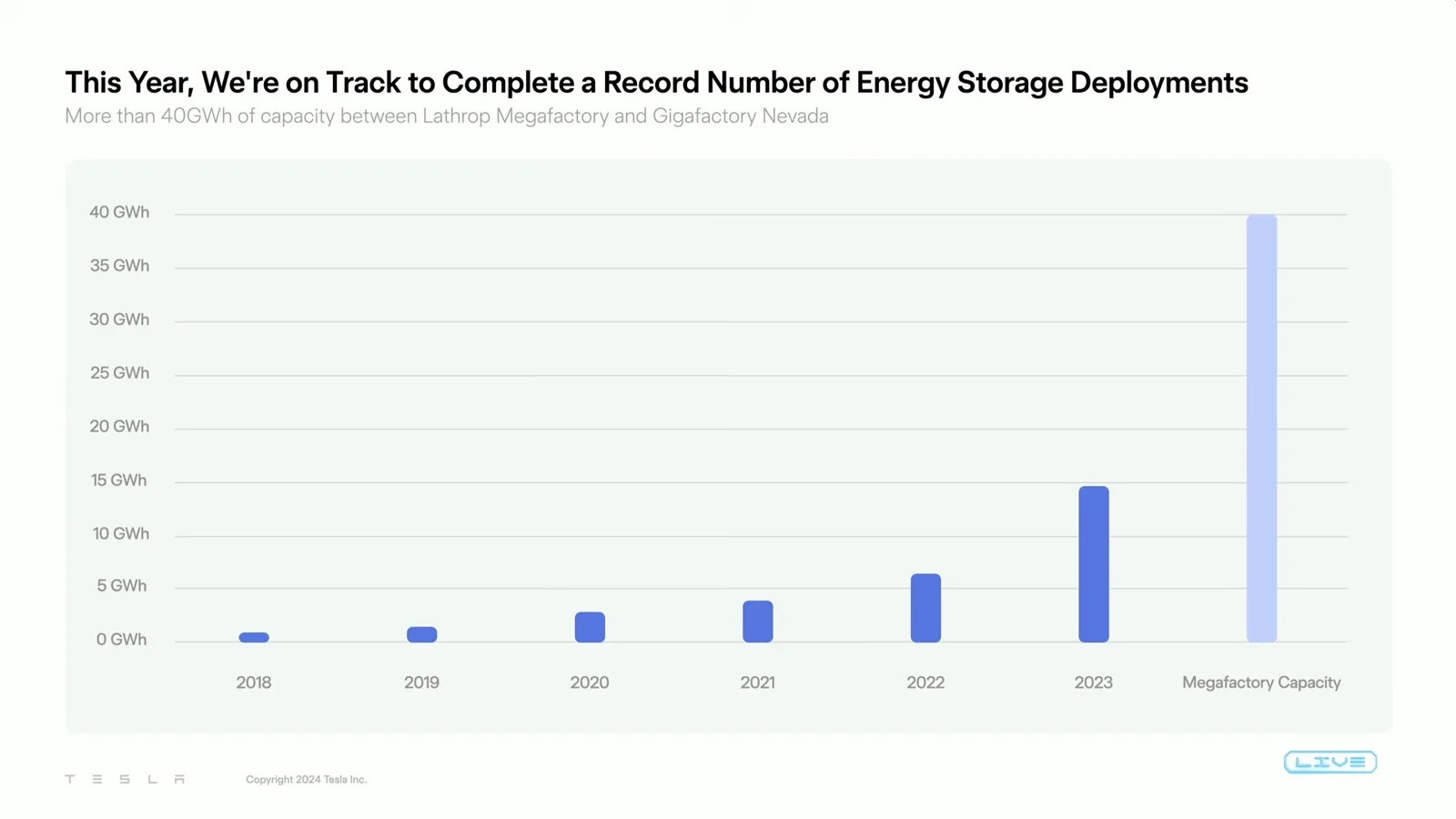
Musk forecasts rapid growth in stationary energy storage deployments and discusses ramping Powerwall 3 and Megapack production. He describes a future Megapack design that could integrate more power equipment.
AI chips, model testing and robot manufacturing
He discusses vehicle compute, shadow-mode testing and Optimus prototypes, and makes forecasts about future capabilities.
He characterizes Tesla as a software and hardware company, pointing to vehicle, energy, insurance and internal operations software. He argues that the company’s experience processing real-world video gives it an advantage in AI.
Musk discusses Tesla-designed inference chips, comparing Hardware 3 and 4 and forecasting a more capable AI5 generation. He says later training will make greater use of newer cameras and computing hardware; the performance multiples and schedule are his predictions.
He speculates that a much larger future fleet could offer distributed computing when vehicles are idle, comparing the idea with cloud services. He presents it as a potential opportunity, not an existing business.
Musk says evaluating increasingly capable driving models can become a bottleneck. He describes shadow mode, where a model’s hypothetical decisions are compared with human driving, alongside simulation and testing at difficult intersections.
He predicts a future software update could let owners add eligible cars to an autonomous fleet. The idea depends on technical capability, regulatory permission and other conditions; the supervised feature discussed at the meeting still required a driver.
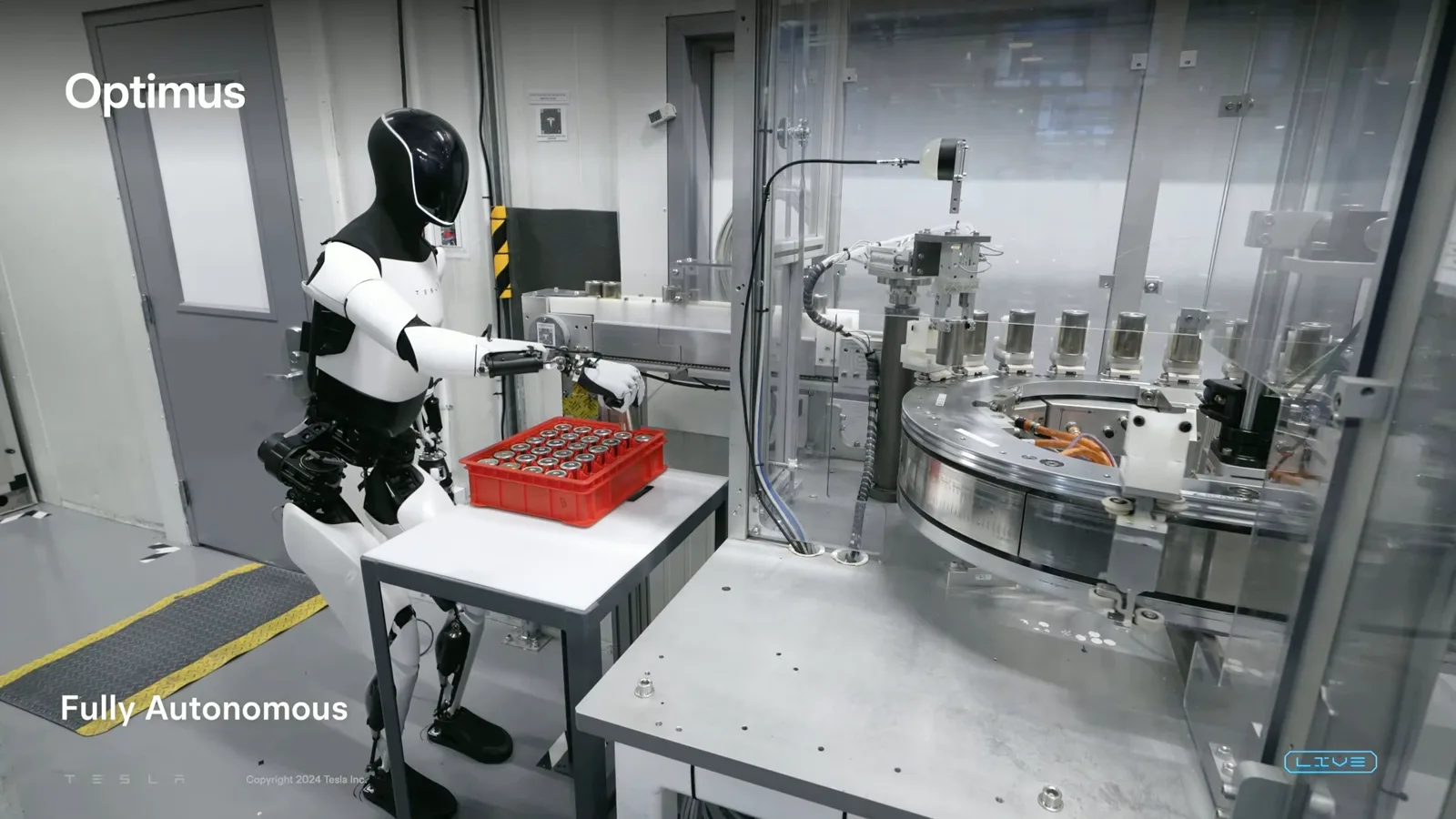
Musk says two Optimus prototypes were performing a task involving cells at the Fremont factory. He predicts limited production for Tesla’s own factories and says broader tasks and better autonomy would require further development.
He argues that a humanoid robot requires integrated motors, gearboxes, sensors, power electronics, AI hardware and software, and manufacturing at scale. He predicts a larger market and lower costs, while acknowledging substantial work remains.
Shareholder questions on safety and products
Questions cover free speech, driver-assistance safety, affordability, software transfers, security and remote assistance.
During questions, an attendee thanks Musk for supporting free expression. Musk says he bought Twitter, now X, because he considers speech important to society’s future.
A Tesla employee asks about bundling software to encourage FSD adoption. Musk suggests offering free trials after significant improvements and says later versions should require fewer interventions.
Asked about safety incidents during the path to autonomous driving, Musk says deployment should be careful and argues that safety per mile is the relevant measure. His comparison is a company claim and does not establish that unsupervised driving is available or safe in all conditions.
Other shareholders ask about Tesla’s valuation, a referral program and a larger passenger vehicle. Musk repeats an outside valuation forecast, says a referral program could be reconsidered and calls vehicle affordability the main demand constraint.
Asked whether customers can transfer purchased FSD to a replacement vehicle, Musk cites sales and revenue complexity but agrees to extend the transfer offer for one more quarter.
A shareholder asks about Musk’s personal health and security as a business risk. Musk says he needs to be careful about security and appreciates the concern.
Asked about home heating and cooling, Musk says an efficient system with filtration and humidity control would be interesting but is not a high priority. Another attendee suggests factory tours for younger children; Musk says Tesla could consider a limited, safer tour.
A shareholder asks why Trump has spoken positively about Tesla despite criticizing electric vehicles. Musk says they have spoken and suggests Trump’s friends’ experiences with Teslas may be a factor.
Asked how a driverless car would handle an unusual situation, Musk says it should be cautious around pedestrians and cyclists. He suggests that if a vehicle becomes stuck, a remote operator might help, while presenting this as a possible future approach.
Battery costs, AI scaling and the final questions
Musk discusses 4680 costs, international Cybertruck certification, model evaluation, robot development and lithium refining.
A shareholder asks about scaling 4680 cells and lowering vehicle prices. Musk says battery-cell prices from suppliers had fallen and that affordability requires reducing costs across thousands of vehicle components, not just the pack.
He says Tesla’s 4680 cells then cost more than supplier cells and predicts a difficult path to cost parity by year-end. He compares the supply cycle to memory chips, where shortages and oversupply can change prices sharply.
Asked about international Cybertruck sales, Musk says the vehicle was designed for North American requirements. He says versions for Europe or China may require design changes and certification, and that the company should first increase production and reduce cost.
He describes cost reduction after a product reaches production as a lengthy grind across many parts. Asked about the Foundation Series, he says non-Foundation versions are expected to begin the following quarter.
A shareholder asks how FSD scaling depends on data, training and inference compute. Musk says large training clusters and video storage are difficult to operate, and predicts successive software versions will improve substantially.
He distinguishes static obstacles from harder dynamic situations such as complex intersections and broken or misaligned traffic signals. A new model can fix one problem while introducing another, so Tesla compares models using simulation, shadow mode and selected challenging intersections.
Asked whether Optimus could use language models and customizable personalities, Musk says yes and imagines a robot adapting to its owner. He later predicts robots could generalize from basic learned actions to a wider range of tasks; these are future capabilities he expects.
Musk says Tesla intends to focus on high-volume production of a humanoid design instead of many low-volume robot variants. He argues that scale and manufacturing design are essential to bringing cost down.
A shareholder asks about Tesla’s future without him. Musk says the company could still do well, but describes his own role as accelerating innovation and production before competitors reach the market.
An attendee asks about overnight parking and charging for people visiting Starbase in electric cars. Musk says he will inquire about places where people could stay in their vehicles and charge.
Asked about lithium refining, Musk says global capacity is adequate if Chinese refining is included, but geopolitical disruption could create shortages. He says Tesla’s Texas refinery helps the company understand and manage that risk.
In the final exchange, a participant proposes an intermediate rental-car service in which an empty vehicle would drive to a customer overnight and then operate under supervision. Musk thanks him and reiterates his expectation of rapid FSD improvement before closing the meeting.
같은 채널의 다른 글
 24:44EN
 Tesla· 2026년 11월 6일Elon Musk Unveils the Cybertruck: Steel Body, Cracked Glass and a New Pickup DesignElon Musk · TeslaAt Tesla’s 2019 event, Musk introduced the electric pickup and demonstrated its body, glass, suspension and cargo bed.
 59:56ENTesla· 2026년 10월 21일Tesla Q3 2026: Cash Flow, FSD Demand and the Cost of Scaling RobotsElon Musk, Vaibhav Taneja, Travis Axelrod · TeslaExecutives discuss quarterly margins, capital spending and plans for Cybercab, Optimus and chip production.
 23:21ENTesla· 2026년 10월 16일Tesla’s Roadster Event: A Ramp Stunt, Aerodynamics and a 2028 Production TargetElon Musk, Franz von Holzhausen, Lars Moravy · TeslaElon Musk, Franz von Holzhausen and Lars Moravy demonstrate a prototype developed with SpaceX engineering.
 1:09:55ENTesla· 2026년 7월 22일Tesla’s Q2: Margins Narrow as Spending on Robots and AI RisesTravis Axelrod, Elon Musk, Vaibhav Taneja, Ashok Elluswamy, Lars Moravy · TeslaTesla reported higher energy deployment and negative free cash flow while executives outlined Robotaxi and Optimus plans.
 27:27ENTesla· 2026년 5월 21일Tesla’s Final Model S and X Deliveries: How the Cars EvolvedElon Musk, Franz von Holzhausen, Lars Moravy · TeslaElon Musk and Tesla’s team recall a tent-based design studio, years of changes, and plans for the former production line.
 1:05:20ENTesla· 2026년 4월 22일Tesla Plans a $25 Billion Investment Year as It Prepares OptimusTravis Axelrod, Elon Musk, Vaibhav Taneja, Lars Moravy · TeslaOn Tesla’s Q1 2026 call, executives detail one-time margin gains, battery constraints and plans for robots and driving software.