30초 요약
Theo discusses Cloudflare bringing in VoidZero, its open-source commitments and the opportunity to connect Vite tooling to cloud infrastructure. He compares platform tradeoffs and demonstrates Lakebed, his own unreleased project, while identifying his competitive interest and speculative predictions.
- 1VoidZero joins CloudflareTheo interprets the acquisition through the future of application building and deployment.
- 2Code-driven infrastructureVoid aims to connect application imports and configuration to platform resources.
- 3An open-source commitmentThe announcement says the toolchain will remain vendor-agnostic and community-driven.
- 4Different parts of the stackTheo compares Vercel and Cloudflare using a simplified map of platform capabilities.
- 5Lakebed demonstrationTheo shows an unreleased project that aims to help agents build and deploy an application.
- 6Funding and a CLI directionCloudflare announced a Vite ecosystem fund and described goals for a unified CLI.
핵심 정리
- VoidZero and Cloudflare said the Vite toolchain would remain open source and vendor-agnostic.
- Faster AI-assisted coding can make initial deployment and service setup a more visible bottleneck.
- Theo’s platform comparison reflects his experience rather than a complete measure of portability or features.
- Lakebed was unreleased when demonstrated and its competitive implications are speculative.
- Cloudflare announced funding for the Vite ecosystem and described a direction for its unified CLI.
챕터별로 다듬은 전문 읽기
Vite and the acquisition
Theo introduces the VoidZero team and his interpretation of its fit with Cloudflare. He also discloses his competing project.
Vite has become one of the most important tools in web development because it makes building applications fast and reliable. The ecosystem around it includes Vitest, Rolldown, Oxc and Vite+. Now Cloudflare is bringing in VoidZero, the company founded by Vue and Vite creator Evan You.
I think the acquisition makes sense if you look beyond a bundler to the cloud that coding agents will use. I have been watching the relationship between the two companies, and I am also building a potential competitor myself. My view of their strategy is an interpretation, not a statement of their private plans.
Why deployment remains hard
Void aims to connect application code to the infrastructure it needs. Theo compares deployment setup with faster AI-assisted development.
VoidZero had been developing Void as a platform for deploying applications built with tools like Vite. Its aim was to make the transition from a working local app to real infrastructure much easier. That goal resonates with me because many developers have working projects on their computers that they never deploy.
Years ago I spent roughly 30 to 40 hours building my streaming marker tool and another two or three hours setting up deployment, a database and authentication. That overhead felt acceptable relative to the build. When AI can help me produce a working project in perhaps half an hour, the same setup time feels much larger.
Void’s proposed workflow uses a Vite plugin and a deployment command to connect application code to infrastructure. Importing a database or another service can describe what local development and production need. The broader idea is that code should tell the platform what resources to provision, rather than requiring separate dashboards and configuration for every component.
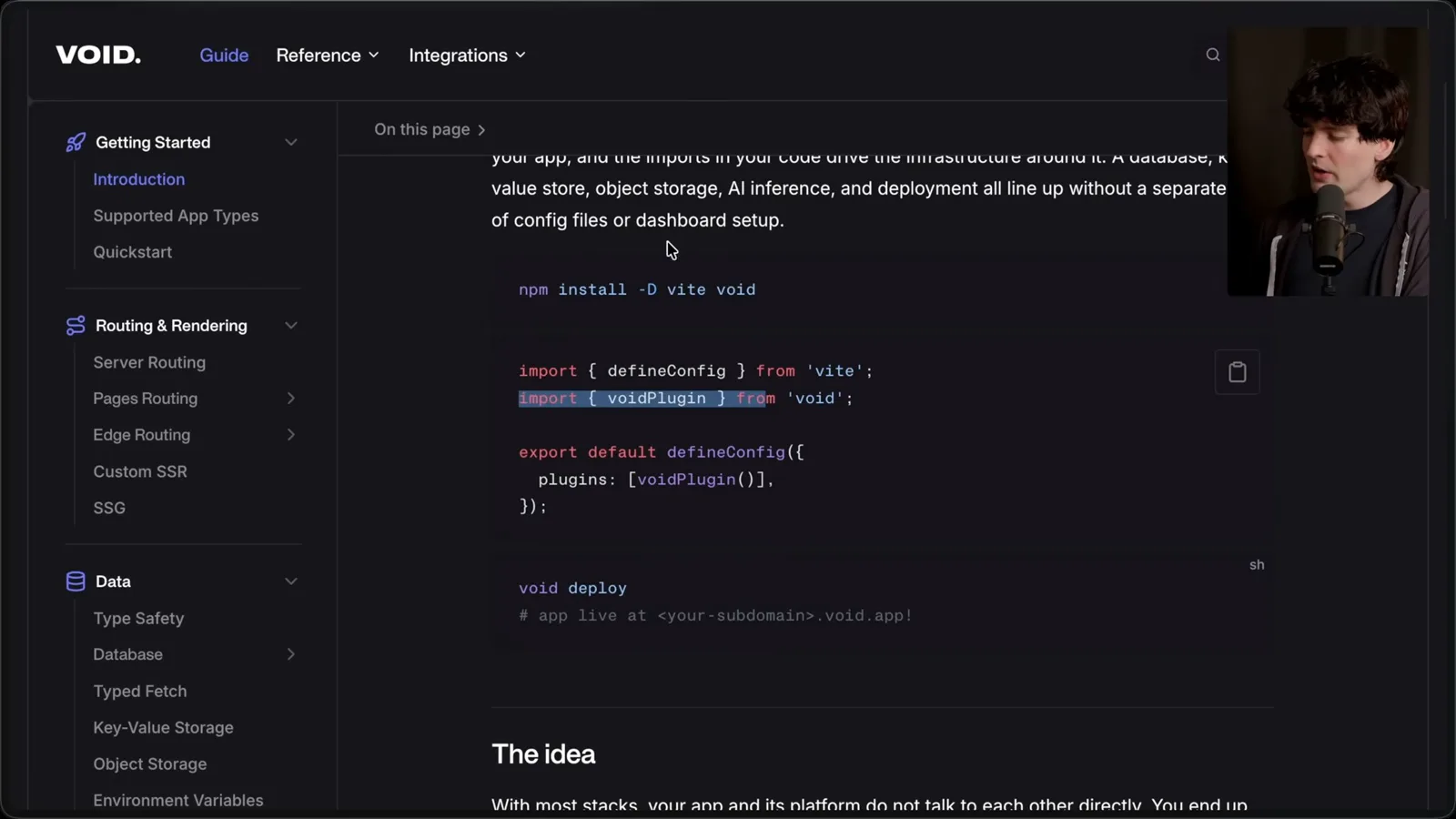
To be clear, my three-hour example is the initial work of connecting services and configuring a new project, not the duration of every subsequent deployment. Once a project exists, pressing deploy does not necessarily take three hours. My point is that creating the setup has not improved as quickly as writing the application.
Void uses existing ecosystem conventions, including database schemas defined with Drizzle, and deploys server code on Cloudflare Workers. I see why that choice makes sense for scalable workloads, while recognizing there are runtime constraints and provider-specific tradeoffs. The acquisition brings the team and its platform work closer to the infrastructure underneath.
Open source and developer experience
Cloudflare commits to a vendor-neutral toolchain. Theo recounts his experience with Cloudflare configuration and compares it with Vercel.
Cloudflare’s announcement says the VoidZero team is joining and that Vite, Vitest, Rolldown, Oxc and Vite+ will remain open source, vendor-agnostic and community-driven. Those are commitments in the announcement; the community will still need to watch how governance and portability work in practice.
My provocative take is that applications built specifically for Cloudflare often involve more provider-specific configuration than a typical Next.js application deployed on Vercel. This is my experience, not a universal portability measurement: a framework can have its own lock-in and deployment differences even when application code does not name the host.
In my experience with Workers, adding features has required Cloudflare configuration and tools such as Wrangler as well as changes to application code. When I tried porting T3 Chat, I wanted one project to serve static files and API routes, but encountered conflicting overrides and documentation. Cloudflare subsequently produced better templates for the pattern.
By comparison, I found it straightforward to create a Next.js app and connect its repository to Vercel. Cloudflare has strong infrastructure, but I think the gap between a locally working app and a deployed one has historically been too large. Runtime differences, including Node compatibility in an isolate-based environment, can also matter for some workloads.
I also describe problems our UploadThing team encountered with successive Cloudflare Terraform provider versions: the features we needed were not all available together in the versions we tried. That is a specific historical account, not a claim about every current release. It reinforces my frustration with how much platform knowledge deployment can require.
In my assessment, Cloudflare has sought help with developer experience through teams and acquisitions, while Void was already building an easier layer on top of its infrastructure. The aim is to reduce the amount of Cloudflare-specific work developers need just to ship an application.
Mapping the application stack
A simplified diagram shows different platform strengths across frameworks, bundlers, compute and databases. The comparison is Theo’s assessment.
I draw a rough spectrum of application-platform concerns: CSS libraries, frameworks, bundlers, CDNs, compute and databases. It is a conceptual map, not a comprehensive comparison of products. It helps explain how two cloud platforms can be strong at different parts of the same developer workflow.
I place Vercel primarily around the framework-to-compute portion. Next.js and deployment are closely integrated, but in my projects authentication and databases often involve separate services such as Clerk, WorkOS, Convex or PlanetScale. Connecting those pieces becomes tedious when creating many applications.
I place Cloudflare closer to CDN and compute, with services such as D1 extending toward databases. My characterization is an opinion about the platform’s relative strengths, not a complete product inventory. In this view, VoidZero gives Cloudflare stronger tools on the framework and build side.
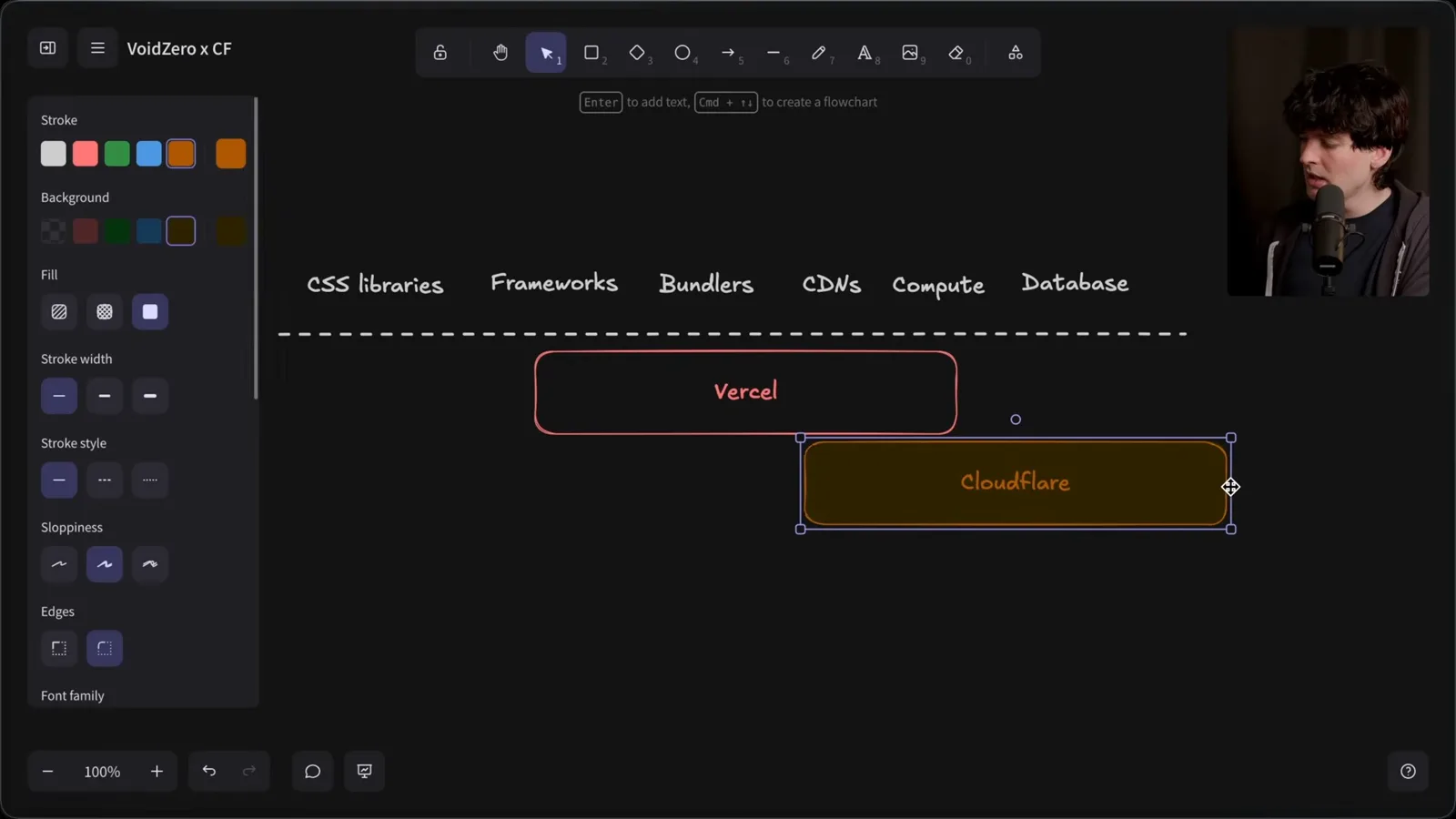
I mention Hono as an example of a small routing library whose creator works closely with Cloudflare; I correct myself that employing its creator is not the same as owning Hono. My wider concern is whether developers can build and deploy a complete application without repeatedly adapting its pieces to a particular platform.
Lakebed and agents
Theo demonstrates his unreleased platform and an agent-built kanban application. He explains why code-oriented infrastructure may appeal to agents.
My own project, Lakebed, was not publicly released at the time of this video. It is a useful lens for the same problem. I assume coding agents are better at working through code than navigating complicated dashboards, and I think that changes the value of an interface an agent can operate directly.
AI also changes which ambitious projects are practical to attempt. A large integration layer may previously have demanded too much tedious work; agents can help implement more of that work. That does not remove the difficulty of design, integration or ongoing maintenance, but it changes the economics of trying.
Lakebed relies on existing components: I describe Tailwind for CSS, a lightweight Preact fork, esbuild for bundling and adapters over other CDN, compute and database services. The goal is an SDK-like layer that lets an agent work inside a project and access the necessary primitives without manually assembling many separate tools.
In the demo, I create a project with `npx lakebed new` and deploy it with `npx lakebed deploy`. I say the resulting app has a database, authentication and synchronization. This is a demonstration of an unreleased project at the time of recording, not evidence that the workflow is generally available or production-ready.
I ask a coding agent to turn the app into a shared kanban board with live chat and deploy it. The demonstration includes a temporary 404 and a permission prompt before the updated app appears. Viewers then interact with the board and chat. The point is to show a workflow, not a controlled benchmark of agent reliability.
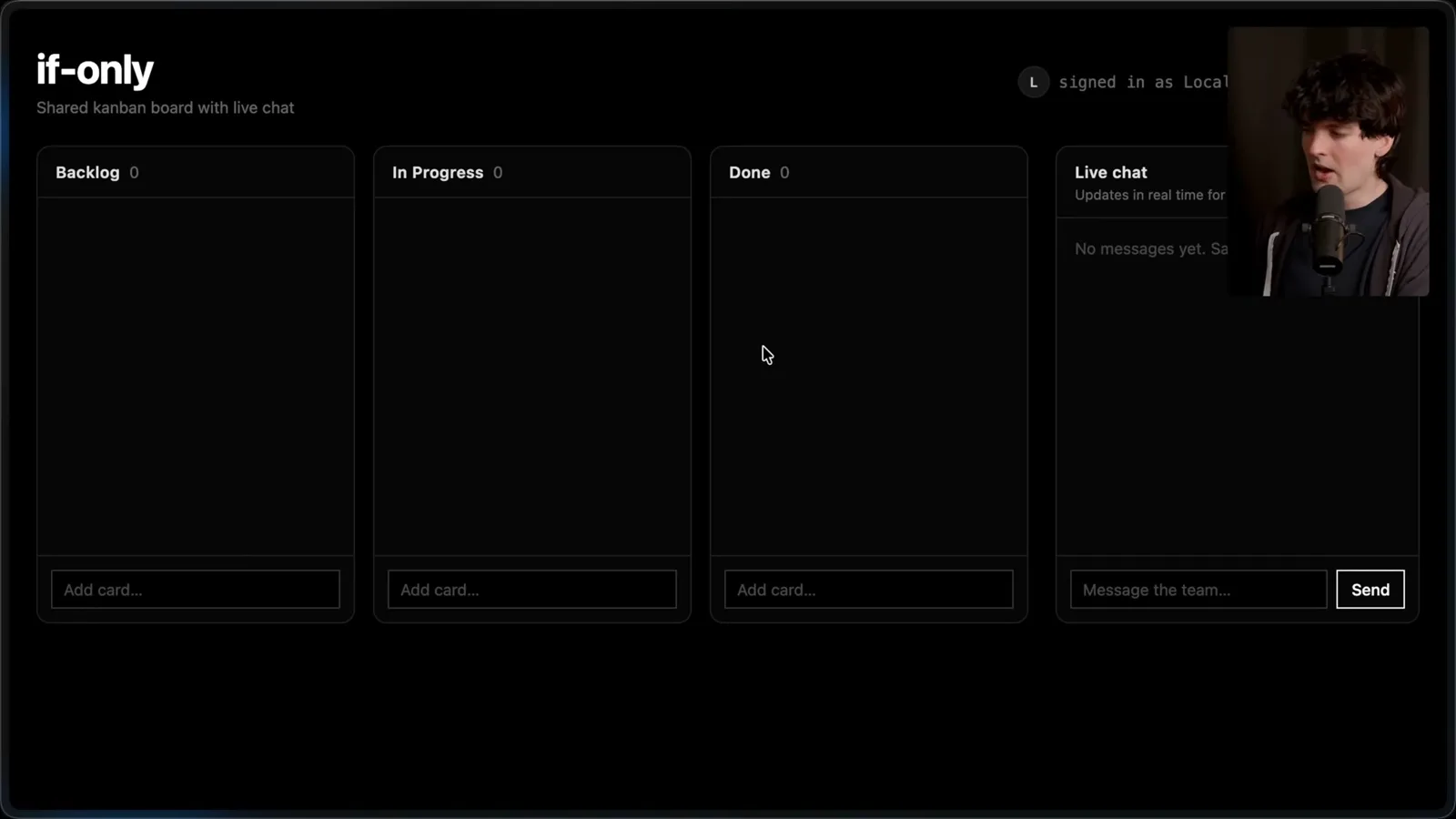
My broader prediction is that more platforms will expose enough familiar primitives for agents to build and deploy applications with fewer separate setup steps. I see VoidZero as already supplying tools agents know and Cloudflare as supplying infrastructure. Whether their combination delivers that experience remains to be seen.
Competition and next steps
Theo discusses potential competition, ecosystem funding and Cloudflare’s proposed CLI. He closes with predictions rather than insider claims.
That combination worries me more as a Lakebed builder than either company did alone. I speculate about what would happen if Cloudflare also acquired a company like Convex, because the relationship between the database and client is a difficult missing piece. This is hypothetical; I do not claim such a deal exists.
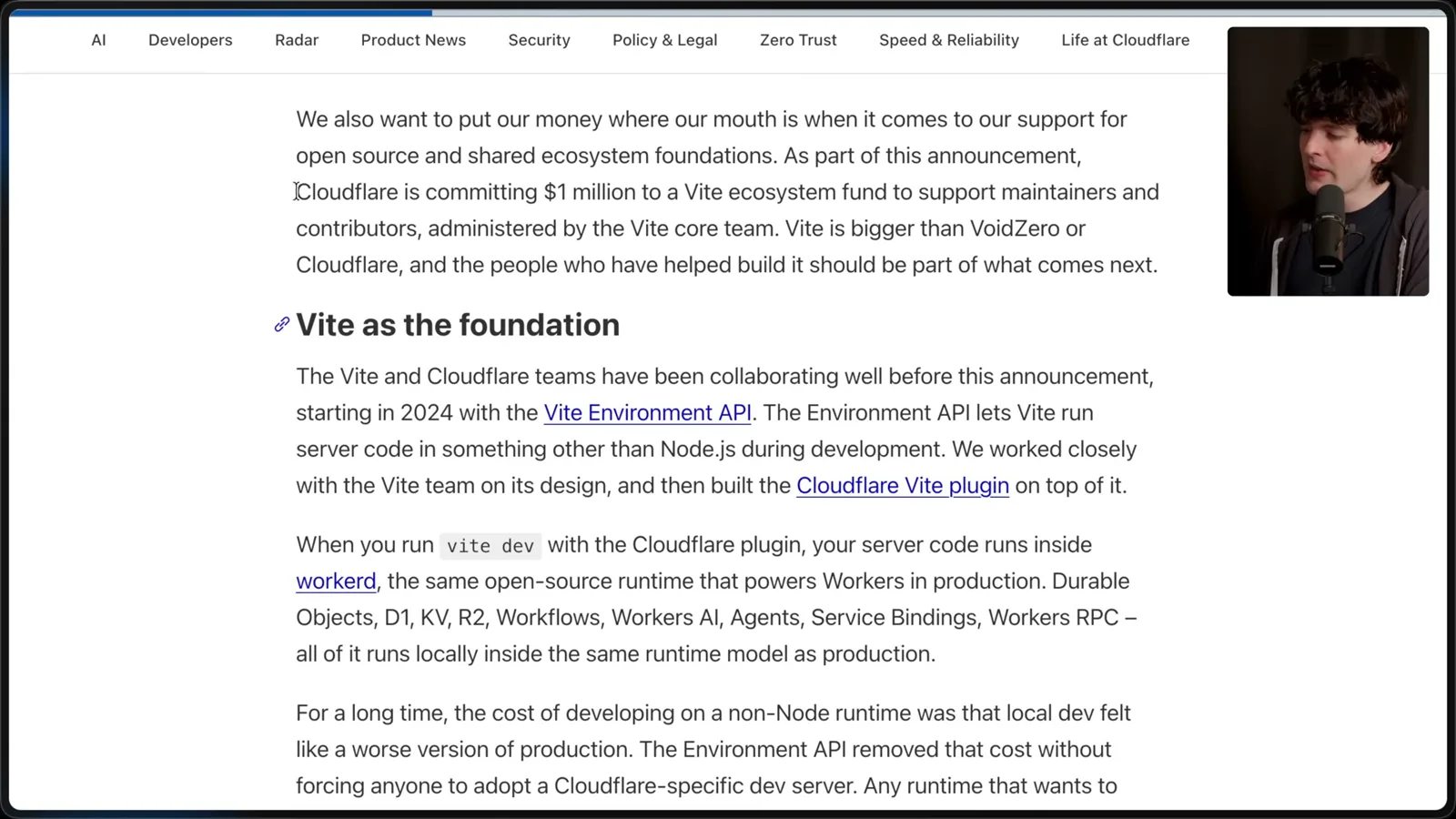
Cloudflare also announced a $1 million Vite ecosystem fund, administered by the Vite core team, to support maintainers and contributors. That matters because many contributors work outside both VoidZero and Cloudflare. I welcome the stated support for the wider ecosystem.
The existing Cloudflare Vite plugin showed how much easier deployment can be when tools are integrated with the platform. The announcement describes Vite’s Environment API and a local Workers runtime. I think familiar, well-documented Vite workflows can be attractive to agents as well as human developers.
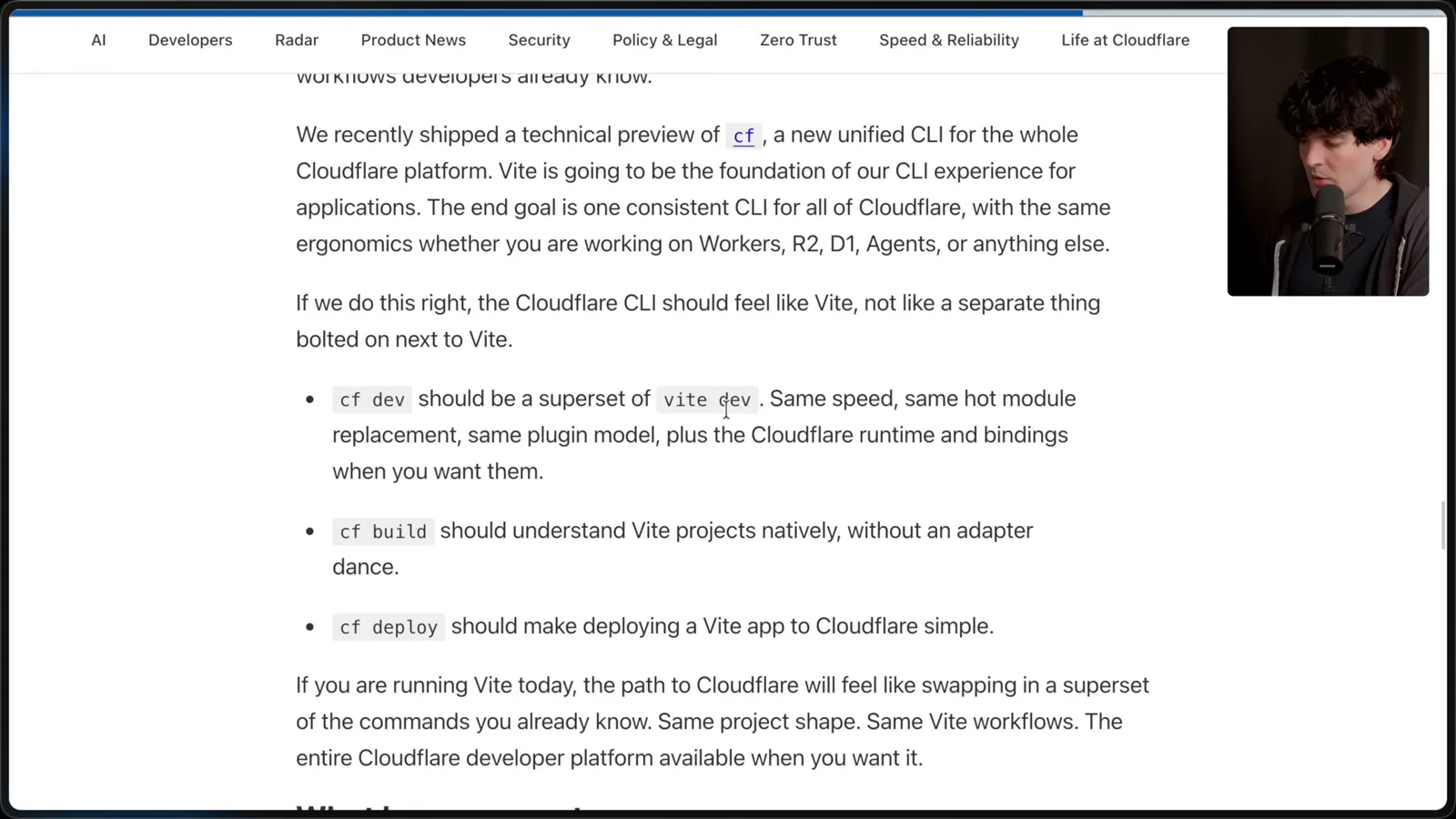
Cloudflare’s announcement outlines a technical preview of a unified `cf` CLI, with goals for `cf dev`, `cf build` and `cf deploy` to work naturally with Vite projects. I find that direction promising, though the screen also shows older Vite and Wrangler commands. The described CLI behavior is a stated goal, not a guarantee that every feature is already complete.
The acquisition could make Cloudflare more competitive as the cloud market adapts to AI-assisted development. I am excited to see what happens to the Vue ecosystem, VoidZero’s tools and Lakebed. My speculation about where other projects might end up is just that: I say I have no inside information.
같은 채널의 다른 글
 38:47EN
 Theo - t3․gg· 2026년 10월 28일Theo’s Long-Running Agent Experiments: Verification, Compute and CostTheo Browne · Ping LabsA skateboard game and two compiler projects show how repeated checks and flexible compute can sustain agent work—and how expensive those loops can become.
 36:07ENTheo - t3․gg· 2026년 10월 27일Theo on Token Costs, Coding Agents, and the Price of AI CapabilityTheo Browne · Ping LabsA viral estimate of Lauren's AI spending prompts a closer look at cache pricing, benchmarks, and the changing work of coding agents.
 30:37ENTheo - t3․gg· 2026년 10월 26일Theo’s Three Skills for Reviewing and Shipping with Coding AgentsTheo Browne · Ping LabsHow sol-loop, full-send and full-stop encode review, verification and different levels of merge authority.
 0:43ENTheo - t3․gg· 2026년 10월 23일Theo Distinguishes Security Vulnerabilities from Active AttacksTheo Browne · Ping LabsA short explanation of why disclosed software flaws and reported attacks are different kinds of security news.
 29:22ENTheo - t3․gg· 2026년 10월 22일Theo on Security Vulnerabilities, Stolen API Keys and AITheo Browne · Ping LabsA look at the gap between vulnerability disclosure and patching, and a speculative account of why stolen inference keys may be valuable.
 31:13ENTheo - t3․gg· 2026년 10월 20일Theo on Why Smarter Models Help More Than DevelopersTheo Browne · Ping LabsFrom game modifications to compiler experiments, Theo revisits his assumptions about who benefits from more capable AI.