30초 요약
Zachary Blumenfeld of Neo4j presents graph engineering as an explicit way to organize agent work, context and procedures. He argues that graph-shaped artifacts can make steps easier to govern, inspect and reuse across runtimes. A fictional loan-review demo compiles successful traces and policies into a portable skill, with programmatic routing and human escalation. He reports faster runs in a small demonstration and distinguishes it from formal research.
- 1Three kinds of graphExecution graphs coordinate work, context graphs connect evidence, and procedural graphs express repeatable steps.
- 2Compile a skillThe approach turns written procedures and supporting files into nodes for decisions, routes and execution.
- 3Traceability is not enforcementA record of an agent’s decisions does not by itself ensure that future runs follow the same path.
- 4Route programmaticallyThe demo uses a CLI and scripts to enforce parts of the loan-review procedure.
- 5Treat the results as a demoThe small comparison reports faster execution and lower cost with a smaller model, not a general benchmark.
핵심 정리
- Execution, context and procedural graphs serve different roles in agent systems.
- A portable procedural graph can make steps, routing and provenance explicit.
- Written skills and decision traces can be compiled into structured artifacts with scripts and references.
- Programmatic rules and escalation can limit the decisions left to a model.
- The loan example is a small demo; its timing and cost figures should not be generalized without further testing.
챕터별로 다듬은 전문 읽기
Three views of graph engineering
Blumenfeld defines execution, context and procedural graphs and describes portability and governance.
Zachary Blumenfeld of Neo4j defines graph engineering as designing agent work as an explicit graph: nodes do work and edges route state. The name is new, he says, but ideas such as state machines, workflow graphs and knowledge graphs are not.
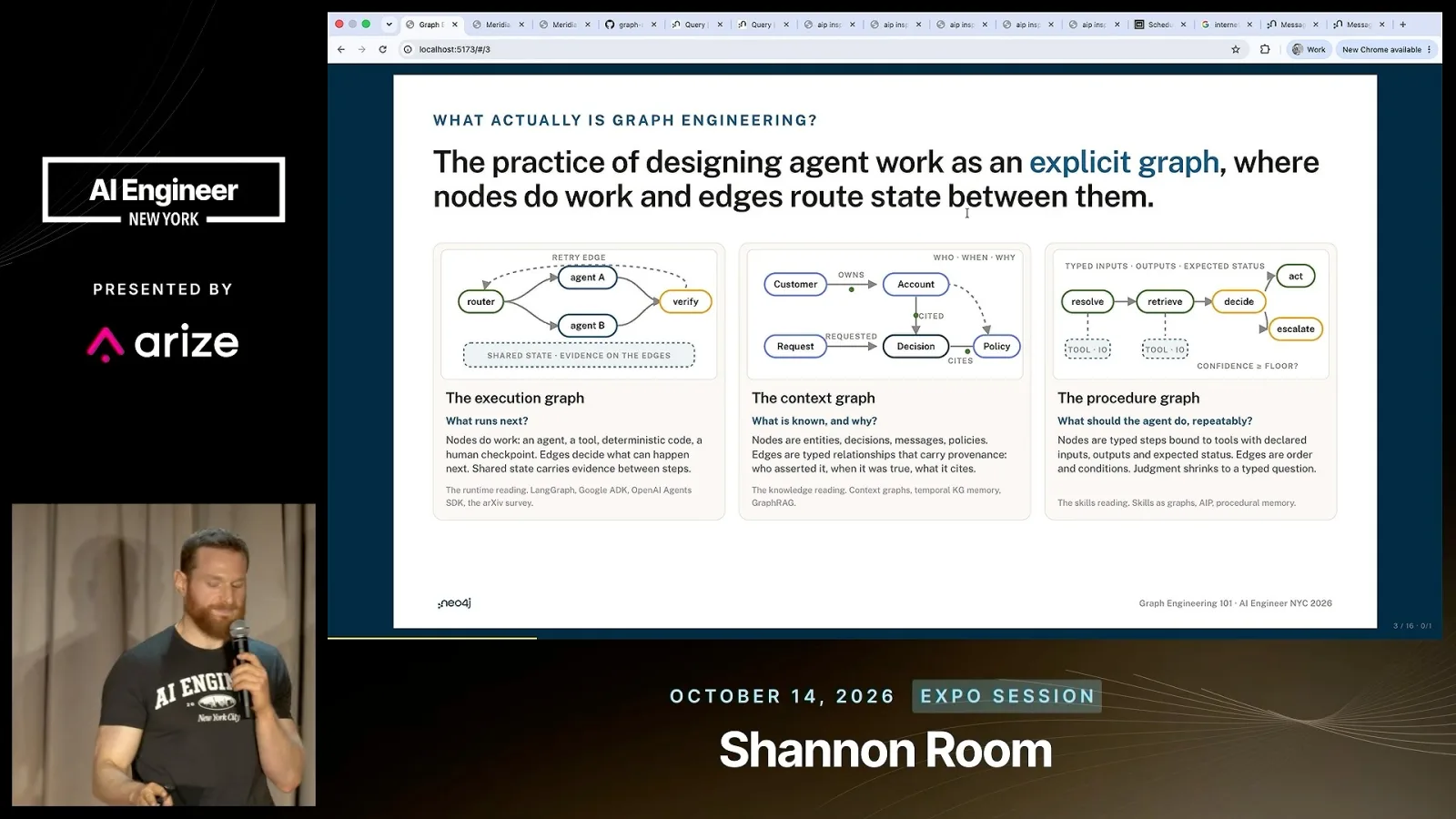
He distinguishes execution graphs, context graphs and procedural graphs. Execution graphs coordinate runtime work; context graphs connect decisions and traces to domain data; procedural graphs represent steps, routing, validation and escalation in a repeatable process.
Blumenfeld argues that explicit graphs can make behavior more predictable, governable and auditable. A graph stored as an artifact alongside data can also be portable between runtimes, rather than existing only inside one orchestration framework.
Skills and memory as graph artifacts
He discusses compiling procedures and connecting them to prior decision traces and source data.
He describes a knowledge layer between systems of record and agents. In Neo4j’s approach, this layer connects source data, documents and memory, while protocols and artifacts expose procedures to different agent runtimes.
A context graph can connect short-term conversation history, longer-term entities and decision traces. Neo4j researchers asked whether procedural knowledge in a written skill, its scripts and references could be compiled into a graph of decisions, routes and executable steps.
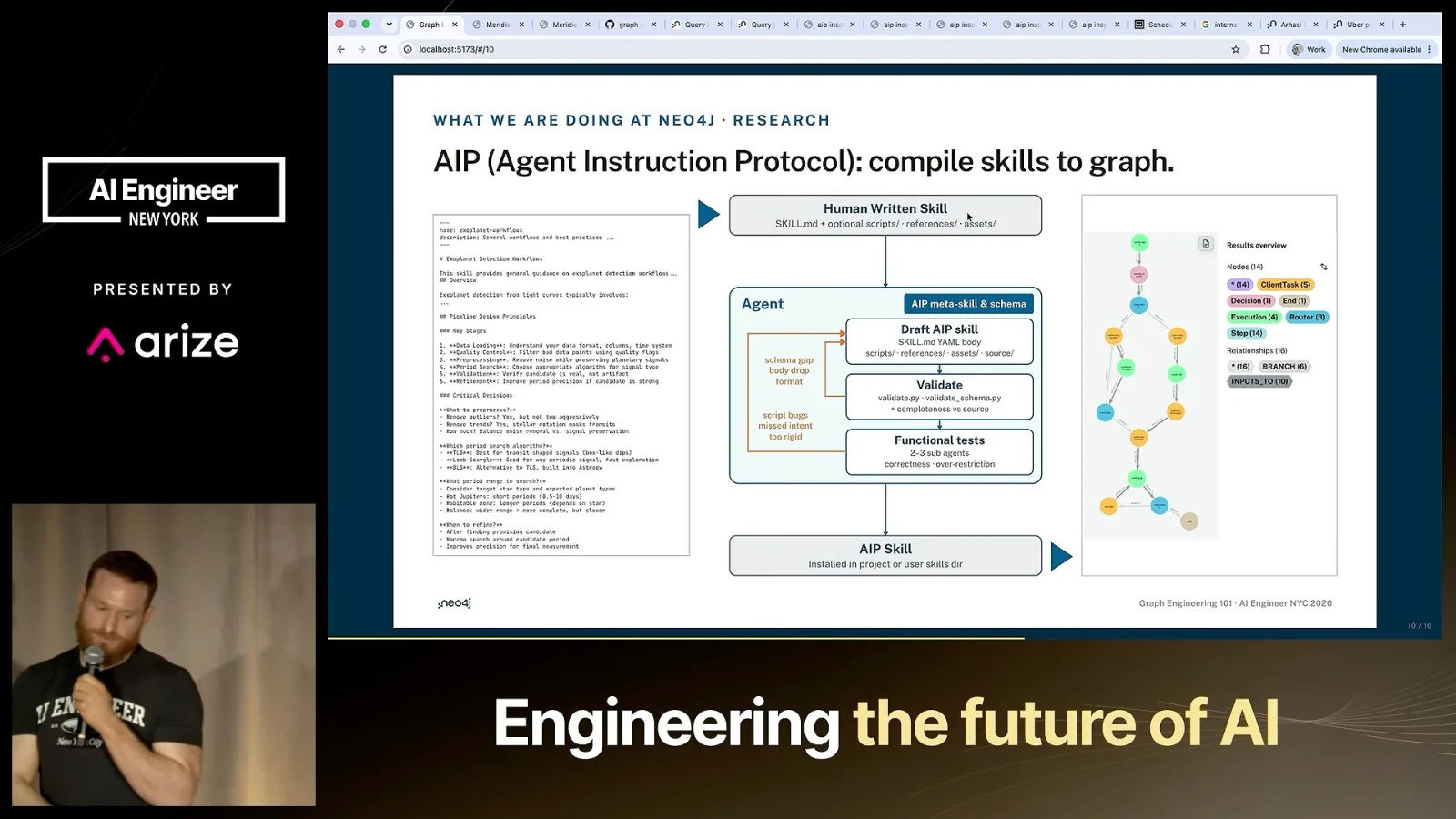
Blumenfeld says their earlier research found higher task reward when agents followed the compiled graph, including with a smaller model. He notes the results were from earlier experiments and were being updated for newer models.
The team also explored distilling a skill from memory and connecting it to prior decision traces. He says this can preserve provenance, version history and governance, allowing humans to inspect or revise the process and trace where decisions came from.
He gives examples of compliance reporting across multiple data sources and geographic configuration rules. In each case, the proposed graph connects data to the logic needed to interpret it. He notes that customers may use different implementations from the lab project.
A loan-review demonstration
A fictional application combines policies, a business plan and past decisions. The team compiles a procedure to make routing more explicit.
The demo concerns a loan decision for a fictional bakery. The agent combines a business plan, past transactions, lending policy and previous decisions. Blumenfeld emphasizes that this is a demo, not a formal research result.
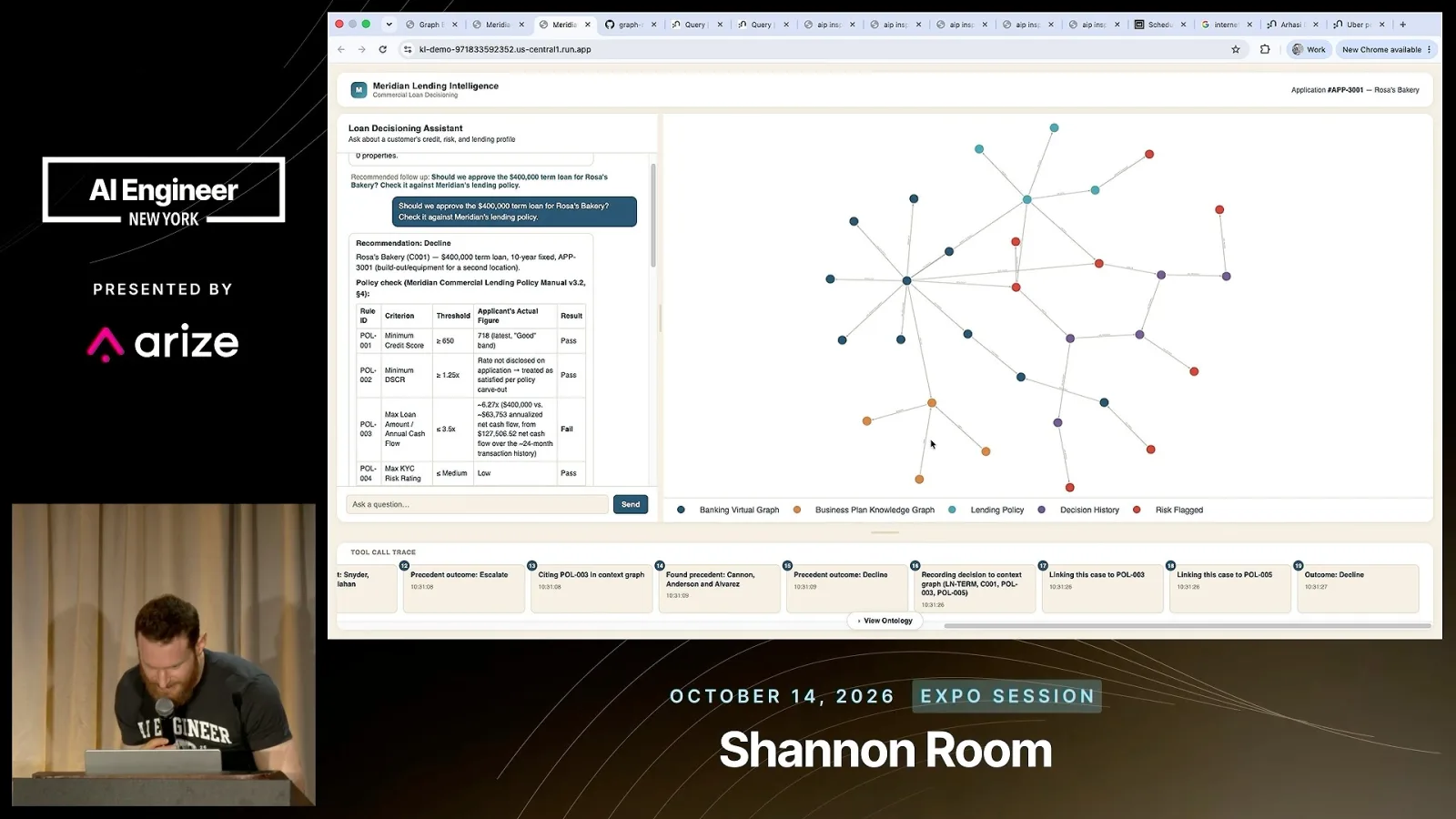
A graph connects those sources and records the agent’s reasoning and tool calls. But repeated runs can take different paths, and confidence claims around approval, denial or escalation are not necessarily calibrated.
The team compiles information from successful runs and policy documentation into a graph-shaped skill represented in YAML, with scripts and supporting assets. The aim is both traceability and a portable description of how to execute the procedure.
Execution, inspection and results
Scripts route the process and store individual runs for inspection. Blumenfeld reports limited demonstration results.
A command-line wrapper lets the agent run the compiled procedure. Rather than asking the model to decide every routing step, the system handles much of the policy and routing programmatically.
The demonstrated flow first checks hard policy rules. Cases not automatically decided can go to a decision model, then to report writing or human escalation; the report is checked before completion.
Runs and their individual steps can be stored in the graph. An inspector can show status, decisions and branches taken, helping a reviewer understand what happened and which parts of the procedure were exercised.
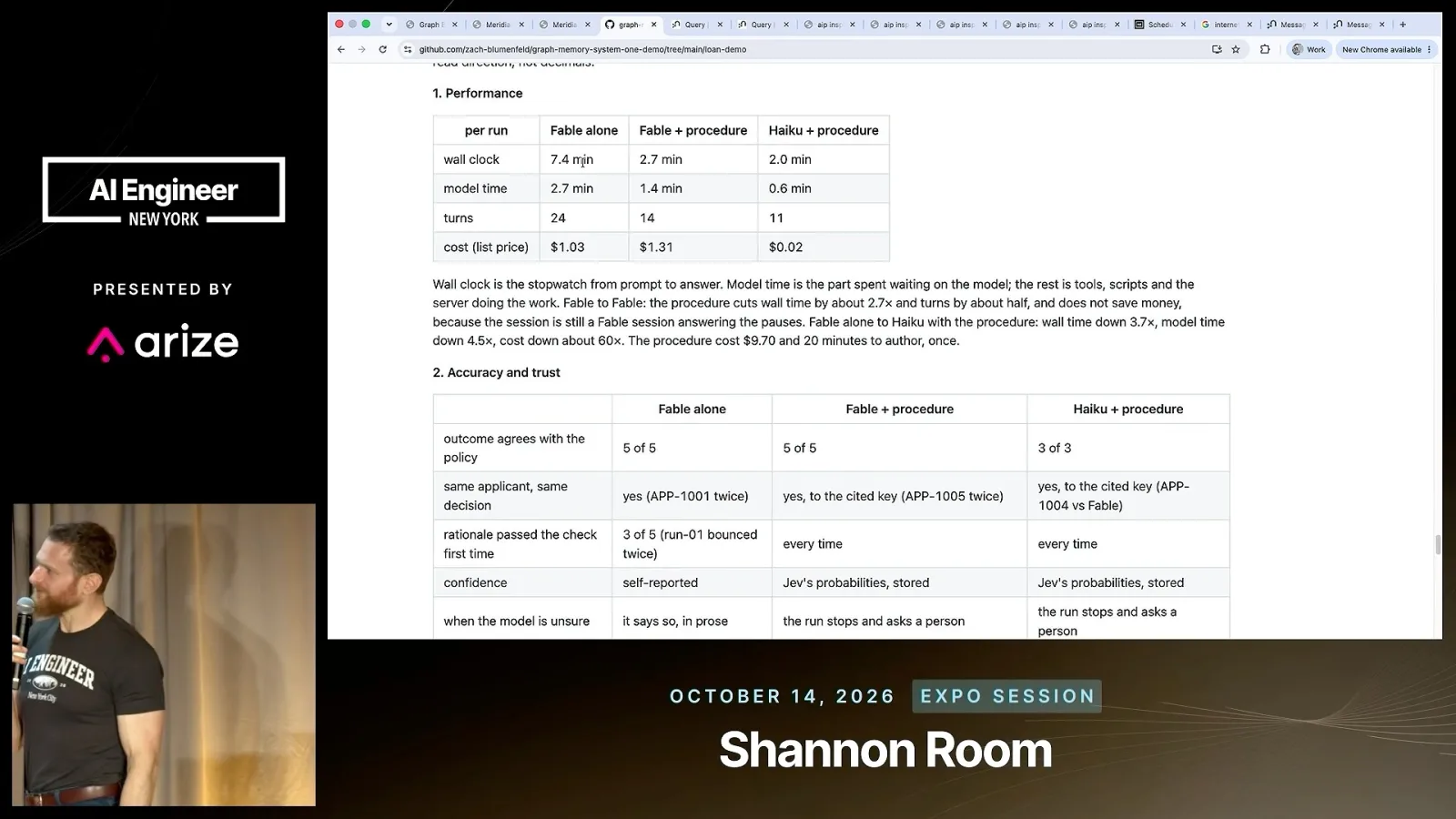
In the small demo, Blumenfeld reports that adding a procedure shortened runtime, and using a smaller model with the procedure reduced it further. The displayed table shows different cost outcomes for the same model with and without the procedure; the cheaper-model combination is the one shown as substantially cheaper.
He stresses that the example involved a few runs and directs viewers to the code and resources. The broader proposal is to make procedural logic explicit and inspectable, while keeping it reusable across agent environments.
같은 채널의 다른 글
 19:12EN
 AI Engineer· 2026년 11월 4일Why AI Agents Need Reliable Processes to Scale Across a CompanyMitchell Troyanovsky · BasisBasis co-founder Mitchell Troyanovsky explains behavior specifications, trajectory forks and simulations for production agents.
 18:01ENAI Engineer· 2026년 11월 4일How NatWest Tests Customer-Facing AI Agents Before LaunchJonathan Osborne · NatWest GroupJonathan Osborne explains routing controls, human validation, unreliable LLM judges and shadow deployment in a regulated bank.
 19:48ENAI Engineer· 2026년 11월 4일Why Datasite Bought Its Document Parser Instead of Building ItAdit Abraham, Raj Bakhru · ReductoRaj Bakhru and Reducto CEO Adit Abraham discuss the engineering trade-offs behind AI for transaction data rooms.
 19:19ENAI Engineer· 2026년 11월 4일Approve the Application, Not the AI Model: Building Evaluation Gates for a BankDoneyli De Jesus · Langfuse by ClickHouseDoneyli De Jesus explains how a bank tested an AI agent on its own data, added a calculator and used domain experts to set production gates.
 16:51ENAI Engineer· 2026년 11월 3일Cristóbal Valenzuela on Interactive Video Models and Runway’s ContinuumCristóbal Valenzuela · RunwayRunway’s co-founder traces next-frame prediction from early generated film to research prototypes for interactive visual interfaces.
 19:42ENAI Engineer· 2026년 11월 3일What Drives AI Agent Costs: Cache Hits, Input Tokens and TurnsGeorge Cameron · Artificial AnalysisArtificial Analysis co-founder George Cameron breaks down an agent benchmark and a framework for choosing models by cost and capability.