30초 요약
Elon Musk says Terafab aims to produce chips for one terawatt of new AI computing capacity per year, much of it eventually in space. His calculation assumes launching about 10 million tons to orbit annually at 100 kilowatts per ton. An initial Austin facility would combine chipmaking, masks and testing to accelerate design changes; separate designs would serve robots and satellites. Musk’s timelines and the far larger lunar-launcher idea are forecasts and proposals.
- 1One terawatt a year depends on huge launch capacityMusk estimates 10 million tons to orbit annually if each ton provides 100 kilowatts; he presents this as a future target.
- 2The Austin fab is intended to shorten design cyclesMusk proposes bringing chipmaking, masks, packaging and testing into one facility so designs can be revised and tested faster.
- 3Cars and satellites need different chip designsThe plan distinguishes efficient inference chips for vehicles and robots from space chips designed around radiation and heat rejection.
- 4The petawatt idea depends on lunar infrastructureMusk imagines a future electromagnetic launcher on the Moon to send much larger quantities of equipment into space.
핵심 정리
- Musk’s one-terawatt annual target assumes about 10 million tons of orbital launches a year at 100 kilowatts per ton.
- The proposed Austin facility would bring chip design iteration, masks, manufacturing and testing closer together.
- The plan distinguishes inference chips for robots and vehicles from radiation- and heat-conscious chips for space.
- Musk predicts orbital computing could become cheaper within two or three years if launch costs fall substantially.
- A lunar electromagnetic launcher is a longer-term concept for scaling beyond the initial target.
챕터별로 다듬은 전문 읽기
A chip project tied to space exploration
Musk introduces Terafab and explains why he wants to expand energy use beyond Earth.
Elon Musk frames Terafab as part of a goal to expand human activity beyond Earth. After an opening sequence, he introduces the proposed chip-building project as a joint effort involving Tesla, SpaceX and xAI.
Musk says he wants a civilization with cities on the Moon and Mars and spacecraft traveling farther into the solar system. He presents the project as infrastructure for that future rather than as a conventional chip factory alone.
He invokes the Kardashev scale, a way of describing a civilization by the energy it can use. He argues that Earth intercepts only a small fraction of the Sun’s output, so very large increases in available power would require collecting energy in space.
Musk compares current human electricity production with the Sun’s total output to illustrate the scale he has in mind. For him, the aim is not just to resolve immediate disputes on Earth but to build a civilization that can explore beyond it.
The near-term project is framed around an annual output of chips for one terawatt of AI computing capacity. Musk says that is a large undertaking by present standards but only a step toward his much larger vision of space-based energy and computation.
He points to Tesla’s vehicle manufacturing and charging network, xAI’s computing infrastructure and SpaceX’s reusable rockets as examples of capabilities the companies could bring. In his account, Starship’s role is to carry the large payloads needed for orbital infrastructure.
The launch and chip supply problem
He outlines his satellite design, launch-rate assumption and comparison with current chip output.
A scale illustration compares Starship, an Optimus robot and a proposed small AI satellite. Musk describes a roughly 100-kilowatt satellite with solar panels and a radiator, and suggests future satellites could be designed at megawatt scale.
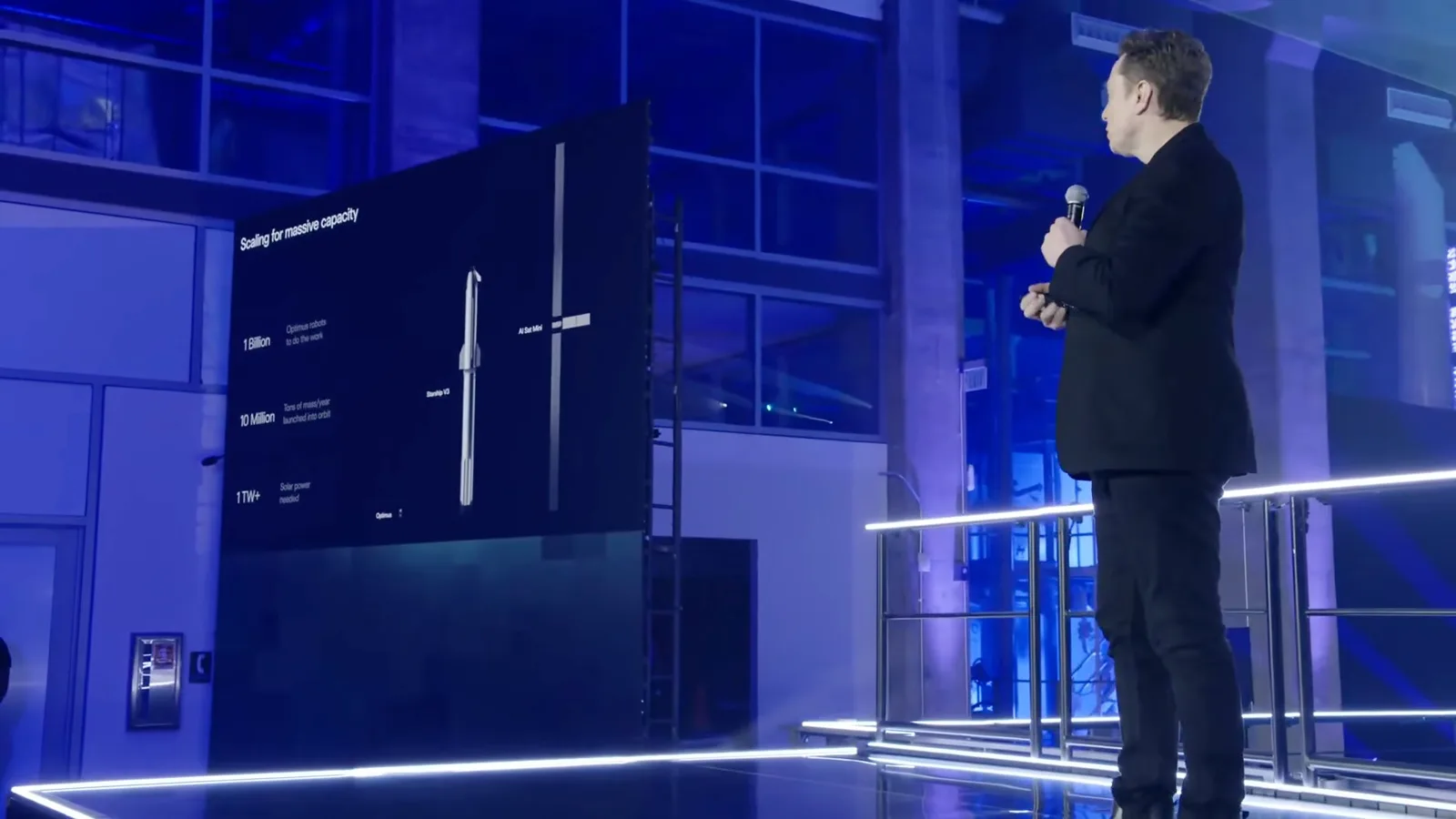
For one terawatt of new computing capacity per year, Musk estimates about 10 million tons of annual payload to orbit at 100 kilowatts per ton. He says he believes SpaceX can eventually reach that launch capacity; it is a projection, not a current launch rate.
He estimates existing global AI chip output at roughly 20 gigawatts of computing power per year and says that would cover only a small fraction of the project’s target. He says he wants existing suppliers, including Samsung, TSMC and Micron, to expand too.
The proposed Austin fab
Musk describes a rapid design-and-test loop and two chip families for terrestrial and space uses.
Musk says the first step is an advanced technology fab in Austin. He proposes putting equipment for logic and memory chips, masks, packaging and testing together so the team can make a design, test it, change the mask and repeat the cycle.
He expects the short design-to-test loop to support experiments with new chip technologies as well as conventional designs. Musk presents faster iteration as a central reason to put so many stages of manufacturing under one roof.
He describes two broad chip categories: efficient inference chips for cars and Optimus robots, and higher-power chips designed for space. He predicts annual humanoid robot production could someday reach one to ten billion units, far above current production.
For space chips, Musk lists radiation, charged particles and heat rejection as design constraints. He says running chips at a higher temperature could reduce the mass of the radiators needed to shed heat.
Why put computing in space?
He predicts that orbital solar power and cheaper launches could change AI costs, and sketches a future lunar launcher.
Musk expects more AI computing capacity to be deployed in space than on Earth because of terrestrial power constraints. He predicts orbital AI could become cheaper than ground-based AI within two or three years, conditional on a large reduction in launch costs.
He argues that solar power in space can avoid atmospheric losses and, with appropriate orbital design, provide long periods of sunlight. He expects lightweight panels and scale to reduce costs, while acknowledging that reaching orbit cheaply is a key condition.
After an animation, Musk asks what could follow a terawatt. His longer-term idea is a lunar electromagnetic mass driver: a device that accelerates payloads from the Moon’s surface without a conventional rocket, taking advantage of the Moon’s lower gravity and lack of atmosphere.
He imagines robots and people building infrastructure on the Moon to enable a thousandfold increase toward a petawatt of capacity. He describes this as a future he hopes to see, not an existing installation.
The abundance Musk imagines
He connects the project to robotics, energy and a speculative future of abundant goods and space travel.
Musk connects the plan to his broader view that sustainable energy, space travel, AI and robotics could create material abundance. He acknowledges that AI could go wrong, while saying he thinks a positive outcome is more likely.
He imagines an economy so productive that ordinary people could travel to Saturn and goods might be effectively free, comparing the idea with Iain M. Banks’s Culture novels. He closes by inviting people to help build the chips, solar capacity and launch system.