30초 요약
An agent that runs for hours needs more than a model call: its harness must route commands to the right environment, expose activity and recover state without repeating actions. OpenAI’s Charlie and Steve describe how the managed Agents API addresses those concerns. In a flight-rebooking demonstration, separate sessions check constraints, hold seats and present their reasoning while a person retains final approval.
- 1A managed harness must solve execution, visibility and recoveryThe speakers identify three problems introduced when agents work remotely for hours.
- 2Users need activity grouped into meaningful turnsRaw tool calls alone did not give one internal team the view it needed.
- 3A dropped connection does not mean an action failedRecovery must account for the environment before repeating a file edit.
- 4The booking agent holds seats for human approvalSeparate checks test arrival and seating constraints before the proposal is confirmed.
핵심 정리
- Separate the cloud harness from the execution environment and route each session’s commands correctly.
- Expose activity and conversational turns so people can follow long-running work.
- Track environment state before retrying a command whose outcome is unknown.
- Use human approval for consequential changes such as confirming a booking.
챕터별로 다듬은 전문 읽기
Why offer a managed harness
The speakers contrast managed agent infrastructure with APIs and SDKs that developers operate themselves.
Charlie from developer experience and Steve from the API team introduce the Agents API as a managed service built on the Codex harness. Developers define instructions, tools and data, and choose an execution environment; OpenAI operates the harness.
As models take on longer tasks, the software around them must change too. The speakers trace the service through the earlier Assistants API, the Responses API and the locally controlled Agents SDK.
The Responses API provides a foundation for different types of model input and output. The Codex harness adds the ability to act, while the managed Agents API makes that harness available to applications without each developer operating it at scale.
Steve says teams often knew their intended product but wanted help choosing infrastructure, managing secrets and operating agents. The managed service is designed to take on the harness while leaving developers control of tools, data and environment.
Run commands in the right environment
A cloud harness must route commands and results between isolated sessions and sandboxes.
The speakers identify three engineering problems: separating the harness from its execution environment, exposing useful activity to users, and preserving long-running state across deployments and server failures.
Codex originally assumed it could read and change files on the local machine. A cloud harness must instead route commands to the correct remote sandbox and keep each session’s commands and results separate.
Developers can use their own sandbox or one hosted by OpenAI. The speakers announce computer use through the API in OpenAI-hosted environments.
Show progress and recover long sessions
Turn information and context compaction support long work. Recovery must account for actions whose results are uncertain.
Charlie says an agent’s path depends on the prompt and tool results, so users need an activity view rather than a fixed progress script. An internal team needed to display tool calls and responses grouped by conversational turn.
The API was changed to expose that turn information, avoiding the need for every application to reconstruct it. Such choices affect how much infrastructure a managed harness actually removes from developers.
Long tasks accumulate history beyond a model’s context window. Compaction carries useful information forward, while the service must also survive its own deployments and server replacement.
Sessions must be located for steering and may wait on remote tool results. Steve says reliable recovery requires tracking state closely enough to resume without inadvertently repeating completed actions.
For example, if a connection drops after a file-edit command is sent, a missing response does not establish whether the edit occurred. The system must account for both the environment’s state and the harness’s record before continuing.
Rebook flights with human approval
The demo uses separate sessions, tools and checks to propose alternatives while a person confirms the booking.
Charlie demonstrates an airline rebooking application after a canceled San Francisco-to-Chicago flight. Separate agent sessions investigate difficult passenger cases, including a traveler who must reach a particular airport and a family that must sit together.
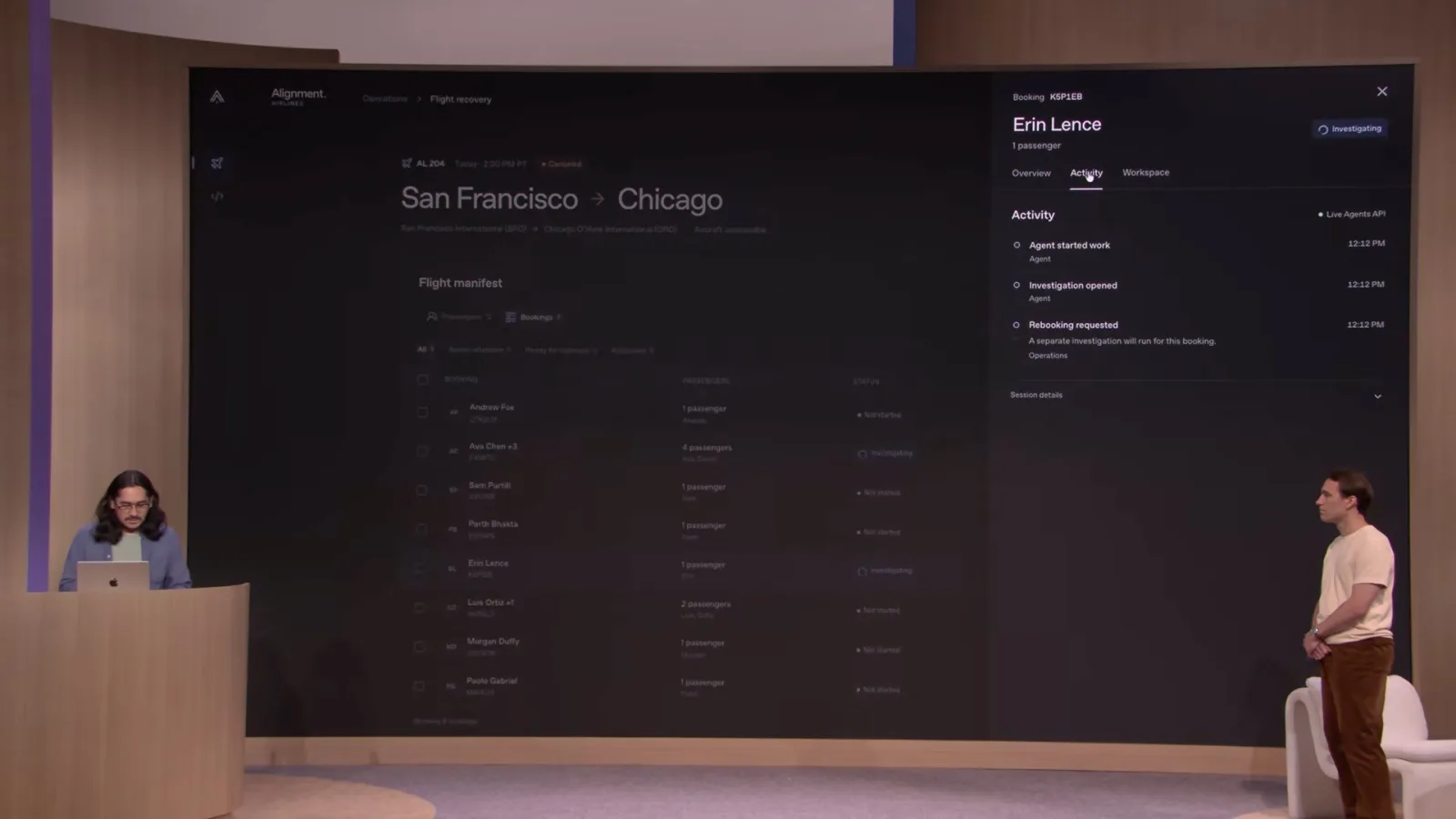
The demo creates sessions in an OpenAI-hosted sandbox, disables broad network access and streams events to the interface. A rebooking skill gives the agent steps, and capability directories can provide skills and plugins.
A flight inventory tool provides advisory availability and can place seats on hold, but a human must confirm the rebooking. Two subagents independently check seating and arrival constraints before a proposal is published.
The requested outputs include a proposal, a comparison of alternatives and a Python script to check the constraints. The speakers note that allowing more concurrent subagents may increase token use.
In the first case, the agent finds a flight to the required airport and holds a seat until a person approves. The activity view shows the sandbox, flight search and delegated checks.
For the family, it rejects one flight with only one available seat and another that cannot guarantee the group sits together. The interface exposes the comparison and checking script before approval.
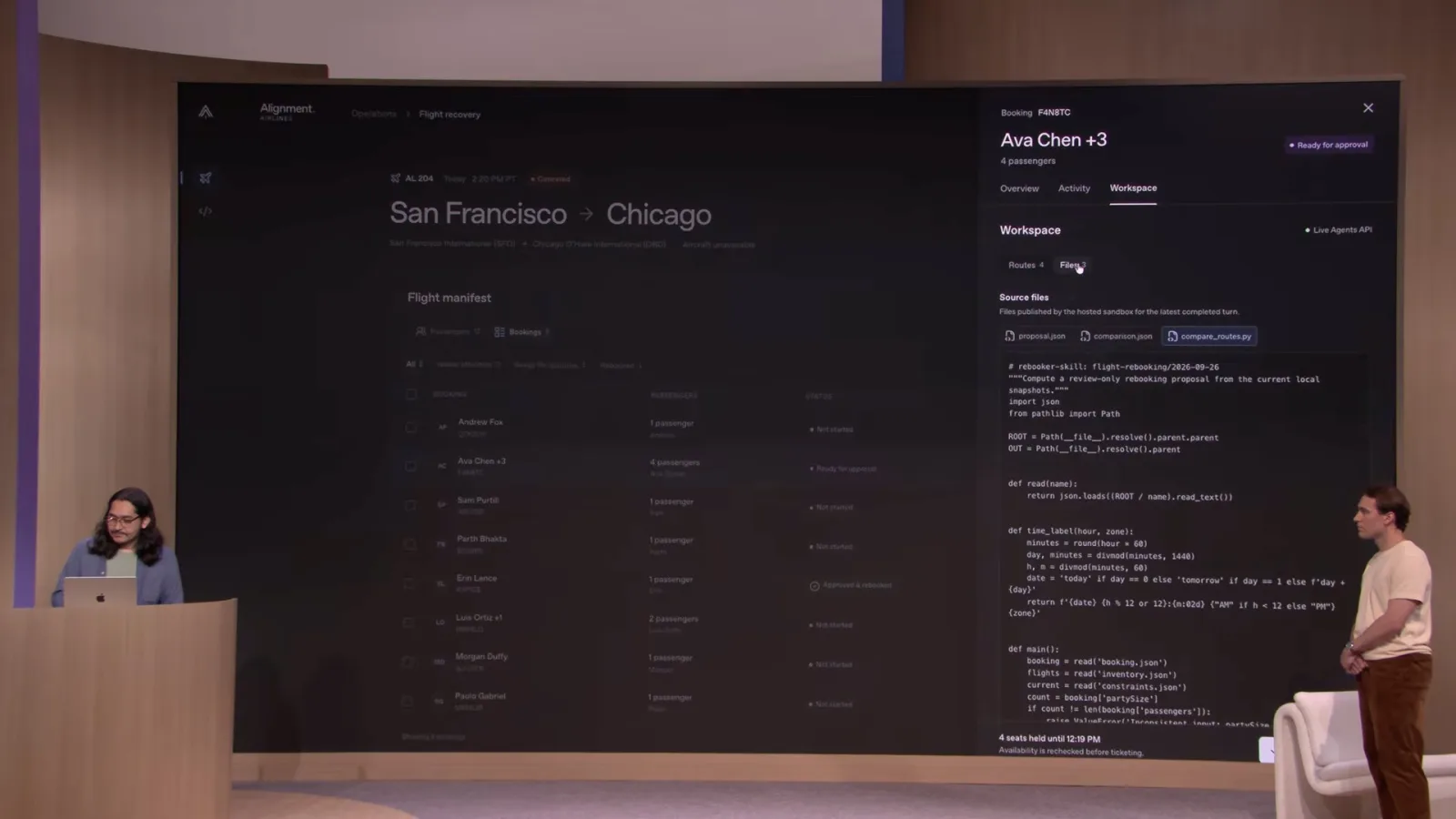
Charlie says the same pattern can handle many bookings in parallel while preserving human review. Developers can focus on business rules and approval points rather than maintaining the long-running harness.
Where customers use managed agents
The speakers describe asynchronous work, research and cloud integration examples.
The speakers cite uses by Notion, Rakuten and Bain, including asynchronous work and synthetic customer research checked by human experts. They also describe an AWS Bedrock managed-agent integration and invite developers to consider larger parallel tasks.
같은 채널의 다른 글
 27:44EN
 OpenAI· 2026년 11월 11일Plugin extensions bring interactive tools into ChatGPTCorey, Max Neuber · OpenAIOpenAI describes discovery, sidebar and file entry points, event-driven automation and revised submissions.
 24:01ENOpenAI· 2026년 11월 11일When agent work needs loops, subagents and a shared logRaj, Eric · OpenAIOpenAI’s Raj and Eric explain persistence, when to delegate and how they coordinate longer work.
 22:37ENOpenAI· 2026년 11월 11일How GPT Live keeps speaking while an agent worksAlex, Erika · OpenAIOpenAI demonstrates simultaneous voice, background delegation and three ways to return updates.
 21:10ENOpenAI· 2026년 11월 11일How OpenAI turned security findings into verified fixesIan, Kyle · OpenAIOpenAI engineers describe the scan, deduplication and patch verification loop behind Codex Security.
 27:09ENOpenAI· 2026년 11월 11일A six-week coding agent run and what it took to superviseOpenAI engineers describe a CI maintenance agent, long-running context and the cost of keeping it working.
 20:48ENOpenAI· 2026년 11월 11일Sites adds personalized connectors and agent-friendly web appsKatia, John · OpenAIOpenAI demonstrates scheduled updates, per-user plugins and WebMCP in two Sites applications.