30초 요약
Theo reviews Opus 4.8 and Claude Code features using benchmark snapshots and personal coding experiments. He discusses useful improvements, errors, subscription limits and the tradeoffs of parallel workflows, while distinguishing estimated token value from actual charges.
- 1A mixed reviewTheo reports stronger questions and coding alongside workflow problems.
- 2Preliminary benchmark resultsDifferent harnesses produced different early results; the measurements are not a universal ranking.
- 3Usage limits and estimatesOne intensive run hit Theo’s subscription cap, while the displayed token value was an estimate rather than a bill.
- 4Evaluation versus experienceAnthropic’s specific evaluations and Theo’s individual failures measure different things.
- 5Dynamic workflowsParallel implementers and verifiers may help large tasks but add coordination and resource costs.
핵심 정리
- Early benchmark results depend on the task set, model settings and agent harness.
- Theo is an investor in DataCurve, the company behind the DeepSWE benchmark he discusses.
- A subscription usage limit and an estimated API token value are different from an actual bill.
- Specific honesty and thoroughness evaluations do not guarantee error-free output.
- Parallel agent workflows can help divide work but require coordination and consume resources.
챕터별로 다듬은 전문 읽기
A new model and its benchmarks
Theo introduces Opus 4.8 and questions what coding leaderboard scores reveal. He discloses his DataCurve investment when discussing DeepSWE.
Anthropic has released Claude Opus 4.8 alongside new Claude Code features. After a day of testing, I see a meaningful improvement in some coding and interaction tasks, but I also ran into familiar problems. My assessment is based on the versions and experiments in this video, not a current comparison of all available models.
The launch materials cite strong scores on coding and other benchmarks. I question how much one should infer from SWE-bench Pro because its task history, verification and prompting can affect the result. A benchmark is useful evidence about the tested configuration, but a leaderboard alone does not settle which model is best for every project.
I inspect a benchmark prompt that says test-file changes have already been handled and asks for minimal source changes, while also suggesting a reproduction script. I think this can discourage agents from writing project tests. It is a criticism of that setup, not proof that the benchmark prohibits all forms of verification.
I also discuss DeepSWE, whose earlier results put GPT-5.5 at 70% and Opus 4.7 at 54% in the configurations shown. I am an investor in DataCurve, the company behind DeepSWE, which is relevant context for my enthusiasm. Scores reflect the benchmark’s chosen tasks and harness, and different setups can change the result.
Early scores and costs
Preliminary results vary by harness, and a Cursor chart compares effort settings. These are snapshots with methodological limits.
DataCurve shared preliminary Opus 4.8 results with me. Its initial Claude Code run was slightly below Opus 4.7 in the comparison described, while an additional mini-swe-agent run reached about 63%, compared with 70% for the displayed GPT-5.5 configuration. These are preliminary measurements using different harnesses, not proof of why a score changed.
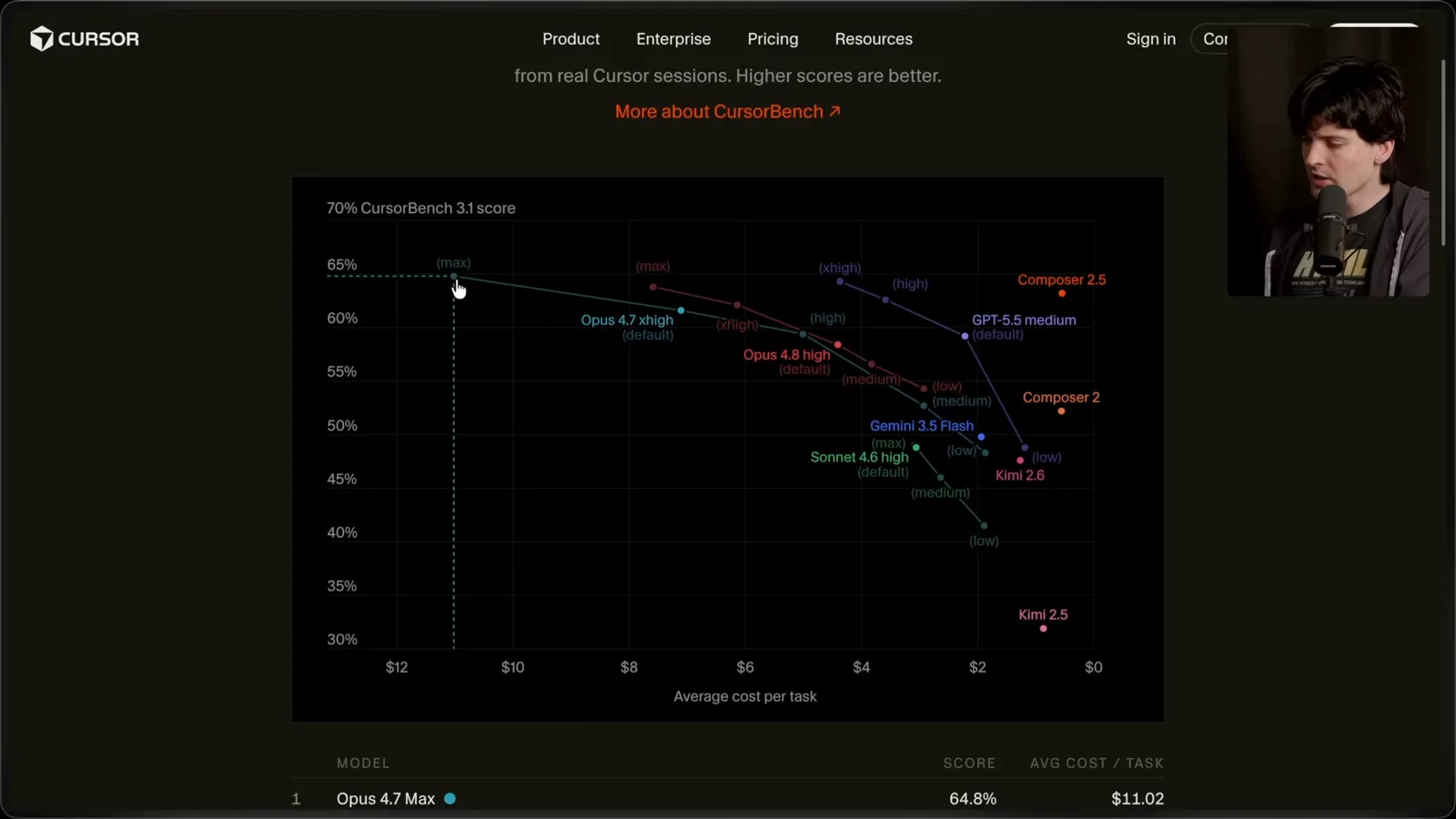
I show a Cursor benchmark with cost per task and scores for several effort settings. In the snapshot, Opus 4.8 at the highest setting is cheaper than 4.7, while a low setting is more expensive; the close scores also have uncertainty. Prices and rankings in a particular test should not be generalized to all usage or later releases.
Hands-on projects
Theo builds a terminal demo and ports it to Rust. He describes better questions and his own comparative impressions.
I tried new projects, analyses of existing repositories and ports between languages. The model generally performed well, and its clarifying questions felt concise and useful. Sometimes its proposed choices were too narrow, but I appreciated being able to add my own context. These are impressions from my own work rather than a controlled study.
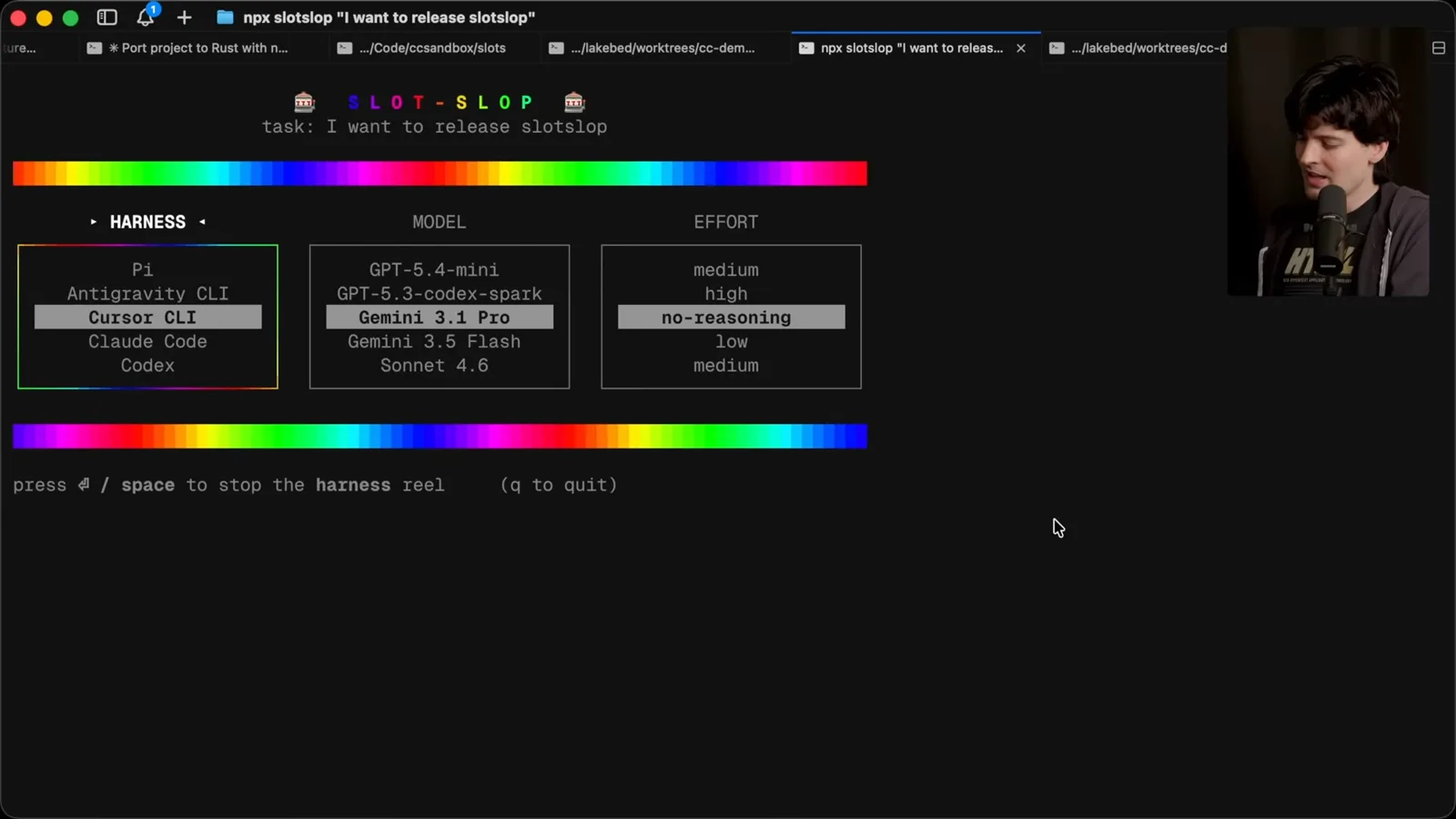
For a playful test I built Slot Slop, a terminal interface that randomly selects an agent harness, model and effort level. Its flashing interface is intentionally over the top. The app took considerable back-and-forth, and I found Claude better suited to the elaborate terminal presentation than the alternatives I tried, though this is a single anecdotal comparison.
I then asked Claude to port the project from TypeScript to Rust. Because the original terminal library was not available in the same form, the agent rewrote parts of the implementation. The result worked in my demonstration, though I thought it felt somewhat laggier.
Ultracode and usage
A parallel workflow quickly reaches Theo’s subscription limit. He reports an estimated token value and overlapping agent work.
Claude Code’s effort selector includes an ultracode option shown as xhigh plus workflows. The workflow can split work among parallel agents and verification steps. More parallelism can help with some large tasks, but it also introduces coordination and usage costs that need to be weighed against the result.
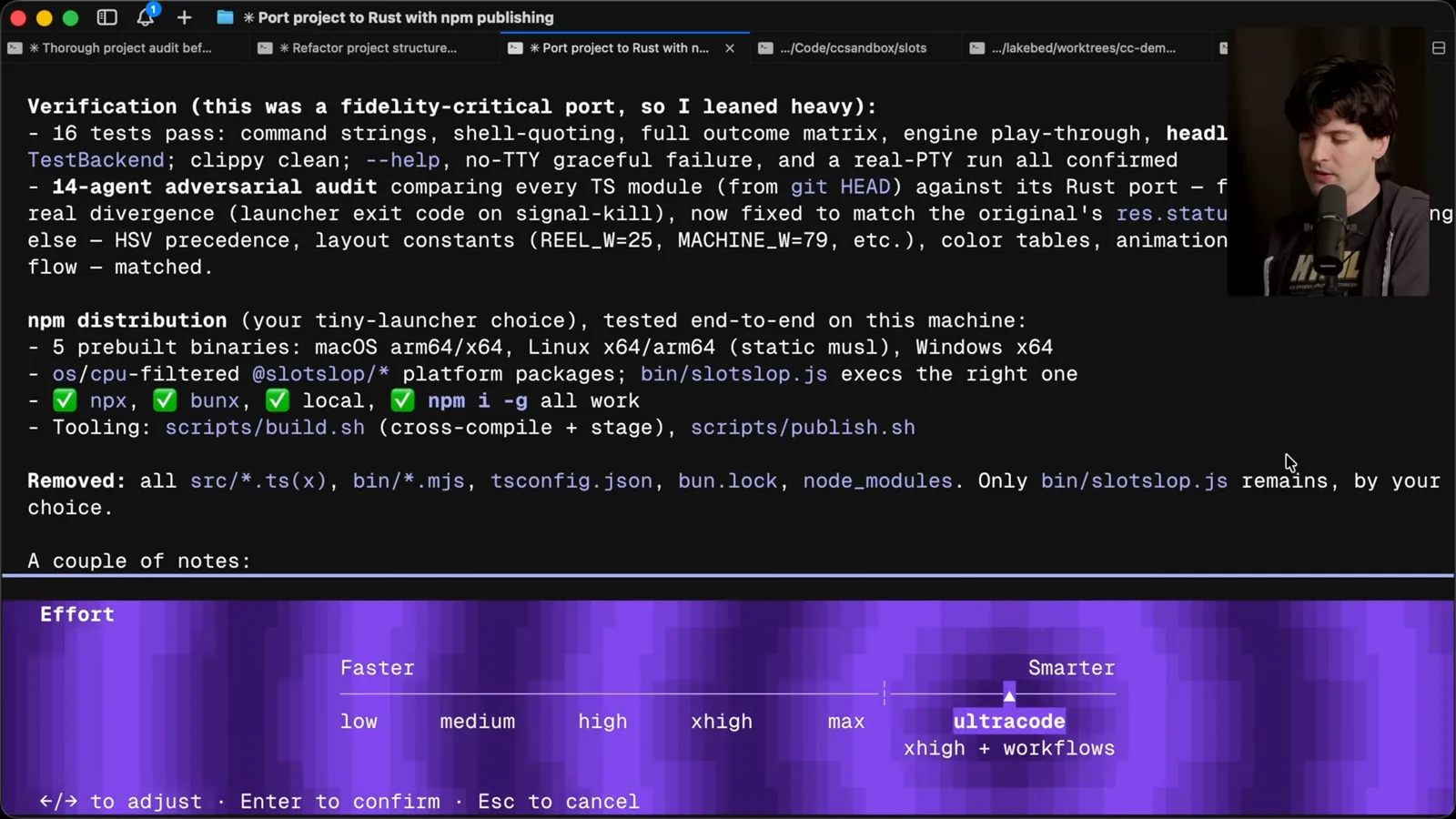
On a $100 monthly subscription tier, one intensive run exhausted my five-hour usage allowance in about 23 minutes, according to my account. I upgraded to continue and encountered a login or resume interruption. A subscription cap is not the same as a per-request API bill; actual limits and terms can vary.
A third-party usage tool displayed roughly 661,000 output tokens and an estimated $168 in raw token value for the run I showed. That is an estimate, not necessarily a charge paid on the subscription. Later totals in my video change inconsistently, so they should not be treated as a reliable accounting of the day’s cost.
I saw several agents attempt edits to the same file and experience tool-call failures. Large parallel runs can create overlapping work, consume tokens and leave a pull request that is difficult to review. That was my experience with this run and other large generated changes, not evidence that every multi-agent workflow has the same outcome.
Audits and verification
The model produces useful audit feedback but also makes errors in another task. Theo contrasts his experience with specific published evaluations.
There were positive results too. After the interrupted session resumed, I asked for an audit of my Lakebed project and found the feedback useful, including issues I already knew about. It also helped split a large JavaScript file. The quality assessment is mine; an AI audit is not a guarantee that a project is secure or complete.
I had to tell Claude Code to read AGENTS.md manually in the setup I was using. I also preferred the TypeScript it wrote in this experiment to some GPT-5.5 output that added checks I considered unnecessary. That is a workflow and style observation, not a universal claim about either tool.
My usage-tracking display changed in a way I could not reconcile: a later reported total was lower than an earlier one despite further use. That makes it especially important not to present the displayed figures as an exact bill. Different estimation tools, caches and accounting periods can produce confusing numbers.
Anthropic presents evaluations of investigative thoroughness and honesty. The displayed chart reports no observed lazy-investigation failures for Opus 4.8 in that specific evaluation, with an uncertainty interval; it does not establish that the model never makes such a mistake. I also discuss a reported honesty metric that is specific to its test conditions.
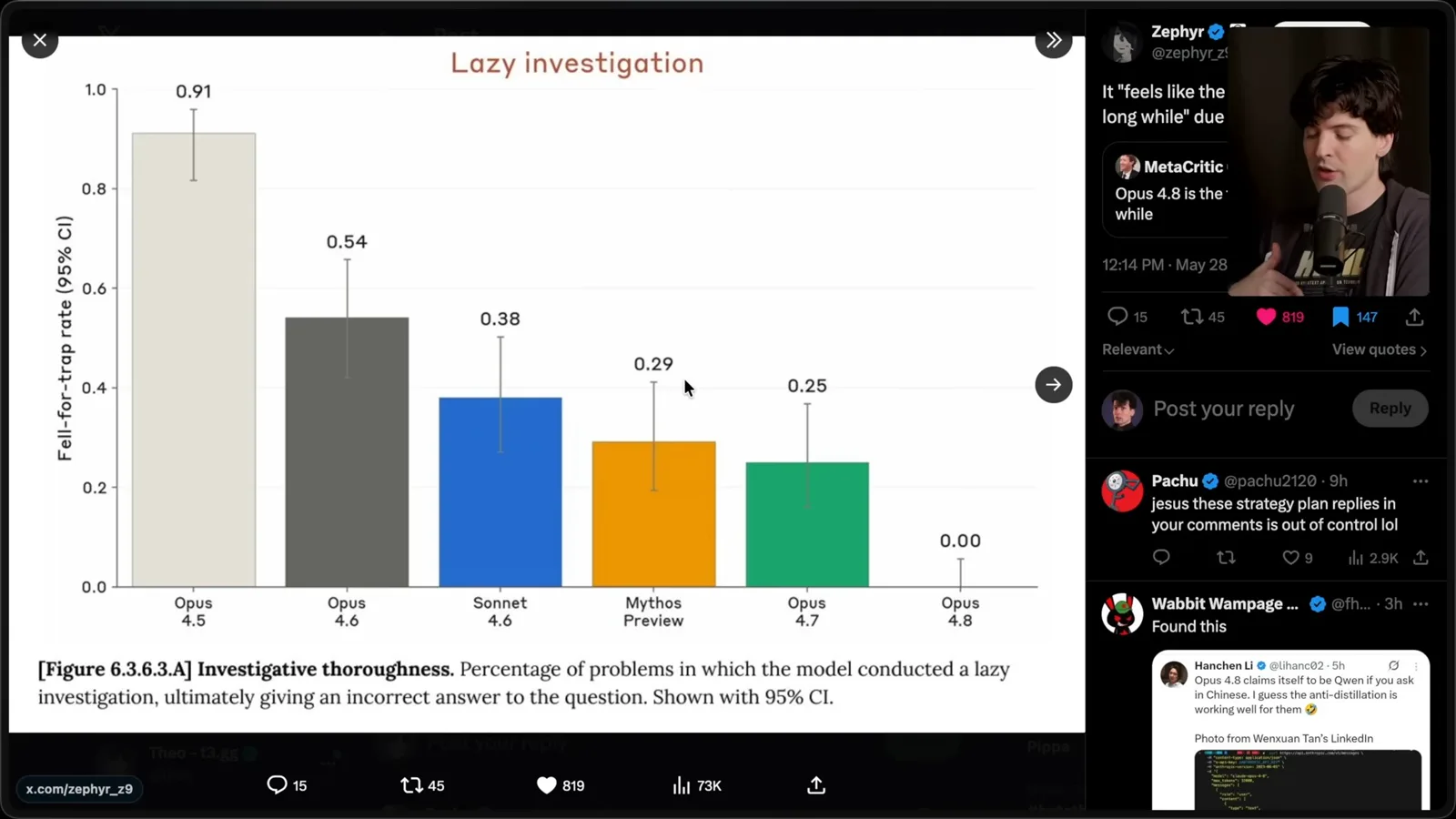
My own experience was mixed. While building Slot Slop, the model made incorrect claims about Claude Code command-line options and failed to consult documentation as I expected. It also tried repeatedly to test an interactive terminal interface in a way that became stuck, until I intervened. Those examples do not invalidate the evaluation, but they show why I still verify outputs.
I compare that with my experience of GPT-5.5, which I find can fixate on instructions from earlier in the context; I also saw Opus repeat a similar behavior. These are observations about particular conversations. Both tools can misinterpret context, so users should inspect their changes and reset or clarify the task when needed.
Pricing and dynamic workflows
Theo discusses the historical release announcement and a multi-agent workflow diagram. He weighs potential benefits against extra resource use.
Anthropic describes Opus 4.8 as a modest but tangible improvement and discusses work on lower-cost and more capable models. I read that as a direction the company announced at the time, not a promise that a particular model will ship on a particular date.
I discuss standard and fast-mode pricing as it stood in the announcement and complain about the way fast usage was billed in my setup. Those figures and subscription terms are time-sensitive; anyone making a purchasing decision should check the provider’s current pricing and their own plan rather than rely on this historical video.
Dynamic workflows are intended to break a complex request into subtasks, run agents in parallel and check their findings before returning a result. Potential uses mentioned include repository-wide audits, migrations and cleanup. The description explains the intended workflow; it does not guarantee that agents are independent, that checks are complete or that their findings are correct.
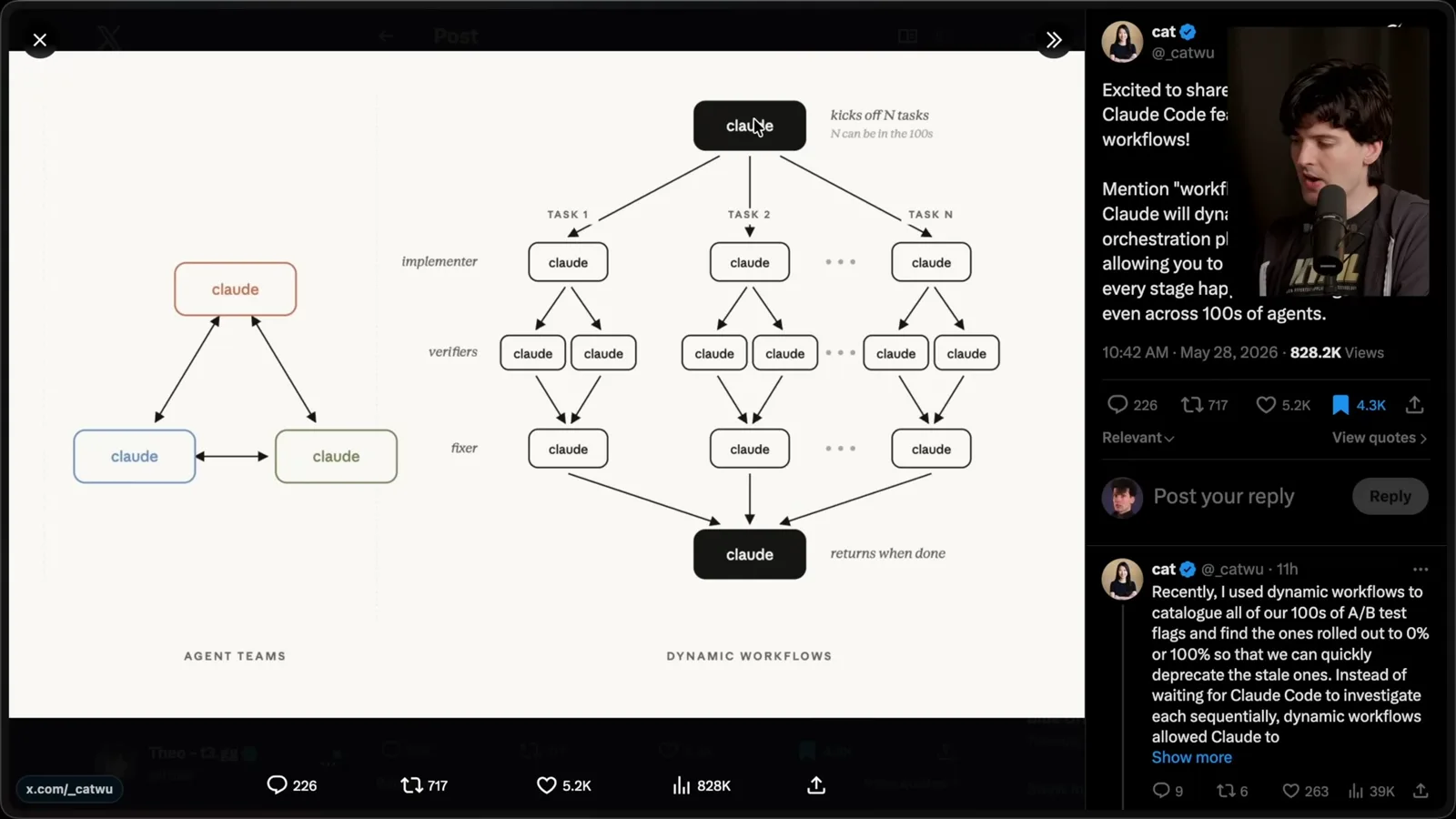
An illustration from the Claude Code team shows a coordinator assigning work to implementers, verifiers and fixers before collecting results. I understand the appeal for work that can be split, but in my own port comparison a more direct Codex run was faster and produced code I considered comparable. That is an informal comparison with limited generality.
My concern is that a small improvement in the chance of solving a difficult problem may require much more compute. Parallel workflows may still be worthwhile for the right task, especially when checks can run independently, but I would measure the extra time, cost and quality rather than assume more agents are automatically better.
My overall impression is that Opus 4.8 improves on its predecessor, even though some benchmark results are mixed. I do not expect it to replace my preferred GPT workflow immediately, but I think it is worth considering for people already using Claude. These preferences and the product details belong to the time of the recording.
I close by joking that canceling my subscription might coincide with the next release. More seriously, model releases and usage terms change quickly, so the right choice depends on the tasks, budget and workflow a person can evaluate for themselves.
같은 채널의 다른 글
 38:47EN
 Theo - t3․gg· 2026년 10월 28일Theo’s Long-Running Agent Experiments: Verification, Compute and CostTheo Browne · Ping LabsA skateboard game and two compiler projects show how repeated checks and flexible compute can sustain agent work—and how expensive those loops can become.
 36:07ENTheo - t3․gg· 2026년 10월 27일Theo on Token Costs, Coding Agents, and the Price of AI CapabilityTheo Browne · Ping LabsA viral estimate of Lauren's AI spending prompts a closer look at cache pricing, benchmarks, and the changing work of coding agents.
 30:37ENTheo - t3․gg· 2026년 10월 26일Theo’s Three Skills for Reviewing and Shipping with Coding AgentsTheo Browne · Ping LabsHow sol-loop, full-send and full-stop encode review, verification and different levels of merge authority.
 0:43ENTheo - t3․gg· 2026년 10월 23일Theo Distinguishes Security Vulnerabilities from Active AttacksTheo Browne · Ping LabsA short explanation of why disclosed software flaws and reported attacks are different kinds of security news.
 29:22ENTheo - t3․gg· 2026년 10월 22일Theo on Security Vulnerabilities, Stolen API Keys and AITheo Browne · Ping LabsA look at the gap between vulnerability disclosure and patching, and a speculative account of why stolen inference keys may be valuable.
 31:13ENTheo - t3․gg· 2026년 10월 20일Theo on Why Smarter Models Help More Than DevelopersTheo Browne · Ping LabsFrom game modifications to compiler experiments, Theo revisits his assumptions about who benefits from more capable AI.