30초 요약
SpaceX’s draft AI1 satellite pairs roughly 120 kilowatts of average computing load with large solar arrays, radiators and laser links. Elon Musk and satellite engineering director Ian Dahl say scaling the concept requires reusable launches, solar production and chips. Musk aims for an annualized deployment rate of one gigawatt of space AI compute by the end of 2027, explicitly calling the schedule an estimate rather than a promise.
- 1Scaling orbital AI requires launches, solar power and chipsMusk says Starship, large solar arrays and radiators, and chip production must all expand.
- 2Full Starship reuse had not yet been achievedMusk hopes to recover and refly the full system, then shorten turnaround without extensive refurbishment.
- 3The AI1 draft pairs 120 kW of average compute with large solar arraysDahl and Musk show a roughly 70-meter-wide satellite design with deployable radiators.
- 4Existing chips could start the system; Terafab is the larger proposalMusk says initial designs can use current processors but expects much greater manufacturing capacity to be needed for scale.
- 5The one-gigawatt deployment rate is a target, not a promiseMusk aims for that annualized rate by the end of 2027 and says later scaling depends on several supply chains.
- 6A lunar mass driver is a long-term conceptMusk imagines producing hardware on the Moon and accelerating satellites into space electromagnetically.
핵심 정리
- The AI1 draft shows 150 kW peak power and 120 kW average computing load.
- Musk says full Starship reuse had not yet been achieved and is needed to reduce launch costs.
- SpaceX aims for a one-gigawatt annualized deployment rate by the end of 2027; Musk calls the timing a best estimate.
- A lunar mass driver is presented as a much longer-term concept.
챕터별로 다듬은 전문 읽기
The energy scale behind the vision
Musk explains the Kardashev scale and why he wants to harness solar energy in space.
SpaceX communications manager Dan Huot introduces Elon Musk and satellite engineering director Ian Dahl. They discuss how Starship, solar production and AI satellites fit into the company’s long-term space plans.
Musk explains the Kardashev scale as a way to classify civilizations by the energy they can harness: from a planet, a star and then a galaxy. He argues that humanity currently uses only a very small fraction of the Sun’s output.
He says the Sun contains nearly all of the solar system’s mass and that Earth intercepts only a tiny share of its energy. Because much of Earth is ocean or difficult terrain, he argues that accessing a substantial share of solar output would require infrastructure in space.
Huot asks what need would justify collecting that energy. Musk proposes satellites that use solar power for computing and radiate waste heat into space, linking the concept to a long-term goal of expanding civilization’s energy use.
Starship and the mass-to-orbit challenge
He describes full reusability and the much larger launch capacity he hopes to reach.
Musk identifies three requirements for scaling: capacity to deliver mass to orbit, large quantities of solar generation and radiators, and enough AI chips. He says Starship is intended to address the launch portion.
Musk argues that full, rapid rocket reuse is essential for affordable transport beyond Earth. He compares expendable rockets to throwing away an aircraft after each flight.
He says reusability is difficult because of Earth’s gravity and atmosphere, requiring optimization of engines, structure, controls and mass. Catching a returning rocket with a tower avoids the weight of landing legs, he says.
Musk says SpaceX has not yet achieved full reusability and hopes to do so with Starship later in 2026. The following step would be rapid reuse without laborious refurbishment or inspection.
Musk says SpaceX currently carries most mass launched to orbit and estimates about 2,500 tons annually. He hopes Starship could increase that to a million tons a year in roughly three years.
A draft AI satellite design
Dahl and Musk explain solar power, radiators, computing and laser links.
Dahl says an orbital data center is not a building in space: the engineering task is to launch computing components, supply power and remove waste heat. He says the team intends to draw on solar-array experience from Starlink.
Musk says the proposed AI satellite would be simpler in some respects than Starlink because it would not need all the same communications antennas. Its main components would be solar arrays, radiators, computing and laser links.
Dahl and Musk show a draft “AI1” design for a satellite with about 150 kilowatts of peak power and 120 kilowatts of average computing load. The illustration depicts a roughly 70-meter wingspan, solar arrays and deployable radiators.
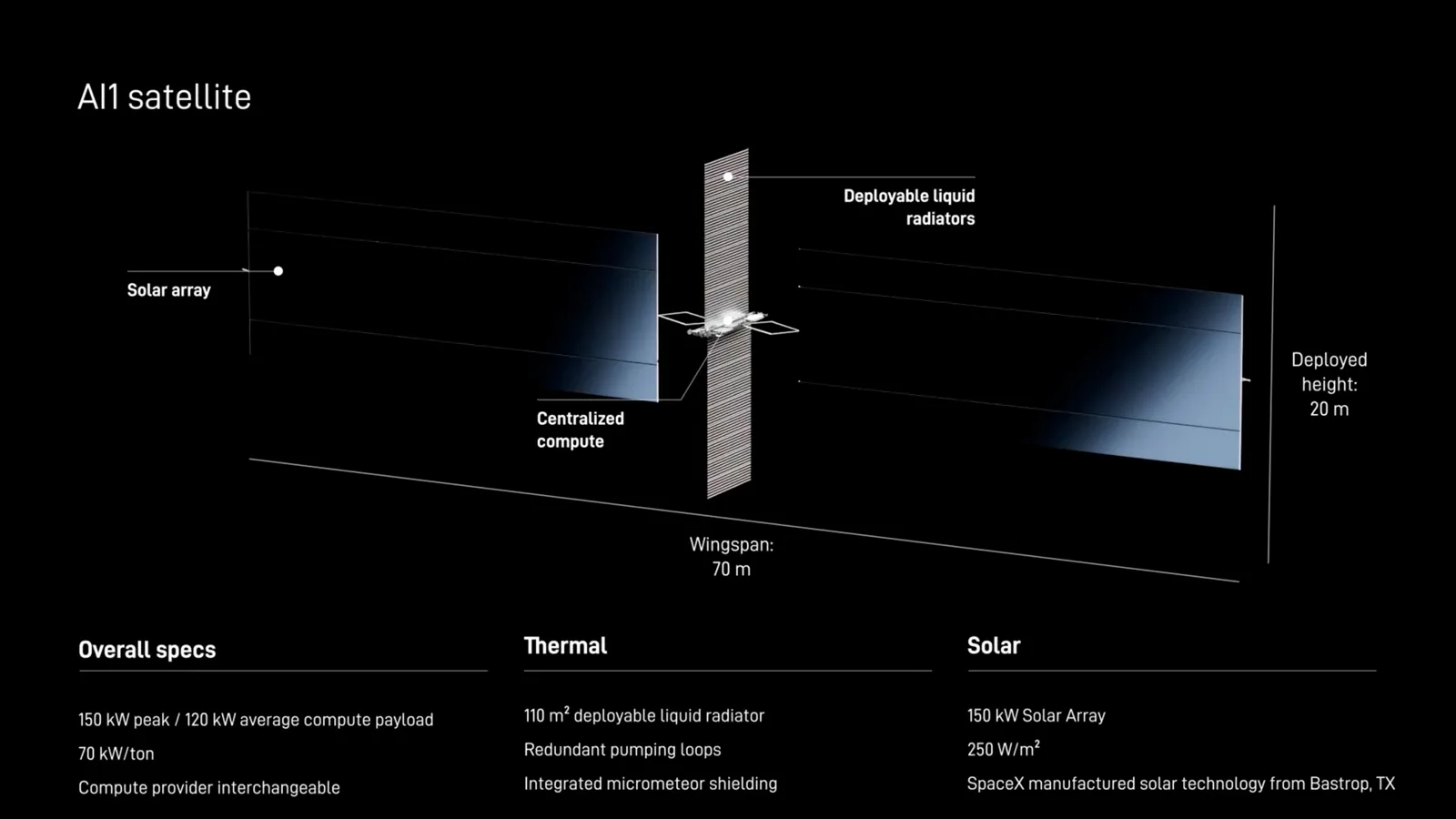
Musk says the draft assumes 250 watts per square meter for the solar arrays and about 1,400 watts per square meter for double-sided radiators. He and Dahl say the design builds on technology developed for Starlink V3.
Musk compares the proposed computing load to a rack of AI chips and says satellites could communicate through laser links with one another or the Starlink network. He estimates that signals from a few hundred kilometers up would travel in milliseconds.
Dahl discusses using large radiators and SpaceX’s experience operating thousands of satellites. Musk says space offers room for a much larger constellation; Dahl says safe constellation operation is a priority.
Factories and chip supply
They discuss Bastrop production plans and the proposed Terafab.
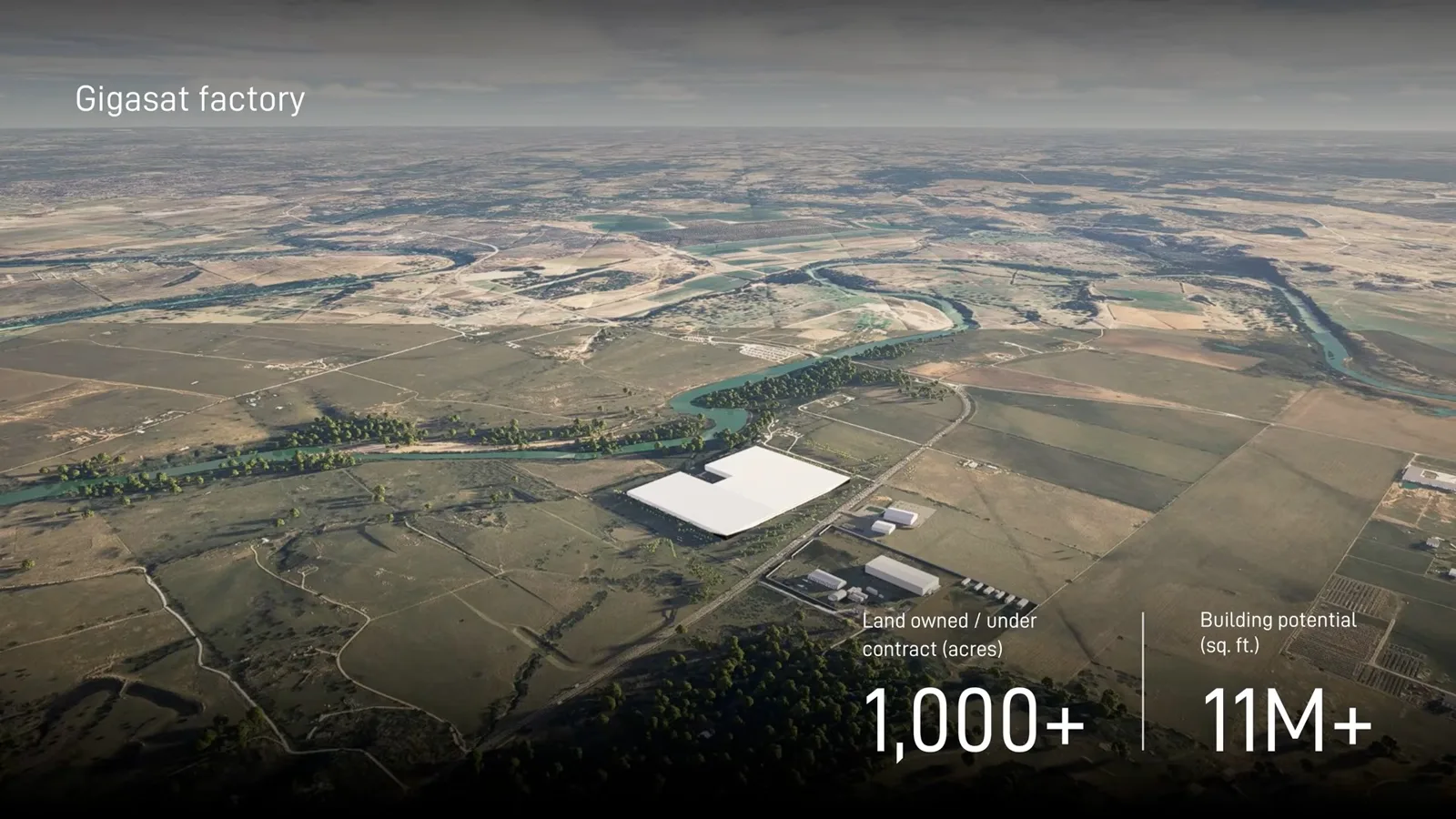
The discussion turns to the Bastrop facility. Musk says solar manufacturing is under construction and an AI satellite production building is planned, with a goal of reaching meaningful output by the end of the next year.
SpaceX also plans higher-volume Starlink terminal production. Musk expects growth in user terminals and direct-to-cell service that connects phones with satellites.
On chip supply, Musk says initial satellite designs could use existing Nvidia chips or other processors. To reach a much larger rate, he proposes Terafab, a large chip-manufacturing project.
He says the proposed factory could span roughly 100 million square feet and frames its main distinction as scale. Musk sketches a path toward producing large numbers of high-power logic chips and the memory to accompany them.
Capacity targets and a lunar concept
Musk presents an explicitly tentative deployment schedule and a long-term lunar mass-driver idea.
Musk cautions that his timeline is an estimate, not a promise. SpaceX aims for an annualized rate of one gigawatt of space AI compute by the end of 2027, then hopes to scale by an order of magnitude per year if launch, solar and chip production permit.
For a much larger scale, Musk proposes making most of the hardware’s mass on the Moon and using an electromagnetic mass driver to send satellites into space. He says the Moon’s lower gravity and lack of atmosphere would make that approach possible.
After a concept animation, Musk says such an expansion could also make travel to the Moon accessible to people who want to go. Huot closes by summarizing the planned satellites, launches, chips and solar production.
같은 채널의 다른 글
 1:04:24EN
 Space SPAN (Science Policy and News)· 2026년 10월 21일Gwynne Shotwell and Elon Musk on SpaceX, Orbital Computing and AI Safety게스트 Gwynne Shotwell, Elon MuskAt the 2026 All-In Summit, Shotwell describes managing SpaceX and Musk proposes peer testing of AI models.
 29:19ENSpace SPAN (Science Policy and News)· 2026년 8월 11일Musk Sets a 10-Gigawatt AI Goal for SpaceXIn a company talk, Musk forecasts AI revenue growth and ties orbital computing to SpaceX’s multiplanetary plans.
 45:46ENSpace SPAN (Science Policy and News)· 2026년 2월 11일Inside xAI’s Reorganization: Coding, Agents and Compute진행자 Elon MuskElon Musk and team members outline four product groups and explain the infrastructure challenges behind large AI training runs.