30초 요약
A reusable heat shield and large-scale orbital refilling are central to SpaceX’s plan to carry substantial cargo to Mars, Elon Musk and Starship engineering head Bill Riley said before an August 2025 flight-test attempt. Their concept sends a cargo ship into orbit nearly out of propellant, then refills it with tanker ships. Musk also explained why catching vehicles with tower arms could speed reuse. The plans remained development goals, not demonstrated Starship capabilities.
- 1A self-sustaining Mars city would require a large industrial baseMusk estimated that at least a million tons might need to reach the surface, while acknowledging the figure could be lower.
- 2Tower catches are intended to shorten the time between flightsThe same arms would catch and restack the vehicles, avoiding transport from a separate landing area.
- 3Heat-shield tiles must survive repeated reentriesMusk said past soft landings shed tiles; flight data and inspection would guide changes to the tiles and their support.
- 4Tankers would refill a cargo ship after it reaches orbitRiley described sending a loaded ship up with nearly empty tanks, then docking other ships to supply propellant for the onward journey.
핵심 정리
- SpaceX’s Mars concept depends on both rapid reuse and transferring propellant to a loaded ship in orbit.
- A reusable heat shield must survive reentry without losing tiles or requiring lengthy repairs.
- Tower catches aim to put a booster straight back on the stand, avoiding the mass and handling of landing legs.
- Musk’s estimated million tons to Mars and hourly booster flights were long-term estimates, not achieved performance.
챕터별로 다듬은 전문 읽기
Why build Starship at scale?
Musk frames Mars settlement as a way to extend life beyond Earth. Riley describes how Starbase grew into a production site.
Before the August 2025 Starship flight-test attempt, SpaceX webcast host Dan Huot welcomes chief engineer Elon Musk and Starship engineering vice president Bill Riley. Asked why they are building the vehicle, Musk says he wants life and consciousness to extend beyond Earth, both to improve their long-term prospects and to create an inspiring future.
Riley describes how Starbase evolved after the Starship program moved there in early 2019: from a trailer and tent used for Starhopper to suborbital tests, two towers and a roughly million-square-foot factory. At the time, SpaceX was working toward the first operational flight from its second tower by year’s end.
Musk describes the site near the Rio Grande and coast, once a sandbar, and plans for a much larger enclosed building called the Gigabay. He says visitors can see the factory and rockets from the public highway and beach, though the area cannot be visited during launch operations.
Riley says Starship was designed for mass production and sustained, rapid operations rather than a single orbital flight. Musk says his long-term ambition requires thousands of ships a year to build a Mars city capable of surviving even if supplies from Earth stop.
A self-sustaining city would need an industrial base able not only to make products such as computer chips but also to build the factories that produce them. Musk estimates that at least a million tons may have to reach the Martian surface, while acknowledging the amount could be lower.
Musk connects Mars settlement to eventual travel beyond the solar system and the search for other civilizations. He reflects on the universe’s age, around 13.8 billion years, and contrasts it with the much shorter span of human written civilization.
Steel, heat shields and rapid reuse
The team explains Starship’s materials and the proposed use of tower arms to return vehicles to flight. Protecting tiles through reentry and capture remains difficult.
The webcast shows the rocket on the pad to convey its scale. Riley points out a worker near the ship and notes that Flight 10 is on the pad while more vehicles are being built. Musk uses the image to explain why one side is black and the other silver.
The black surface is the heat shield on the side exposed during orbital reentry, while the shiny structure is stainless steel. Musk says steel resists ascent and reentry heat better than aluminum and avoids the difficulty of keeping paint attached through repeated cryogenic temperature cycles.
The group turns to the Raptor engine and the wider challenge of making both stages reusable. Musk says this requires advances in engines and structures, a way to return the rocket to the pad and a heat shield that can fly again without extensive refurbishment. He contrasts the goal with the space shuttle’s lengthy turnaround.
The planned sequence is to catch both booster and ship with tower arms. Musk says the booster could be placed directly back on the launch stand; the ship would return after at least one orbit. With several ships available for one booster, he says, an hourly booster flight is a theoretical goal.
Landing legs would require the vehicle to land elsewhere, have its legs stowed, be transported back and then be lifted onto the stand. Musk says using the same tower arms for catching and stacking avoids those steps and the mass of legs. He estimates a booster could return in five or six minutes and that propellant loading might eventually take 30–40 minutes.
Riley compares the intended operation to an airliner pulling up to a gate instead of landing at another airfield and being towed over. The speakers report that three booster catch attempts had succeeded and one booster had flown again; ship reuse and its heat shield remained the focus of testing.
Musk calls the reusable orbital heat shield perhaps the largest remaining engineering challenge. Teams may need to adjust tile strength, gaps and underlying materials, but repeated flights and inspection after landing are necessary to find the weak points. Earlier returns achieved soft landings, he says, while losing many tiles.
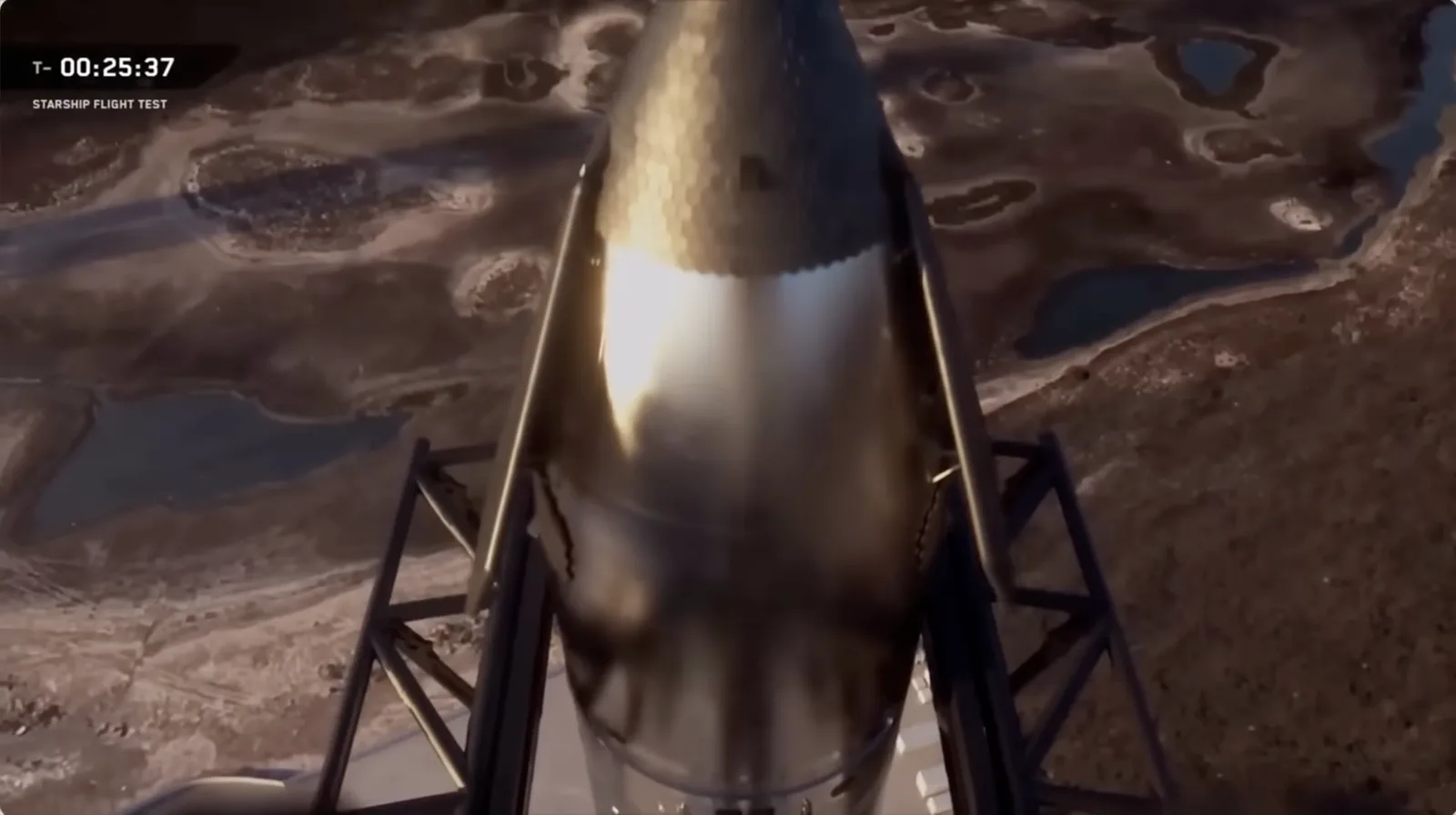
An animation shows a ship being caught at the tower. Riley notes the need to avoid scraping off tiles or crushing the vehicle during capture. For initial landings on Mars and other worlds without towers, he says, the ship would instead use deployable legs, as an earlier suborbital Starship test did.
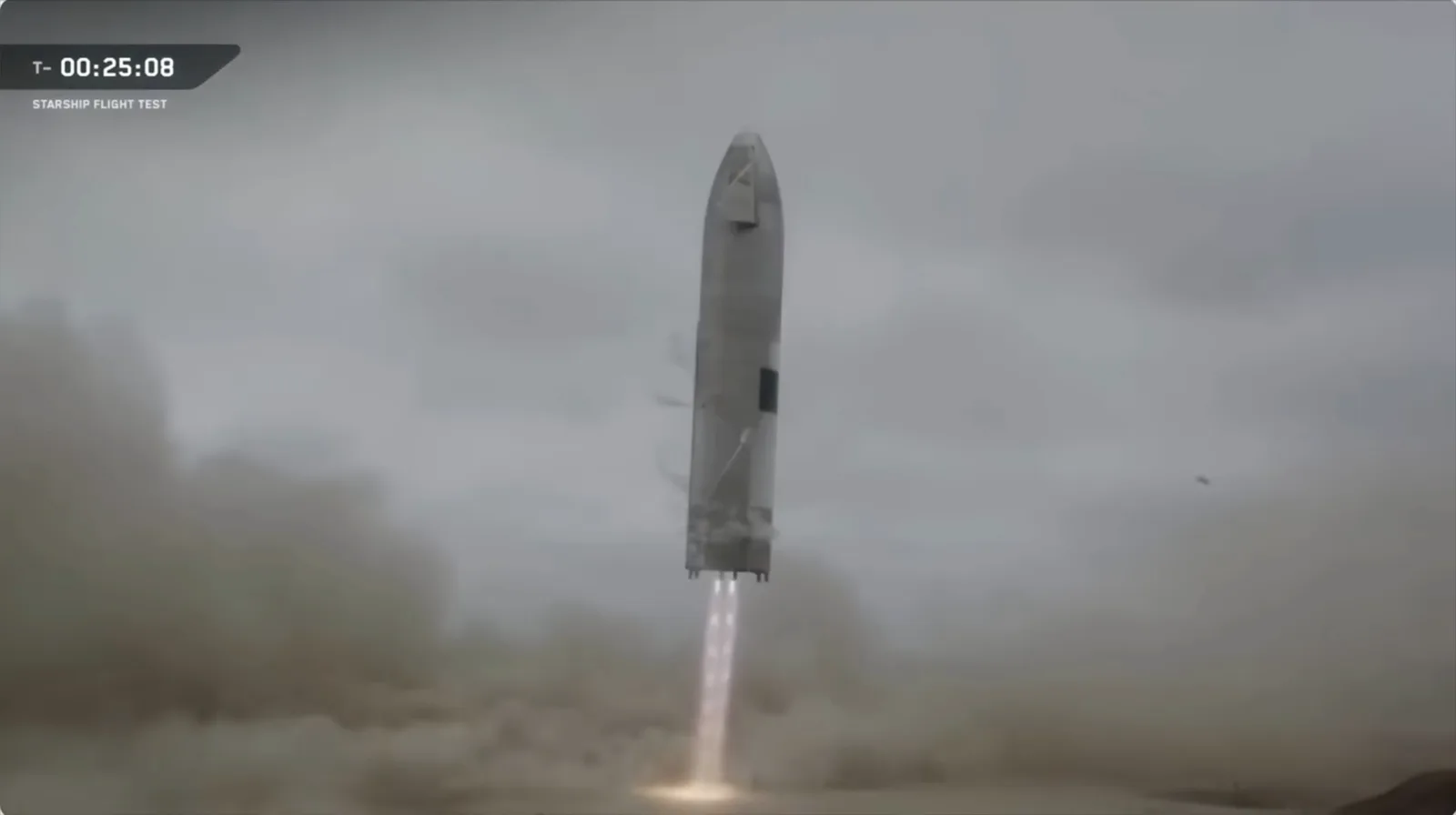
Refilling in orbit and beyond-Earth missions
Riley and Musk explain the proposed tanker system for a Mars-bound ship. They also discuss the possibility of fast point-to-point travel on Earth.
Riley identifies orbital refilling as another technology the team hoped to demonstrate the following year. A ship could reach orbit with a full cargo bay and nearly empty propellant tanks; other ships would then dock and transfer propellant, enabling it to take that payload farther.
Musk says tanker ships could refill a Mars-bound vehicle so it can depart Earth orbit and still have fuel for landing. He says, to his knowledge, propellant transfer had never been demonstrated in orbit. Earlier spacecraft had in fact transferred propellant: NASA records that Orbital Express transferred hydrazine between two spacecraft in 2007. Starship’s proposed large-scale transfer is a different application.
Musk regards full reusability and propellant transfer as the technologies needed for a Mars city. He envisages ships landing there, greenhouses and eventually a settlement that can help life survive a catastrophe on Earth or the Sun’s eventual expansion.
Huot asks what else a lower-cost, high-capacity Starship could enable. Riley suggests better observation of Earth and much faster travel between points on the planet. Musk imagines flights such as Los Angeles to Sydney or Tokyo in under half an hour, describing a future possibility rather than an existing service.
The group jokes about the short flight times and the view from a rocket. They end the conversation to return to launch operations, hoping weather will permit the test and thanking viewers for their support.
같은 채널의 다른 글
 8:50EN
 VideoFromSpace· 2025년 5월 30일Musk sketches a tentative schedule for building a Mars settlementElon Musk · SpaceXIn 2025, Musk described launch windows, possible landing sites and the supplies he thinks a self-sustaining settlement would need.
 39:58ENVideoFromSpace· 2025년 5월 29일Musk’s 2025 Starship Plan: Reuse, Orbital Refueling and MarsElon Musk · SpaceXMusk explains why rapid reuse and orbital propellant transfer are central to SpaceX’s proposed Mars missions.
 10:02ENVideoFromSpace· 2025년 4월 9일Isaacman faces questions on Musk ties and NASA’s Moon plansEdward Markey, Ted Cruz, Jared IsaacmanAt his April 2025 confirmation hearing, Isaacman declines to say whether Musk was present when Trump offered him the NASA job.
 58:52ENVideoFromSpace· 2024년 1월 13일SpaceX’s 2024 update: Falcon reuse and the road to StarshipElon Musk · SpaceXElon Musk reviews 2023 launches, Dragon and Starlink, then lays out Starship tests and the technology needed for lunar refueling.
 9:54ENVideoFromSpace· 2023년 10월 5일Musk’s 2023 plan to catch Starship’s booster with launch-tower armsElon Musk · SpaceXAt the International Astronautical Congress, Musk discusses rapid reuse, satellite launches and a possible uncrewed Mars test.
 13:00ENVideoFromSpace· 2011년 8월 1일Musk’s 2011 AIAA Q&A: Mars transport, Dragon and the challenge of rocket reuseElon Musk · SpaceXMusk discusses prospective Mars payloads, crew escape, electric propulsion and early ideas for Falcon Heavy and booster recovery.