30초 요약
Sana commercial director Lauren Crichton opens the 2025 summit with a speculative view of autonomous AI, a survey of industry and geopolitical pressures, and a call to connect disciplines in shaping the technology.
- 1A speculative AI futureCrichton imagines autonomous systems that can perform research and product work, while presenting an ambitious timeline.
- 2Supply-chain pressureShe describes investment and competition across the AI value chain.
- 3Knowledge across disciplinesShe argues AI could help connect ideas across research fields and professional silos.
- 4CollaborationShe calls for researchers, artists, policymakers and other disciplines to shape the future together.
핵심 정리
- Crichton presents rapid progress toward autonomous AI as a possibility, not a guaranteed outcome.
- AI investment and supply-chain competition are reshaping the industry.
- She argues that combining knowledge across fields may accelerate discovery.
- Different disciplines should participate in choices about AI’s future.
챕터별로 다듬은 전문 읽기
Knowledge and the AI possibility
Crichton connects human knowledge creation with a speculative vision of autonomous AI.
The opening moves through scales of distance before Lauren Crichton reflects on humanity’s unbounded search for its place in the universe. She describes the creation and accumulation of knowledge, and the tools that support it, as a defining human characteristic.
Crichton imagines AI extending knowledge beyond the limits of biological brains. She presents a speculative near-term scenario in which AI could exceed Nobel laureates across many fields; the timeline is her prediction, not an established outcome.
In that scenario, the system would use text, audio, video, a keyboard, a mouse and the internet to communicate, design products and analyze experiments. It might work autonomously, request clarification and delegate tasks to specialized instances.
She cites Dario Amodei’s image of a country of geniuses in a data center and says developments in early 2025 have made previously speculative possibilities feel more concrete.
The state of AI in 2025
She surveys investment, supply chains, patents and geopolitical tension.
Crichton lists Project Stargate, a US executive order, Humanity’s Last Exam, Nvidia’s market-value swing after DeepSeek R1 and semiconductor production as signs of rapid change. She cites 2024 AI patent filing counts of 300,510 for China and 67,773 for the US.
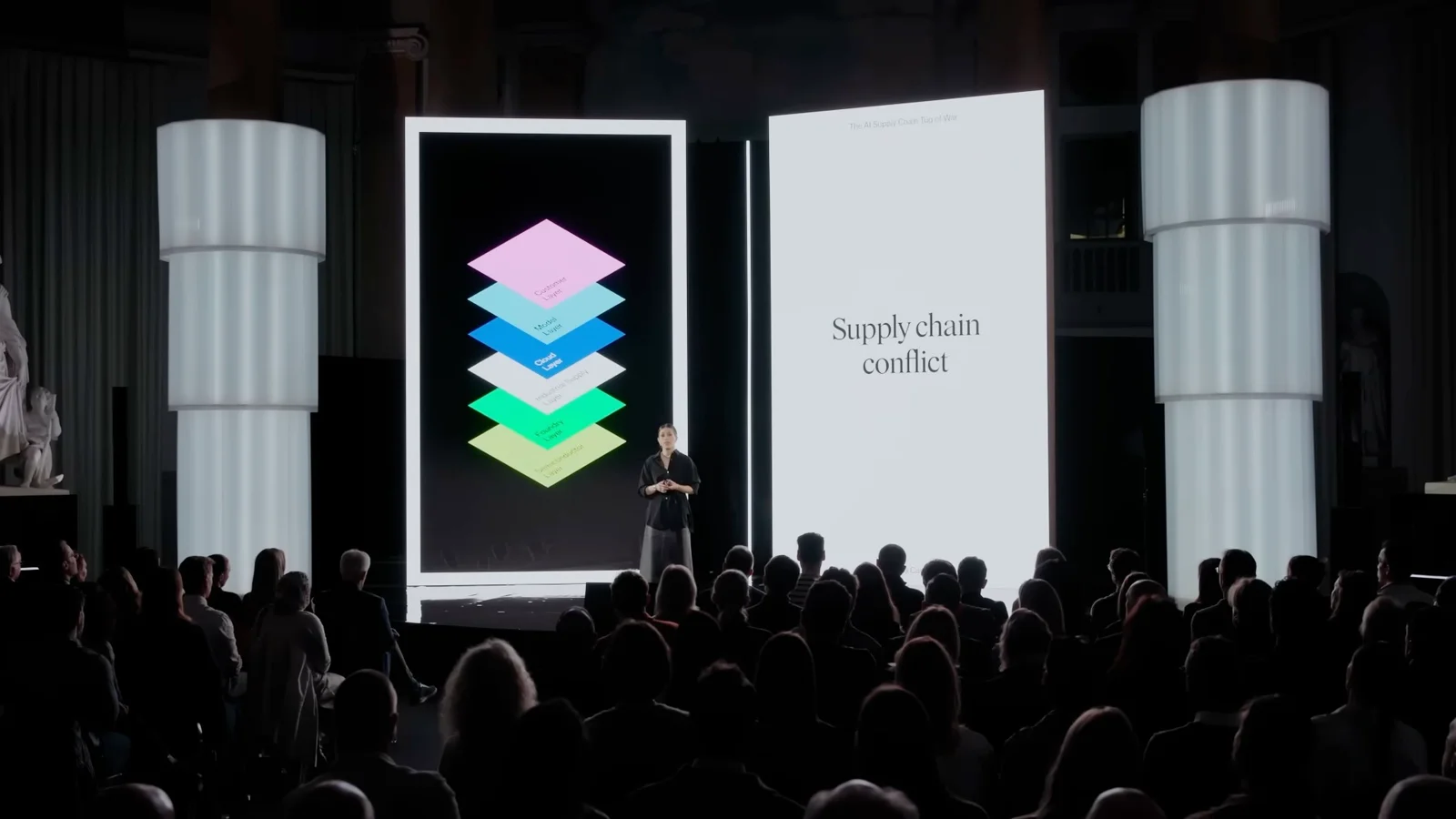
She describes a supply-chain contest in which companies seek profit while managing uncertain AI demand. She cites forecast capital spending of $320 billion in 2025, compared with $246 billion in 2024 and $151 billion in 2023, and examples of companies expanding across the value chain.
She calls the mix of advancing models, solidifying infrastructure and geopolitical tension “artificial general chaos.” Her response is to zoom out and remember how much remains to be understood and discovered.
A wider perspective
She makes the case for connecting disciplines and bringing different voices together.
AI could help connect fields, Crichton argues, because innovation often combines existing ideas. She cites a claim about Nobel laureates with degrees in multiple fields and suggests language models could help researchers make analogies across professional silos.
She calls a potential transition from AI as a tool for accessing knowledge to AI as an independent creator of knowledge a profound shift. It makes collaboration among researchers, philosophers, builders, policymakers, artists and educators more important.
The summit, she concludes, is intended to bring those perspectives together so people can shape the technology thoughtfully rather than remain within their own professional silos.
같은 채널의 다른 글
 1:16EN
 Sana· 2026년 10월 14일팟캐스트How Volkswagen Group Middle East Uses Sana to Prepare Technicians for TrainingThierry Rochat describes using technical documents to create online courses before hands-on academy sessions.
 0:41ENSana· 2026년 9월 8일팟캐스트Sana Learn Customers Describe Bringing Training Resources TogetherA short customer montage contrasts fragmented learning resources with keeping company knowledge in one place.
 0:40ENSana· 2026년 8월 31일팟캐스트Sana Learn Customers Describe Their Partnership ExperienceIn a short montage, customers discuss implementation and the ongoing relationship with Sana.
 48:34ENSana· 2026년 8월 12일팟캐스트 · 2명Tyler Cowen on AI Adoption, Human Agency, and the Search for Beauty게스트 Tyler Cowen · 진행자 Joel HellermarkThe economist explains why AI's economic impact may arrive slowly, what people may still contribute, and why he is calling for a new aesthetic.
 0:16ENSana· 2026년 7월 21일팟캐스트Tyler Cowen on Human Presence in an AI WorldTyler Cowen predicts that charisma, physical presence and human interaction will gain importance as AI advances.
 0:23ENSana· 2026년 7월 9일팟캐스트Ethan Mollick on Measuring AI’s ImpactEthan Mollick argues that companies should allow room for new opportunities rather than relying only on old metrics.