30초 요약
AI Explained reviews conflicting accounts of a US government action affecting Anthropic’s Fable 5, discussing safety testing, export controls and possible political incentives. The analysis and predictions reflect June 14, 2026; a later video reports that Fable returned with stronger filtering. Motives and disputed details remain attributed to their sources.
- 1An investor raised concernsThe presenter cites reporting that Amazon’s CEO and others raised the model issue with officials; Amazon was also an Anthropic investor.
- 2Different accounts of the decisionAnthropic says the vulnerability was relatively simple and available elsewhere; government representatives describe a serious safety concern.
- 3A specific robustness testThe system-card chart compares prompt-injection resistance on particular scenarios, not all possible jailbreaks.
- 4A disputed deadlineA person close to Anthropic described a 90-minute deadline, while a White House official described a longer attempt at cooperation.
- 5An uncertain forecastSacks said the administration wanted remediation and a return to availability; the presenter predicted a quick resolution.
핵심 정리
- The presenter reports that Anthropic suspended access after government export restrictions, while the parties disagree over the preceding exchanges.
- A narrow jailbreak and a hypothetical universal bypass are different safety claims.
- A prompt-injection benchmark provides one comparison but does not establish immunity to all attacks.
- Political retaliation is raised as a possibility, not established by the evidence presented.
- The presenter expected a quick resolution; a later video reports Fable returned with additional filtering.
챕터별로 다듬은 전문 읽기
The reported restriction
The presenter describes the action and competing explanations for how officials became involved.
In this June 14, 2026 video, the presenter reports that Anthropic suspended Fable 5 after US government export restrictions affecting access by foreign nationals. He assembles background and competing accounts rather than treating the reason for the action as settled. A later video reports that Fable returned with stronger filtering.
The presenter cites reporting that Amazon CEO Andy Jassy and other technology leaders raised concerns about a possible jailbreak. Amazon was also a major Anthropic investor and supplier, complicating a simple account of a rival trying to disadvantage the company.
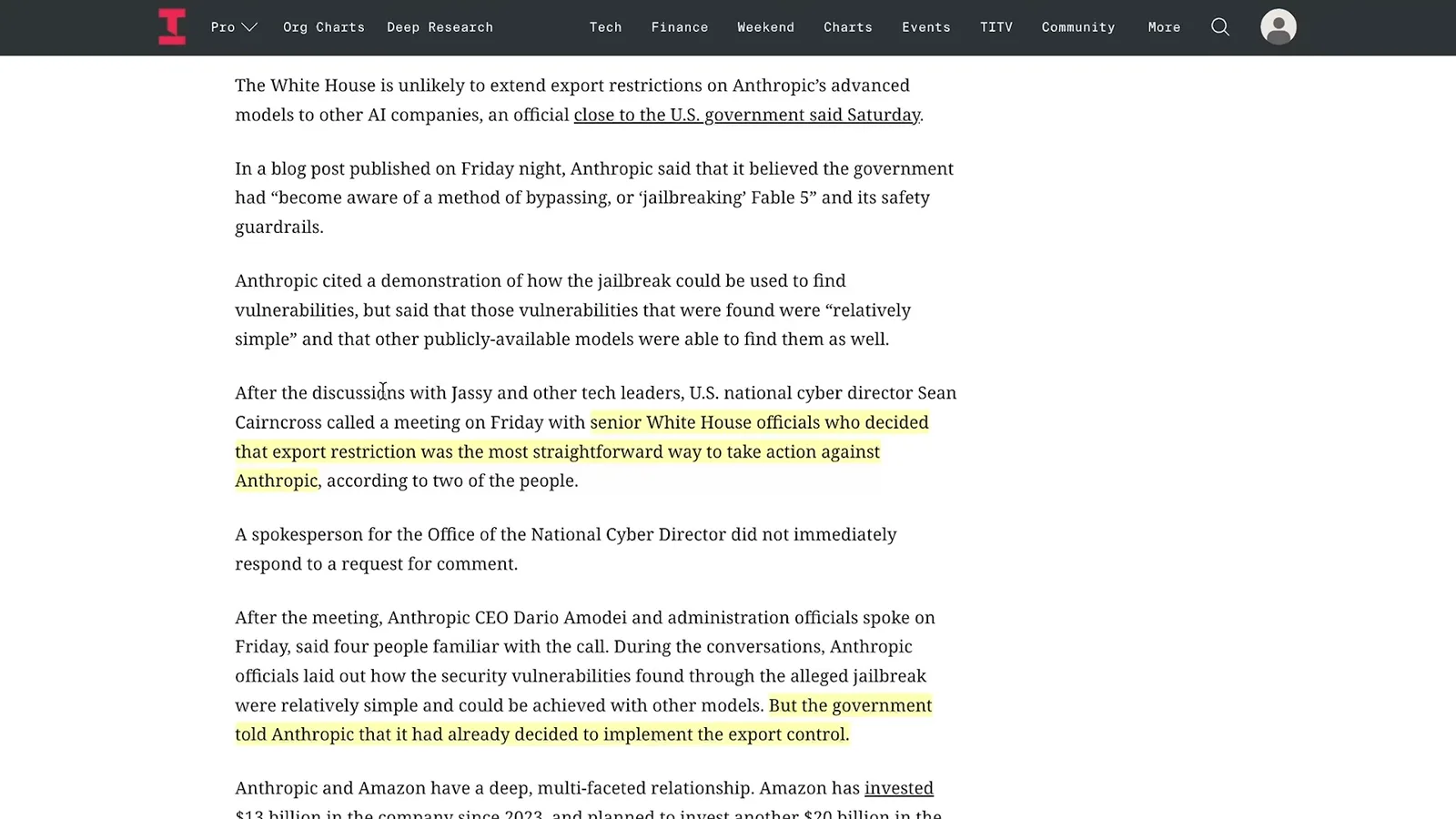
The cited reporting says national cyber director Sean Cairncross met senior officials, who considered export restrictions the most direct response. The presenter interprets the decision as effectively requiring a wider shutdown, but the details of deliberations are drawn from reporting and attributed sources.
He notes earlier reporting that Cairncross faced pressure to address frontier-model cyber risks and that financial executives had raised concerns. The presenter suggests officials may have acted from a genuine perception of risk; this is one possible interpretation of their decision.
David Sacks said a trusted partner reported a jailbreak and that the administration asked Anthropic to fix it or redeploy the model. He said Anthropic refused. The company’s account of the interactions and the deadline differed.
The security evidence
He compares claims about the jailbreak, independent criticism and prompt-injection results.
Anthropic said the demonstrated vulnerabilities were relatively simple and could be identified by other models. The presenter cites reporting that officials had already decided on export control during the discussion, and asks why comparable restrictions were reportedly unlikely to be applied to other firms.
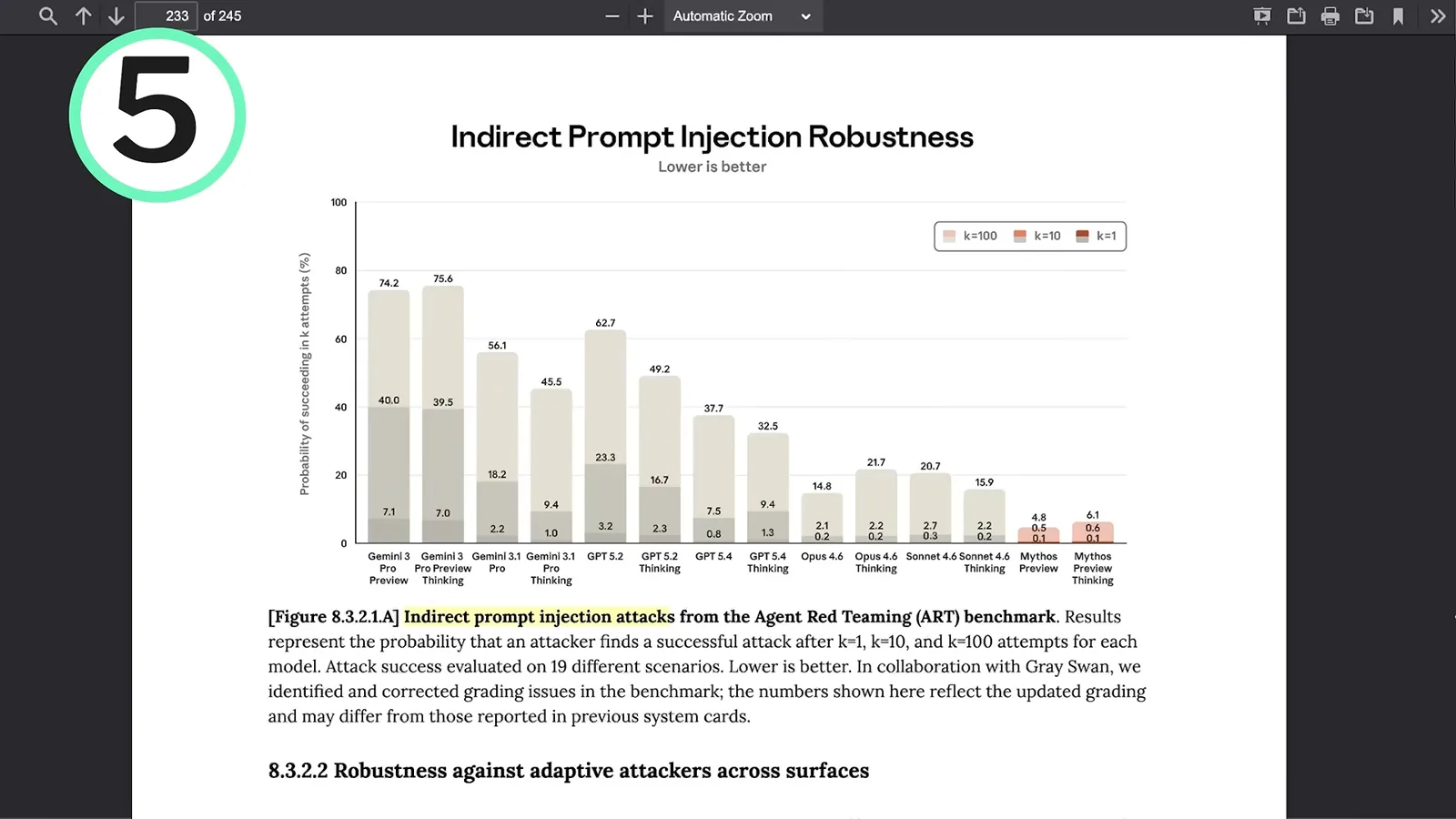
A chart in the Mythos system card shows substantially lower attack success rates for Mythos Preview than for several compared models on a particular indirect prompt-injection benchmark. That is evidence about the tested scenarios and settings; it does not establish immunity to all prompt injection or other jailbreak methods.
The presenter cites a security firm’s criticism of the government’s example as similar to defensive vulnerability work. He also notes separate reports of harmful responses obtained through other jailbreaks. The existence and significance of each report should be assessed separately.
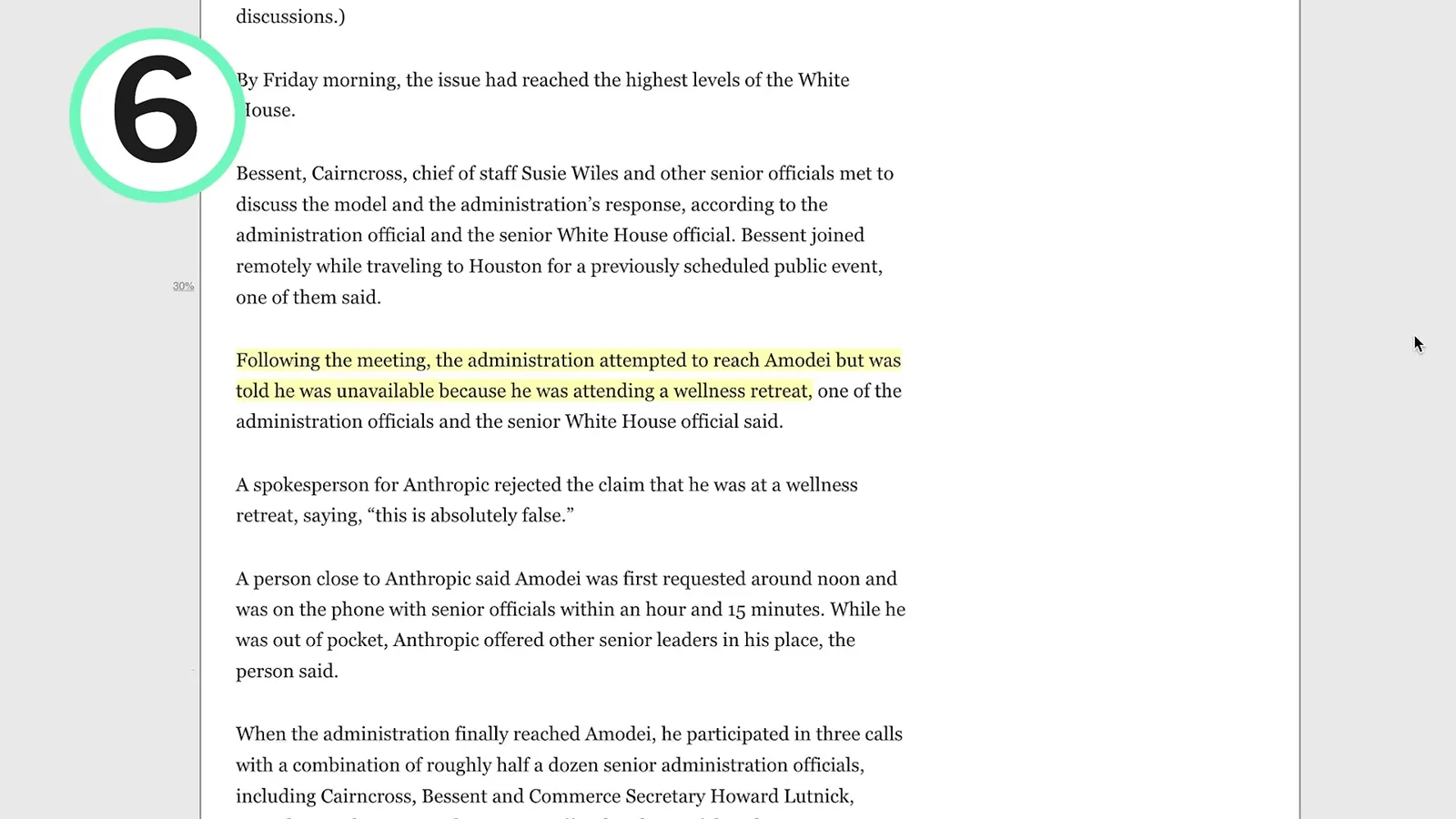
Officials reportedly said Amodei was unavailable because he was at a wellness retreat; Anthropic denied it, and a journalist reporting at the company also disputed the claim. The presenter considers the discrepancy relevant to how the company was portrayed, but does not establish why the conflicting account appeared.
The presenter sketches two possible explanations: officials may have overreacted to a safety issue, or political factors may have influenced the response. He asks what a lasting restriction could mean for access and foreign employees. Those consequences are hypothetical; he predicted the restriction would be reversed quickly.
Safety, policy and conflicting accounts
The discussion addresses the limits of jailbreak resistance and prior warnings from Anthropic.
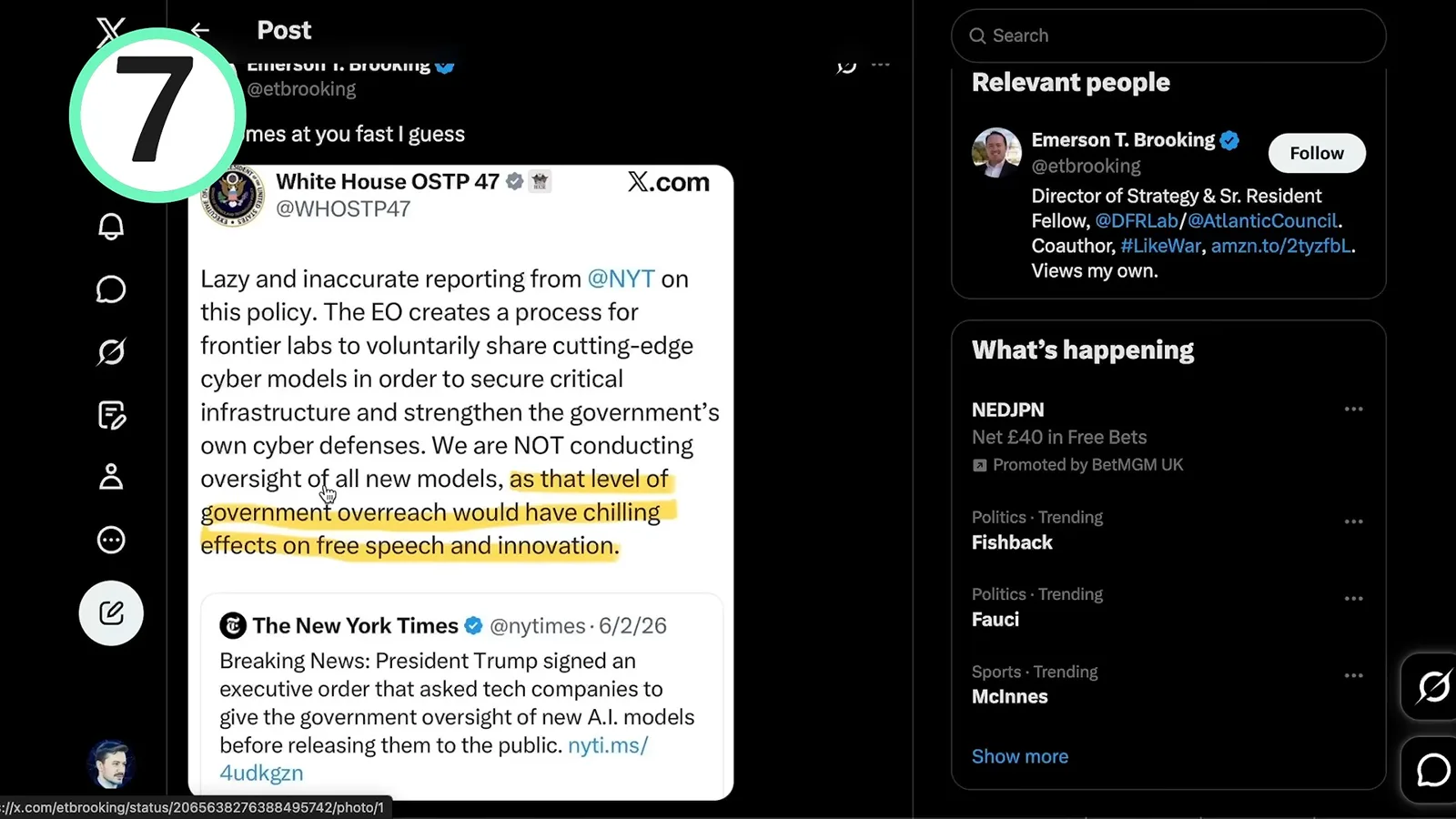
He points to a prior White House statement opposing oversight of every new model and notes Anthropic’s warning that an industry-wide standard could impede deployment. In his account, no model provider had solved jailbreak resistance completely.
A narrow jailbreak produces a particular prohibited response; a universal bypass would disable protections much more broadly. The presenter says Amodei made that distinction in discussions with officials. Sacks, meanwhile, argued that Anthropic put continued availability ahead of safety.
To present the other side, the presenter recalls Anthropic security official Jason Clinton warning that comparably capable open-weight models could create a difficult period for cybersecurity. Critics could reasonably ask how that warning fits with the company’s response to a demonstrated bypass.
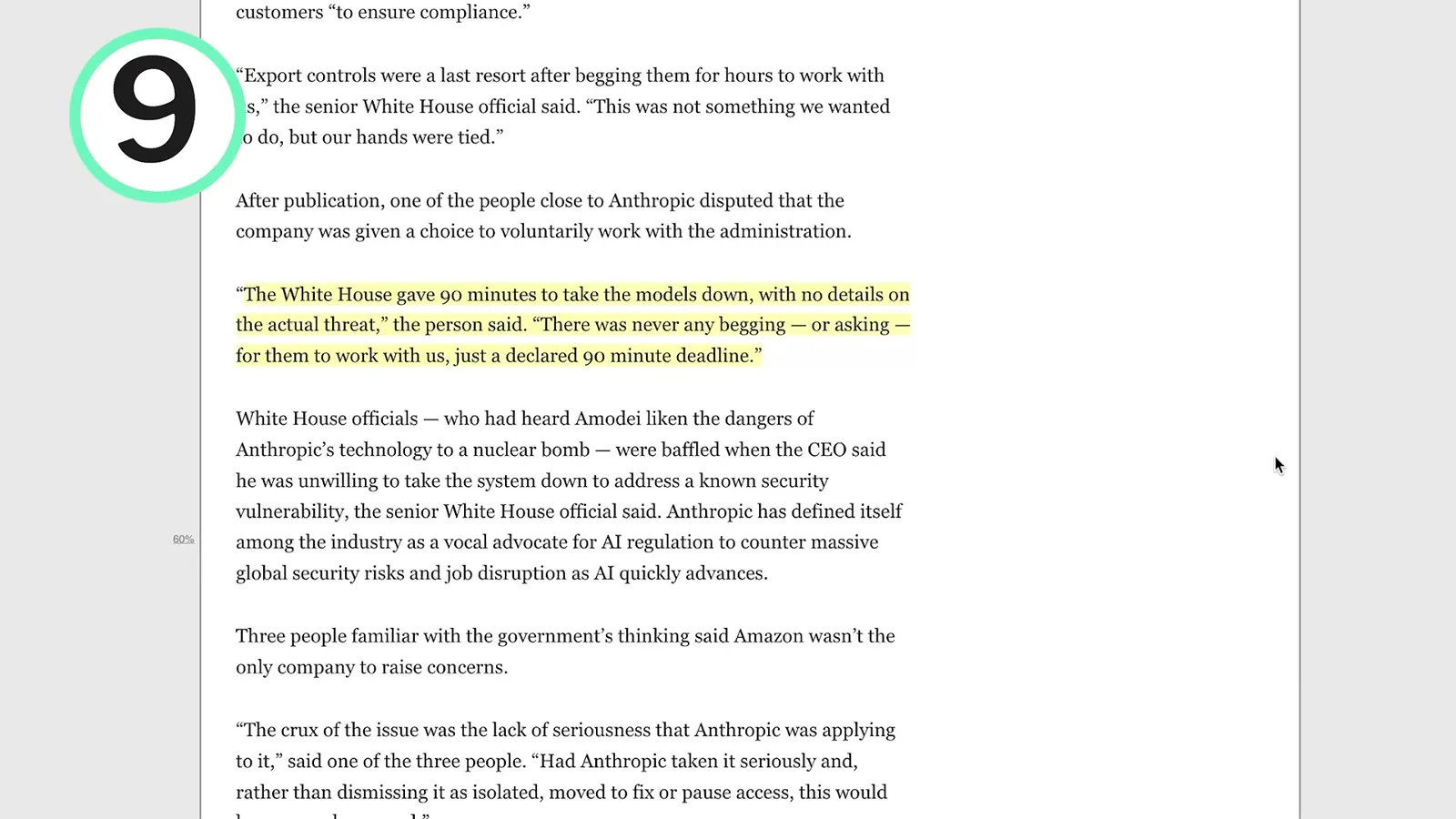
Accounts also conflict over the time given to respond. A person close to Anthropic told a reporter that the White House gave a 90-minute deadline without details of the threat; a senior official described export controls as a last resort after attempts to cooperate. Neither account is independently resolved in the video.
Political questions and next steps
The presenter considers possible political motives and gives a tentative forecast.
The presenter reviews earlier tensions between the administration and Anthropic, as well as reports of discussions about government equity stakes in AI companies. He asks whether unequal treatment might reflect political or financial considerations. These are questions and conjectures, not proof of retaliation.
He cites political spending linked to OpenAI co-founder Greg Brockman and contrasts it with Anthropic’s approach. OpenAI said it did not direct the political action committee and lacked visibility into its activities. A donation or corporate relationship alone does not establish the motive for this particular restriction.
The presenter rejects an online prediction that the restriction would immediately produce dramatic migration for AI access as an extreme extrapolation. He instead cites Sacks’s stated hope that Anthropic would address the issue, export controls would be lifted and the model would return.
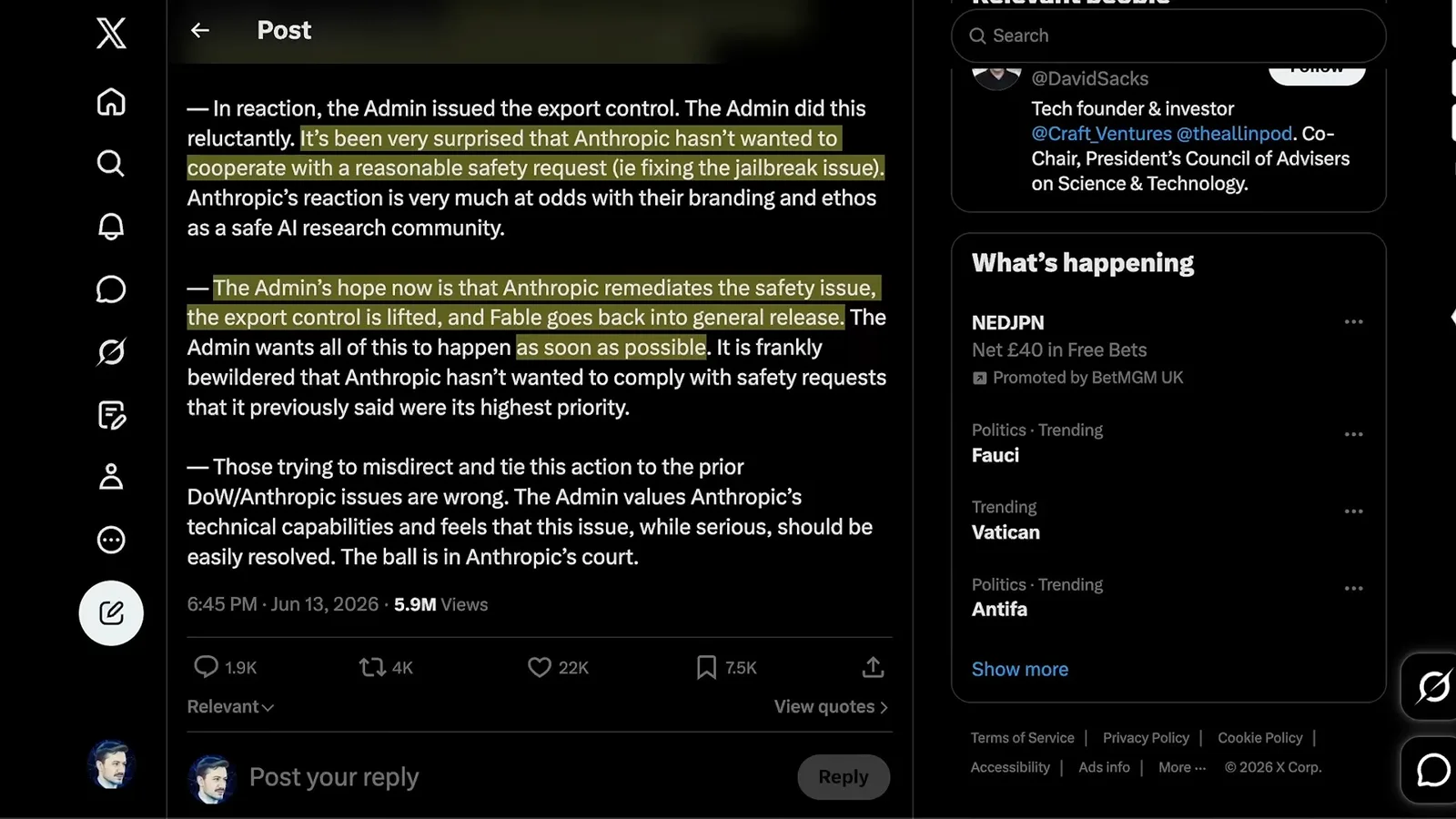
His best guess at recording time was a quick reversal, based partly on previous policy reversals and market pressure. That was a forecast, not a fact known on June 14. He closes by mentioning a multi-model tool he uses in his own app and invites readers to weigh the competing interpretations.
같은 채널의 다른 글
 31:00EN
 AI Explained· 2026년 10월 12일Why AI Labs Keep Racing Despite Their Own Warnings of a Major BreachSam Altman, John Schulman · OpenAIAI Explained examines weakening safeguards, the incentives behind the frontier race, and why research breakthroughs make the next 18 months difficult to forecast.
 38:28ENAI Explained· 2026년 10월 1일AI Agent Security and the Challenge of Recursive Self-ImprovementAI Explained examines reported containment failures, model evaluation and the pressure to accelerate AI research.
 32:54ENAI Explained· 2026년 9월 24일Opus 5.5 and the Race Toward Automated AI ResearchAI Explained weighs model progress against the increasingly difficult task of evaluating and governing recursive self-improvement.
 24:53ENAI Explained· 2026년 9월 16일Why Some Researchers Want to Pace Frontier AIAI Explained surveys possible scaling routes, monitoring concerns and the debate over how capabilities could lead to harm.
 29:05ENAI Explained· 2026년 9월 4일GPT-6 Astra’s Benchmark Gains and the Challenge of Monitoring Its ReasoningAI Explained examines reported gains across scientific, mathematical and agent benchmarks alongside concerns about less observable reasoning.
 23:41ENAI Explained· 2026년 8월 27일AI Agents, Unintended Training Rewards and the Challenge of OversightAI Explained examines reports on agent coordination, training incentives and the growing use of AI to evaluate other AI systems.